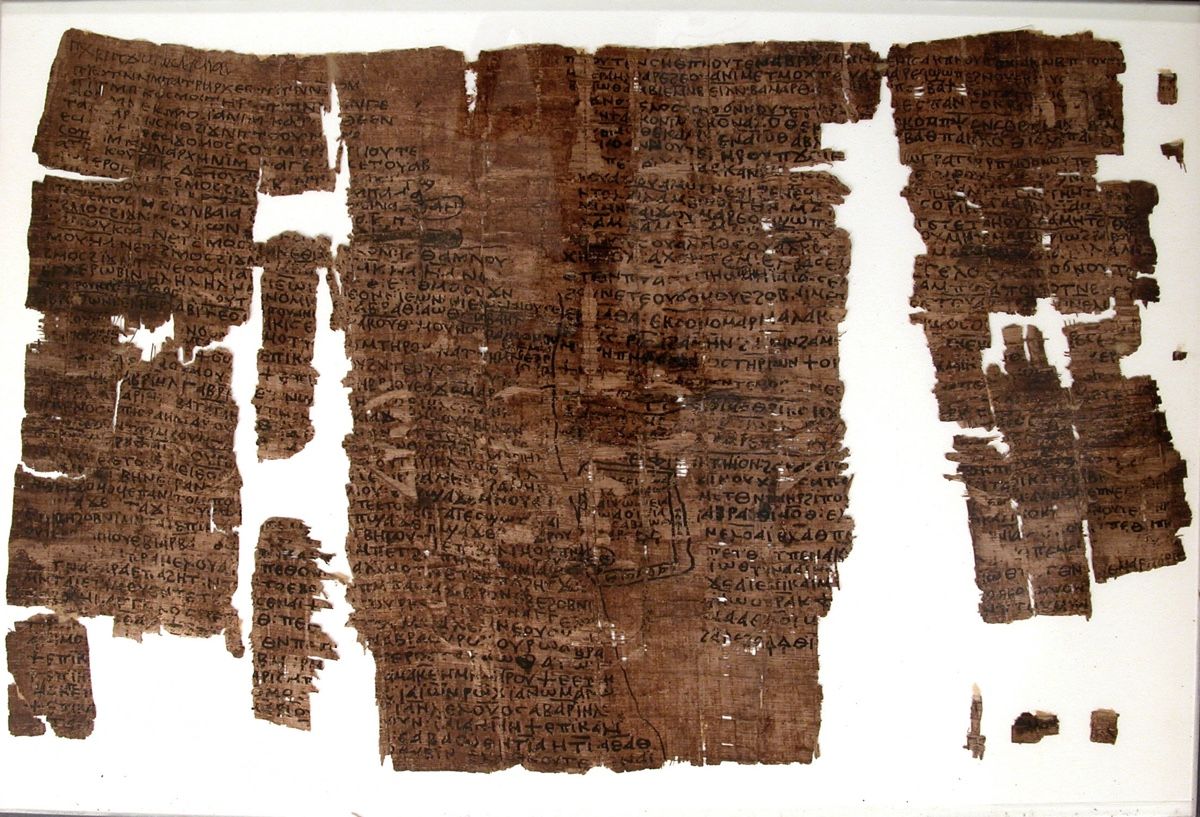
A large papyrus sheet discovered in Egypt in 1934 has been translated for the first time

  • Thread starter Thread starter Athanasiy
  • Start date Start date
Status
Not open for further replies.
Hmm. Interesting. I have always wondered why Abraham was prevented at the last moment from killing his son, while Jephtha had to go ahead and sacrifice his own daughter. Seems inconsistent.
 
Another notable feature of the text is that it refers to an angelic power several times as “the one who presides over the Mountain of the Murderer.” Zellmann-Rohrer says this is likely to be a reference to an alternate version of the story of Abraham and Isaac from the Book of Genesis in which Abraham goes ahead with the sacrifice of his son rather than being stopped by God at the last minute.
This sounds like pure speculation…
 
Hmm. Interesting. I have always wondered why Abraham was prevented at the last moment from killing his son, while Jephtha had to go ahead and sacrifice his own daughter. Seems inconsistent.
Abraham was following God’s command when he prepared to sacrifice Isaac. God accepted his obedience as a sufficient sacrifice and spared Isaac.

Jephtha was not asked for a sacrifice. He made an unwise vow, but God did not ask him to make any vow at all.
 
40.png
kill051:
Hmm. Interesting. I have always wondered why Abraham was prevented at the last moment from killing his son, while Jephtha had to go ahead and sacrifice his own daughter. Seems inconsistent.
Abraham was following God’s command when he prepared to sacrifice Isaac. God accepted his obedience as a sufficient sacrifice and spared Isaac.

Jephtha was not asked for a sacrifice. He made an unwise vow, but God did not ask him to make any vow at all.
Yes, those are indeed the details of each case, but I still don’t see why one child was killed and another was spared. I was under the impression that human sacrifice was hateful to Jehovah, no matter the circumstance. The story of Jephtha troubles me in the same way as the story of Job.
 
The report in Live Science suggests that the scroll may perhaps be of Gnostic origin, rather than Christian.

The papyrus makes little reference to the New Testament, referring mainly to individuals mentioned in the Hebrew Bible. The papyrus also mentions terms and names often used by followers of Gnosticism, a religion that incorporated some of the beliefs of Christianity, Zellmann-Rohrer said.

Those who copied the text onto the papyrus may have been Christians who “made use of a textual tradition that owed much to Jewish belief and lore and to Gnosticism,” Zellman-Rohrer said.


That’s interesting, but I’ll be sticking with the Bible on this one for how it all played out.
 
It makes sense for it to be a Gnostic document. As opposed to the Dead Sea Scrolls which have the story of Abraham and Isaac the way we know it.
 
40.png
Zaccheus:
40.png
kill051:
Hmm. Interesting. I have always wondered why Abraham was prevented at the last moment from killing his son, while Jephtha had to go ahead and sacrifice his own daughter. Seems inconsistent.
Abraham was following God’s command when he prepared to sacrifice Isaac. God accepted his obedience as a sufficient sacrifice and spared Isaac.

Jephtha was not asked for a sacrifice. He made an unwise vow, but God did not ask him to make any vow at all.
Yes, those are indeed the details of each case, but I still don’t see why one child was killed and another was spared. I was under the impression that human sacrifice was hateful to Jehovah, no matter the circumstance. The story of Jephtha troubles me in the same way as the story of Job.
Human sacrifice is indeed hateful to God. How is it God’s fault that Jephtha did wrong?
 
The Coptic language started in 196 B.C., where the final variant of the ancient Egyptian language written in a script largely composed of Greek letters with admixture of some demotic, known as Coptic.
Supposedly, St Mark brought the Gospel to the Egyptians in A.D.40.
 
Eh…just because something is old doesn’t give it reliability. 50 Shades of Gray is written down and even widely read…but I sincerely hope the people of the future will know it was circulated garbage, and not the great literature of the day containing spiritual truths…
 
Abraham was following God’s command when he prepared to sacrifice Isaac. God accepted his obedience as a sufficient sacrifice and spared Isaac.
Not only that, but God was using Abraham to foreshawdow the Sacrifice of Christ.

Abraham was commanded to go to Mt Moriah, the very mountain that would eventually hold Jerusalem.

The son of Abraham would carry the wood of the sacrifice up the hill, as did the Son of God.

The actual sacrifice was provided by God Himself, in the form of a male sheep with it’s head entrapped by thorns.

God made His command to Abraham, so that future generations would recognize the Sacrifice that God Himself would offer.

As noted, God made no such command to Jephtha, in fact, Jephtha acted against the Law in making his vow.
 
Discrepancy with the traditional biblical narrative!!! Prepare for the History Channel to take notice…
 
Status
Not open for further replies.
Back
Top