Apparent gaudiness in classical church architecture

  • Thread starter Thread starter jcunningham352
  • Start date Start date
Status
Not open for further replies.
J

jcunningham352

Guest
Hi,
I don’t know if this I’d the correct forum to post under, but I have been touring Geany recently, and visiting a lot of Catholic churches. They are VERY beautiful with their gold and paintings and statues. I was taught that the “gaudiness” of the churches was to represent God’s glory. I do not know how to describe this to my Protestant friends though because they might say that God’s glory/blessings (money/gold) can be used in other ways (i.e. feeding the homeless). Any ideas or ways to combat this question? Thanks! (Danke shun!)
 
Hi,
I don’t know if this I’d the correct forum to post under, but I have been touring Geany recently, and visiting a lot of Catholic churches. They are VERY beautiful with their gold and paintings and statues. I was taught that the “gaudiness” of the churches was to represent God’s glory. I do not know how to describe this to my Protestant friends though because they might say that God’s glory/blessings (money/gold) can be used in other ways (i.e. feeding the homeless). Any ideas or ways to combat this question? Thanks! (Danke shun!)
Varieties of this question have been answered many times over. More than for just symbolism, we are to give our greatest to God. In the Old Covenant, when Jews offered sacrifices, they gave the best they had to be sacrificed. When God ordered the building of the Arc of the Covenant and the building of the temple, He commanded the use of the purest metals, including gold. Some may claim that “God doesn’t care about that stuff”, while that is true that God could care less about valuable material goods, God does care about us and our attitude towards Him. If we don’t offer God our best, then we aren’t putting God first in our lives.

And in reference to feeding the hungry:
First, I would venture to say the majority of the Church’s ‘wealth’ is in property and art. If the Church sold all this off, God only knows what would happen to these things. The art and architecture are more than just ‘stuff’ they are history. The Church protects these things.
Second, even if the Church sold all these things off, it wouldn’t make a big difference. The best analogy I can give is the one of a hungry homeless man and a man with a fish. “Give the man a fish, feed him for a day. Teach the man to fish, feed him for a lifetime”. If the Church sold off all of these things and gave it to all of the poor in the world, it would only last for so long, and then what? It’s all gone with no more to give. Our Lord also said “The poor you will always have with you; but you will not always have me.” (Matt 26:11)

You can also ask them why don’t they sell their big church building for a smaller building, or sell their sound system and settle for acoustic instruments, or even no instruments at all?! I personally feel that I see more modern extravagances in evangelical churches than Catholic Churches.

 
Hi,
I don’t know if this I’d the correct forum to post under, but I have been touring Geany recently, and visiting a lot of Catholic churches. They are VERY beautiful with their gold and paintings and statues. I was taught that the “gaudiness” of the churches was to represent God’s glory. I do not know how to describe this to my Protestant friends though because they might say that God’s glory/blessings (money/gold) can be used in other ways (i.e. feeding the homeless). Any ideas or ways to combat this question? Thanks! (Danke shun!)
Of course, “gaudiness” is in the eye of the bolder. What was esthetically pleasing to people in the 11th century might not be pleasing to modern sensibilities. And not all ancient Catholic churches are ornate. There are many that are much plainer than any Protestant church could hope to be. It just depends on the culture that built it, the intentions of the builders, and who built it. Our Franciscan friends will tell you they prefer simple architecture and minimal furnishings in their parishes, monastery chapels. While other orders and groups of people prefer/preferred more lavish decorations. Also, in times when people could not read or write, the paintings, statues, stained glass windows, etc. all told biblical stories or depicted the saints of the Church that they could not read about for themselves. It was meant to be a visual help to faith.
 
The best answer is that it is simply human nature for people to put their money and wealth into the things they REALLY value. Plenty of people criticize the wealth catholics (used to) put into architecture, art, liturgy, etc. But those same people on average don’t put nearly as much wealth into really helping the poor as catholics do.

Those “gaudy” churches were built by peasants that mostly lived in huts with thatched roofs and no indoor plumbing. Today critics sneer at the church while they live in unprecedented luxury and wealth for themselves. As I said, people put their money into what they value in this world. It’s just human nature. Criticizing the sacrifices for God of people in the past is just a way to avoid looking in the mirror and assessing our own priorities.

This same attitude was a rallying cry in “Reformation” era England. The critics bemoaned all the land, treasure and art amassed by the religious orders in England and the King saw and opportunity to seize it all. So what happened? He gave it all to his cronies, spent it on wars and England’s social structure collapsed. Gone were the days when ANYBODY hungry could go to a monastary for food and medical care. Instead the powerful made it illegal to be vagrant and arrested the poor. Then they faced the choice of dying in jail or joining the Navy or Army. Gone were the days when the monasteries rented out their vast lands for modest rents to the poor who could then support themselves. Instead the rich walled off those lands and raised sheep there and left the poor to starve (see above).

In short, the cry of “the church is too rich” has always been the rally cry of knaves and traitors to God. From Judas Iscariot to today, they’re always on about it.
 
To be honest the guadiness of Catholic churches, even poor ones in small towns, has always been extremely off-putting to me. To be fair though so do churches with sound systems. If I found faith in god and returned to church it would have to be a very simple one. Even as a kid fancy churches never seemed genuine to me.
 
Perhaps this is a valid question.

Pope Frances is decrying the scandalous hunger of the world.

He- himself- lives more humbly.

I do not think he is saying to tear down the beautiful cathedrals, they are so beautiful 🙂

however …

we must begin to really think of the things Jesus said and to turn around.

On more personal level, I am having a very difficult time with a certain

parish that is wanting to add on, although for a good cause, none the less-

the focus is in complete absence of more important urgent causes. Hunger is urgent!

Inviting those outside the church- into the faith. Reaching out. Lifting up.

So, I think the question is a valid one. And maybe to help us all, me included, turn

to what Christ is telling us.

Maybe for us to stop “rationalizing” our priorities.
 
Hi,
I don’t know if this I’d the correct forum to post under, but I have been touring Geany recently, and visiting a lot of Catholic churches. They are VERY beautiful with their gold and paintings and statues. I was taught that the “gaudiness” of the churches was to represent God’s glory. I do not know how to describe this to my Protestant friends though because they might say that God’s glory/blessings (money/gold) can be used in other ways (i.e. feeding the homeless). Any ideas or ways to combat this question? Thanks! (Danke shun!)
Simple answer: point to the Tabernacle and to Solomon’s Temple. Point also to the story of the anointing of Jesus’ feet with expensive ointment.

Six days before the Passover, Jesus therefore came to Bethany, where Lazarus was, whom Jesus had raised from the dead. So they gave a dinner for him there. Martha served, and Lazarus was one of those reclining with him at table. Mary therefore took a pound of expensive ointment made from pure nard, and anointed the feet of Jesus and wiped his feet with her hair. The house was filled with the fragrance of the perfume. But Judas Iscariot, one of his disciples (he who was about to betray him), said, “Why was this ointment not sold for three hundred denarii and given to the poor?” He said this, not because he cared about the poor, but because he was a thief, and having charge of the moneybag he used to help himself to what was put into it. Jesus said, “Leave her alone, so that she may keep it for the day of my burial. For the poor you always have with you, but you do not always have me.”
 
Monastic Catholic churches, on the other hand, tend to be very plain.
 
I also tend to reference the anointing of Jesus with the spikenard.

Is it perfect? I don’t know. My Protestant friend sensibly questioned whether the moral of the tale would have been different were Judas not asking on account of his own greed.

I think Jesus’ rebuke may have been different in nature but I do not think his answer would have been.

In the same way of thinking, we pour glory onto the Lord, not that it can benefit Him (Does the Lord delight in burnt offerings and sacrifices as much as in obeying the Lord? 1 Sam 15) but out of our love for the Lord we do it anyway.

Feel no anxiety! 😉 You’re in good company if Jesus agrees.
 
Did somebody mention Gaudi-ness? 😃

(Please Note: This uploaded content is no longer available.)

This is simply, sublimely, enormously beautiful, by the way.
 
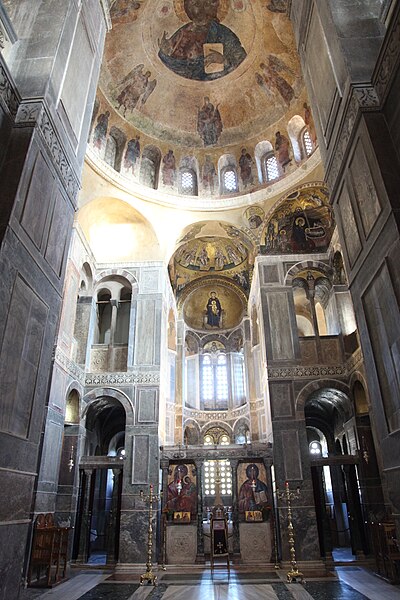
When it comes to ‘gaudiness’ I’m more of a fan of Byzantine and Romanesque architecture. 😃


I think gaudiness is in the mind of the beholder. One of my favorite churches is Mission San Xavier del Bac. It was built by Piro Indians south of Tucson over 200 years ago, they were and continue to be extremely poor yet every inch is covered by statues and murals.

About feeding the poor. I was raised in a fundamentalist denomination and their main concern is getting people “saved”. They weren’t very concerned about feeding the poor at all.

This large congregation is the only one I am quailfied to speak of from personal knowedge will have members living in mcmansions with multiple car garages to hold all their gas hogs, wall to wall carpet, art on the walls.

But the house they give to God is dirt cheap, made of cinder blocks and the windows they have are plain cheap clear glass. The money goes back into their bank accounts and gas tanks.
 
The Catholic Church is the largest charitable organization in the world. We are feeding the hungry, clothing the naked, caring for the sick and dying, rendering aid to those affected by disaster and war, educating people and so much more. In my opinion, if we can do all that and still have beautiful Churches that give glory to God, then we truly are blessed!
 
One answer is in simple economics. Sell off all of our art and land and give that money to the poor OR charge 4.7 million people a year (according to a Google search) 8 euros each to view them in the Vatican? Never mind the Cathedrals around the world. It is a more sustainable system.
 
I have probably been in hundreds of Churches in my life in many states and several countries. I can honestly say I have never been in a gaudy Church. At least not in the “hard” elements (artwork, painting, carving, windows, etc). I have seen some banners and vestments that might cross the line, however. 🙂 Some Churches are more ornate and others more plain but none are gaudy.

I am not saying they don’t exist anywhere in the Church. I am just saying that, if they do, they are pretty rare but there seems to be a broad brush criticism against them. 🤷
 
One answer is in simple economics. Sell off all of our art and land and give that money to the poor OR charge 4.7 million people a year (according to a Google search) 8 euros each to view them in the Vatican? Never mind the Cathedrals around the world. It is a more sustainable system.
Selling off the art is not going to change anything. Somebody else will own them, and somebody else is going to profit off them. When that happens, shouldn’t the next owner also sell it off and give all the proceeds to charity, again and so on? After all, shouldn’t everyone be obligated to charity? Why limit it to the Church? 🤷

Given the price other museums charge and the value of these works of faith and art, I think 8 euros is a bargain! I am much happier to see the profits return to a assuredly charitable organisation like the Church to benefit Catholics and non-Catholics around the world than some privatised museum. I support private capital, but the Church also deserves to be financially sustainable. 👍

Also, I believe Catholic cathedrals do not charge for access to the Nave, although they may have small sections like bell towers and museums that charge entrance fees. Do correct me if I am wrong. 🙂
 
Status
Not open for further replies.
Back
Top