Communion in the hand with gloves

  • Thread starter Thread starter Robinkay
  • Start date Start date
Status
Not open for further replies.
In post #37, I quoted St. Thomas Aquinas. He said it much better than me.

 
In post #37, I quoted St. Thomas Aquinas. He said it much better than me.
I saw. Most of it seems to be addressing whether priests or laymen can dispense the Eucharist. As to the part where he specifically mentions touching it, he just says that out of reverence only that which is consecrated should touch it.

I’m not Aquinas obviously, but I just don’t follow his reasoning here. My tongue is no more consecrated than my hand, and I still don’t understand the general argument that touching = irreverence.
 
It seems far from certain that latex gloves actually help. A nurse told me that outside of a clinical environment gloves are really not much use. Yes, they protect your skin, but the gloves quickly become contaminated and then contaminate everything you touch with them.
I apologize if someone has already posted this information.

I know we’re using the term “latex,” but this won’t be happening anywhere because of the danger of latex allergies. The reactions are very serious and sometime life-threatening. We haven’t used them in the hospital for years.

So it will be latex-free gloves, probably nitrile. Or perhaps even the white gloves for women and black for men that everyone, even children, used to wear to church (at least in the Protestant churches–I have pictures of myself with these pretty little white gloves!).

Also, as to the effectiveness of the nitrile gloves–we have been told that they need to be changed every half hour as the sweat and other chemicals from our skin renders the gloves ineffective as a barrier. Of course, hands should be washed thoroughly with soap and water (not just a squirt of hand sanitizer) in between changes.

I think many Catholics will simply remain in their pews during Holy Communion in the large Masses (if the large Masses are even allowed) for many months, and I question whether Holy Communion will even be available to the laity in the pews for many months. What a tragedy if an outbreak should happen!

Although I do think that the small faithful group of regulars who attend daily Masses (much smaller) will probably feel somewhat comfortable receiving Holy Communion, as they all know each other well. Again, though, Holy Communion may not be available for a long time–at least that’s what I think.

It’s so sad. But we do have the option of making a spiritual communion with Our Lord, and that’s what Protestants do all the time.
 
Just to recap:

" I answer that, The dispensing of Christ’s body belongs to the priest for three reasons. First, because, as was said above (Article 1), he consecrates as in the person of Christ. But as Christ consecrated His body at the supper, so also He gave it to others to be partaken of by them. Accordingly, as the consecration of Christ’s body belongs to the priest, so likewise does the dispensing belong to him.

IOW, because the priest is alter Christus, his entire being is consecrated to God and is more perfectly conformed to Christ, he acts in persona Christi, ergo, the dispensation of the Body, Blood, Soul and Divinity of Christ belongs to him.

AFAIK, neither of us can act in persona Christi. I know I can’t, thanks be to God.
 
I don’t think so. For my own first communion and my daughter’s, girls who wore gloves had to remove them to receive.
 
Last edited:
AFAIK, neither of us can act in persona Christi . I know I can’t, thanks be to God.
But this doesn’t address what we’re talking about. This would be more relevant if we were debating the appropriateness of lay Eucharistic ministers.

It seems to me that whether the priest places the host on the communicants tongue or in his or her hand, the priest is the one “dispensing”.
 
I was a Protestant most of my life, until 4 years ago, and had no concept of making a Spiritual Communion. We believed that we had “asked Jesus into our heart” one time, and that was never repeated. That was the “sinner’s prayer” that we believed saved us. Once saved, always saved. We also had no concept of the Real Presence in the Eucharist. We had no idea what we were missing. Now that I know, I could never settle for that again.
I heard our Archbishop last night (online, of course), and he is hoping for a restoration of masses just as soon as possible, and of the Eucharist as well. There was no indication that we would be able to go to mass but not receive the Eucharist. I haven’t heard that from anyone, and hope it is not the case. I don’t think that liturgically they can prevent Catholics who come to mass from receiving the Eucharist, unless there is some known grave sin and risk of scandal.
I still occasionally go to the grocery store. I pick up my groceries, I place them on the checkout conveyor, where they are handled by the checker who scans them and puts them into bags. I handle them again when I get home. The checker wears gloves, but as per this post, how effective are they, and how often does he change them? And who else might have touched that same carton of eggs that I picked up? So regardless of the steps I take to prevent infection, there is some degree of risk. If I am willing to take this risk to buy food, I am certainly willing to take a similar risk to receive the Body of Christ. I just wondered about whether or not to wear gloves while receiving. I’m guessing maybe not.
 
Gloves will most likely get particles of the blessed sacrament stuck in them, so while there might not yet be a written rule against it, it’s most certainly against divine law. I have even seen a very modern priest make someone take their gloves of a few years ago at my cathedral (for obvious reasons). If you mean Latex gloves then this is worse because they are thrown in the bin, which means that potentially there will be some days in which you are throwing Christ in the bin.

I would just travel to a church which will give communion on the tongue if I were you, or make a spiritual communion. Nevertheless I suppose as long as your not wearing gloves there is no risk of fabric being a problem.

(Please Note: This uploaded content is no longer available.)
 
God willing, they will not use any extraordinary ministers. Honestly, that would be a big mistake and increase the chances of spreading the virus (esp if a EMHC didn’t know he/she had the virus).
Exactly, we don’t know where these people have been, they could be spreading all sorts of things. Perhaps this would be a good reason for banning the use of extraordinary ministers in general. The less people involved the better, as a matter of safety and hygiene among other things
 
40.png
Margaret_Ann:
The Particles of the Host can remain on the latex or vinyl gloves. Also what if the Host breaks?
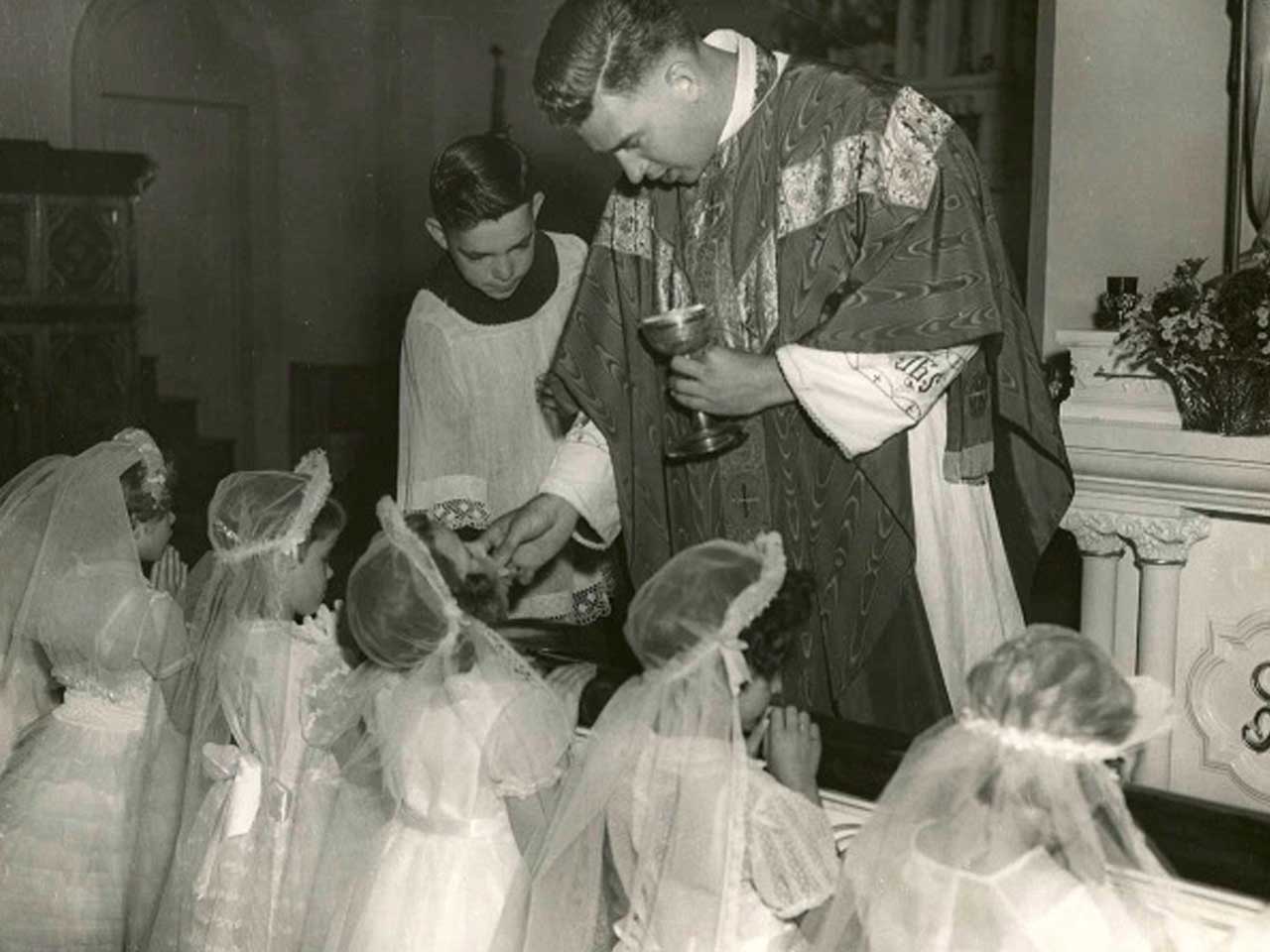
Is there not a similar concern about the host being in contact with the skin?
Yes there is a similar concern, that’s one of the many reasons why I don’t receive in the hand, it’s much easier than checking my hands every time, or trying to find a way or purifying my fingers the way the priest does while I’m in the congregation.
 
If you want to understand why some trad Catholics consider communion in the hand to be not okay, read this:

 
Do “tiny particles” matter? My understanding is that once it has lost the appearance of bread and wine, the Real Presence no longer remains anyway.
Usually, the idea is more that those vessels intended to contain the Blessed Sacrament are always treated as if they could contain a fragment that could be seen but is merely not seen at present.

I have found this to be an indispensible rule. Before I wash altar linens such as corporals, I inspect them for just that sort of fragment, even though I know that the priest has already done so. I don’t find such fragments often, but I do find them. In any event, after inspection the linens are soaked in water to ensure that any visible-sized fragments that that no one saw will become saturated with water. When such a fragment becomes saturated with water, it would no longer have the appearance of bread alone, but both bread and water. Then it is safe to assume that the eucharistic species are no longer present and then the linens can be laundered without worry about the profanation. The water is disposed of as a sacramental, as any holy water would be.
 
Last edited:
Status
Not open for further replies.
Back
Top