Is downloading video from YouTube a violation of the terms of service? Who cares if one cannot get caught, correct?
(snip)
Since when does,“for personal use” mean “save and upload for public viewing?”
Per a CNET article from way back in 2008, "…users could unknowingly be liable if they click on the wrong YouTube link. The fact that they’re not aware that a video was illegally uploaded is irrelevant. (snip)
It is hardly a prosecutable crime…but not does not getting caught make it less of a sin of detraction or less complicit in a crime?
First of all, you are comparing apples with oranges and apples with cumquats here. You are quite correct that the person who downloaded the video, in all likelihood, violated the TOS of the service with Google. In which case, he may have committed a violation of the 8th commandment: he may have lied when he clicked the “agree” button when he first registered to use the service (he did register to use the service, right?). Or perhaps Google, through their TOS, assumes ownership of copyright for all content uploaded to their service…I don’t know. Having said that, Google has ample remedies at their disposal…they can suspend or cancel the user’s account for violation of their TOS.
Further, on any YouTube video, we see the following:
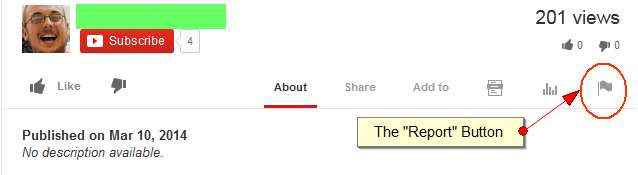
If Deacon Sandy wanted this content removed, Deacon Sandy could simply click the “report” button, it would be evaluated by the staff of Google and it would be taken down if the staff of Google believed that it either violated the TOS or Title 17, US Code.
Funny that Google has never pursued legal action against the authors of any number of extensions for Firefox, IE, and, yes, even (Google-owned) Chrome, designed to download videos from YouTube.
That was the “apple” in the argument. Here’s the “orange”: I haven’t carefully enough looked at the YouTube TOS to see if Google acquires the copyright for any video uploaded to YouTube, so I’ll cover both eventualities.
If Google did acquire the copyright, then Deacon Sandy no longer owns it. So Deacon Sandy has no rights at all in this eventuality.
If Google did not acquire the copyright, then my argument above holds. This was a non-commercial use for the purpose of criticism (which is explicitly allowed by Section 107 of the Copyright Law, which I cited above).
Now for the “cumquats”: There is a distinct difference between a third party ripping a commercial movie DVD and uploading it to a video streaming service and an individual uploading a non-commercial movie of his own.
The individual uploading the commercial movie is abetting others to evade having to pay the licensing fee to a copyright owner for the ability to view the movie in a theater or to buy a perpetual license to have a copy of the movie for personal use at home. This could cause notable damage to the owner of the copyright because of people using the content without paying the licensing fee.
Another example of damage would be if this third party was to duplicate the video onto other media and then sell those duplicates, making money from content that was not his. (At least in days gone by, this used to be something that was very, very common in the developing world)
Yet another example would be if the third party got his hands on a movie that was later axed by the production company…the third party does the post-production and then markets the finished product as his own creation…obviously, the original creator would have a cause of action because the third party took somebody else’s creation and pawned it off as his own.
Having said the above, the third party would be fully entitled, under Section 107, to take snippets of this movie (even the ‘unpublished’ example, above), upload those snippets to a streaming site, and then embed those snippets into a web page that provided a review of the movie. Section 107 calls that “comment” and “criticism.”
But that’s not the situation here with Deacon Sandy. There is no commercial use here. Deacon Sandy (and/or the good people of “Good Shepherd Catholic Community”) simply uploaded raw content to YouTube, much for the same motivation as one who takes videos during summer vacation and then uploads those videos to share with family and friends.
There is no commercial interest. Deacon Sandy is not marketing his “work” (his homilies). The individual who has kept a copy of those videos has no commercial interest in those videos. No commercial interest = no damages.
As far as “detraction” is concerned. Let us look at the definition of the word.
From Father Hardon’s Modern Catholic Dictionary:Revealing something about another that is true but harmful to that person’s reputation. It is forbidden to reveal another person’s secret faults or defects, unless there is proportionate good involved. The fact that something is true does not, of itself, justify its disclosure. Detraction is a sin against justice. It robes one of what most people consider more important than riches, since a person has a strict right to his or her reputation whether it is deserved or not.
No secret faults or defects have been revealed through this process…or alleged through this process.
Detraction would be if you disclosed that he’d had a vasectomy…or if you’d disclosed that he’d been charged with child abuse but the charges were dropped…or if you’d disclosed that you caught him having an affair with the second grade CCD teacher. Assuming that the allegations were true (obviously, if they were false, that would, instead, be calumny).
What the man says and does during homilies is not a possible subject of detraction. Why? Because they are already out in the public.