During the sign of peace, why do my fellow catholics seem so cold?

  • Thread starter Thread starter 123Strontium
  • Start date Start date
Status
Not open for further replies.
"During the sign of peace, why do my fellow catholics seem so cold? "

Perhaps it’s time to have someone take a look at the heater in your church? It has been a rough winter. 😃

Seriously though, I prefer parishes that skip the sign of peace only because in many of the ones I have been to where it is practiced, it becomes a spectacle that distracts from the Holy Sacrifice of the Mass. It’s especially frustrating when after meditating during the Consecration and preparing myself for Holy Communion, the priest then takes a couple minutes to walk around the church to shake everyone’s hands. People mentioned in the EMHC thread that the EMHCs are necessary to reduce the Mass times; well, get rid of the handshaking and you can save a couple minutes right there.

I’m not speaking with authority from the Church on this matter, only my personal preferences. Take it as you will.
 
usccb.org/prayer-and-worship/the-mass/general-instruction-of-the-roman-missal/girm-chapter-2.cfm

The Rite of peace, which follows the Lords prayer, and proceeds the fraction of the bread is to be done in a somber manner, and only to those who are closest. #82 for those of you who care to know what the Roman Missal instructs.
Maryj… It actually says “sober” manner rather than “somber”… A big difference, but thank you for referencing the GIRM. If we all follow that, there would be no debate on this point
 
malphono;10448996:
ProVobis;10448690:
I’m not exactly sure what the exact protocol calls for. Various intructions were given in 1970 about how and whom you greet around you. In the Maronite liturgy, the sign is given to someone who then in turn goes down the aisles and extends the sign to the first person in the pew who in turn extends the sign to the person next to him. And so on down each pew. That way it appears the sign comes from the altar. The sign, by the way, is not a handshake per se, but a sort of “cupping” of the hands.
Yes, that’s quite right. 🙂 And the same custom is followed by the Chaldeans.

BTW, the way it’s passed is for the “giver” to place his/her hands together in the “praying hand” position while the “receiver” takes the peace by cupping his/her hands over. 😉

I hope to do it right the next time. 🙂
I suppose I should have added a remark about how the peace is given from the celebrant among the Maronites.

The “old way” (i.e. pre-conciliar) was quite nice (and BTW, this occurs early in the Anaphora, right after the anaphoral “Prayers of Peace” (which follow the Opening Doxology and all but one of which are variable): the celebrant touched his fingers to his lips, then touched the altar and the oblation in sequence, (at this point, if there were concelebrants, or clergy assisting in choro, the celebrant would greet each with the ritual check-to-cheek kiss) finally touching the right hand (which was placed palm-up on the altar) of the deacon or chief server, who subsequently passed the peach to the other servers (if any) and then to the congregation. The translation of the accompanying prayer was: “Peace to you, O holy Altar, Peace to the Holy Mysteries placed upon you. Peace to you, deacon (server) of the Holy Spirit.” When the peace was transmitted by the deacon/server, he stood and said: “Let each one of us give peace to his neighbor in love and faith which is pleasing to God. Peace be to you, father, pure priest.”

The “new way” is markedly less dramatic. (It still happens early in the Anaphora, but the arrangement of the Prayers of Peace has been somewhat altered (and shortened), and in some cases the prayers themselves have been, let’s say “modified”.) The priest still touches the altar and the oblation, saying a similar (though not quite identical) prayer, and gives the peace to any concelebrants or clergy in choro with the ritual kiss. However, he gives it to the standing deacon(s) and/or servers using the “praying hands” posture. The diaconal proclamation has been shortened: “Let each of give the greeting of peace to his neighbor in charity and loyalty that we may please the Lord.” At this point, some sort of modern hymn is usually sung as the peace makes its way through the congregation. And, for the record, a lot of people these days no longer bother with traditional method of passing the peace, but opt, instead, for the Novus Ordo-style handshake. 🤷
 
It’s proven to be the case there is quite a common perception on here too, on this small representation of the catholic population here on this forum. And even more so, that the glumness is actually acknowledged which is explained away as ‘solemnity’. Facial expressions are recognized universally around the world, a smile is warmth, a supercilious look is one of condescension, an inverted mouth is sadness, faces and moods can be read all over the world from every race. And common perception would have it that a glum look is classed as unfriendly. Unfriendly is the perception, we’re talking on the level of perception and interpretation.

So what we have established from the various opinions on the thread is that
  1. Glumness is solemnity 2. Some people have depression + illness. 3. Some people want to get done with and go home. 4. Social issues eg. shyness. 5. Can’t be bothered. 6. Un-expressivity is their default demeanour. 7. Fear.
All these reasons can equate to perceptions of unfriendliness, solemnity or false piety. Any more for any more?

The same way people say ‘why do catholics worship statues?’ , well that is the perception,
I do wonder myself if catholics are worshipping statues, as they kiss the statues and crosses like there is some intrinsic worth in the Alabaster (or what ever material it is). It is a worthy question to ask because how do we know catholics ‘know’ that they’re not supposed to invest intrinsic worth in the statues?’ How do we know that catholics ‘know’ that they are supposed to have this fellowship thing or communal spirit, so it was a question worth asking. It’s been very informative.

Or to go way off topic: in the commandments in Exodus 20 verse 4:

Another question googled:

Why did the catholic church do away with this 2nd commandment in the Bible in the Catholic Catechism:

“You shall not make yourself a carved image or any likeness of anything in heaven above or on earth beneath or in the waters under the sea.”

It makes one wonder why there are gothic churches with gargoyles and angels carved on gutters and hoppers, why the whole Renaissance Art movement represented images of Heaven and ***, why the sistene chapel is full of representations of the celestial world.

This can be saved for a future discussion. This one is harder to explain away by apparent misperceptions.

I think this will be my last posting, not sure what more can be said on the matter.
I think you’re reading way into it.
 
Again, obviously God is the source of love and peace. But one must be careful not to adopt the way of thinking of the Pharisees, who meticulously fulfilled all the rules and regulations of the law, fasted twice a week, gave money to the poor, spent much time in the temple and performed all the prescribed religious sacrifices, thinking they were close to God; yet Jesus told them they were far from God, because they had no love for neighbor and were quite proud of themselves.
Glad to know that my ancestors over the past 1360 years were all Pharisees, and that every time I attend the TLM I am a Pharisee because we do not shake hands and try to offer peace to one another in the name of the Lord!

Let’s actually look at the liturgical text:

Domine Iesu Christe, qui dixisti Apostolis tuis: Pacem relinquo vobis, pacem meam do vobis: ne respicias peccata nostra, sed fidem Ecclesiae tuae; eamque secundum voluntatem tuam pacificare et coadunare digneris. Qui vivis et regnas in saecula saeculorum.
R. Amen.

Pax Domini sit semper vobiscum.
R. Et cum spiritu tuo.

“Lord Jesus Christ, Who said…” “Who live and reign for ever and ever.” “The peace of the Lord be with you”

Where does this become about our neighbors, or any other worldly, human concern? But alas, I’m just a wretched Pharisee because I prefer the way it was done for thousands of years when the Mass was a Christ-centered Sacrifice rather than a man-centered meal… 🤷
 
I don’t care for the “sign of peace” during mass. I am there to pray. I do however enjoy talking to people before and after Mass. Then again, I don’t get to church at the last minute or rush to get back to my car after.The “sign of peace” seemed to have evolved after Vatican II. If you attend a Latin Mass, you do not give a sign of peace, you pray. The sign of peace seems very Protestant to me, even with a wink, smile and handshake, it is very superficial and not productive. How many people at mass give the sign of peace and never mingle before or after? If you do mingle with other members, why do you need to give them a sign of peace?
 
I don’t care for the “sign of peace” during mass. I am there to pray. I do however enjoy talking to people before and after Mass. Then again, I don’t get to church at the last minute or rush to get back to my car after.The “sign of peace” seemed to have evolved after Vatican II. If you attend a Latin Mass, you do not give a sign of peace, you pray. The sign of peace seems very Protestant to me, even with a wink, smile and handshake, it is very superficial and not productive. How many people at mass give the sign of peace and never mingle before or after? If you do mingle with other members, why do you need to give them a sign of peace?
It’s a ritual moment, can’t you just accept it as that?

Do you know that in one parish I know the Sign of Peace actually kept one woman from becoming a Catholic for 3 years? I’m not really sure who was who, but it involved two refugees, a Croat and a Serbian. One was Muslim, requesting baptism and the other was Catholic. The Muslim, for 3 years, refused to offer the Sign of Peace to the Catholic. And for three years the community, the Pastor and her sponsor judged that she wasn’t ready for Baptism. Then, one year she found herself able to actually look at this person as simply another human, not an enemy. The next Easter she was baptized and afterwards expressed her belief that everyone had been right, she had not ‘converted’ until she was able to shake the hand of this other woman.
 
It’s a ritual moment, can’t you just accept it as that?

Do you know that in one parish I know the Sign of Peace actually kept one woman from becoming a Catholic for 3 years? I’m not really sure who was who, but it involved two refugees, a Croat and a Serbian. One was Muslim, requesting baptism and the other was Catholic. The Muslim, for 3 years, refused to offer the Sign of Peace to the Catholic. And for three years the community, the Pastor and her sponsor judged that she wasn’t ready for Baptism. Then, one year she found herself able to actually look at this person as simply another human, not an enemy. The next Easter she was baptized and afterwards expressed her belief that everyone had been right, she had not ‘converted’ until she was able to shake the hand of this other woman.
“It’s a ritual moment, can’t you just accept it as that?”

No I cannot. For this reason I attend Latin Mass and never attend Novus Ordo.
 
It’s proven to be the case there is quite a common perception on here too
You quoted my post, without even beginning to get the point of it.

There is a difference between truth and public perception of truth. Google does not deal with truth, and is not evidence of truth.

And if you are actually a Catholic and have any doubts whatsoever about whether Catholics worship statues, you need to talk to a priest right away.

–Jen
 
It’s a ritual moment, can’t you just accept it as that?

Do you know that in one parish I know the Sign of Peace actually kept one woman from becoming a Catholic for 3 years? I’m not really sure who was who, but it involved two refugees, a Croat and a Serbian. One was Muslim, requesting baptism and the other was Catholic. The Muslim, for 3 years, refused to offer the Sign of Peace to the Catholic. And for three years the community, the Pastor and her sponsor judged that she wasn’t ready for Baptism. Then, one year she found herself able to actually look at this person as simply another human, not an enemy. The next Easter she was baptized and afterwards expressed her belief that everyone had been right, she had not ‘converted’ until she was able to shake the hand of this other woman.
That is a nice story, very unique.

For most of us, it’s a ritual moment that is designed today to “force” community. The problem is, you can’t “force” community and have it be real. It becomes a going through the motions thing. Or, at the other extreme, you have the “cliques” in every parish that make it into a free for all. I’ve been to parishes where Father comes down off the altar and shakes hands with a certain group of parishioners.:rolleyes:

At our parish, we have TWO of these rituals. Before Mass, we are told to “Rise, look for a face you don’t recognize and evangelize”. This cues an explosion of chatting and shaking hands that doesn’t end until the organist loudly plays the first chord.

Personally, I love flu season where I can just make a simple bow, say “Peace be with you” and have done with it.
 
It’s a ritual moment, can’t you just accept it as that?

Do you know that in one parish I know the Sign of Peace actually kept one woman from becoming a Catholic for 3 years? I’m not really sure who was who, but it involved two refugees, a Croat and a Serbian. One was Muslim, requesting baptism and the other was Catholic. The Muslim, for 3 years, refused to offer the Sign of Peace to the Catholic. And for three years the community, the Pastor and her sponsor judged that she wasn’t ready for Baptism. Then, one year she found herself able to actually look at this person as simply another human, not an enemy. The next Easter she was baptized and afterwards expressed her belief that everyone had been right, she had not ‘converted’ until she was able to shake the hand of this other woman.
It is a lovely anecdote, and I am very glad that she finally converted.

But what about these folks:


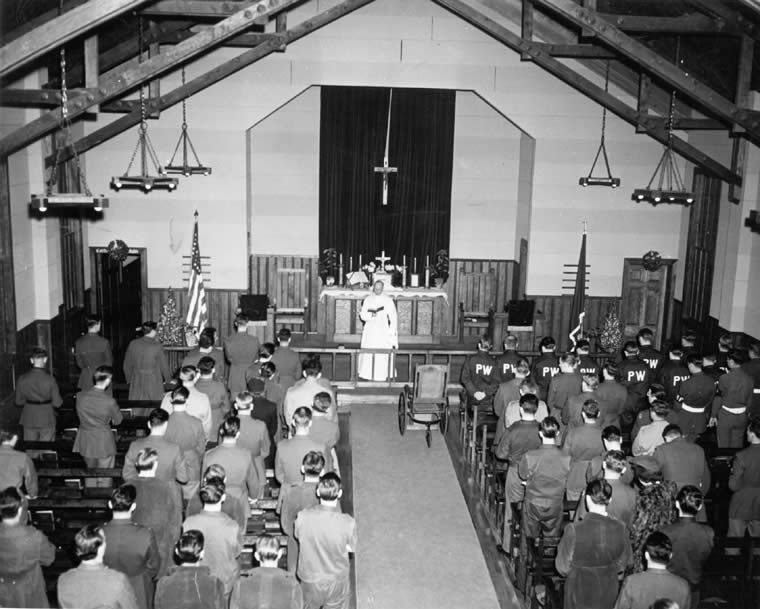
Here we see a Mass during WWII at the O’Reilly (US) military chapel. The Allied soldiers, at least one wife (or perhaps a nurse?), and even Axis POWs all worshiping Christ together – and no modern-day adaptation of the Sign of Peace. Were they not authentically Catholic since the MPs did not shake hands with the POWs after the Our Father? Were they uncharitable Catholics because they did not shake hands? Were they Pharisees?

Or, were they all united as one body of Catholics in prayer, focused, during the most solemn Sacrifice of the Mass, solely on Christ and eternity…
 
During the sign of peace, I force myself to beam a smile even when my fellow catholics give me a limp handshake and no smile. It’s like this every week with different people.

Why are they so unfriendly?

I went to an anglican church and I get smiles from the canons and people seem nice and warm?

My personal theory is that the catholic church emphasizes penitence above love whilst the anglicans emphasize love above penitence. Different emphasis leads to different christian character profiles.

I don’t want to be anglican, because I’m doctrinally catholic. I think moral duty is important.

ps/ I think like some others that the sign of peace should be placed elsewhere in the order of Mass, I do find it hard to concentrate on the Lamb of God after the sign of Peace.
don’t be fooled. not all anglican like sign of the peace any more than some Catholics. Being in an Anglican church I can vouch from experience. I think I would rather not shake hands than meet the limpett hands… 😊 I am not big on it but happy enough to fit in. I do find it harder when people want to hug but luckily our one who did has moved on a long time ago.
 
It’s proven to be the case there is quite a common perception on here too, on this small representation of the catholic population here on this forum. And even more so, that the glumness is actually acknowledged which is explained away as ‘solemnity’. Facial expressions are recognized universally around the world, a smile is warmth, a supercilious look is one of condescension, an inverted mouth is sadness, faces and moods can be read all over the world from every race. And common perception would have it that a glum look is classed as unfriendly. Unfriendly is the perception, we’re talking on the level of perception and interpretation.

So what we have established from the various opinions on the thread is that
  1. Glumness is solemnity 2. Some people have depression + illness. 3. Some people want to get done with and go home. 4. Social issues eg. shyness. 5. Can’t be bothered. 6. Un-expressivity is their default demeanour. 7. Fear.
All these reasons can equate to perceptions of unfriendliness, solemnity or false piety. Any more for any more?

The same way people say ‘why do catholics worship statues?’ , well that is the perception,
I do wonder myself if catholics are worshipping statues, as they kiss the statues and crosses like there is some intrinsic worth in the Alabaster (or what ever material it is). It is a worthy question to ask because how do we know catholics ‘know’ that they’re not supposed to invest intrinsic worth in the statues?’ How do we know that catholics ‘know’ that they are supposed to have this fellowship thing or communal spirit, so it was a question worth asking. It’s been very informative.

Or to go way off topic: in the commandments in Exodus 20 verse 4:

Another question googled:

Why did the catholic church do away with this 2nd commandment in the Bible in the Catholic Catechism:

“You shall not make yourself a carved image or any likeness of anything in heaven above or on earth beneath or in the waters under the sea.”

It makes one wonder why there are gothic churches with gargoyles and angels carved on gutters and hoppers, why the whole Renaissance Art movement represented images of Heaven and ***, why the sistene chapel is full of representations of the celestial world.

This can be saved for a future discussion. This one is harder to explain away by apparent misperceptions.

I think this will be my last posting, not sure what more can be said on the matter.
I agree with you 100%. This thread has been taken over by hard core traditionalists which is not the original question here. This thread is about a perception of Catholics at Mass (which is obviously NO NOT EF) which express frustration and coldness given off by Catholics during the kiss of peace of unfriendliness and coldness and indifference. This wasn’t a question about the history, the value of, the meaning of, what Catholics think or not think of kiss of peace and all the rest. This isn’t a promotion of social time at Mass but a perception of rudeness by Catholics whether they mean it or not. No one was asking about EF Mass or what Catholics think or not think of any of the changes since Vatican 2 nor of some of the obnoxious opinions given or implied about Pope Paul IV and the changes authorized by the Church at that time. Someone coming to Mass and looking to become Catholic really is not going to care about any of this stuff at all. But if they don’t feel welcomed even during the part of Mass where we wish each other peace then what good are we to those who are visiting? Instead of introspection of one’s own behavior we get this EF is the better, rudeness is ok because I’m pious, Pope Paul was wrong, I don’t like it comments which does nothing to invite anyone to become Catholic. If we don’t care how others view us in wanting to join then what good are we really?
 
Gunny2.us lÃ* trang web trò choi Gunny có phiên b?n Gunny 2 m?i nh?t v?i các tÃnh nang t?t nh?t, uu vi?t nh?t, d?y d? nh?t trên th? tru?ng hi?n nay. Gunny2.us du?c xây d?ng nh?m mang d?n m?t sân choi vui v?, lÃnh m?nh cho t?t c? các b?n tr? thanh, thi?u niên sau nh?ng gi? h?c t?p cang th?ng. V?i d?i ngu Ban V?n HÃ*nh chuyên nghi?p, Gunny2.us s? mang l?i cho các b?n 1 d?ch v? ch?t lu?ng t?t nh?t.

OpenBeta 8h18 ngÃ*y 8/3/2013
Các liên k?t b?n c?n

Trang ch?: gunny2.us
Fanpage: http:// www.facebook.com/gunny2us

C?u hình trò choi
  • T? l? kinh nghi?m : x10
  • T? l? r?t d?: x5
  • T? l? cu?ng hóa: x5
  • C?p d? cu?ng hóa t?i da: 15
  • T? l? d?c l?: x5, 6 l?
  • T? l? n?p th?: x100
  • Level t?i da: 60
  • Full skills
Các di?m n?i b?t
  • R?t nhi?u các ho?t d?ng THU?NG XU (nh?n hÃng gi? t? ruong, nh?n hÃng ngÃy, nh?n khi war, khi lÃm nhi?m v?,…).
  • H? th?ng nông tr?i, thú cung ho?t d?ng t?t (so sánh v?i các server l?u khác).
  • H? th?ng phó b?n phong phú nh?t qu? d?t (GÃ*, Ki?n, GÃ* con, B? l?c, Pháo dÃ*i, R?ng, D?u tru?ng, Vòng xoáy).
  • H? th?ng bang h?i v?i nhi?u c?i ti?n phong phú.
  • H? th?ng d? m?i nh?t, giao di?n m?i nh?t, liên t?c c?p nh?t.
    . và còn nhi?u n?a, hãy t? khám phá nhé .*
M?t s? hình ?nh
Thú cung

Phó b?n

War boss

OpenBeta 8h18 ngÃ*y 8/3/2013
 
It is a lovely anecdote, and I am very glad that she finally converted.

But what about these folks:
http://thelibrary.org/lochist/oreilly/images/r0140.jpg

Here we see a Mass during WWII at the O’Reilly (US) military chapel. The Allied soldiers, at least one wife (or perhaps a nurse?), and even Axis POWs all worshiping Christ together – and no modern-day adaptation of the Sign of Peace. Were they not authentically Catholic since the MPs did not shake hands with the POWs after the Our Father? Were they uncharitable Catholics because they did not shake hands? Were they Pharisees?

Or, were they all united as one body of Catholics in prayer, focused, during the most solemn Sacrifice of the Mass, solely on Christ and eternity…
Why on earth can you just not accept that the forms are different? Why must you compare? I wouldn’t dream of saying any of the things you list.

If I go to an EF Mass I do what that form calls for and if I go to an OF Mass I do what that form calls for. If the priest says “Let us offer each other a sign of peace,” I do it and if he doesn’t I don’t do it because it’s not my call to decide whether the exchange of peace with my pewmates at that point is correct - Rome made that call for me more than 40 years ago and subsequent Popes have upheld that decision. You are, in effect, saying that you know better than the Pope.
 
I agree with you 100%. This thread has been taken over by hard core traditionalists which is not the original question here. This thread is about a perception of Catholics at Mass (which is obviously NO NOT EF) which express frustration and coldness given off by Catholics during the kiss of peace of unfriendliness and coldness and indifference. This wasn’t a question about the history, the value of, the meaning of, what Catholics think or not think of kiss of peace and all the rest. This isn’t a promotion of social time at Mass but a perception of rudeness by Catholics whether they mean it or not. No one was asking about EF Mass or what Catholics think or not think of any of the changes since Vatican 2 nor of some of the obnoxious opinions given or implied about Pope Paul IV and the changes authorized by the Church at that time. Someone coming to Mass and looking to become Catholic really is not going to care about any of this stuff at all. But if they don’t feel welcomed even during the part of Mass where we wish each other peace then what good are we to those who are visiting? Instead of introspection of one’s own behavior we get this EF is the better, rudeness is ok because I’m pious, Pope Paul was wrong, I don’t like it comments which does nothing to invite anyone to become Catholic. If we don’t care how others view us in wanting to join then what good are we really?
I’m not a traditionalist by any stretch, I just don’t like what the Sign of Peace has become in real life, in real parishes. It’s either a ritual that everyone sighs and gets through, or it’s “party time” when everyone dances all over the place-breaking the flow of the liturgy.
 
Status
Not open for further replies.
Back
Top