does anyone know where i can find a Greek bible? ideally not written with Greek lettering, eg kata Matthaion euangelion (NOT κατὰ Ματθαῖον εὐαγγέλιον).
You’re searching for a transliterated Bible then. Unfortunately I don’t think such a thing is available on print - now on the web
available.is But better yet, why not learn to read the Greek alphabet?
As for Greek Bibles, I haven’t yet seen a complete Koine Greek Bible in print - for some reason they’re quite rare. Not counting critical editions of the Septuagint and the NT like
Rahlfs, the
67-volume Göttingen Septuagint,
the Nestle-Aland Novum Testamentum Graece, or The United Bible Societies’
Greek New Testament (which are often what scholars, translators, and many people outside Greece who study the Greek Scriptures use), what I do tend to find are Bibles in
modern (Demotic) Greek -
such as this New Testament., which has both the
1904 Patriarchal Text (the standard version of the Bible used today in the Greek Orthodox Church) plus a Demotic Greek translation (the TGV - Today’s Greek Version). There’s also the 1850 translation by
Neophytos Vamvas, I believe into the literary
Katharevousa. So
caveat emptor in that regard.
Not true. The Greek Septuagint is as close to the original as you can get. It is older than most Hebrew manuscripts and far more accurate than the Masoretic Hebrew text the King James bible was based on. All the early Christians except for the Syrians had their Old Testament translated from the Septuagint. The Syriac Old Testament was translated from the Hebrew, but agrees with the Septuagint and not the Masoretic which demonstrates they were both translated from a similar Hebrew source.
(1) The Septuagint (or books of it anyway) is based on a Hebrew text different from what became the Masoretic text. So on that count I don’t think one is more ‘original’ than the other, given that we know that the text of the OT books were transmitted in different versions in antiquity before the MT became the standard among the Jews. (For the record, Hebrew texts with Septuagintal readings are found among the Dead Sea Scrolls - though at the same time, they’re really just a small fraction of the total. Most of the other manuscripts from Qumran either do agree with the Masoretic reading - which is a majority - or are ‘non-aligned’ (i.e. don’t exhibit particular agreement with a single version) or agree with the version found in the Samaritan Torah.)
(2) The Septuagint of course is a translation, and since it is more of a collection of different translations made by different people rather than a single work, the translation quality of course varies from the slavishly literal to paraphrase. So there’s that to take to account.
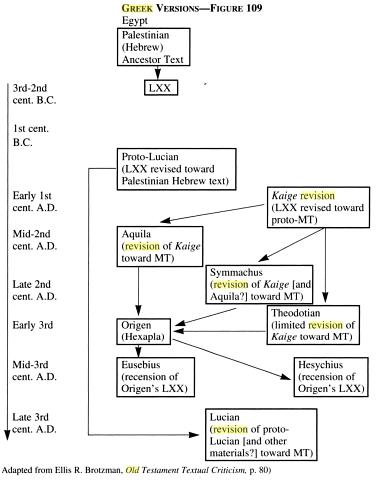
(3) The modern Septuagint is not exactly the ‘original’ version. Even during the 1st century and well into the Christian era, different people revised the text, which tended to bring it closer to the Hebrew (proto-Masoretic) text. One of these - Origen’s Hexapla - became the basis for most surviving LXX manuscripts (From
Handbook for Bible Study by Lee J. Gugliotto, p. 325):
(4) As for the Peshitta: it is true that the Peshitta is translated from a Hebrew text, and that there are many passages where the Peshitta agree with the Septuagint against the MT or in selecting one of a number of possible meanings of the MT. However, it would seem that the ‘Septuagintal’ elements can be explained, on the one hand, by the translator/s consulting (but oftentimes misunderstanding) the Greek text, and on the other, by the translator/s freely combining elements from the Greek and Hebrew. The Septuagint influence in the Peshitta as a whole is really sporadic, in that it’s mostly concentrated on Isaiah and the Psalms - perhaps also Proverbs.

