Icon Explanation

  • Thread starter Thread starter JMJ_coder
  • Start date Start date
Status
Not open for further replies.
Hello,

Could someone explain the icon Protection of the Theotokos?

http://www.lukedingman.com/imagesicon/theotokosprotection1.jpg
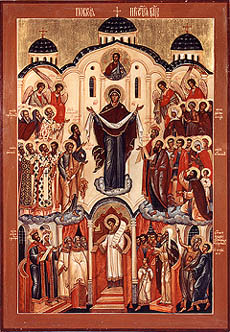
In the early tenth century Constantinople was under threat of attack from pagan Russians. The people were at prayer at the vigil service in the imperial church of Blachernae where there was preserved a miraculous icon of the Theototokos and her robe and belt. It is said that Saint Andrew the Fool for Christ’s Sake was present at the vigil and in the course of the service he saw the Theotokos entering the church with angels and saints, including St John the Forerunner and St John the Theologian. Ascending first the ambon, then entering the altar, she wept profusely, praying to Christ for the protection and preservation of the faithful and then was seen to remove her veil and hold it spread out over the people offering them the protection of her intercession. According to some, Saint Andrew then brought out from the altar the robe of the Theotokos and through its virtue, and by the grace of God, at the prayers of the Theotokos, the city and people were saved.
The icon shows the Theotokos interceding for the world, and holding out her veil which, according to Saint Andrew, shone with glory. Saint Andrew is shown to the lower right, explaining the vision to his disciple, Epiphanios; in the lower centre Saint Romanos the Sweet-singer chants from the ambon - his feast day falls on the same day as the miraculous vision, although he lived several centuries earlier. The emperor and empress appear to the lower left.
 
It’s also one of those excruciatingly funny Greek puns: “skepi” means both “veil” and “protection.”
 
Hello,
and then was seen to remove her veil and hold it spread out over the people offering them the protection of her intercession.
The icon shows the Theotokos interceding for the world, and holding out her veil which, according to Saint Andrew, shone with glory.
Thanks for the explanation. Could you expand on this part here further - it is the part I am really interested in and inquiring about.
 
Bear in mind that, as mentioned in a previous post, *i agia skepi *in Greek conveys the meaning of both *the holy veil *and the holy protection, As usual, the best interpretation of the meaning of the feast and the icon is to be drawn from the liturgical texts.

Apolytikion (Tone 4)
Today the faithful celebrate the feast with joy, illumined by your coming, O Mother of God. Beholding your pure image we fervently cry to you: encompass us beneath the precious veil of your protection, and deliver us from every form of evil, by entreating Christ, your Son and our God that He may save our souls.
Kontakion (Tone 3 - melody ‘Today the Virgin’)
Today the Virgin stands in the midst of the Church, and with choirs of Saints she invisibly prays to God for us. Angels and bishops worship, apostles and prophets rejoice together, since for our sake she prays to the Eternal God!
{note that the kontakion ‘paraphrases’ the Nativity kontakion composed by Saint Romanos, commemorated the same day.}

A relatively ‘modern’ text of the service is to be found at anastasis.org.uk/1october.htm

If you read Slavonic you might appreciate this apparently ancient text synaxis.info/psalom/research/simmons/pokrov/pokrov_alt.pdf. One of the doxastikhons is to be sung ‘osmoglasnik’ - that is, each line is sung consecutively in one of the eight tones or modes - indicating a very high level of joyful celebration.

 
Hello,
Bear in mind that, as mentioned in a previous post, *i agia skepi *in Greek conveys the meaning of both *the holy veil *and the holy protection, As usual, the best interpretation of the meaning of the feast and the icon is to be drawn from the liturgical texts.
Thanks. I am interested in this because I see a direct correlation between the Mantle of Mary depicted in this icon and the Brown Scapular of Our Lady of Mount Carmel.
 
Status
Not open for further replies.
Back
Top