
P
patrick457
Guest
(Continued)
I know of at least two samples of the earliest depictions of Jesus crucified after Christianity’s emancipation in the 4th century, both from 5th century Rome. One is an ivory casket, the other is a panel in a wooden door in the basilica of Santa Sabina. In both depictions, the nails in Jesus’ hands are clearly depicted, but there are no traces of nails on the feet (but then again, maybe the limitations of the medium have something to do with it: the artists may have simply found it difficult to carve nail heads there).

But after that, Christian artists all agreed in portraying Jesus’ feet nailed, one nail driven through each foot (often Jesus is shown standing on a footrest or a pedestal as well, particularly in Eastern icons), for a total of four nails. Which would continue to be the case until …

From the Rabula Gospels (ca. 586)
… the 12th century, when in the West a new artistic fad emerged. Jesus’ feet is now depicted as being pierced by a single nail: one foot is placed over the other and one nail is driven through both. It’s not exactly clear why Western artists suddenly shifted to showing just three nails, but one common explanation is that the symbolism of the number three may have something to do with it. (Another explanation claims that this was a side effect of Western artists starting to depict a crucified Jesus who is either clearly suffering horribly or stone-cold dead. Having Jesus’ feet placed on top of each other and Jesus’ body curving and drooping is more dramatic than the earlier, four-nail depictions, where at best He’s just standing stiff and erect.)
Not everybody liked this depiction at first (a 12th century Spanish-French bishop reacted in horror to “ill-shapen” images of the crucified Jesus “with one foot laid over the other, so that both are pierced by a single nail;” he claimed that such depictions “[strive] to annul or render doubtful men’s faith in the Holy Cross and the traditions of the sainted Fathers” ); however, by the 15th century, most Western crucified Jesuses were of the three-nail variety. (In the East, the older four-nails convention still remained the standard (it still does to this day), though a few Western-influenced icons do show just three nails.)
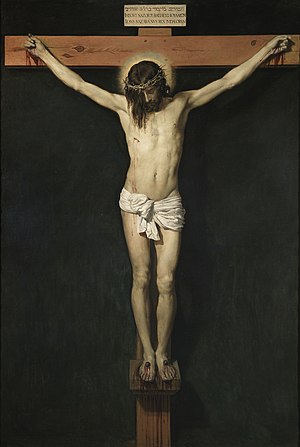
Now during the Counter-Reformation, there was a short-lived attempt by a segment of Spanish artists - under the instigation of painter and official censor for the Spanish Inquisition, Francisco Pacheco - to revive the four-nails depiction, which they argued was more authentic and more historically-accurate. They took as their basis, aside from earlier depictions and earlier writings, the visions of St. Bridget: Bridget in her visions saw Jesus’ feet nailed with two nails, with His feet crossed, left foot over right. Some artists faithfully followed her description, while others depicted four nails but did not have the feet crossed. (Diego Velazquez’s painting of the Christ on the Cross is of the latter type.)
(A side note about St. Bridget. A comparison of her visions with that of Blesseds Maria de Agreda and Catherine Emmerich would show that all three contradict each other on the details. In their respective visions, Agreda and Emmerich ‘saw’ Jesus’ feet pierced by a single nail, as was common artistic convention by their time, but the earlier Bridget ‘saw’ two nails used, as was common artistic convention during her time. This goes back to what Mintaka said earlier.)
I know of at least two samples of the earliest depictions of Jesus crucified after Christianity’s emancipation in the 4th century, both from 5th century Rome. One is an ivory casket, the other is a panel in a wooden door in the basilica of Santa Sabina. In both depictions, the nails in Jesus’ hands are clearly depicted, but there are no traces of nails on the feet (but then again, maybe the limitations of the medium have something to do with it: the artists may have simply found it difficult to carve nail heads there).

But after that, Christian artists all agreed in portraying Jesus’ feet nailed, one nail driven through each foot (often Jesus is shown standing on a footrest or a pedestal as well, particularly in Eastern icons), for a total of four nails. Which would continue to be the case until …
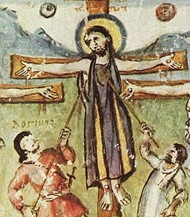
From the Rabula Gospels (ca. 586)
… the 12th century, when in the West a new artistic fad emerged. Jesus’ feet is now depicted as being pierced by a single nail: one foot is placed over the other and one nail is driven through both. It’s not exactly clear why Western artists suddenly shifted to showing just three nails, but one common explanation is that the symbolism of the number three may have something to do with it. (Another explanation claims that this was a side effect of Western artists starting to depict a crucified Jesus who is either clearly suffering horribly or stone-cold dead. Having Jesus’ feet placed on top of each other and Jesus’ body curving and drooping is more dramatic than the earlier, four-nail depictions, where at best He’s just standing stiff and erect.)
Not everybody liked this depiction at first (a 12th century Spanish-French bishop reacted in horror to “ill-shapen” images of the crucified Jesus “with one foot laid over the other, so that both are pierced by a single nail;” he claimed that such depictions “[strive] to annul or render doubtful men’s faith in the Holy Cross and the traditions of the sainted Fathers”
); however, by the 15th century, most Western crucified Jesuses were of the three-nail variety. (In the East, the older four-nails convention still remained the standard (it still does to this day), though a few Western-influenced icons do show just three nails.)Now during the Counter-Reformation, there was a short-lived attempt by a segment of Spanish artists - under the instigation of painter and official censor for the Spanish Inquisition, Francisco Pacheco - to revive the four-nails depiction, which they argued was more authentic and more historically-accurate. They took as their basis, aside from earlier depictions and earlier writings, the visions of St. Bridget: Bridget in her visions saw Jesus’ feet nailed with two nails, with His feet crossed, left foot over right. Some artists faithfully followed her description, while others depicted four nails but did not have the feet crossed. (Diego Velazquez’s painting of the Christ on the Cross is of the latter type.)

(A side note about St. Bridget. A comparison of her visions with that of Blesseds Maria de Agreda and Catherine Emmerich would show that all three contradict each other on the details. In their respective visions, Agreda and Emmerich ‘saw’ Jesus’ feet pierced by a single nail, as was common artistic convention by their time, but the earlier Bridget ‘saw’ two nails used, as was common artistic convention during her time. This goes back to what Mintaka said earlier.)