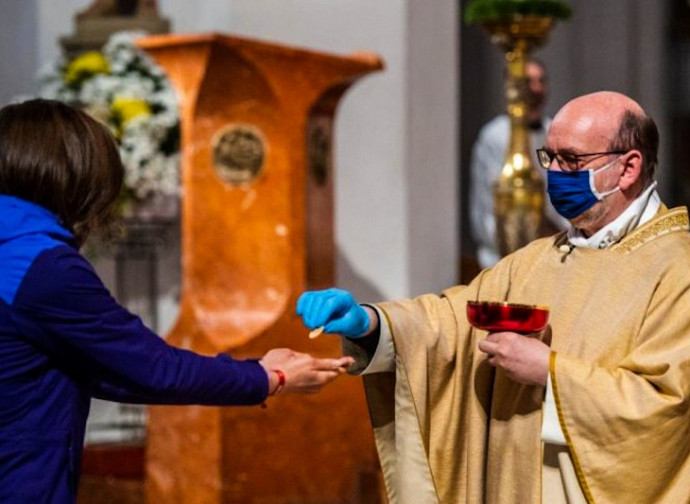
Receiving communion in the hand using a purificator?

Status
Not open for further replies.
Why, yes I am.
Although I more resemble a wookie!
(Except the top of my head. I’m becoming quite adept at “buzzing” my own hair until this stay-at-home business ends - which in L.A. may never happen?!) 😬
 
This is why I say that:

(Please Note: This uploaded content is no longer available.)

…and this is just L.,A. County - not even the whole Archdiocese!
Over the years I have become an ITH communicant for no good reason other than convenience, but I understand the more reverent culture, too.

At this point, I’d be happy to just sit in my Church alone and meditate!
 
Last edited:
The purificator is to “purify” one’s hands and the sacred vessels. It does not “purify” Our Lord.
I’m not trying to talk you out of it, and you should certainly follow the dictates of your conscience. That said, I’ve never fully understood this idea that touching the Host with your hands is somehow irreverent or disrespectful or presumptuous. Communion is us literally taking His flesh into our body. Next to that, touching Him with our hand seems pretty trivial.
 
40.png
HomeschoolDad:
The purificator is to “purify” one’s hands and the sacred vessels. It does not “purify” Our Lord.
I’m not trying to talk you out of it, and you should certainly follow the dictates of your conscience. That said, I’ve never fully understood this idea that touching the Host with your hands is somehow irreverent or disrespectful or presumptuous. Communion is us literally taking His flesh into our body. Next to that, touching Him with our hand seems pretty trivial.
It’s not conscience, it’s just strong, strong preference, for what in my mind are very good reasons.

To my knowledge, the Church has never had a binding doctrine or teaching one way or the other on a layperson touching the Sacred Host. St Thomas Aquinas did have quite a bit to say about it (he opposed it), but by himself, he is not the teaching Church. Nonetheless, was he right, or was he wrong? If he was wrong, why was he wrong? (See the end of this post.)

The whole “not touching the Host” thing largely revolves around the inability (because of logistics) of each layperson to purify their hands, and to inspect for fragments (arguably they could do this), after having handled the Host. Traditionally (there goes my favorite adverb again!), the priest himself kept his thumb and index finger tightly pressed together until he purified them after communion. Some still do. In the EF, I believe it is even part of the rubrics — I’d have to look it up — but even if it’s not, it is universal practice in the EF.

This whole “to CITH or not to CITH” thing has been done to death, so at this point I’m just going to hand the mike over to the Angelic Doctor himself, take it away, STA.

…because out of reverence towards this sacrament, nothing touches it, but what is consecrated; hence the corporal and the chalice are consecrated, and likewise the priest’s hands, for touching this sacrament. Hence it is not lawful for anyone else to touch it except from necessity, for instance, if it were to fall upon the ground, or else in some other case of urgency.

Note that not even Aquinas says that a layperson may never, ever touch the Blessed Sacrament.
 

Just some food for thought here. Unfortunately, the article is in Italian — I couldn’t find an English version — but if you will run this through Google Translate, you will get a serviceable English translation. It’s just a little clumsy, but you can read it and make sense of it.

I would hasten to add, that fragments too small to be seen by the naked eye, only arguably remain the Body of Christ, and the smaller these fragments get, the less the likelihood. Simply put, no appearance of bread, no Body of Christ. But fragments of 1-2mm are definitely large enough to be seen unaided.
 
Last edited:
Traditionally (there goes my favorite adverb again!), the priest himself kept his thumb and index finger tightly pressed together until he purified them after communion. Some still do. In the EF, I believe it is even part of the rubrics — I’d have to look it up — but even if it’s not, it is universal practice in the EF.
Yes, it is part of the rubrics.
 
at this point I’m just going to hand the mike over to the Angelic Doctor himself, take it away, STA.

…because out of reverence towards this sacrament, nothing touches it, but what is consecrated; hence the corporal and the chalice are consecrated, and likewise the priest’s hands, for touching this sacrament. Hence it is not lawful for anyone else to touch it except from necessity, for instance, if it were to fall upon the ground, or else in some other case of urgency.
Great quote!

I forget where I read this but here goes:

In China, the communists broke into a chapel and threw the ciborium on the floor, with the Hosts scattered on the floor 😱. A young girl would sneak into the chapel every day on her knees, bend down and using ONLY her tongue consumed 1 Host a day. She did this every day. On the day that she consumed the last Host, the communists came again and killed her in the chapel.

Awesome.
 
Last edited:
In China, the communists broke into a chapel and threw the ciborium on the floor, with the Hosts scattered on the floor 😱. A young girl would sneak into the chapel every day on her knees, bend down and using ONLY her tongue consumed 1 Host a day. She did this every day. On the day that she consumed the last Host, the communists came again and killed her in the chapel.
I have read this story before. I hope it is apocryphal, because I hate to think of an innocent young girl dying in that fashion. Clearly, per Aquinas (as well as just a common sensus catholicus), she could have picked up the Hosts and replaced Them in the ciborium, or to preserve Them from further sacrilege, she could have just self-communicated herself all of Them at once. But, if the story is true, she didn’t know that. “Back in the day” (another phrase I use a lot, as I noted earlier today), the faithful were not generally taught that they could touch a Host to preserve It from sacrilege, if there were an emergency such as this one, with no priest available.
 
Last edited:
Afaik, it’s a true story. (This was when the Communists were taking over China, so mid-20th century.)
 
Status
Not open for further replies.
Back
Top