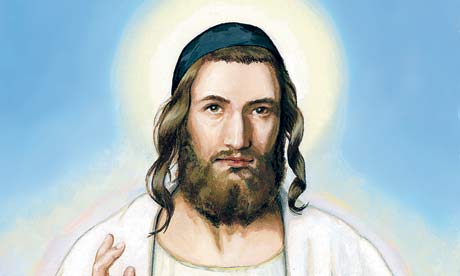
They say Jesus was not follow Judaism to 100%

  • Thread starter Thread starter henrikhank
  • Start date Start date
Status
Not open for further replies.
H

henrikhank

Guest
Luadetur Jesus Christus!
People say that since Jesus didn’t wear the important Jewish Kippah he was not following Judaism 100%. What do you have to say about it?
 
Do we know he didn’t cover his head?

Anyway, there were many schools of thought in ancient Judaism and Jesus’ authority was/is above all of them. If Jesus said something wasn’t required (like washing hands) then it wasn’t. If he decided the same thing about covering one’s head then that would also have been the correct interpretation of Judaism.

In this particular case, I believe the Mosaic Law only required that Israelite men cover their heads during prayer. The custom of covering one’s head at all times grew slowly out of this, I would guess as a “fence” to prevent accidental or debatable infractions of the actual law. Also I thought this development happened primarily after the time of Christ, and that the skullcap style kippa we know today is a modern fashion.
 
Luadetur Jesus Christus!
People say that since Jesus didn’t wear the important Jewish Kippah he was not following Judaism 100%. What do you have to say about it?
So? He also violated the rules on the Sabbath. He is God incarnate.
 
Luadetur Jesus Christus!
People say that since Jesus didn’t wear the important Jewish Kippah he was not following Judaism 100%. What do you have to say about it?
Simple. The custom of wearing a kippah (aka yarmulke) as we know it today only developed after the time of Jesus. While Jews today ascribe religious importance to covering one’s head, in earlier times wearing some sort of headcovering (perhaps something like a turban or a keffiyeh) were done for more practical reasons: protection from the weather. There was apparently still no cultural expectation that a man must cover and uncover His head at specific times.
 
As mentioned, it is really hard to say that Jesus was not totally practicing Judaism, because there was no singular ‘Judaism’ per se at the time. Instead, what you have is different schools of thought that agreed on the basics (monotheism, the divine election of Israel, the Law, repentance and forgiveness, etc.) and yet differed on many particulars: the differences in opinion was such that some authors would even use the plural term ‘Judaisms’ to describe them. You have the Pharisees, the Sadducees, the Essenes (and perhaps other groups not known to us), each with their own distinctive theology and practice, and those who were not affiliated to any party but simply practiced ‘common’ Judaism.

Jesus, while He does have theological similarities with some of these schools (the Pharisees for one) is really a separate category on His own.
 
We are talking about God himself. What rules should He follow?
 
As mentioned, it is really hard to say that Jesus was not totally practicing Judaism, because there was no singular ‘Judaism’ per se at the time. Instead, what you have is different schools of thought that agreed on the basics (monotheism, the divine election of Israel, the Law, repentance and forgiveness, etc.) and yet differed on many particulars: the differences in opinion was such that some authors would even use the plural term ‘Judaisms’ to describe them. You have the Pharisees, the Sadducees, the Essenes (and perhaps other groups not known to us), each with their own distinctive theology and practice, and those who were not affiliated to any party but simply practiced ‘common’ Judaism.

Jesus, while He does have theological similarities with some of these schools (the Pharisees for one) is really a separate category on His own.
Plus there were even different schools within these schools. I’m not sure about the Sadducees, but there were different kinds of Essenes and different schools of thought within the Pharisees.
 
Plus there were even different schools within these schools. I’m not sure about the Sadducees, but there were different kinds of Essenes and different schools of thought within the Pharisees.
The Sadducees were a branch of Judiasm that
  1. Denied the Scriptural status of any books other than the Torah\Pentatuch. In other words, they considered all of the other books of the Bible to be nice books, but not Divinely inspired Scripture.
  2. They also denied any afterlife.
 
The Sadducees were a branch of Judiasm that
  1. Denied the Scriptural status of any books other than the Torah\Pentatuch. In other words, they considered all of the other books of the Bible to be nice books, but not Divinely inspired Scripture.
  2. They also denied any afterlife.
Yes. What I meant was I don’t know if there were different schools of thought within the Sadducees like the Essenes and Pharisees or if they were basically a single uniform group.
 
The Pharisees, and others, were constantly checking up on Him and criticizing any deviations. I think they would have mentioned His failure to wear a Kippah if that had been a rule at the time.
 
The Sadducees were a branch of Judiasm that
  1. Denied the Scriptural status of any books other than the Torah\Pentatuch. In other words, they considered all of the other books of the Bible to be nice books, but not Divinely inspired Scripture.
  2. They also denied any afterlife.
We firs hear of the idea about the Sadducees accepting only the Torah from some Church Fathers such as Origen and St. Jerome. Their testimony is quite suspect at this point however since they seem to have confused the then-extinct Sadducees with the Samaritans. Josephus’ (our sole contemporary source) statement about the Pharisees and Sadducees in Antiquities 13.297 is also invoked, but in reality the quote is more concerned with Sadducean rejection of Pharisaic traditions.

What I would now explain is this, that the Pharisees have delivered to the people a great many observances by succession from their fathers, which are not written in the laws of Moses; and for that reason it is that the Sadducees reject them, and say that we are to esteem those observances to be obligatory which are in the written word, but are not to observe what are derived from the tradition of our forefathers.
 
We firs hear of the idea about the Sadducees accepting only the Torah from some Church Fathers such as Origen and St. Jerome. Their testimony is quite suspect at this point however since they seem to have confused the then-extinct Sadducees with the Samaritans. Josephus’ (our sole contemporary source) statement about the Pharisees and Sadducees in Antiquities 13.297 is also invoked, but in reality the quote is more concerned with Sadducean rejection of Pharisaic traditions.

What I would now explain is this, that the Pharisees have delivered to the people a great many observances by succession from their fathers, which are not written in the laws of Moses; and for that reason it is that the Sadducees reject them, and say that we are to esteem those observances to be obligatory which are in the written word, but are not to observe what are derived from the tradition of our forefathers.
Very interesting. I have read somewhere that some people have suggested a connection between the ancient Sadducees and the modern Karites, and this reminds me of that.
 
I partly quote from What Do Jewish People Think about Jesus?: And Other Questions Christians Ask about Jewish Beliefs, Practices, and History
by Michael L. Brown:

Although it would be unthinkable for a religious Jewish man today to walk with his head uncovered, there is no explicit biblical support for this custom, while in Jesus’ day, there is little to no evidence that it was a religious custom for Jewish men to cover their heads. …]

The origins of the yarmulke are unclear, since there is nothing in the Torah that would relate to this (other than the fact that the high priest wore a certain kind of head covering), and there is scant mention in the Talmud about this practice, aside from the reference to an exceptionally pious man who would not walk more than a few feet without covering his head “since the Divine Presence is above my head” (b. Kiddushin 31a). What is clear that, over the centuries, “covering the head became a sign of reverence and awe and an acknowledgement of the omnipresence of God”—especially when praying and studying. Indeed, this has become such a sign of piety that for a Jewish man not to cover his head would be to loudly proclaim his impiety. In keeping with this, a famous twentieth-century rabbi was once chastised by his mother when, as a little boy, he was not quick enough in putting his yarmulke back on his head after it had fallen off. How, she asked, could he be so irreverent?

This practice, which did not become fixed until the late Middle Ages, is then projected back to biblical times by traditional Jews. In fact, a rabbi told me a traditional Jewish joke that claims that we can prove from the Torah that Isaac covered his head. The text cited is Genesis 24:63, stating that Isaac went into the field to meditate. The “proof” is this: “You mean to tell me that Isaac would pray and meditate without covering his head?”

On a more serious, historical note, Christians should be aware that any depiction of Jesus wearing a yarmulke would be anachronistic, since there is no proof of any kind that this was the custom of the day—especially in the form of a traditional skullcap.
 
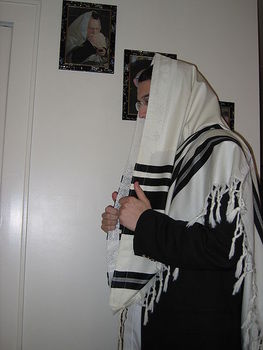
Admittedly, there has been a surge amongst many Christian circles to assert the Jewishness of Jesus, after studies and important discoveries have helped us become more aware of the world Jesus lived in. Part of this boom is the increase of artworks which ostensibly attempt to portray a more ‘Jewish’ Jesus, showing Him donning stereotypical Jewish attributes such as tefillin (phylacteries), a kippah (yarmulke), a tallit, and payot (sidecurls).


Good intentions may this artworks belie, but speaking from a historical sense they aren’t pretty much accurate.

Aside of course from the kippah issue, there is also the matter of portraying Jesus draped with a modern-day ‘prayer shawl’. The problem with this is, the miniature shawl-like tallit as we know it today is but a shadow of its former self. In Numbers 15:38-39 and Deuteronomy 22:12, the Israelites are commanded to add the tzitzit, or the tassels, to the “four corners of [their] garments” as a remembrance of the commandments of the Lord. And which article of clothing had four corners in those days? The mantle which men draped over their tunics as part of their daily clothing, of course.

This mantle only became a ceremonial garment (and decreased in size), thus turning into the tallit we know today much later in time, because fashions were changing and people in most areas no longer wore cloaks. To the dilemma of how could Jews preserve the commandment of wearing tassels, the more portable and compact shawl was a godsend. (Another solution to the problem was the poncho-like tallit katan, worn under or over one’s clothing.)


Samuel anoints David, from the 3rd century synagogue in Dura-Europos, Syria. Notice how Samuel and David and his brothers all wear cloaks over their tunics.


Jeremiah or Ezra holding a scroll, from the same. Note the tiny tassel at the corner of the cloak (bottom right, beside the left lower leg): was it a tzitzit, or a simple show fringe?


As for payot, while it is often interpreted as a fulfilment of Leviticus 19:9-10 and 27, also doesn’t seem to be a custom practiced during the time period in question, instead it seems to be a fairly recent tradition mainly observed among Eastern European Jews in the past few hundred years.

We are on more firmer ground on tefillin: the New Testament, for one, speaks of Jesus criticizing the scribes and Pharisees for enlarging the ones they wear, and fragments of tefillin cases (as well as the slips which would have been once placed inside one) from the period have been found in the Judaean desert. Interestingly though, unlike the box-shaped form we are familiar with today, the tefillin housings found at Qumran (dating ca. 1st century BC to 1st century AD) were flat rectangular leather pouches with one or more small compartments where the slips would be placed.


There’s also a minor difference in the Scripture passages contained therein. Modern tefillin usually contain the following four passages, all of which include a reference to the commandment of tefillin (Exodus 13:1-10; 11-16; Deuteronomy 6:4-9; 11:13-21). Based on the discoveries, ancient phylacteries have also apparently contained the text of the Ten Commandments (Deuteronomy 5:1-6:3), at least before the early 2nd-century Mishnaic reforms.
 
Very interesting. I have read somewhere that some people have suggested a connection between the ancient Sadducees and the modern Karites, and this reminds me of that.
Well, the Karaites do hold only to a literal interpretation of Scripture. While the Sadducees are sometimes characterized likewise, the only thing we know about them was that most of them were aristocratic, they did not believe in any form of life after death, and that they did not accept the special traditions of the Pharisees, having their own. Some scholars theorize that they preserved a more archaic form of Judaism than the Pharisaic doctrine, which developed gradually within the climate of the exilic and post-exilic period and evolved and became elastic as times and needs changed. Because of this conservative reflex and the fact that they virtually are the ruling majority over the Temple, it is thought they were naturally wary of Pharisaic ideas which placed huge emphasis on democracy of religion and did not center itself on Temple ritual.
 
Related to this, I’ll quote myself shamelessly here:
It is ‘generally believed’, yes, but this ‘general belief’ has, as I mentioned, gone into some questioning recently. Josephus was once cited as proof for this idea, but what he actually says is (Antiquities 13.297 [10.6]):

περὶ μέντοι τούτων αὖθις ἐροῦμεν. νῦν δὲ δηλῶσαι βούλομαι, ὅτι νόμιμά τινα παρέδοσαν τῷ δήμῳ οἱ Φαρισαῖοι ἐκ πατέρων διαδοχῆς, ἅπερ οὐκ ἀναγέγραπται ἐν τοῖς Μωυσέως νόμοις, καὶ διὰ τοῦτο ταῦτα τὸ Σαδδουκαίων γένος ἐκβάλλει, λέγον ἐκεῖνα δεῖν ἡγεῖσθαι νόμιμα τὰ γεγραμμένα, τὰ δ᾽ ἐκ παραδόσεως τῶν πατέρων μὴ τηρεῖν.

What I would now explain is this, that the Pharisees have delivered to the people a great many observances by succession from their fathers, which are not written in the laws of Moses; and for that reason it is that the Sadducees reject them, and say that we are to esteem those observances to be obligatory which are in the written word, but are not to observe what are derived from the tradition of our forefathers.

It doesn’t say anything about canons of Scripture, but Sadducees rejecting Pharisaic traditions.

Some later Church Fathers (Hippolytus, Refutation of all Heresies 9.24; Origen, Contra Celsum 1.49; St. Jerome, Commentary on Matthew 22:31f.) did claim that the Sadducees accepted only the Torah as canonical, but this is a matter contemporary sources - that is, the New Testament or even Josephus - does not say anything (though admittedly, this is an argument from silence), and as a consequence, there are folks who advise against uncritical use of these sources.

I quote from The Law and the Prophets: A Study in Old Testament Canon Formation by Stephen B. Chapman:

The evidence that the Sadducees did not accept the prophetic books has long rested upon meager references by Origen and Jerome (Origen, Against Celsus, 1.49; Jerome, Commentary on Matthew, on 22:31), the nature of which might just as well indicate a later confusion (second or third century A.D.) of the Sadducees with the Samaritans (For references, LeMoyne, Sadducéen, 142-44. Cf. Sundberg, Church 77-78. The confusion may have arisen from the actual fusion of these two groups in this period).
Building on the work of J. Maier (J. Maier, Auseinandersetzung), Carr has concluded that despite this possible confusion, and the complete absence of any confirmatory evidence in the writings of Josephus, early Mishnaic regulations indicate that priestly circles including the Sadducees ‘revered the Torah alone.’ (Carr, Canonization, 36 n. 39. Carr terms this absence ‘conspicuous’, but explains it away as the consequence of Josephus’ own goal of presenting a unified Judaism with a single canon. Contra Carr, it would seem a rather weak point for Josephus to make if it was so patently untrue.)
However, it is clear in Josephus’ work that the issue of contention between the Pharisees and the Sadducees did not have to do with a different scriptural canon, but with the authority of oral law, which the Pharisees championed. (Josephus, Antiquities 18.16; cf. Antiquities 13.297. Carr admits this point (Canonization, 36 n. 39), which then provides another example of interpreting ‘the law’ too narrowly. Cf. the sound judgments of Beckwith, Formation, 74; and Bruce, Canon, 40-41.)
Thus, to argue that Josephus overlooked the disagreement between the two groups over the scriptural canon is also to argue that he created a controversy over the oral law where none existed, and that he retreated from his effort to present a unified Judaism in one instance, but not in the other. Surely it is more likely that Josephus simply meant what he said.

Jesus’ debated with the Sadducees concerning the resurrection and the afterlife is also cited as proof, since Jesus quotes from the Torah. However, one could argue Jesus using Exodus at this point does not seem to automatically mean they solely rely upon the Torah if we look at the history of Biblical interpretation: after all, later Jewish (Deuteronomy 32:39; cf. Talmud, Tractate Pesachim 68a; Sifre Deuteronomy 306) and Christian tradition used passages from the Pentateuch in support of the resurrection. Also note Jesus’ words: he does not criticize them for an ignorance of ‘Moses’ or the ‘Law’, but their misunderstanding of “the Scriptures [and] the power of God.” His answer possesses force not because it is from pentateuchal tradition, and therefore authoritative, but because it uses Scripture to ground a belief in resurrection in God’s own self, and thus makes resurrection an essenial tenet of a ‘Scriptural’ faith.

 
Status
Not open for further replies.
Back
Top