Does anyone know when the Veronica story first appeared or was documented?
First about the woman.
One of the earliest references to Veronica the woman come from the apocryphal
Acts of Pilate, aka the
Gospel of Nicodemus. There’s this passage in the work where various people appear at Jesus’ trial before PIlate to testify about Him. One of the witnesses was the woman (formerly) with the issue of blood who touched the hem of Jesus’ garment. While in the earliest recensions of the work the woman is not given a name, in some later versions she is given the name
Berenikē (Greek: Βερενίκη) or some variant thereof - one of which is
Veronica.
And a woman called Bernice [Latin: Veronica] crying out from a distance said: “I had an issue of blood and I touched the hem of his garment, and the issue of blood, which had lasted twelve years, ceased.” The Jews said: “We have a law not to permit a woman to give testimony.”
Aside from this brief cameo in the
Acts of Pilate, we don’t hear much about the haemorrhaging woman (let’s call her the
Haemorrhissa) in other early Christian apocrypha, although the woman and her story had a tendency to be named from time to time whenever Christian writers touched on the issue of whether to allow menstruating women to go to church or not, both sides - those who think that menstruating women going to church are okay and those who think otherwise - using her in support of their respective opinions.
In the East, the Haemorrhissa tended to be associated more with the role she is given in the
Acts of Pilate: as the hemorrhaging woman who was healed by touching Jesus’ garment. In this capacity the woman is usually named in early Byzantine (and Germanic) folk charms and incantations for stopping blood flow along with Zechariah (the father of John the Baptist, conflated with “Zechariah son of Barachiah” of Matthew 23:35). Here’s one example:
By the great name of the almighty God. The prophet Zacharias was slaughtered in the temple to the Lord and his blood solidified in the middle of the sanctuary like a Stone. So thou too stop the blood of the servant of God, congeal disease, as that one and as a Stone, may it be annulled.
I exorcise thee by the Faith of Berenice (
Beraioonikii), blood, that you may not drip further; let us stay good, let us stay in fear; amen. Jesus Christ conquers.
A medieval Latin charm against nosebleed also runs pretty much the same:
For stopping blood from the nose. In the name of Christ write on the forehead with the own blood of the same the name of Veronica.
The same is it who said: If I touch the fringe of the garment of my Lord I shall be healed.
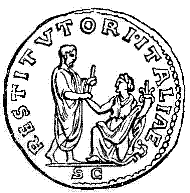
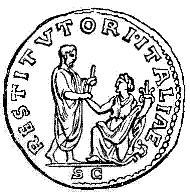
At this stage, the Haemorhissa was not yet explicitly connected with any portrait of Jesus. Although, there was already a popular belief among some contemporary Christians connecting the woman with the issue of blood with a certain bronze statue in Paneas (ancient Caesarea Philippi) depicting a man and a kneeling woman, which they claim was a depiction of Jesus and the Haemorhissa, believing it to be erected by the woman herself in gratitude for her cure. Both Origen, in the mid-3rd century (
Contra Celsum VI.34), and Eusebius in the early 4th century (
Church History VII.18) is already aware of such a tradition.
Granted, modern historians generally doubt the belief that the statue was really that of Jesus. Instead they think that the statue was either that of the Roman god of healing Aesculapius (due to the presence of “a certain strange plant, which climbs up to the hem of the brazen cloak (of the male figure), and is a remedy for all kinds of diseases” being part of the ensemble), or a symbolic depiction of the submission of Judaea, represented by the woman, to the 2nd-century emperor Hadrian, which the (Christian) locals have simply given a symbolic, Christian meaning. (Such reinterpretations of pagan imagery are, after all, known to have been done by early Christians.) The statue itself was eventually destroyed during the reign of Julian the Apostate (361-363).