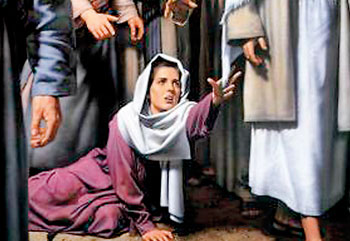
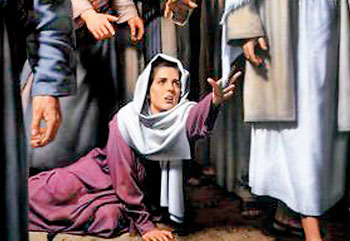
. There’s this passage in the work where various people appear at Jesus’ trial before PIlate to testify about Him. One of the witnesses was the woman (formerly) with the issue of blood who touched the hem of Jesus’ garment. While in the earliest recensions of the work the woman is not given a name, in some later versions she is given the name
And a woman called Bernice [Latin: Veronica] crying out from a distance said: “I had an issue of blood and I touched the hem of his garment, and the issue of blood, which had lasted twelve years, ceased.” The Jews said: “We have a law not to permit a woman to give testimony.”
Aside from this brief cameo in the
Acts of Pilate, we don’t hear much about the haemorrhaging woman (let’s call her the
Haemorrhissa) in other early Christian apocrypha, although the woman and her story had a tendency to be named from time to time whenever Christian writers touched on the issue of whether to allow menstruating women to go to church or not, both sides - those who think that menstruating women going to church are okay and those who think otherwise - using her in support of their respective opinions.
In the East, the Haemorrhissa tended to be associated more with the role she is given in the
Acts of Pilate: as the hemorrhaging woman who was healed by touching Jesus’ garment. In this capacity the woman is usually named in early Byzantine (and Germanic) folk charms and incantations for stuff like blood flow and nosebleeds along with Zechariah (the father of John the Baptist, conflated with “Zechariah son of Barachiah” of Matthew 23:35).
At this stage, the Haemorhissa was not yet explicitly connected with any portrait of Jesus. Although, there was already a popular belief among some contemporary Christians connecting the woman with the issue of blood with a certain bronze statue in Paneas - ancient Caesarea Philippi - of a man and a kneeling woman (originally perhaps depictions of the Roman god Asclepius or the Roman emperor Hadrian), which became identified by local Christians as a depiction of Jesus and the Haemorhissa, believing it to be erected by the woman herself in gratitude for her cure. Both Origen, in the mid-3rd century (
Contra Celsum VI.34), and Eusebius in the early 4th century (
Church History VII.18) is already aware of such a belief.

It is in the 8th century that in the West we begin to see Berenice/Veronica connected with a portrait of Jesus, usually said to be on a piece of cloth. Back then, the story at its core was highly similar to the origin story of
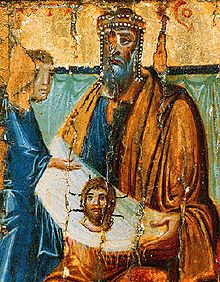
the Holy Mandylion of Edessa: someone (Veronica / King Abgar) wanted to obtain an image of Jesus; depending on the story, either they commission a painter who paints a portrait of Jesus on a canvas or (in what would become the standard form of the story later) Jesus Himself grants their request by washing His face and wiping it on a piece of cloth / said canvas, leaving a miraculous imprint of His face on it.
The ‘Veronica’ version of the story goes on to tell how Veronica kept this portrait of Jesus with her and later used it to cure the Roman emperor Tiberius of his leprosy. (There’s also a parallel to the story of the Holy Mandylion here: King Abgar of Edessa was also in his story a leper, and just like Tiberius in this legend, he has heard of Jesus’ miraculous cures and sent a messenger to Judaea to fetch Him, but Jesus could not be persuaded to go. Instead, Jesus sends Abgar a letter promising to send one of His disciples to Him later; and in later versions of the story, He also eventually sends Him the Mandylion, either by the hand of the king’s messenger or said disciple of His.)

King Abgar with the Mandylion
In the earlier forms of the story, Veronica’s image had no connection with the Passion of Jesus yet: she obtains the image somewhere during Jesus’ ministry, after He has cured her of her issue of blood. (In fact, that’s what triggers her desire for an image of Jesus in these stories: as a kind of memento.) It was only later that the timing of the event was gradually shifted, until by the 13th-14th century, Veronica is now said to have obtained her image while Jesus was carrying His cross to Golgotha; the cloth He wipes His face on is now said to be her veil, which she gave to Him as an act of kindness.
(Interestingly, there’s also a parallel to the Edessa image here: older variants of the Mandylion story also use Jesus’ ministry as their backdrop, but in the later retellings, you see a connection between it and the Passion being drawn: Abgar’s messenger is now said to have reached Jesus just days before, or even the day before, His Passion - which actually makes the reason why Jesus refused to go with the messenger to Edessa more understandable. In fact, in one late variant of the Mandylion’s origin story, the image was instead formed during Holy Thursday night, when Jesus wiped His face drenched with bloody sweat after His agony in Gethsemane.)