Which liturgucal language is closest to Jesus' Aramaic?

  • Thread starter Thread starter Jerry-Jet
  • Start date Start date
Status
Not open for further replies.
Well, partially. The city of Antioch itself was bi-lingual (and bi-ethnic), albeit that the “upper crust” was Greek-speaking (much the same syndrome as one can find in Brussels – which is what I’ve heard called “a Flemmish city with a French complex” – where for many years, it was “fashionable” for the local Flamands to be Francophone), irrespective of ethnicity. While I am far less familiar with Egypt, I think the same can be said for Alexandria. In any case, this had absolutely nothing to do with Chalcedon.

I wouldn’t say it quite that way. In the early stages, there were two groups called Melkites: the “Melkite Maximites” (who ultimately adopted the Byzantine Imperial liturgical usage) and the “Melkite Maronites” (who maintained their Syriac liturgical usage). While the moniker arose because of Chalcedon (and therefore, of course, the Emperor), it was proudly worn. After all, Syria was still part of the Empire.
I was always told that the melkites were the Syriacs who gave into byzantinisations.
 
I was always told that the melkites were the Syriacs who gave into byzantinisations.
Initially no, but in the end, yes. When the “Melkite Maximites” adopted the usage of Constantinople, the Maronites dropped (and spurned the use of) the qualifier. When that happened, the Byzantines were the only Melkites. And so it remains. 😉
 
So, the Maronites are the Chalcedonian Syriacs who weren’t hellenized?
 
Melkites comes from malkieen. Which is a derogatory syriac word that means “kings”. It was used to refer to the Melkites in an offending way as they took on the “elitist rich people language”.
 
I don’t know Syriac, but I always thought it came from malik(i’in]), the Arabic word for king(s); the words are of similar derivation in any case. (Note that I never had any evidence to back up my derivation of the name, but just, what is it called, “cognatism”?.)
 
I don’t know Syriac, but I always thought it came from malik(i’in]), the Arabic word for king(s); the words are of similar derivation in any case. (Note that I never had any evidence to back up my derivation of the name, but just, what is it called, “cognatism”?.)
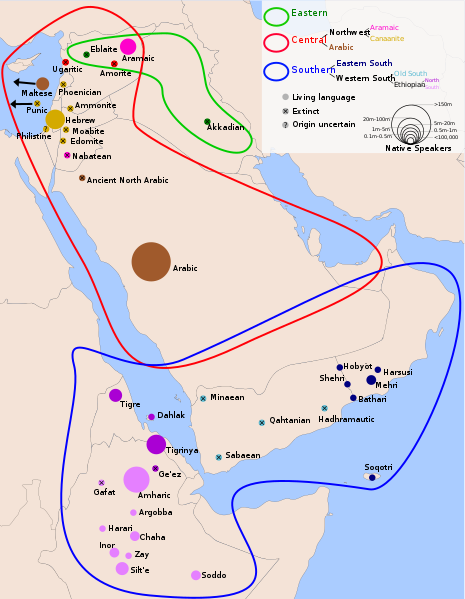
I think that’s pretty much it. Akkadian malku, Hebrew melekh, Arabic malik, Aramaic malka’, as well as Phoenician, Ugaritic, and Old South Arabian mlk all share the same root: Proto-Semitic *mal(i)k- (M-L-K).

Melkite = Melchita (Latin) = Melchites (Greek) = Malkaya (Syriac)
 
It would seem that Hebrew was the liturgical language of The Lord -

hebrew4christians.com/Articles/Jesus_Hebrew/jesus_hebrew.html ;

thus, the Geez language , that has roots in Hebrew would seem to be the closest ; with more Hebrew Catholics being active in the Church , their presence , hopefully would help to bring forth even a liturgy , in Hebrew , which could be very much like the one that The Lord celebrated with the disciples , after the Resurrection .

As far as languages go, Hindi is also said to be close to Hebrew , through the Sanskrit connection ; thus , languages with roots in same also could claim a close connection .

Such a Hebrew presence also might help to bring forth more , a sense of common roots , for the whole Church and also helping in doing away with the effects of idolatry /greed , in cultures world over , in its many forms , damaging faith .

The call and the grace , to repent on behalf of each other , as a gfit of The Spirit , can also be brought forth more powerfully , for all in the family , which , from the perspective of our Jewish 'roots ’ , thus can bring forth more fruit , for the whole world ; after all, esp. in our times, when we are connected , through T.V and such , with others , who come into our lives, our children’s lives, in an instant turn of a switch , our hearts being able to turn often , to say , 'Jesus , Son of David , have mercy on me a sinner ’ on behalf of each other too and invoking The Mother of us all - to 'pray for us sinners ’ ; may such too be what our interest in our Jewish roots would help us to be able to do !

Peace !
 
thus, the Geez language , that has roots in Hebrew would seem to be the closest ; with more Hebrew Catholics being active in the Church , their presence , hopefully would help to bring forth even a liturgy , in Hebrew , which could be very much like the one that The Lord celebrated with the disciples , after the Resurrection .
Ge’ez isn’t derived from Hebrew. It is a Semitic language like Hebrew, Aramaic/Syriac or Arabic, although it belongs to a different subcategory. Ge’ez is a North Ethiopic language and is part of the Ethiopian Semitic (aka Afro-Semitic) language group, which along with Old South Arabian forms the Western branch of the South Semitic family. Hebrew and Aramaic/Syriac, meanwhile, are Northwest Semitic languages which, along with Arabic, form part of the Central Semitic family.


As far as languages go, Hindi is also said to be close to Hebrew , through the Sanskrit connection ; thus , languages with roots in same also could claim a close connection .
Nuh-uh. Sanskrit is an Indo-European language (like Greek, Latin, or English ;)) and is not directly related to Semitic languages.
 
Thank you for the comments !

Well, might have to go by the 'authority ’ ( 😉 ) of Bl.Emmerich again , who mentions that Sanskrit was the language of our first parents ; thus , guess , our family connections are still not that far apart ! 🙂
 
http://www.csmonitor.com/var/ezflow...-1-eng-US/0402-OARAMAIC-maaloula_full_600.jpg

http://aski-sham.net/userfiles/image/Malula-02.jpg

MALULA, Syria — Elias Khoury can still remember the days when old people in this cliffside village spoke only Aramaic, the language of Jesus. Back then the village, linked to the capital, Damascus, only by a long and bumpy bus ride over the mountains, was almost entirely Christian, a vestige of an older and more diverse Middle East that existed before the arrival of Islam.

nytimes.com/2008/04/22/world/middleeast/22aramaic.html?_r=0
 
http://www.csmonitor.com/var/ezflow...-1-eng-US/0402-OARAMAIC-maaloula_full_600.jpg

http://aski-sham.net/userfiles/image/Malula-02.jpg

MALULA, Syria — Elias Khoury can still remember the days when old people in this cliffside village spoke only Aramaic, the language of Jesus. Back then the village, linked to the capital, Damascus, only by a long and bumpy bus ride over the mountains, was almost entirely Christian, a vestige of an older and more diverse Middle East that existed before the arrival of Islam.

nytimes.com/2008/04/22/world/middleeast/22aramaic.html?_r=0
I want to visit that place! 🙂
 
Status
Not open for further replies.
Back
Top