
A new Cardinal with Black dress instead of Red

  • Thread starter Thread starter josethomas2005
  • Start date Start date
Status
Not open for further replies.
J

josethomas2005

Guest
The major archbishop of the Syro Malankara catholic church, Baselios Mor Cleemis has been ordinated as Cardinal today. It is astonishing that he wears the traditional Antiochene black dress and hat instead of a cardinal’s red. Note that at the same time, Maronite patriarch of Antioch, Butros Rai, who is also ordinated cardinal today wore the red dress and red hat.

(Please Note: This uploaded content is no longer available.)

Note that the cross he wears was presented to him by the bishop of Syriac orthodox church in India , Joseph Mor Gregorios.

(Please Note: This uploaded content is no longer available.)

In an interview to an Indian channel before his ordination, Baselios mor Cleemis said that he always remember the words of our lord, “You must be wise like snakes and innocent like pigeons”. Then he said that 'universal church is catholic church and Roman Pope is the successor of apostle Peter".
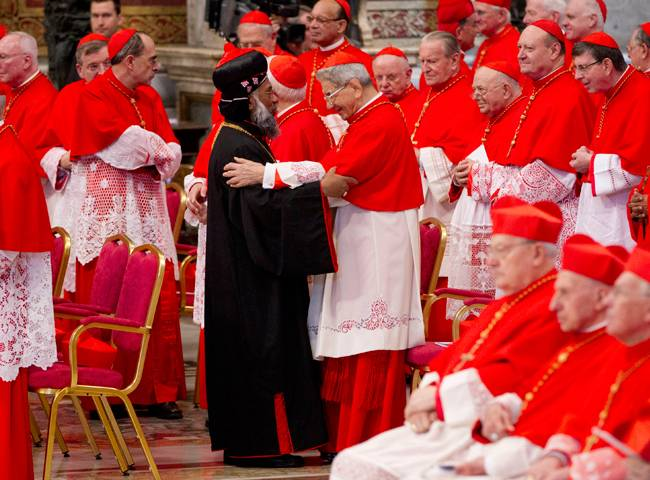
 
The major archbishop of the Syro Malankara catholic church, Baselios Mor Cleemis has been ordinated as Cardinal today. It is astonishing that he wears the traditional Antiochene black dress and hat instead of a cardinal’s red. Note that at the same time, Maronite patriarch of Antioch, Butros Rai, who is also ordinated cardinal today wore the red dress and red hat.
FYI, Maronite Patriarchs have worn red (of a slightly different shade than that of Roman Cardinals), including the tobiyye (our version of the Syriac “turban”) (and please forgive me but I can never remember the proper Syriac name for it), for many centuries. Note that in the Consistory, Mor Bechara Petrous is NOT wearing a Roman biretta, but rather the traditional tobiyye (albeit in "Cardinal red). In any case, it’s been the practice in Rome in the more recent past to forgo a biretta for non-Latins who are named Cardinals, at least for those whose Churches have their own proper headwear.

It’s interesting that Mor Basilios Cleemis is wearimg a rather novel adaptation of the traditional cap, with a peak in “Cardinal red.” Mor George of the Syro-Malabars also designed a rather unique biretta-like hat at the time he was named.

I should also point out that there is no “ordination” involved for a Cardinal. It’s merely an investiture.
 
I’m surprised that on the list of names and in the order of reception of the “red hat” or in this consistory a “black hat”, the Maronite Patriarch was not first in either. Logically, he outranks the rest and should have been followed by the Major Archbishop of the Syro Malankara Church. Why was the American Archbishop James Harvey the first to receive the red hat? Shouldn’t he have been last since he is in fact a Titular Archbishop.
 
I haven’t studied this issue of cardinals much, so I’ve got a question.

Cardinals are normally regarded as prelates of the Roman Church. Can we consider an incardinated non-Latin hierarch’s use of their traditional vestments as a sign that the incardination does not actually make them prelates of the Roman Church? (I hope so:D)

Blessings,
Marduk
 
I wonder if there’s any cultural thing regarding red that he’s trying to avoid by not wearing it?
 
Gotta love the comments section of CNN. I read the story… then (as I always do) I scrolled down to the comments section to see if the first comment was a positive or negative one. Not only was the first one negative, but 99% were. (sigh…)
 
The major archbishop of the Syro Malankara catholic church, Baselios Mor Cleemis has been ordinated as Cardinal today. It is astonishing that he wears the traditional Antiochene black dress and hat instead of a cardinal’s red.

No, it isn’t. Of course he wears his traditional vestments.
 
He may wear his traditional Antiochean dress but if you notice it has been tweaked with the cardinal red. For example the hats interior is now red and on the top red has been added. Also the crosses on the Syro Malankara veil which are usually white are now red. I wonder if Rome designed this or the Syro Malankara Church did. I know Mar George Alencherry the Syro Malabar Major Archbishop was given or had created a special biretta reflecting the Syro Malabar mitre.

Ill post a picture to show the difference between this new cardinal Syro Malankara dress and the original version. Also what Mar George Allenchery now wears after his cardinal ordination.
 
So the red means that (1) one is an elector of the next Pope, and (2) shares in the Pope’s universal solicitude for the Church in a special way?

QUESTION: Are Cardinals more likely to be papabile than others?

Blessings,
Marduk
 
So the red means that (1) one is an elector of the next Pope, and (2) shares in the Pope’s universal solicitude for the Church in a special way?

QUESTION: Are Cardinals more likely to be papabile than others?

Blessings,
Marduk
It’s almost prerequisite.
 
It’s almost prerequisite.
Thanks for the answer. My next question:

How many non-Cardinals have become Pope since the institution of the College of Cardinals? Or, can someone name some Popes that were not Cardinals previously?

I think the College of Cardinals came into existence in the second millenium, so need to discuss anyone in the first millenium.

Blessings,
Marduk
 
I think the College of Cardinals came into existence in the second millenium, so need to discuss anyone in the first millenium.

Blessings,
Marduk
Depends what you mean by ‘College of Cardinals’ - it has always been the practice that the clergy of Rome elected the Pope. It may well be a second millennium development to give these roles to clergy who did not actually officiate in their titular roman churches, but all Cardinals are titular clergy of some ancient roman parish or another (Cardinal archpriest, Cardinal priest or Cardinal deacon of a named actual church in the city).

Blessings, Many Years to the new Cardinals.
 
I’m surprised that on the list of names and in the order of reception of the “red hat” or in this consistory a “black hat”, the Maronite Patriarch was not first in either. Logically, he outranks the rest and should have been followed by the Major Archbishop of the Syro Malankara Church. Why was the American Archbishop James Harvey the first to receive the red hat? Shouldn’t he have been last since he is in fact a Titular Archbishop.
Yeah I might be wrong but I thought the order of the names was classified in the cardinalate order. I also didn’t understand why Harvey came before Tagle, since Harvey is in the Diaconal order and Tagle is in the presbyterial order.

I might be wrong, I don’t know.
 
I haven’t studied this issue of cardinals much, so I’ve got a question.

Cardinals are normally regarded as prelates of the Roman Church. Can we consider an incardinated non-Latin hierarch’s use of their traditional vestments as a sign that the incardination does not actually make them prelates of the Roman Church? (I hope so:D)

Blessings,
Marduk
Cardinals elect and assist the Roman Pontiff, have power when the Apostolic See is vacant, and a cardinal may be a special emissary, and Cardinals are different than Prelates.

CIC

Can. 349 The Cardinals of the Holy Roman Church constitute a special College, whose prerogative it is to elect the Roman Pontiff in accordance with the norms of a special law. The Cardinals are also available to the Roman Pontiff, either acting collegially, when they are summoned together to deal with questions of major importance, or acting individually, that is, in the offices which they hold in assisting the Roman Pontiff especially in the daily care of the universal Church.

Can. 353 §1 Cardinals assist the Supreme Pastor of the Church in collegial fashion particularly in Consistories, in which they are gathered by order of the Roman Pontiff and under his presidency. Consistories are either ordinary or extraordinary.

§2 In an ordinary Consistory all Cardinals, or at least those who are in Rome, are summoned for consultation on certain grave matters of more frequent occurrence, or for the performance of especially solemn acts.

§3 All Cardinals are summoned to an extraordinary Consistory, which takes place when the special needs of the Church and more serious matters suggest it.

§4 Only an ordinary Consistory in which certain solemnities are celebrated, can be public, that is when, in addition to the Cardinals, Prelates, representatives of civil states and other invited persons are admitted.

Can. 358 A Cardinal may be deputed by the Roman Pontiff to represent him in some solemn celebration or assembly of persons as a ‘Legatus a latere’, that is, as his alter ego; or he may, as a special emissary, be entrusted with a particular pastoral task. A Cardinal thus nominated is entitled to deal only with those affairs which have been entrusted to him by the Roman Pontiff himself.

Can. 359 When the Apostolic See is vacant, the College of Cardinals has only that power in the Church which is granted to it by special law.

intratext.com/IXT/ENG0017/_P18.HTM#AN
 
Dear brother DL82,

I finally took the time to research Cardinals (well - the quickest way I knew of, Wikipedia :D). It says that that the only exception to the rule that Cardinals become titular clergy of an ancient Roman parish are the Eastern/Oriental Patriarchs (which includes, naturally, the Major-archbishops who are Patriarchs in fact if not in title). Since it is Wikipedia – well, does anyone have info to affirm or deny this? If it is true, then Eastern/Oriental Cardinals do not in fact become prelates of the Roman Church.
Depends what you mean by ‘College of Cardinals’ - it has always been the practice that the clergy of Rome elected the Pope. It may well be a second millennium development to give these roles to clergy who did not actually officiate in their titular roman churches, but all Cardinals are titular clergy of some ancient roman parish or another (Cardinal archpriest, Cardinal priest or Cardinal deacon of a named actual church in the city).

Blessings, Many Years to the new Cardinals.
Blessings,
Marduk
 
I finally took the time to research Cardinals (well - the quickest way I knew of, Wikipedia :D). It says that that the only exception to the rule that Cardinals become titular clergy of an ancient Roman parish are the Eastern/Oriental Patriarchs (which includes, naturally, the Major-archbishops who are Patriarchs in fact if not in title). Since it is Wikipedia – well, does anyone have info to affirm or deny this? If it is true, then Eastern/Oriental Cardinals do not in fact become prelates of the Roman Church.
It seems that Wikipedia is correct. It’s only Patriarchs who are now designated “Cardinal-Bishops” and are no longer given titular Roman Sees. The others, including Major-Archbishops, are designated “Cardinal-Priest” and are given titular Roman parishes. See, for example, Mor Basilous Cleemis who has his titular Roman church at San Gregorio, and Mar George Alencherry who has his at San Bernardo alle Terme.
 
It seems that Wikipedia is correct. It’s only Patriarchs who are now designated “Cardinal-Bishops” and are no longer given titular Roman Sees. The others, including Major-Archbishops, are designated “Cardinal-Priest” and are given titular Roman parishes. See, for example, Mor Basilous Cleemis who has his titular Roman church at San Gregorio, and Mar George Alencherry who has his at San Bernardo alle Terme.
Thanks for the info, brother Malphono! I think that’s gotta change. I don’t believe any Eastern or Oriental Cardinal should be prelates of the Roman Church.

Blessings,
Marduk
 
Thanks for the answer. My next question:

How many non-Cardinals have become Pope since the institution of the College of Cardinals? Or, can someone name some Popes that were not Cardinals previously?

I think the College of Cardinals came into existence in the second millenium, so need to discuss anyone in the first millenium.

Blessings,
Marduk
Urban VI in late 1300s wasn’t a Cardinal and was the most recent.

The first I think was Celestine V (can someone confirm this?) also in the 1300s. He was a monk in his 80s and quit soon after. Funnily enough, Dante supposedly placed him in hell in his works for resigning, yet the reality was that he was a saint.

The last time a non-cardinal got votes in a conclave was supposedly the then-Archbishop Montini of Milan. He wasn’t elected in that conclave which gave us John XXIII, though John made him a Cardinal and Montini was the frontrunner and winner in the following Conclave and became Paul VI.

The last time a non-bishop cardinal was elected was Gregory XVI in the 19th century. Today though Cardinals are required to be bishops unless the Pope dispenses them of the obligation, which happens with older Cardinals who seem to mainly be Jesuits for some reason.

In any case, you need to be a Bishop to finally be Pope but not a Cardinal. So when Gregory XVI was elected, he had to be made a bishop before he was officially Pope.
 
Thanks for the info, brother! It helps fill a gap in my knowledge of the Catholic Church.

Blessings,
Marduk
Urban VI in late 1300s wasn’t a Cardinal and was the most recent.

The first I think was Celestine V (can someone confirm this?) also in the 1300s. He was a monk in his 80s and quit soon after. Funnily enough, Dante supposedly placed him in hell in his works for resigning, yet the reality was that he was a saint.

The last time a non-cardinal got votes in a conclave was supposedly the then-Archbishop Montini of Milan. He wasn’t elected in that conclave which gave us John XXIII, though John made him a Cardinal and Montini was the frontrunner and winner in the following Conclave and became Paul VI.

The last time a non-bishop cardinal was elected was Gregory XVI in the 19th century. Today though Cardinals are required to be bishops unless the Pope dispenses them of the obligation, which happens with older Cardinals who seem to mainly be Jesuits for some reason.

In any case, you need to be a Bishop to finally be Pope but not a Cardinal. So when Gregory XVI was elected, he had to be made a bishop before he was officially Pope.
 
Status
Not open for further replies.
Back
Top