
H
Huiou_Theou
Guest
Interesting, in the dogmatic definition the word death isn’t used.
Just the completion of the course of her earthly life.
This is a very delicate thing, because a person may be comatose – not entirely dead.
St. Thomas Aquinas goes quite, ummmm, hyperdulia – nay! latria – over the life/death issue of Christ’s flesh while it lay in the tomb:
He comes to sort of both conclusions at once, – the flesh is no longer animated (moving) by the soul, but is in perfect lifelike stasis absolutely sustained as it were – which I have always understood to be one of the principle powers of a spiritual soul.
Perhaps there is a more to this than I am aware?
Much of St. Thomas’ speculation along this line is over my head, but the scholastic tradition leaves quite a bit of room for interpretation and is prior to the Dogmatic definition.
What is not in contest is that Mary ceased to follow living activity with the body – but I think it important to emphasize that her communion with her son was perfect there being no defect of Grace to be found in her.
There is a notion of “evil” the privation of Good – and then there are the indifferent, and the perfect. I understand that God created the indifferent and the good together – but not evil. Being as we are not God, the deficiency between absolute perfection and a necessarily lesser creation was bridged by God in Adam and Eve – the so called preternatural gifts.
Adam and eve were created less than God – a privation not of evil but of indifference and necessity – with some way of knowing God’s will. So their ignorance, whatever it was, was to be informed in some way by God – perhaps an Angel (the messenger of God) of whom a betrayer was found. Hence the sin of Adam and Eve was mitigated – whereas the sin of the Angel was not.
But, when we say that the mother was perfected in Grace – she had the gifts required to be free from every taint and stain of evil. From this, I would expect she shared – in some way – the union with God (perhaps more direct that Adam and Eve’s) which would provide an intimate contact with God which surpassed the gifts of Adam and Eve.
Although, Mary is not above our Lord, I am not convinced that death is completely satisfactory as a description. Lazarus who clearly died is not granted that title by our Lord when Jesus first announces his intention to go to the tomb – Lazarus is sleeping.
In this light, I wonder if saying she “died” in the first place rather than she fell asleep – and then only saying she “died” to the dense would be more appropriate. Certainly her honor is above Lazarus.
In the last days, men will eat and drink – and then at the sound of the trumpet – will they all die before they are transformed – in that wink of an eye? If it is a split second – then will their Glory exceed the honor of his mother whom he wrote the command to honor?
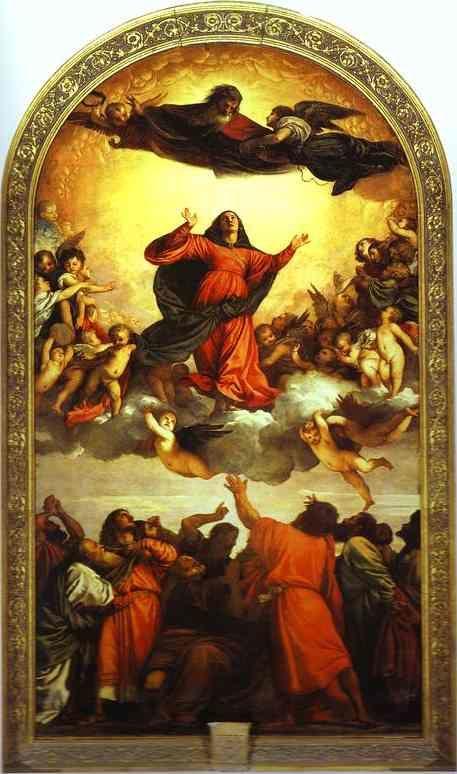
On this feast of our mother, may we hope that her death was of the shallowest sleep. And of course, when she awoke – alive – she entered heaven with joy just as the paintings show.
Amen.
Just the completion of the course of her earthly life.
This is a very delicate thing, because a person may be comatose – not entirely dead.
St. Thomas Aquinas goes quite, ummmm, hyperdulia – nay! latria – over the life/death issue of Christ’s flesh while it lay in the tomb:
He comes to sort of both conclusions at once, – the flesh is no longer animated (moving) by the soul, but is in perfect lifelike stasis absolutely sustained as it were – which I have always understood to be one of the principle powers of a spiritual soul.
Perhaps there is a more to this than I am aware?
Much of St. Thomas’ speculation along this line is over my head, but the scholastic tradition leaves quite a bit of room for interpretation and is prior to the Dogmatic definition.
What is not in contest is that Mary ceased to follow living activity with the body – but I think it important to emphasize that her communion with her son was perfect there being no defect of Grace to be found in her.
There is a notion of “evil” the privation of Good – and then there are the indifferent, and the perfect. I understand that God created the indifferent and the good together – but not evil. Being as we are not God, the deficiency between absolute perfection and a necessarily lesser creation was bridged by God in Adam and Eve – the so called preternatural gifts.
Adam and eve were created less than God – a privation not of evil but of indifference and necessity – with some way of knowing God’s will. So their ignorance, whatever it was, was to be informed in some way by God – perhaps an Angel (the messenger of God) of whom a betrayer was found. Hence the sin of Adam and Eve was mitigated – whereas the sin of the Angel was not.
But, when we say that the mother was perfected in Grace – she had the gifts required to be free from every taint and stain of evil. From this, I would expect she shared – in some way – the union with God (perhaps more direct that Adam and Eve’s) which would provide an intimate contact with God which surpassed the gifts of Adam and Eve.
Although, Mary is not above our Lord, I am not convinced that death is completely satisfactory as a description. Lazarus who clearly died is not granted that title by our Lord when Jesus first announces his intention to go to the tomb – Lazarus is sleeping.
In this light, I wonder if saying she “died” in the first place rather than she fell asleep – and then only saying she “died” to the dense would be more appropriate. Certainly her honor is above Lazarus.
In the last days, men will eat and drink – and then at the sound of the trumpet – will they all die before they are transformed – in that wink of an eye? If it is a split second – then will their Glory exceed the honor of his mother whom he wrote the command to honor?
On this feast of our mother, may we hope that her death was of the shallowest sleep. And of course, when she awoke – alive – she entered heaven with joy just as the paintings show.
Amen.
 **
**
