Abortion restrictions do they reduce abortions

  • Thread starter Thread starter catholictiger
  • Start date Start date
Status
Not open for further replies.
You’re confusing two separate issues. Restricting abortion reduces the abortion rate. That does NOT automatically mean increasing the birth rate! Birth rates are influenced by many other factors.
All of which have been accounted for. If you think some relevant factor has been ommited in the analysis I posted in another thread, then please name it and present supporting data. From what I posted there, Polish women have sex as often as Slovakian women, use less contraceptives, do not use NFP, do not have abortions as Slovakian women do and somehow manage to have less babies than Slovakian women. If you can explain that, I am all ears.
Great! Then we’ve got a simple solution to reduce the rates of all crimes. Just make them all legal, and then people will be less determined to commit them!:rolleyes:
Misrepresentation. If a woman wants to abort, she will abort, regardless of how many hurdles you throw in front of her. The probablity of getting caught is low, because a correctly performed abortion will leave no evidence. Hence no deterrent.
And you know this, because you’ve got some secret dossier of reports of abortions which were reported to you and not to the government? :rolleyes:
No, because I can back-calculate their numbers from other data. Abortions do not exist in a vacuum, and there are other measurable metrics which they influence.

Thought exercise: how does DEA know what is the value of cocaine trade, if the drug cartels don’t report their financial data? 🙂
 
All of which have been accounted for. If you think some relevant factor has been ommited in the analysis I posted in another thread, then please name it and present supporting data. From what I posted there, Polish women have sex as often as Slovakian women, use less contraceptives, do not use NFP, do not have abortions as Slovakian women do and somehow manage to have less babies than Slovakian women. If you can explain that, I am all ears.
Sure. As I said there are innumerable variables, a few, not “all” of which you have accounted for (though I would place very little trust in supposed nationwide quantifications of “how often people have sex” .)

Some I can think of right off the top of my head are:
  • there was an exodus of childbearing-age Poles to western Europe in those years;
  • Slovakia is a mountainous country which has remained almost entirely pastoral with most people living in small villages and towns; Poland is flat, heavily industrialised, heavily urbanised in large cities, has poorer food and water, more prone to diseases etc and Poles on average should be expected to have a lower fertility.
Misrepresentation. If a woman wants to abort, she will abort, regardless of how many hurdles you throw in front of her. The probablity of getting caught is low, because a correctly performed abortion will leave no evidence. Hence no deterrent.
What did I misrepresent? There are many crimes which are usually very difficult to detect from circumstantial evidence unless a witness comes forward. In no other case does anyone argue that this is a reason for making them legal.

And in every other case in every other place for every other crime, making it illegal reduces the incidence. Why should abortion be the one exception? It doesn’t even make sense on a theoretical level, even before we get to the fact that you have absolutely no evidence that it has ever happened in real life.
No, because I can back-calculate their numbers from other data. Abortions do not exist in a vacuum, and there are other measurable metrics which they influence.
Thought exercise: how does DEA know what is the value of cocaine trade, if the drug cartels don’t report their financial data? 🙂
They use** hard evidence**, which you are completely lacking for your speculatiion which you present as an assertion.

Among the many sources of info they use are - the amounts seized, statements by witnessses and culprits, analyssis of the quality fo the drugs seized, the price of the drug on the streets, information from overseas police forces etc, etc.
 
  • there was an exodus of childbearing-age Poles to western Europe in those years;
Exodus started in 2004 – at the same time the fertility rate started climbing. But I grant that post-2004 fertility rate in Poland may be actually higher than reported. However, you still have to explain pre-2004 data.

Another funny piece of data: fertility rate of Polish women in the UK (where abortion law is very liberal) is much higher than at home. 🙂
  • Slovakia is a mountainous country which has remained almost entirely pastoral with most people living in small villages and towns; Poland is flat, heavily industrialised, heavily urbanised in large cities, has poorer food and water, more prone to diseases etc and
    Poles on average should be expected to have a lower fertility.
Well, I think Microsoft Encarta was famous for having such “insights” on Central Europe, but it was over a decade ago. You should move to more reliable sources. Let’s try wikipedia:

Poland - urbanization 61%, labour force by occupation: agriculture: 14.8%; industry: 30.7%; services: 54.5%
Slovakia - urbanization 55%, labour force by occupation: agriculture: 3.5%; industry: 27%; services: 69.4%
Among the many sources of info they use are - the amounts seized, statements by witnessses and culprits, analyssis of the quality fo the drugs seized, the price of the drug on the streets, information from overseas police forces etc, etc.
So how about that – authentic case from last year: Law enforcement caught an abortion provider and charged him with performing 70 abortions. Around 500 legal abortions are performed each year nationwide, and only these get reported. So if this guy was included, he would have single-handedly raised the numbers by 14%. Then consider that (1) he probably did more abortions than that and (2) he was not alone.

Also – birth and death records are hard data.
 
Another funny piece of data: fertility rate of Polish women in the UK (where abortion law is very liberal) is much higher than at home. 🙂
Not funny at all, it neatly illustrates my point: fertility rate does NOT depend very much if at all upon the availability of abortion, but other factors are much more important.
Well, I think Microsoft Encarta was famous for having such “insights” on Central Europe, but it was over a decade ago. You should move to more reliable sources. Let’s try wikipedia:
Poland - urbanization 61%, labour force by occupation: agriculture: 14.8%; industry: 30.7%; services: 54.5%
Slovakia - urbanization 55%, labour force by occupation: agriculture: 3.5%; industry: 27%; services: 69.4%
leaving aside the interesting idea that wikipedia is the most reliable source, the number of people involved in each sector is not really related to what I was talking about. The relevant thing is the amount of heavy industry, pollution etc. .
So how about that – authentic case from last year: Law enforcement caught an abortion provider and charged him with performing 70 abortions. Around 500 legal abortions are performed each year nationwide, and only these get reported. So if this guy was included, he would have single-handedly raised the numbers by 14%. Then consider that (1) he probably did more abortions than that and (2) he was not alone.
Also – birth and death records are hard data.
Yes but as I showed, you can’t just simplistically extrapolate from birth rates to abortion rates.

And you still haven’t answered my most important question:

"What did I misrepresent? There are many crimes which are usually very difficult to detect from circumstantial evidence unless a witness comes forward. In no other case does anyone argue that this is a reason for making them legal.

And in every other case in every other place for every other crime, making it illegal reduces the incidence. Why should abortion be the one exception? It doesn’t even make sense on a theoretical level, even before we get to the fact that you have absolutely no evidence that it has ever happened in real life."
 
leaving aside the interesting idea that wikipedia is the most reliable source,
Ridiculous. They source these data from CIA World Fact Book. Is CIA an unreliable source?
the number of people involved in each sector is not really related to what I was talking about.
Let me quote your claim again:
[Slovakai is a] country which has remained almost entirely pastoral with most people living in small villages and towns
Again from wikipedia:
Slovakia became industrialized mostly in the second half of the 20th century. Heavy industry (including coal mining and the production of machinery and steel) was built for strategic reasons because Slovakia was less exposed to the military threat than the western parts of Czechoslovakia. after the end of the Cold War, the importance of industry, and especially of heavy industry, declined. In 2010, industry (including construction) accounted for 35.6% of GDP, compared with 49% in 1990. Nowadays, building on a long-standing tradition and a highly skilled labor force, main industries with potential of growth are following sectors: Automotive, Electronics, Mechanical engineering, Chemical engineering, Information technology.
Entirely pastoral economy, indeed!
The relevant thing is the amount of heavy industry, pollution etc. .
Which is comparable in both counties. Now, please cite supporting data for your claim that Polish people have increased infertility prevalence compared to other nations in Central Europe, and that increase is big enough to account for observed anomaly in birth rates.
Why should abortion be the one exception?
It shouldn’t. The same applies for e.g. drug use and copyright violation. All these behaviors are primarily widespread social problems, and it has been demonstrated that criminalizing them makes little difference.
 
Ridiculous. They source these data from CIA World Fact Book. Is CIA an unreliable source?
If you wanted to claim that as your source, then that’s what you should have quoted.
Let me quote your claim again:
Again from wikipedia:
Entirely pastoral economy, indeed!
I never said it was entirely pastoral.
Which is comparable in both counties. Now, please cite supporting data for your claim that Polish people have increased infertility prevalence compared to other nations in Central Europe, and that increase is big enough to account for observed anomaly in birth rates.
I made neither such claim. I merely mentioned the former possibility as one of an almost unlimited number of factors which may cause variance in birth rates.
It shouldn’t. The same applies for e.g. drug use and copyright violation. All these behaviors are primarily widespread social problems,
So if a crime becomes a widespread spocial problem, we should legallise it? And that will impriove matters how?
and it has been demonstrated that criminalizing them makes little difference.
Begging the question. You have been called upon to demonstrate this claim and have failed to do so. Simply re-stating the claim in other words is not evidence.

I also wonder if you’ve thought about the implications of your claim. IF your claim is true, then millions of dedicated Catholics and other men of goodwill have been busting their guts in the pro-life cause for the last 50 years or more, and all for nothing. They may as well have just sat home in their armchairs, and let abortion on demand be legal everywhere with no restriction, because, according to you, theer will be the same number of abortions regardless of whether it’s legal or illegal.

More to the point, the Church has repeatedly taught that all Catholics who are in the position to have any influence over the matter, whether as judges, legislators or voters, have a duty to do whatever they can to ensure that abortion becomes and remains illegal, or, if that is not immediately achievable, then as an interim measure, ensure that there are as many restrictions as possible placed upon legal abortion.

You really think that the Church and everyone in the pro-lide movement has got it all so wrong for so many years, and you have got it right?
 
things like required sonograms waiting periods, consoling and so on and so forth.

Also if you please could cite some data, I’m trying to find some data that supports restrictions or requirements like mandatory ultra sound or sonogram. Waiting periods. If at all possible cite from reputable sources.

Also should we do these to try and slow abortion, or should we only focus on the ultimate end overturn RVW.
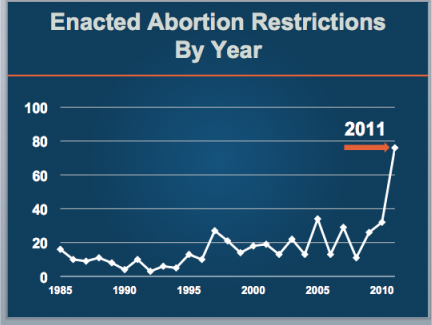
Legislative trends in the last 25 years:


dailykos.com/story/2011/06/24/988070/-Louisiana-adds-to-this-years-huge-spike-in-anti-abortion-legislation

These pro life laws had little to no support from Democrats.

Peer reviewed scholarly article in State Politics and Policy Quarterly which compiled data from Centers for Disease Control and Prevention (CDC) and the Guttmacher Institute from nearly every state between 1985 and 2005 has found pro life state laws has led to decline in the number of abortions:
*
The number of abortions that were performed consistently increased throughout the 1970s and the 1980s (Brener et al. 2002). However, between 1990 and 2005, the number of legal abortions declined by 22.22 percent (Gamble et al. 2008; Koonin, Smith, and Ramick 1993). A number of different reasons for this decline are possible. However, one factor that played a role was the increased amount of anti-abortion legislation that was passed at the state level. Indeed, the Supreme Court’s decisions in both Webster and Casey and the electoral success of anti-abortion candidates at the state level resulted in a substantial increase in the number of restrictions on abortion.
Code:
By 2005, more states had adopted parental involvement laws and informed consent requirements (NARAL 1992, 2005). A comprehensive series of regressions provides evidence that these laws are correlated with declines in in-state abortion rates and ratios. Furthermore, a series of natural experiments provides even more evidence about the effects of these restrictions on abortion. States where judges nullified anti-abortion legislation were compared to states where anti-abortion legislation went into effect.

The results indicate that enforced laws result in significantly larger in-state abortion declines than nullified laws. Other regression results indicated that various types of legislation had disparate and predictable effects on different subsets of the population. For instance, parental involvement laws have a large effect on the abortion rate for minors and virtually no effect on the abortion rate for adults. These results provide further evidence that anti-abortion legislation results in declines in the number of abortions that take place within the boundaries of a given state.*
spa.sagepub.com/content/11/1/28.full.pdf+html

2008 analysis found state parental involvement laws contributed to nearly 50% decline of abortions performed in minors between 1985 and 1999.
 
Also, if the abortionists ever put forward the "incest, rape, save the life of the mother, in the form of a bill, I think pro-lifers should be all over that, and accept that. Then keep moving forward. With life, it took a long time to get this fouled up, and it will take a long time to right itself. The rest of the world has pretty much given in. The U.S. is the last battleground. We must approach each battle with our eyes wide open, and take every small victory we can.
See, I think that making abortion illegal except for the case of incest, rape and to save the life of the mother would be something that the majoirty of people want. I do think that’s what the majority of people want. But then they read about how it will be a gateway to make it illegal in all cases, and that makes them resistant all over again. Reading about how the pro-lifers just want to throw them a bone in order to make it easier to get an all-out ban is going to make it less likely to happen. Plus, most staunch pro-lifers don’t want the exception in at all. So I think there will be a little bit of resistance on both sides.
 
From our President:
"As we mark the 39th anniversary of Roe v. Wade, we must remember that this Supreme Court decision not only protects a woman’s health and reproductive freedom, but also affirms a broader principle: that government should not intrude on private family matters,” Obama said. “I remain committed to protecting a woman’s right to choose and this fundamental constitutional right.

“While this is a sensitive and often divisive issue – no matter what our views, we must stay united in our determination to prevent unintended pregnancies, support pregnant woman and mothers, reduce the need for abortion, encourage healthy relationships, and promote adoption,” Obama said.

“And as we remember this historic anniversary, we must also continue our efforts to ensure that our daughters have the same rights, freedoms, and opportunities as our sons to fulfill their dreams.”

So fulfilling “our” dreams includes murdering anyone who gets in our way??? Makes one wonder who else could be on the list to “remove” as an obstacle to fulfilling ones dreams.

Holy Mary, Mother of God pray for us.
 
I never said it was entirely pastoral.
Slovakia is a mountainous country which has remained almost entirely pastoral.
I made neither such claim. I merely mentioned the former possibility as one of an almost unlimited number of factors which may cause variance in birth rates.
Which is precisely why my reasoning is based on comparing Poland against neighboring Central European countries, which are similar economically, socially, culturally and religiously (ceteris paribus). Main social and economic trends are the same accross the region and have been for the last 20 years if not more. The factor responsible for the discrepancy would has to be specific to Poland, i.e. not cause differences between other countries I used in the comparison (Czech Rep., Slovakia, Hungary). There is precisely one such factor, and it is the abortion law, which impacts how statistics is gathered.

What you are doing, is that you are asserting that discrepancy is due to some unaccounted for factor, but you are unable to name this factor. Sorry, the onus is on you to (1) name that factor, (2) present values of that factor for each country under comparison and (3) show how that factor impacts fertility rates. I’ve done my homework, so I’m waiting till you do yours. Numbers, please.
So if a crime becomes a widespread spocial problem, we should legallise it? And that will impriove matters how?
Regarding abortion, I like the German approach with mandatory counselling. Also, you may want to know that German Catholic Church provided such counseling and Church-affiliated advisors had the best results in turning the women away from abortion. In 1999 Vatican banned this 😦 .

In case abortion is illegal there is no counselling, because abortion providers are in it for the money (and there is a suitable risk premium…).

For a more general example while criminalization is not always the best answer, see this: en.wikipedia.org/wiki/Drug_policy_of_Portugal
Begging the question. You have been called upon to demonstrate this claim and have failed to do so. Simply re-stating the claim in other words is not evidence.
Fact one: a single abortion provider busted last year clandestinly performed at least 14% of officially reported abortions. That means that the official abortion statistics is unreliable. Or, more specifically, there is a vast abortion underground that does not enter official numbers.

Fact two: fertility rate is the same as similar neighboring countries, where abortion is legal and 10-30% of pregnancies are aborted. No other convincing explanation for the discrepancy. (Actually, I am being generous here. If you look at the data, the fact that Poland has both lower contraceptive use and lower fertility rate than Slovakia is a strong indicator that Poland has more abortions that Slovakia, if we assume that countries under comparison are similar enough.)

Fact three: official 2008 data: 1611 rapes, 1 (one) legal abortion under rape exception. From US data, a raped woman has ca. 5% chance for getting pregnant, and 50% of these choose to abort. Which means that Poland should be recording around 40 rape-related abortions per year. Even if we were to assume that Polish women are so pro-life that only a quarter of pregnant rape victims would request an abortion (instead of half), we still should have 20 reported abortions under this exception. Not happening.

Fact four: Thinly veiled ads for abortion services in newspapers.
I also wonder if you’ve thought about the implications of your claim.
Yes. Between 50 thousand (my estimate) and 200 thousand (estimate from Polish pro-choice groups) Polish children are killed each year, while both the government and the Church wave the official data and claim that the problem does not exist.

How’s that?
 
…If a woman wants to abort, she will abort, regardless of how many hurdles you throw in front of her.
This is a gross oversimplification. The range of women who “want” an abortion is very wide. At one extreme there are women who are 100% determined to abort and will risk everything to do it, including the chance of getting caught and the disapproval of her friends and society in general. At the other end of the spectrum are women who find themselves quite uncertain as to what to do. They feel that their pregnancy is inconvenient, or maybe they are just a little scared of being a mother. For these women it only takes the mildest form of encouragement from friends, family, or social norms of acceptable behavior to tip the scales in favor of keeping the baby. And between these two extremes are every sort of variation you can imagine. It is naive to think that all women, or even most women are like the first extreme. In fact it is much more reasonable to recognize that laws and social norms of proper behavior will in fact deter most women from deciding to follow through with an abortion.
 
Each abortion represents Church’s objective failure at teaching morality. Outlawing abortion is an attempt to outsource this job to the state, and a testament to Church’s ineffectiveness in this regard. The really bad situation happens when the Church cedes this responsibility to the state and the state is unable (or unwiling) to enforce the law.
 
I can’t link on this. Go to pub Ed.gov and search Impact of state restrictions on abortions.
Also you can do data searches for abortions in philipines, maternal death rate, and overall percentage then compare that to us rate. I believe there are actually more abortions in pi per capita and the medical complications run about 25 percent. Then you can look at law enforcement in countries with strong walls.
 
See, I think that making abortion illegal except for the case of incest, rape and to save the life of the mother would be something that the majoirty of people want. I do think that’s what the majority of people want. But then they read about how it will be a gateway to make it illegal in all cases, and that makes them resistant all over again. Reading about how the pro-lifers just want to throw them a bone in order to make it easier to get an all-out ban is going to make it less likely to happen. Plus, most staunch pro-lifers don’t want the exception in at all. So I think there will be a little bit of resistance on both sides.
Because the exceptions you list are loopholes big enough to drive a battleship through. All the abortionists do is ask the woman “will you be sad if you have this baby”? She says “yeah” and they check the “health of the mother” box (mental health counts, and if she is sad she is depressed). They will still kill disabled babies in the womb like they do now - 90% kill rate there already.

The biggest tragedy, we will see medical abortions continue and use of the abortion/morning after pill increase.
 
Slovakia is a mountainous country which has remained almost entirely pastoral.
Indeed. You omitted “almost”.
Which is precisely why my reasoning is based on comparing Poland against neighboring Central European countries, which are similar economically, socially, culturally and religiously (ceteris paribus). Main social and economic trends are the same accross the region and have been for the last 20 years if not more. The factor responsible for the discrepancy would has to be specific to Poland, i.e. not cause differences between other countries I used in the comparison (Czech Rep., Slovakia, Hungary). There is precisely one such factor, and it is the abortion law, which impacts how statistics is gathered.
What you are doing, is that you are asserting that discrepancy is due to some unaccounted for factor, but you are unable to name this factor. Sorry, the onus is on you to (1) name that factor, (2) present values of that factor for each country under comparison and (3) show how that factor impacts fertility rates. I’ve done my homework, so I’m waiting till you do yours. Numbers, please.
Sorry, that’s faulty reasoning. You have posited that there can be and must be only one reason for the lower birthrate, viz. unrecorded abortions. I have said there may be many other reasons. The onus is not on me to prove one of those possible reasons. The onus is on you to prove that all other possible reasons are in fact impossible. It is you, not I, who is making the claim that there can be only one possible reason. “He who asserts must prove” goes the maxim.

Note also the case of Ireland mentioned before. Despite the claim that Irishwomen wanting abortions simply go to England (or go to illegal abortionists) Ireland’s birth rate is significantyly higher than every other country in Europe.
Regarding abortion, I like the German approach with mandatory counselling. Also, you may want to know that German Catholic Church provided such counseling and Church-affiliated advisors had the best results in turning the women away from abortion. In 1999 Vatican banned this 😦 .
That is a preposterous distortion of what “the Vatican” did. The Holy See in fact strongly endorsed the idea that fact-based independent counselling be given to women seeking abortion. It objected only to Church agenvies being required to give a woman a formal medical referral to an abortionist for the purpose of abortion.
For a more general example while criminalization is not always the best answer, see this: en.wikipedia.org/wiki/Drug_policy_of_Portugal
(a) I never claimed that everything that’s immoral must be made illegal; and
(b) drug misuse IS still illegal in Portugal. All Portugal has done is to change the penalty regime it imposes to rehabilitate the criminals and prevent them returning to teh crime, in certain cases involving very minor offences. A very similar scheme (the “Drug Court” system has been in place ion Australia for many years.)
Fact three: official 2008 data: 1611 rapes, 1 (one) legal abortion under rape exception. From US data, a raped woman has ca. 5% chance for getting pregnant
Frankly this claim is preposterous.
Firstly, since the widespread DNA analysiss of evidence, nearly all rapists use condoms,
secondly ,most rape victims these days are taking hormaonal contraceptives
thirdly, rape is less likely than a normal consensual sexual congress to result in pregnancy, for a number of reasons - rape is badsically a crime of violence, many rapists do not even complete the act in the victim’s genital tract
fourthly, even if all of these factors were absent, the chance of pregnancy resulting from one random sexual act is less than 0.5%.
Yes. Between 50 thousand (my estimate) and 200 thousand (estimate from Polish pro-choice groups) Polish children are killed each year, while both the government and the Church wave the official data and claim that the problem does not exist.
How’s that?

So your recommendation is that all pro-life groups simply shut up shop because their efforts will never achieve anything?

I’m guessing that you have a vested interest in them doing so, since you refer to pro-abortion groups by the grossly dishonest weasel-word “pro-choice”.

I note you also ignored for example, Abysinnia’s post above showing that even pro-abortion groups admit, and publish statistics proving, that legal restrictions on abortion reduce the number of abortions.
 
Each abortion represents Church’s objective failure at teaching morality. Outlawing abortion is an attempt to outsource this job to the state, and a testament to Church’s ineffectiveness in this regard. The really bad situation happens when the Church cedes this responsibility to the state and the state is unable (or unwiling) to enforce the law.
So is it bad that people, including some Catholics, still commit rape and that the Church’s teaching that rape is gravely immoral, has “failed” and that the Church “outsources her job” to the State which has made rape a civil crime?

Sorry mate, you can’t just use this argument only for crimes which in your opinion are less serious or not crimes at all. If you apply it to one you must logically apply it to all.
 
Status
Not open for further replies.
Back
Top