About the washing of hands, sign of peace and communion bread

  • Thread starter Thread starter Loved_Disciple
  • Start date Start date
Status
Not open for further replies.
L

Loved_Disciple

Guest
Hello everybody. I have a few questions on my head. I’d appreciate any help I can receive to clarify them.

I’ve been wondering why there’s no washing of the hands at the Divine Liturgies I’ve been to. I wonder if none of the Eastern Churches have it as part of their celebration. (I understand that our Lord washed his hands as it is a Jewish liturgical tradition for Passover.) Same goes for the sign of peace between the faithful (which I understand is precisely that, a sign of being in peace with everyone, not necessarily a gesture that occurred at the Last Supper).

I also wonder two things about the Eucharistic bread:
  • Have Eastern Catholics always been allowed to use leavened bread for their DL? (I’m pretty sure I’ve had it at many DL’s I’ve been to.)
  • How would one answer the argument that Catholic hosts (particularly the ones used on the Roman rite) aren’t “valid” supposedly because the bread that Jesus used on the Last Supper had oil and I don’t know what other ingredients, not just wheat flour and water, as our hosts? And what about the argument that Jesus gave broken bread, not individual pieces, like the ones we get at the Roman rite?
Thanks so much in advance,

Juan
 
The thing about Divine Liturgy is that its only the major part of the entire Eucharistic celebration in the Eastern Rites during a Sunday. Everything really begins with Vespers the previous evening when preparation for the Eucharist begins with prayers and spiritual preparation. Before the start of the Divine Liturgy is a short ritual called the Proskomedia where the bread and wine are prepared. Unlike in the Roman Rite Mass where the gifts are offered during the Offertory and blessed right there in the middle of Mass, the Proskomedia is before Divine Liturgy and the gifts have been blessed by the start of the Divine Liturgy.

The East have used leavened bread from as long as anyone can remember. There is a claim that the Roman Church has used leavened bread as well earlier on.

There is no oil in the bread used in the Byzantine Rite. I make prosphoras for our parish and I just use wheat, water, salt and yeast. Oil is forbidden during Great Fasts such as Lent, so putting oil in bread that will be consecrated would violate that Fast.
 
The sign of peace is done at the Divine Liturgy but only among the clergy of equal levels. So if you do not have concelebrating priests or more than one deacon serving you will not see it. I believe this is how the sign of peace is in the EF Mass.

The washing of the hands does occur but only when there is a sub-deacon and I believe it is only the bishop who does it.
 
The sign of peace is done at the Divine Liturgy but only among the clergy of equal levels. So if you do not have concelebrating priests or more than one deacon serving you will not see it. I believe this is how the sign of peace is in the EF Mass.
I’ve seen the priest and the deacon give each other the sign of peace, yes, just not among us faithful.
The washing of the hands does occur but only when there is a sub-deacon and I believe it is only the bishop who does it.
I see. I thought it was just not part of their rite.

I guess it’s just part of their tradition.
 
I’ve seen the priest and the deacon give each other the sign of peace, yes, just not among us faithful.
It may vary from parish to parish, it is done among the faithful in our parish. It’s funny because or priest usually tells us to give one another the sign of peace. One time a visiting priest substituted for him and he didn’t tell the people to greet one another. He was at the altar ready to say his next prayers when he realized there was total silence behind him. He turned around and then he asked if they were waiting for him. Then he apologized and said in his parish people just go to giving one another the sign of peace without him telling them to. 😃
I see. I thought it was just not part of their rite.

I guess it’s just part of their tradition.
I’ve never seen it because we don’t have a subdeacon. Well, we had but he was always in the role of cantor as we also needed that one.
 
The thing about Divine Liturgy is that its only the major part of the entire Eucharistic celebration in the Eastern Rites during a Sunday. Everything really begins with Vespers the previous evening when preparation for the Eucharist begins with prayers and spiritual preparation. Before the start of the Divine Liturgy is a short ritual called the Proskomedia where the bread and wine are prepared. Unlike in the Roman Rite Mass where the gifts are offered during the Offertory and blessed right there in the middle of Mass, the Proskomedia is before Divine Liturgy and the gifts have been blessed by the start of the Divine Liturgy.

The East have used leavened bread from as long as anyone can remember. There is a claim that the Roman Church has used leavened bread as well earlier on.

There is no oil in the bread used in the Byzantine Rite. I make prosphoras for our parish and I just use wheat, water, salt and yeast. Oil is forbidden during Great Fasts such as Lent, so putting oil in bread that will be consecrated would violate that Fast.
I see. The reason I brought up the “communion bread formula” is that a Pastor of the “Church” (sect really) of the “Light of the World” claimed that we ought to use the same kind of bread that Jesus, as a Jew, used himself. I never heard this kind of argument before.
 
I see. The reason I brought up the “communion bread formula” is that a Pastor of the “Church” (sect really) of the “Light of the World” claimed that we ought to use the same kind of bread that Jesus, as a Jew, used himself. I never heard this kind of argument before.
It depends on if the Last Supper was the Passover meal or not.

If it was then unleavened bread was used, if it was not then leavened bread was used.

The Gospels are not clear on whether or not the Last Supper was the Passover meal, the synoptic Gospels (Matthew, Mark, and Luke) have it as the Passover meal but John has the Last Supper occurring before the Passover meal.
 
I see. The reason I brought up the “communion bread formula” is that a Pastor of the “Church” (sect really) of the “Light of the World” claimed that we ought to use the same kind of bread that Jesus, as a Jew, used himself. I never heard this kind of argument before.
I believe that what we have today is what has been handed down from the Apostles themselves. Why should we do otherwise? There is no greater proof of the past than following the traditions that has been kept since then. Making guesses about whats in the bread Jesus used is just that, a guess.
 
It depends on if the Last Supper was the Passover meal or not.

If it was then unleavened bread was used, if it was not then leavened bread was used.

The Gospels are not clear on whether or not the Last Supper was the Passover meal, the synoptic Gospels (Matthew, Mark, and Luke) have it as the Passover meal but John has the Last Supper occurring before the Passover meal.
As far as I’m concerned the Jewish Passover is a liturgical celebration in which a normal meal is also had in the midst of it. I went to one (well, to a sort of a Protestant version of Judaism, with a female Rabbi presiding) and was myself a witness to that.
I believe that what we have today is what has been handed down from the Apostles themselves. Why should we do otherwise? There is no greater proof of the past than following the traditions that has been kept since then. Making guesses about whats in the bread Jesus used is just that, a guess.
He could probably argue that what the Jews use today (the matzah) is the same as what they’ve been using for the past thousands of years. But apparently they use exactly just wheat flour and water, like our bread.

I mean, I know it’s a fallible man’s word against the Tradition and Magisterium of the Church, but it’s always good to refute their arguments as far down as to the roots as possible.
 
I mean, I know it’s a fallible man’s word against the Tradition and Magisterium of the Church, but it’s always good to refute their arguments as far down as to the roots as possible.
Thats a tough argument because if you ask any Jew, what they do today has evolved from what they did 2000 years ago. Very similar on how many traditions of the Church evolve over time. Since the Eucharist is very sacred to us, I doubt that we would have allowed any changes to the recipe of the bread from what it was 2000 years ago.
 
In our Byzantine Church, the congregation is involved in the right of peace. The little entrance and great entrance have the priest and attendants process around the interior of the church. Before the Divine liturgy all the icons around the interior of the church are incensed. After the gospel, each of the laity come forward to kiss the gospel book. I believe that those Eastern Churches that do not involve the laity in the right of peace or shorten the the little and great entrances are omitting some of the beauty of the Divine liturgy and are almost as inactive as the Roman mass. In the Roman Church, at least, the congregation participate in the rite of peace.
 
As far as I’m concerned the Jewish Passover is a liturgical celebration in which a normal meal is also had in the midst of it.
Well, yes it’s a meal but no, it’s not exactly “normal” in the sense that there are certain things which are prescribed and others that are proscribed for Passover.
I went to one (well, to a sort of a Protestant version of Judaism, with a female Rabbi presiding) and was myself a witness to that.
At her house?
He could probably argue that what the Jews use today (the matzah) is the same as what they’ve been using for the past thousands of years. But apparently they use exactly just wheat flour and water, like our bread.
Matzoh (or, massa, in the mizrahi way) is indeed flour and water and is only used for Passover. Standard bread, eaten the rest of the year, includes yeast and perhaps a pinch of salt.

In any case, the Armenians (including the Orthodox) use unleavened altar bread. So, too, the Chaldeans and the ACoE. Among the others in union with Rome, the Maronites and Syro-Malabars both use unleavened bread, although historically that was not always the case for the Maronites. The remaining Eastern and Oriental Churches (Byzantine, Syriac, and Alexandrene) use leavened bread.
 
The rubrics direct the priest to wash his hands after he has put on all his priestly vestments - this would not normally be seen because it occurs within the altar, behind the ikonostas.
 
As far as I’m concerned the Jewish Passover is a liturgical celebration in which a normal meal is also had in the midst of it. I went to one (well, to a sort of a Protestant version of Judaism, with a female Rabbi presiding) and was myself a witness to that.

He could probably argue that what the Jews use today (the matzah) is the same as what they’ve been using for the past thousands of years. But apparently they use exactly just wheat flour and water, like our bread.

I mean, I know it’s a fallible man’s word against the Tradition and Magisterium of the Church, but it’s always good to refute their arguments as far down as to the roots as possible.
The Jews use matzah for the passover meal. As I said it is unclear from scripture sources alone whether or not the last supper was the passover meal or not.
 
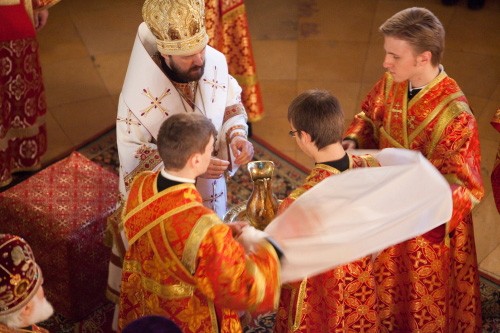
WASHING HANDS

Washing of hands occurs during Proskomidiya at the Zhertvennik table by priests. But at an Archpriestly liturgy also occurs specially during liturgy. Here is photograph of such hand washing by Metropolit Ilarion Volokolamskiy:


What is called Kiss of Peace is called the Trinity kiss (трикратное лобзание) between Church Servers. Here is such Kiss

 
I have only seen the passing of the peace amongst the laity when I visited the local Assyrian-Chaldean Catholic. There it went from the altar passed by the deacon row by row to the laity in pews.

Russian and Greek Orthodox, and the Melkite I have only witnessed locally. There I’ve only seen the peace shared between the priests, “only among the clergy of equal levels” as ByzCath referred to it, which is also what happens in my EC parish. (Now I’m wondering if I saw the bishop and the priest exchange at the Melkite…)
 
I have only seen the passing of the peace amongst the laity when I visited the local Assyrian-Chaldean Catholic. There it went from the altar passed by the deacon row by row to the laity in pews.
FYI the Maronite and, I believe the Syriac, custom is quite the same as the Chaldean. In general, the sign of piece is given to the deacon who then passes it to the altar server(s) who in turn pass it to the congregation, row by row. If there is no deacon (or subdeacon), the celebrant or a concelebrant (if present) passes it to the server(s).
 
I have only seen the passing of the peace amongst the laity when I visited the local Assyrian-Chaldean Catholic. There it went from the altar passed by the deacon row by row to the laity in pews.

Russian and Greek Orthodox, and the Melkite I have only witnessed locally. There I’ve only seen the peace shared between the priests, “only among the clergy of equal levels” as ByzCath referred to it, which is also what happens in my EC parish. (Now I’m wondering if I saw the bishop and the priest exchange at the Melkite…)
.
The Sign of peace is standard among all the churches of the Oriental Tradition. It is a sign of the peace of Christ being given to the Church, and passes first from the altar to the congregation. The Armenians have the most personable sign, involving a kiss on the cheek. The Coptic Tradition involves passing on the sign in clasped hands as if in the form of prayer. I’ve seen it done in various parishes either preceded by a kiss from lips to the hands, or without the preceding kiss (much akin to a simple handshake). Brother Malphono has already testified to the Syrian Tradition (which is also carried on by the Indian Churches).

Interestingly, I have seen in Latin parishes the priest himself come down to the congregation, and I find it beautiful. Of course, ultra-traditionalists (seemingly unaware that the sign of peace was an ancient tradition of the Latin Church) complain vehemently that this is just a sign of modernism. I propose these folks know not of what they speak.

Blessings,
Marduk
 
Status
Not open for further replies.
Back
Top