D
Don_Ruggero
Guest
No, actually. It isn’t.Absolutely! The rail is so much simpler!

No, actually. It isn’t.Absolutely! The rail is so much simpler!
I think alter rails make sense all around. They reinforce a sense of reverence, they help to humble the communicant, they also prevent the bumper cars scenario where people are coming from all sides of the church attempting to form a single file. I think they’d also be great at getting rid of EMHCs. Just the logistics of it would make it so they would no longer be needed.My issue comes with unnecessary usage of EMHC (if they are supposed to be EXTRAOrdinary, why are they an Ordinary fixture at every single Mass?) and also with people wantonly receiving Communion without prior Confession.
I like altar rails in Churches even if they are not used for Communion.Spyridon:
I think alter rails make sense all around. They reinforce a sense of reverence, they are help to humble the communicant, they also prevent the bumper cars scenario where people are coming from all sides of the church attempting to form a single file. I think they’d also be great at getting rid of EMHCs. Just the logistics of it would make it so they would no longer be needed.My issue comes with unnecessary usage of EMHC (if they are supposed to be EXTRAOrdinary, why are they an Ordinary fixture at every single Mass?) and also with people wantonly receiving Communion without prior Confession.
The fact that I have been a priest who, when young, experienced the norm to be the use of a rail – across the decades to today when the norm is that communicants are standing.what makes you say that?
Extraordinary Ministers have been among the greatest gifts that I have seen in the years of my priesthood. I have looked for ways to expand them – NEVER to “get rid of them.”I think they’d also be great at getting rid of EMHCs. Just the logistics of it would make it so they would no longer be needed.
They are extraordinary because they lack the ontological character of Order. They are not extraordinary because they are to be rarely used. Indeed, in many places where I am Presider, the extraordinary ministers FAR outnumber the, often sole, ordinary minister.My issue comes with unnecessary usage of EMHC (if they are supposed to be EXTRAOrdinary, why are they an Ordinary fixture at every single Mass?)
 wdtprs.com
How about an effective effort for the NEW EVANGELIZATION?
ACTION ITEMS for 2018
Work to diminish Communion in the hand
Promote kneeling for Communion
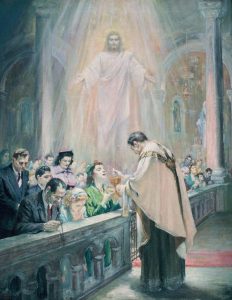
Install altar rails
Implement ad orientem worship
These four things would revolutionize… revitalize… a parish.
And… TLM!
Meanwhile….
GO TO CONFESSION!
What do you see as the main benefit of the EM’s? Logistical benefits? Or not really that so much, but the fact the the EM ministry gets the faithful more involved in the liturgy?Extraordinary Ministers have been among the greatest gifts that I have seen in the years of my priesthood. I have looked for ways to expand them
Yeah, I’m pretty sure the old man with the peg leg in my parish wasn’t forced to kneel to receive back in the old days. I’ve seen no problem with people receiving from the chalice at the local Anglican parish. Every time someone mentions altar rails it seems like we have this litany of reasons why they couldn’t possibly work.Yes, absolutely. Those who cannot kneel can also go to the rail but can stand at that spot rather than kneel. Surely back in the days when altar rails were the norm everywhere, there must also have been a number of people who could not kneel. I’m sure it’s not a new problem. It’s the same thing even now with the parts of Mass where the congregation kneels. No one expects those who cannot kneel to do so.
At the Trad parish that I attend, we have an alter rail and the celebrant alone administers the Eucharist to the entire congregation (about 50 in all). The problem is that these Eucharistic Ministers are said to be extraordinary, yet there isn’t anything extraordinary about them. They’re at nearly every OF mass. There is simply no need to have an average of 4 EMHCs (which is about what I see in my diocese), not including the priest, for a congregation of less than 50.Extraordinary Ministers have been among the greatest gifts that I have seen in the years of my priesthood. I have looked for ways to expand them – NEVER to “get rid of them.”
Every church in my diocese removed the altar rails after Vatican II. I think in the past 50 years I could count on ten fingers the number of churches with altar rails that I’ve been to (and I’ve lived and attended Mass in 8 different provinces) and amid those would be a few Anglican churches. I won’t include in that the 5 in Europe that are major tourist destinations.When you say “got rid of the alter rail”, do you mean physically removed or don’t use?
I’m aware that some churches are built without them and some churches removed them, but nearly all churches I’ve been in over the course of my life have altar rails.