
B
bben15
Guest
Hi. I posted this last night, but it is not on the sub-forum. I apologize to the moderator if this was deleted purposefully, but please tell me so I do not post this again.
In the Middle Ages, an aumbry was often used to store the Eucharist, as well as other vessels. I read that it is cabinet connected to the wall, and its use is now forbidden.
I read that the Eucharist can only be stored in a tabernacle, but there are tabernacles in sacristies that look like cabinets. Plus, they are connected to a larger cabinet that holds vestments and other vessels, and it is connected to the wall (like the one pictured below).
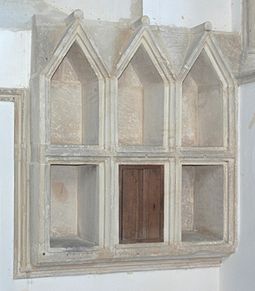
What exactly is the difference between an aumbry and a tabernacle, and why are aumbries forbidden today? On the top is a picture of an aumbry in a cathedral built in the Middle Ages.
God bless you for answering my question.
In the Middle Ages, an aumbry was often used to store the Eucharist, as well as other vessels. I read that it is cabinet connected to the wall, and its use is now forbidden.
I read that the Eucharist can only be stored in a tabernacle, but there are tabernacles in sacristies that look like cabinets. Plus, they are connected to a larger cabinet that holds vestments and other vessels, and it is connected to the wall (like the one pictured below).
What exactly is the difference between an aumbry and a tabernacle, and why are aumbries forbidden today? On the top is a picture of an aumbry in a cathedral built in the Middle Ages.
God bless you for answering my question.
