They aren’t really.
Well, technically speaking, Abraham - one of the first biblical personages one could attempt to pin a credible date to - is supposed to have lived somewhere during the 2100-1800 BC, just about the same time
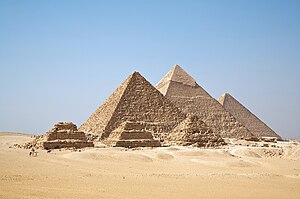
as the end of the First Intermediate Period (2181-2055 BC) and the beginning of the Middle Kingdom of Egypt (ca. 2055 BC-1650 BC). The pyramids were built much earlier,
during the period of the Old Kingdom (2686-2181 BC). And the Egyptians made mummies well up to the Roman period.
P.S. There was no single, universal time the ‘Bronze Age’ or the ‘Iron Age’ started or lasted, since it happened differently for different cultures. (For the record, those names denote the time when a given culture either started using bronze instead of stone, and then iron instead of bronze, tools and weapons, or the time when bronze or iron was first introduced.) Though there is a rough average: for the Middle East (Mesopotamia, the Levant, Anatolia, including Egypt) the Bronze Age lasted approximately for 3300-1200 BC. For Europe and China, on the other hand, it lasted much longer (well into the 700s-600s BC). Korea had a rather late Bronze Age (900 BC-800 BC). In Japan, there was no ‘Bronze Age’ distinct from ‘Iron Age’, since bronze and iron were introduced at the same time (300 BC-AD 300). In America, the Moche people in Peru (AD 100-700) discovered bronze independently from Europe. For most of Africa, the traditional view was that there was no continent-wide universal Bronze Age; in many areas iron succeeded immediately the use of stone.

 I find it miraculous that so many of these things haven’t long ago disintegrated. I wonder how they are able to preserve, even the pyramids, or ruins of temples and walls in the Holy Land.