E
Eric_Hilbert
Guest
**Stick with the topic and stop the bickering. **

It seems to me you are under the impression that I have not read anything from a non-Catholic authored Reformed perspective, as if in doing so I would not be asking the questions that I am. Why is that?You really should read something from a Reformed perspective. And I don’t mean something a Catholic has written about what the Reformed believe.
So…would you call these protestant bible commentators, that disagree with you…full of royal steward siliness too?Did you write that royal steward silliness too?
Acts 15:1-11 describes a Jerusalem council that dealt with the question of circumcision. In verses 7-11, Peter spoke… and in verse 12, “the whole assembly fell silent”. In other words, debate over.If I recall correctly James spoke last, not Peter. Nobody called him the Supreme Leader. Most of this is eisegetical.
Presbyterians don’t even agree with each other, much less with other Protestants, as evidenced by this Wikipedia chart:This is the job of the Holy Spirit.
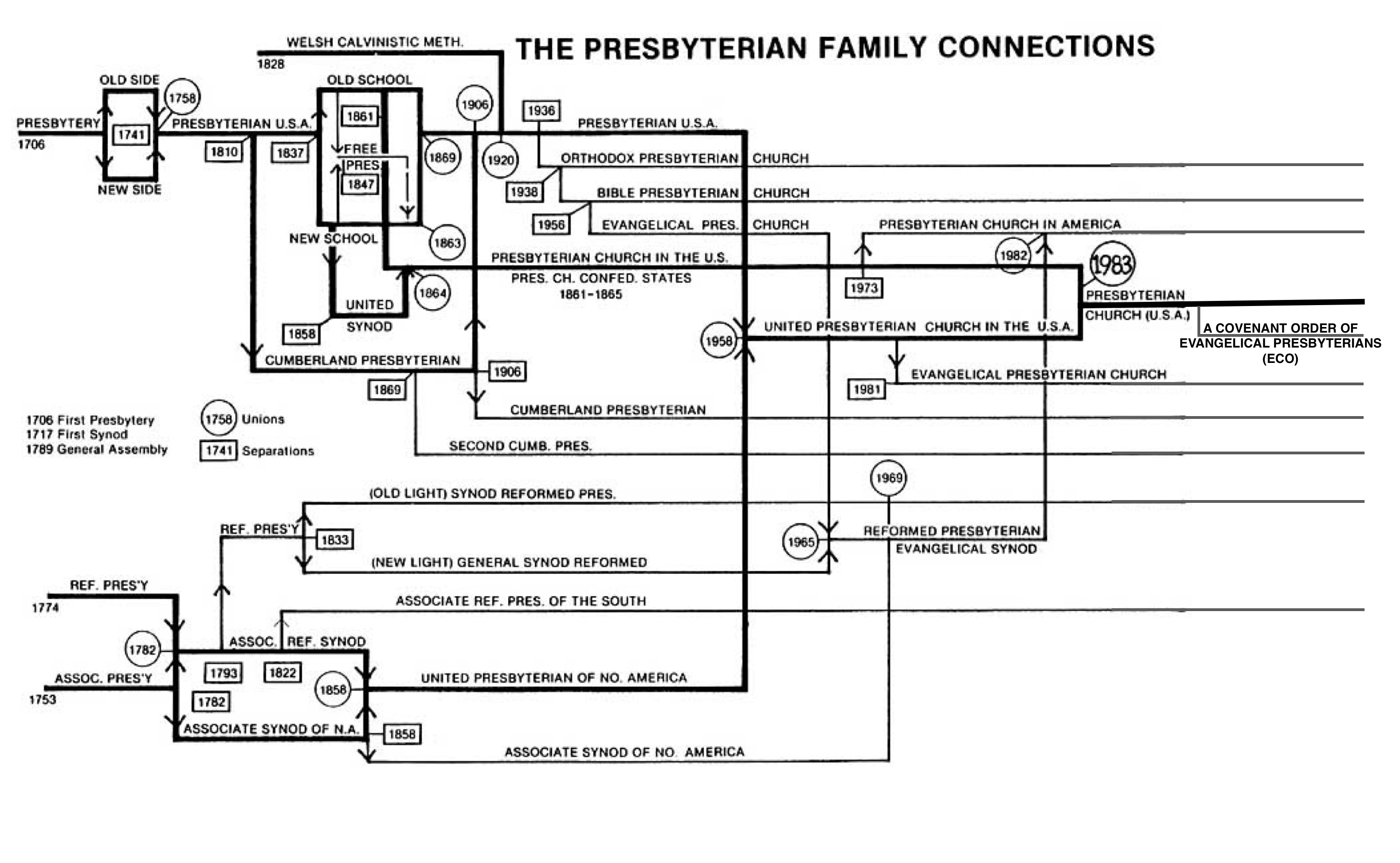
Thanks for taking the time to present it the way you did, very well done. As many times as we need to demonstrate our faith that was handed on from the Apostles, we “must” do it. Paul pleaded from his heart with the early believers for unity: 1 Cor. 1:10.Presbyterians don’t even agree with each other, much less with other Protestants, as evidenced by this Wikipedia chart:
http://upload.wikimedia.org/wikipedia/commons/3/32/Presbyterian_Family_Connections.jpg
There are currently nine branches of Presbyterianism in the USA (judging from the number of lines that extend to the right side of the above chart). Would it be fair to say that at least eight of these branches have wandered away from the Westminster Confession to a certain extent? And that the ninth branch (assume for the moment it’s the “Evangelical Presbyterian Church” branch) is the only one that’s “got everything right”? And what about the fact that the ninth branch (whichever one it is) differs from Catholicism, Orthodoxy, Lutheranism, Anglicanism, and for that matter all the rest of the branches that consider the Reformed church as their historical foundation?
If one takes “This is the job of the Holy Spirit” to mean that anyone asking for a proper interpretation will receive one from God—and that is exactly how most Protestants understand the assistance of the Holy Spirit to work—then the multiplicity of interpretations, even among Protestants, should give people a gnawing suspicion that the Holy Spirit has not been doing his job very well.
Did the Apostles teach different things to different people? Of course not. The Apostles all taught the same doctrines…ALL the same doctrines. After all, Jesus tells us that the Holy Spirit was to guide them into all truth. If they are guided into all truth, then they cannot help but teach identical doctrines…they cannot help but teach the same truths…to all the different peoples they came across. From 1 Cor 11:18-19, it is obvious that there were those among the Corinthians who believed different doctrines. Who taught them these different doctrines, the Apostles? I don’t think so.
In fact, Jesus and the Apostles demanded conformity to the doctrines they taught. Paul to Titus, speaking of those who are bishops, wrote that they should “Give instruction in sound doctrine and also to confute those who contradict it,” (Titus 1:9). “Teach what befits sound doctrine,” (Titus 2:1). “Guard the truth that has been entrusted to you by the Holy Spirit,” (2 Tim 1:14). “That you may charge certain persons not to teach ANY different doctrine,” (1 Tim 1:3) - no mention here that it’s okay to teach different doctrine, as long as it is “non-essential.” Conformity to doctrine is commanded in all of these instances by Paul. And we know that Paul is inspired by the Holy Spirit Who was sent by Jesus, so Jesus, as did the Apostles, does indeed demand conformity to the doctrines He taught.
So… why is it that Catholics (and Orthodox, for that matter) teach that Mary is the Mother of God, the Ark of the New Covenant, the Queen of Heaven, the New Eve, Most Holy, Ever-Virgin, etc, and **pastors of today’s thousands upon thousands of Protestant denominations teach different doctrines one from another? Why is it okay to not have doctrinal conformity amongst the various denominations? How can anyone think that the lack of doctrinal conformity could in any way be of God? **
In 1 Tim 4:1, Paul even states that there will be those who fall away from the faith by believing false doctrines. The Church was founded by Jesus Christ. It teaches the truth and nothing but the truth, unless one believes that the true Body of Christ can teach error. Also, Scripture tells us Satan is the father of all lies. So, if there is false doctrine, that doctrine is the spawn of Satan, and believing something that is of Satan would never meet with the approval of the Apostles and other leaders of the early Church.
While that might be – and in my mind is – true when we think about many of the so-called free churches, it is not (necessarily) true of the historical Churches. My Church, the Church of Norway, has had a visible structure since it was founded over a period of some 30-50 years, from when Olaf Tryggvason brought Christianity to the realm* until the years following the martyrdom of St. Olaf and the erection of the Archdiocese of Nidaros. The question is: Can a Church reform itself without ceasing to be visible, and can a Church cut its ties to the Papacy and still be Catholic? As a Greek Orthodox Christian I cannot imagine you thinking otherwise.The problem could be stated another way, can those churches which claim an inheritance in the fathers: Apostles, Apostolic fathers, Nicene and everyone after, can they really be the inheritors of the Christian faith in its fullness if they fundamentally disagree with the concept of church which was promulgated? That is Protestants, every one of them without exception (in my opinion), have to rely on an invisible church construct or else suggest the true believers were completely hidden and only appeared when their church came about. This is why I think apostolic succession means little to the protestant, what counts is the invisible church, that is the faith which is passed down which effects the individual and not so much the outward status of the community.
Well, the Lutheran position is not that anyone can claim to be a true Church, but that the one true Church is, in the words of art. VIIConfessio Augustana, “the congregation of saints, in which the Gospel is rightly taught and the Sacraments are rightly administered.”Perhaps Lutherans and Anglicans might jump in here and say they do not agree with this. It seems to me based on what I have heard Lutherans say, that they do not identify the Lutheran church as the one true church, rather the church is wherever the Sacrament and word are rightly distributed, which could be any church. This still seems a far cry from the church before the reformation, who even called those whom denied what we would see as minor things, heretics and cut off from the church.
Then I would have to disappoint you. If we should follow your demands, no one could ever claim succession, thanks in part to Napoleon Bonaparte.In my mind at least, AS as we Catholics see it, must be proveable by accurate historical records starting with the twelve Apostles and continuing in an unbroken line until this very day.
Rubbish.Then I would have to disappoint you. If we should follow your demands, no one could ever claim succession, thanks in part to Napoleon Bonaparte.
You deny the power of God with comments like this, do you think for a minute that Napoleon Bonaparte could foil the plan of God to accomplish what He set out to do? Like Randy Carson said, “rubbish”.Then I would have to disappoint you. If we should follow your demands, no one could ever claim succession, thanks in part to Napoleon Bonaparte.
Very good research here. I’ve always felt the the primary reason that apostolic succession was rebutted during the Reformation is one of authority recognition. Once the reformers split with Church, they simply HAD to deny that succession, otherwise the link to Peter and his being the head of Church could not be negated.It is both, actually, it starts in the OT:
Numbers 27:
18 So the LORD said to Moses, “Take Joshua son of Nun, a man in whom is the spirit of leadership,[a] and lay your hand on him. 19 Have him stand before Eleazar the priest and the entire assembly and commission him in their presence…………22 Moses did as the LORD commanded him. He took Joshua and had him stand before Eleazar the priest and the whole assembly. 23 Then he laid his hands on him and commissioned him, as the LORD instructed through Moses.
The example of St. Paul, before his first missionary journey:
at Acts 13:
1 Now in the church at Antioch there were prophets and teachers: Barnabas, Simeon called Niger, Lucius of Cyrene, Manaen (who had been brought up with Herod the tetrarch) and Saul. 2 While they were worshiping the Lord and fasting, the Holy Spirit said, “Set apart for me Barnabas and Saul for the work to which I have called them.” 3 So after they had fasted and prayed, they placed their hands on them and sent them off.
And then Paul telling Titus to to do the same thing:
In Titus 1:5, Paul tells Titus: “For this cause I left thee in Crete, that thou shouldst set in order the things that are wanting, and shouldst ordain priests in every city, as I also appointed thee.”
And then Clement of Rome:
earlychristianwritings.com/text/1clement-lightfoot.html
1Clem 42:4 So preaching everywhere in country and town, they appointed their firstfruits, when they had proved them by the Spirit, to be bishops and deacons unto them that should believe.
1Clem 44:2 For this cause therefore, having received complete foreknowledge, they appointed the aforesaid persons, and afterwards they provided a continuance, that if these should fall asleep, other approved men should succeed to their ministration.
Rubbish.
Bonaparte may have destroyed the written records, but he did not destroy the living witnesses - the Bishops themselves.
It would be nice to have documents, but they are not absolutely necessary in order for us to believe that there was no time in the past when
*]all of the Catholic bishops died simultaneously thus breaking the line of apostolic succession or that
*]“fake” bishops inserted themselves into the lineage of the Catholic Episcopacy so successfully that
A) no one noticed them doing this and that
B) they outnumbered the authentic bishops thus breaking the line of succession.
Well, when you are ready to reply to my post, and not a strawman, give me a word.You deny the power of God with comments like this, do you think for a minute that Napoleon Bonaparte could foil the plan of God to accomplish what He set out to do? Like Randy Carson said, “rubbish”.
Yes, and they also might say that the Catholic church hierarchy was always corrupt, but there were always true believers present in the church and even outside of it (invisible church), who found the opportunity to break away when the Reformation came to be. So to the first Protestant’s, Apostolic Succession, pre-Reformation, was really nothing but a long line of power hungry Catholic bishops.Once the reformers split with Church, they simply HAD to deny that succession, otherwise the link to Peter and his being the head of Church could not be negated.
Which is partly true, partly not.Yes, and they also might say that the Catholic church hierarchy was always corrupt, but there were always true believers present in the church and even outside of it (invisible church), who found the opportunity to break away when the Reformation came to be. So to the first Protestant’s, Apostolic Succession, pre-Reformation, was really nothing but a long line of power hungry Catholic bishops.
So the result of all this is that the Reformer’s didn’t continue a different branch of Apostolic Succession with their own Pope’s, but they started a whole new church which claimed Apostolic Succession was not biblical anymore, instituted sola scriptura, disposed of most the sacraments, and many other things were tossed out.
What part isn’t true?Which is partly true, partly not.
The Scandinavian Lutherans retained, and claimed, apostolic succession, the same way Orthodox do even though they don’t either have “their own Pope’s” except, perhaps, the Patriarchs (which are really Eastern equivalents of Archbishops).
Some individual Lutherans did reject succession, mostly in Germany, but many did not. It is not true, then, that all Lutherans rejected succession.What part isn’t true?
This thread is an excellent example of man setting the rules via Tradition as the Church grew. Using Scripture as a foundation, the early church fathers …generation by generation…decided how the organization was to be run. Much of that process was biased when the Roman Empire set the Catholic Church up as the primary State Church.Some individual Lutherans did reject succession, mostly in Germany, but many did not. It is not true, then, that all Lutherans rejected succession.
You are correct on one level, but read on:Growing up Protestant I new I could always take my sin straight to Jesus as he is “the only mediator between God and man” I Timothy 2:5. So while I see AS in that the early church and the apostles received training and the right to teach and in the case of the apostles the binding and loosing I am struggling with the notion that if I confess my sins to the local priest he has the right or the power to forgive them. I could confess my sins to the Lord and he is faithful and just to forgive me of them and to cleanse me from all unrighteousness" (I John 1:9). So I see AS in some ways but the power to forgive is one that puts things into a different level.