
April 25th: Study and Meditations For Good Shepherd Sunday

  • Thread starter Thread starter Fidelis
  • Start date Start date
Status
Not open for further replies.
F

Fidelis

Guest
To help you prepare for this coming Sunday, here are the readings and reflections for this coming Sunday’s Scripture readings. This Sunday is the 4th Sunday of Easter, popularly known as “Good Shepherd Sunday.”

Here are the Scripture readings from the U.S. Catholic bishops website.

My own weekly study (along with Don Schwager’s meditation) can be found here under "Current Study.

Reflections on the Sunday Scriptures to share with the younger ones in your family by Emily and Jeff Cavins can be found at Family Night .

Here also are links to audio reflections on the Gospel reading by Dr. Scott Hahn and Fr. Robert Barron.

The Navarre Bible Commentary for each reading can be viewed here.

Further study resources for the Readings: St. Charles Borromeo Bible Study can be found here, and *Catholic Matters *can be found here.

Here are a trio of recorded weekly Catholic Bible studies on the readings, each about an hour long:
– Franciscan Sisters Sunday Scripture Study
– St. Martha Catholic Church Adult Faith Formation
– Sunday Gospel Scripture Study.

Discussion and charitable comments are always welcome. Have a blessed and joyful Easter Season!

http://www.bridgebuilding.com/images/mi570x.jpg
 
Reading 1
Acts 13:14, 43-52
Paul and Barnabas continued on from Perga and reached Antioch in Pisidia. On the sabbath they entered the synagogue and took their seats.
Many Jews and worshipers who were converts to Judaism followed Paul and Barnabas, who spoke to them and urged them to remain faithful to the grace of God.

On the following sabbath almost the whole city gathered to hear the word of the Lord.
When the Jews saw the crowds, they were filled with jealousy and with violent abuse contradicted what Paul said. Both Paul and Barnabas spoke out boldly and said, “It was necessary that the word of God be spoken to you first, but since you reject it and condemn yourselves as unworthy of eternal life, we now turn to the Gentiles. For so the Lord has commanded us,
I have made you a light to the Gentiles,
that you may be an instrument of salvation
to the ends of the earth.”


The Gentiles were delighted when they heard this and glorified the word of the Lord. All who were destined for eternal life came to believe, and the word of the Lord continued to spread through the whole region.
The Jews, however, incited the women of prominence who were worshipers and the leading men of the city, stirred up a persecution against Paul and Barnabas, and expelled them from their territory. So they shook the dust from their feet in protest against them, and went to Iconium.
The disciples were filled with joy and the Holy Spirit.
 
Reading 1
Acts 13:14, 43-52


• This Sunday’s First Reading related the experience of the Apostles Paul and Barnabas in the city of Antioch of Pisidia.
• St. Paul traveled more widely than the other disciples, undertaking three missionary journeys, each more extensive than the previous one, then a final journey to Rome to join Peter.
• The First Reading is from St. Paul’s first missionary journey. See map here. (click on map for larger image)

**14
They [Paul and Barnabas] continued on from Perga and reached Antioch in Pisidia. On the sabbath they entered (into) the synagogue and took their seats. **

• Perga was a city on the southern coast of Asia Minor (modern day Turkey). Antioch in Pisidia (not to be confused with Antioch in Syria) was an inland city in the Roman province of Galatia. It was founded by Greeks in the early third century, B.C.
• Most large cities in the Roman Empire with a sizable Jewish population had a synagogue where Jews could meet on the Sabbath. When arriving at a new town on his missionary journeys, the synagogue was the first place Paul would go to preach.
• The first Christians, who were Jewish, continued to attend the synagogue on the Jewish Sabbath, later on meeting in their homes to celebrate the Eucharist. The Synagogue service was comprised of prayers, scripture reading, the singing of psalms and a short homily on the Scriptures—much like the first part of the Catholic Mass, the Liturgy of the Word.
• Sometimes, visiting rabbis would be allowed to preach on the Scripture: St. Paul apparently availed himself of this opportunity on this occasion.

<<< Omitted from this reading are verses 15—43a, Paul’s sermon in the synagogue at Antioch >>>

**43
After the congregation had dispersed, many Jews and worshipers who were converts to Judaism followed Paul and Barnabas, who spoke to them and urged them to remain faithful to the grace of God. **

• Worshippers who were converts to Judaism— (literally, “God-fearers and proselytes”) Gentiles who were attracted to Judaism through Jewish missionary activity, but may or may not have gone already submitted to circumcision.
• In his sermon, Paul spoke about Jesus as the promised Messiah, raised from the dead.
• Remain faithful to the grace of God—His hearers were so moved, they invited him to come speak the following week.

44
On the following sabbath almost the whole city gathered to hear the word of the Lord.


• Mostly everyone in the crowd would be Greeks—non-Jews.

**45
When the Jews saw the crowds, they were filled with jealousy and with violent abuse contradicted what Paul said. **

• When Paul spoke to the Jews the previous week in the synagogue (the omitted verses) they asked him to come back. Now that the Gentiles are coming in crowds, they are not so welcoming.
• From this point on, Paul’s reception in the synagogue will be like this. The only exception will be in Beroea (cf. 17:10-12).

Continued on the next post…
 
46
Both Paul and Barnabas spoke out boldly and said, "It was necessary that the word of God be spoken to you first, but since you reject it and condemn yourselves as unworthy of eternal life, we now turn to the Gentiles.


• Spoken to you first—the Jews is meant.
• Since you reject it— “He who hears you hears me, and he who rejects you rejects me, and he who rejects me rejects him who sent me.” (Luke 10:16)
• Not that the Apostles will abandon the Jews (in the very next episode, starting at 14:1, he is again preaching in the synagogue); only that from now on the focus also will be on preaching the Kingdom of God to the nations. This seems to be Paul’s strategy: to make the Jews jealousy work toward bringing them into the Church. See Romans 11:11-12.
**46. **Paul may have been hoping that Christianity would flourish on the soil of Judaism, that the Jews would peacefully and religiously accept the Gospel as the natural development of God’s plans. His experience proved otherwise: he encountered the terrible mystery of the infidelity of most of the chosen people, his own people.
Even if Israel had been faithful to God’s promises, it would still have been necessary to preach the Gospel to the Gentiles. The evangelization of the pagan world is not a consequence of Jewish rejection of the Word; it is required by the universal character of Christianity. To all men Christianity is the only channel of saving grace; it perfects the Law of Moses and reaches out beyond the ethnic and geographical frontiers of Judaism. Navarre Bible Commentary]
**47
For so the Lord has commanded us, ‘I have made you a light to the Gentiles, that you may be an instrument of salvation to the ends of the earth.’" **

• A quotation from the Septuagint (Greek Old Testament), Isaiah 49:6. Part of a “Servant Song,” originally applied to Israel in their intended role to bring God to the nations, it is in its fullness applied to Christ in Luke 2:32. Used here it is associating Paul with the Servant of Yahweh who preaches good news to the Gentiles (the nations).
47. Paul and Barnabas quote Isaiah 49:6 in support of their decision to preach to the Gentiles. The Isaiah text referred to Christ, as Luke 3:32 confirms. But now Paul and Barnabas apply it to themselves because the Messiah is “light for the Gentiles” through the preaching of the Apostles, for they are conscious of speaking in Christ’s name and on His authority. Therefore, probably here “the Lord” refers not to God the Father but to Christ. Navarre Bible]
**48
The Gentiles were delighted when they heard this and glorified the word of the Lord. All who were destined for eternal life came to believe, **

• All who were destined for eternal life—Not to be understood in the erroneous Calvinist sense of pre-destination removed from human free will but, as St. Thomas Aquinas taught, “The disposition of God, by which he prepares, what he will himself perform, according to his infallible foreknowledge.”

**49
and the word of the Lord continued to spread through the whole region. **[50] **The Jews, however, incited the women of prominence who were worshipers and the leading men of the city, stirred up a persecution against Paul and Barnabas, and expelled them from their territory. **

• Pagan women who had sympathies to Judaism (mentioned in verse 43) and Gentile men who were influential in the city. They would be more effective than the Jews in stirring up persecution.
• *“Blessed are you when men revile you and persecute you and utter all kinds of evil against you falsely on my account. Rejoice and be glad, for your reward is great in heaven, for so men persecuted the prophets who were before you.” *(Matthew 5:11-12). One of the rewards of discipleship is persecution (Mark 10:30). The message of Christ is coming through.

51
So they shook the dust from their feet in protest against them and went to Iconium.


• Shaking the dust dramatically expresses complete dissociation; the Jews regarding as unclean the dust of anywhere other than the holy land as unclean.
• Matthew 10:14.23—“And if any one will not receive you or listen to your words, shake off the dust from your feet as you leave that house or town…When they persecute you in one town, flee to the next; for truly, I say to you, you will not have gone through all the towns of Israel, before the Son of man comes.”
51. “They shook the dust from their feet”: a traditional expression: the Jews regarded as unclean the dust of anywhere other than the holyland of Palestine. Our Lord extended the meaning of the phrase when He told the disciples He was sending them out to preach, “If any one will not receive you or listen to your words, shake off the dust from your feet” (Matthew 10:14; cf. Luke 9:5). This gesture of Paul and Barnabas echoes what Jesus said and amounted to “closing the case” or putting on record the unbelief of the Jews. Navarre Bible]
**52
The disciples were filled with joy and the holy Spirit. **

• *“Count it all joy, my brethren, when you meet various trials, for you know that the testing of your faith produces steadfastness.” *(James 1:2-3)
 
From the Catechism of the Catholic Church:
**2640 **St. Luke in his gospel often expresses wonder and praise at the marvels of Christ and in his Acts of the Apostles stresses them as actions of the Holy Spirit: the community of Jerusalem, the invalid healed by Peter and John, the crowd that gives glory to God for that, and the pagans of Pisidia who “were glad and glorified the word of God.”[Acts 2:47; 3:9; 4:21; 13:48.]
 
A meditation for application from Catholic Matters:
APPLICATION: How wonderful are the ways of God! The Incarnation, his plan in creation to unite the human with the divine, thus raising man, the masterpiece of his creation, to the supernatural state of adopted sons, did not take place for centuries and centuries. Yet, as St. Paul says, it took place, “in the fullness of time,” at the right moment in history.
When Christ came, the known world, after many wars and upheavals, was united under one government—the Roman Empire. It was 99% pagan but, apart from the daily widespread immorality which paganism encouraged, there was very little belief or trust in the many pagan gods among the people. They saw them for what they were, the work of men’s hands, or earthly creatures more helpless than their adorers.
Thus was the Christian message welcomed by all right-minded pagans, for it was the news of a true God who was creator and governor of the whole universe, who had made man in order to share in God’s eternal happiness. This true God so loved mankind, that he sent his son on earth in our human nature to teach us to know and love our Creator. This son suffered and died as our representative, but was raised from the dead by God the Father, thus earning for us all the adopted sonship of God, and the guarantee that everyone who would follow his teaching would likewise be raised from the dead to an everlasting life.
This was surely startling, but pleasing, news. Coming as it did from men whose personal integrity and whose positive proofs were such as to convince any unprejudiced mind, it is little wonder that, in the life-time of the Apostles, all the important cities and towns of the Mediterranean side of the Roman Empire had their flourishing Christian communities.
But today, twenty centuries later, there are still some people who have not heard of the true God, and unfortunately there are millions more who have heard of him but deny him. God can and does provide, in his own ways, for those who through no fault of their own have not yet heard of him. But does he not expect some cooperation from us, who have the blessing and the consolation of his knowledge, in bringing the light of faith to these people?
Likewise, as regards those who know of God but ignore him, are we true Christians if by our daily lives we do little or nothing to make them stop and think of their folly, if they persevere in their practical atheism? Pope Pius XI once said that today we must all be apostles or else we become apostates. If our faith is a living faith, its light and heat will go out to enlighten and move others. If it is lukewarm or cold it will not save others. Think for a few moments on St. Paul today and compare your own appreciation of and zeal for the faith with his.
 
Reading 2
Revelation 7:9, 14b-17
I, John, had a vision of a great multitude, which no one could count, from every nation, race, people, and tongue. They stood before the throne and before the Lamb, wearing white robes and holding palm branches in their hands.

Then one of the elders said to me, “These are the ones who have survived the time of great distress; they have washed their robes and made them white in the blood of the Lamb.

“For this reason they stand before God’s throne and worship him day and night in his temple. The one who sits on the throne will shelter them. They will not hunger or thirst anymore, nor will the sun or any heat strike them. For the Lamb who is in the center of the throne will shepherd them and lead them to springs of life-giving water, and God will wipe away every tear from their eyes.”
 
Reading 2
Revelation 7:9, 14b-17

**Revelation 7:1-17. **This chapter consists of two visions designed to illustrate God’s protection of Christians and the happy circumstances of the martyrs. The victory of the Church is depicted–of the entire Church, made up of people from the four points of the compass (vv. 9-12). What is not so clear, however, is who the one hundred and fort four thousand are, drawn from the twelve tribes of Israel, whom an angel has marked with the seal of the living God (vv. 1-8). Some commentators interpret them as all being Christians of Jewish background (Judaeo-Christians). Others say that they are those who make up the new Israel which St Paul speaks about in Galatians 6:17; that is, all the baptized viewed first as still engaged in their battle (vv. 1-8) and then after they have won victory (vv. 9-17). The most plausible interpretation is that the one hundred and forty four thousand stand for the Jews converted to Christianity (as distinct from those not converted)–the ‘remnant of Israel’ (cf. Is 4:2-4; Ezek 9; etc.). St Paul says that they prove the irrevocable nature of God’s election (cf. Rom 1l:1-5) and are the first-fruits of the restoration which will come about at the End (cf. Rom 11:25-32).
The hundred and forty-four thousand are included in the second vision; they would be part of the great multitude “from all tribes and people and tongues”. Thus, the vision in vv. 9-17 takes in the entire Church without any distinctions, whereas the vision in vv. 1-8 can refer only to a part of the Church–those Jews who, by becoming Christians, made up the original nucleus of the Church. The Church admits these on the same basis as all those who become Christians later without having had to pass through any stage of Jewish observance.Navarre Bible]
• Last week we heard St. John describing his vision of the heavenly liturgy where he saw the Lamb of God in the Holy of Holies in his perpetual offering to God—the heavenly offering of Jesus himself which we join at every Mass.
• Today we join St. John as he again views this heavenly liturgy and describes the Church in heaven (what we call the Church Triumphant) as it glorifies God.

**9
After this I had a vision of a great multitude, which no one could count, from every nation, race, people, and tongue. They stood before the throne and before the Lamb, wearing white robes and holding palm branches in their hands. **

• Like the reading last week, describes an uncountable large crowd from all nations. This may also be an allusion to the promise made to Abraham—see Genesis 15:5. God’s kingdom rejects no one who comes to him in faith and obedience.
• This contrasts with the 144,000 from the people of Israel described in verses 1—8.
• The 144,000 may represent a large, select group within this body, those of the Old Covenant (12,000 from each of the 12 tribes of Israel) perhaps all Christians of Jewish background.
• The Lamb—discussed in last Sunday’s study, found here.
• White robes—a symbol of the victory of the righteous dead.
• Palm branches—A sign of victory (1 Maccabees 13:51; 2 Maccabees 10:7) and thanksgiving of the elect.

<<< Verses 10 through 14a omitted from this reading >>>

Continued on next post…
 
14b
[One of the elders] said to me, "These are the ones who have survived
[literally, “are coming out of”] the time of great distress; they have washed their robes and made them white in the blood of the Lamb.

• Great distress—the times of great persecution for God’s people which Jesus warned about when he spoke to his disciples on the Mount of Olives (Matthew 24:34; Mark 13:30; Luke 21:32).
• This tribulation would occur for the then-existing generation, for God’s people a various times and places throughout Church history and at the end of time.( Cf. Rev. 18:24; 19:1-8; CCC 2642, 677)
• In the blood of the Lamb— The blood of the Lamb signifies the death of Christ and its salvific value. Those who avail of it through their lives, will be dressed in the white robe of their baptismal innocence and thus enter heaven.
• Verse 14 and the first part of verse 15 describe the blessed before the resurrection of the body; verses 15b through 17 describe them in eternity after their souls are reunited with their bodies.

**15
"For this reason they stand before God’s throne and worship him day and night in his temple. The one who sits on the throne will shelter them. **

• Stand before God’s throne—no greater honor or blessing can be imagined.
• Worship him day and night—ceaselessly celebrating a celestial liturgy (see 1 Chronicles 9:33; 23:30; Psalm 134:1). The whole of God’s holy people shares in his worship.
• Will shelter them—(or “dwell among them”). Literally, “will spread his tabernacle over them.” Alludes to Isaiah 4:6, and recalls John 1:14.

**16
They will not hunger or thirst anymore, nor will the sun or any heat strike them. **

• Along with “springs of life giving water” (next verse), heavenly happiness is expressed in Old Testament terms for earthly contentment—Isaiah 49:10; Jeremiah 2:13; Psalm 35:10; Exodus 15:13; Deuteronomy 1:33; Psalm 5:9; 86:11; Wisdom 9:11.

17
For the Lamb who is in the center of the throne will shepherd them and lead them to springs of life-giving water, and God will wipe away every tear from their eyes."


• The Lamb…will shepherd—the Lamb, paradoxically, will be the shepherd.
• Life-giving water—literally, “the water of life,” God’s grace, which flows from Christ; cf Isaiah 49:10; Revelation 21:6; 22:1, 17; John 4:10, 14.
• Wipe away every tear—Recalls imagery from Isaiah 25:8.
9-17. Pope John Paul II has commented on this passage as follows: “The people dressed in white robes whom John sees with his prophetic eye are the redeemed, and they form a ‘great multitude’, which no one could count and which is made up of people of the most varied backgrounds. The blood of the Lamb, who has been offered in sacrifice for all, has exercised its universal and most effective redemptive power in every corner of the earth, extending grace and salvation to that ‘great multitude’. After undergoing the trials and being purified in the blood of Christ, they–the redeemed–are now safe in the Kingdom of God, whom they praise and bless for ever and ever” (“Homily”, 1 November 1981). This great crowd includes all the saved and not just the martyrs, for it says that they washed their robes in the blood of the Lamb, not in their own blood.
Everyone has to become associated with Christ’s passion through suffering, as St Augustine explains, not without a certain humor: “Many are martyrs in their beds. The Christian is lying on his couch, tormented by pain. He prays and his prayers are not heard, or perhaps they are heard but he is being put to the test…so that he may be received as a son. He becomes a martyr through illness and is crowned by him who hung upon the Cross” (“Sermon” 286, 8).
"It is consoling and encouraging to know that those who attain heaven constitute a huge multitude. The passages of Matthew 7:14 and Luke 13:24 which seem to imply that very few will be saved should be interpreted in the light of this vision, which shows that the infinite value of Christ’s blood makes God’s will be done: “(God) desires all men to be saved and to come to the knowledge of the truth” (1 Tim 2:4).
In vv 14-17 we see the blessed in two different situations–first, before the resurrection of the body (v. 14) and, then, after it, when body and soul have been reunited (vv. 15-17). In this second situation the nature of risen bodies is highlighted: they cannot suffer pain or inconvenience of any kind: they are out of harm’s reach; they have the gift of “impassibility” (cf. “St Pius V Catechism”, I, 12, 13).
This consoling scene is included in the vision to encourage believers to imitate those Christians who were like us and now find themselves in heaven because they have come through victorious. The Church invites us to pray along similar lines: “Father, you sanctified the Church of Rome with the blood of its first martyrs. May we find strength from their courage and rejoice in their triumph” (“Roman Missal”, Feast of the First Martyrs of the Church of Rome, opening prayer). Navarre Bible]
 
From the Catechism of the Catholic Church:
775 “The Church, in Christ, is like a sacrament - a sign and instrument, that is, of communion with God and of unity among all men.” The Church’s first purpose is to be the sacrament of the inner union of men with God. Because men’s communion with one another is rooted in that union with God, the Church is also the sacrament of the unity of the human race. In her, this unity is already begun, since she gathers men “from every nation, from all tribes and peoples and tongues”; at the same time, the Church is the “sign and instrument” of the full realization of the unity yet to come.
1138 *“Recapitulated in Christ,” *these are the ones who take part in the service of the praise of God and the fulfillment of his plan: the heavenly powers, all creation (the four living beings), the servants of the Old and New Covenants (the twenty-four elders), the new People of God (the one hundred and forty-four thousand),[Cf. Rev 4-5; 7:1-8; 14:1; Isa 6:2-3] especially the martyrs “slain for the word of God,” and the all-holy Mother of God (the Woman), the Bride of the Lamb,[Rev 6:9-11; Rev 21:9; cf. 12] and finally “a great multitude which no one could number, from every nation, from all tribes, and peoples and tongues.”[Rev 7:9]
2642 The Revelation of “what must soon take place,” the Apocalypse, is borne along by the songs of the heavenly liturgy but also by the intercession of the “witnesses” (martyrs). The prophets and the saints, all those who were slain on earth for their witness to Jesus, the vast throng of those who, having come through the great tribulation, have gone before us into the Kingdom, all sing the praise and glory of him who sits on the throne, and of the Lamb. In communion with them, the Church on earth also sings these songs with faith in the midst of trial. By means of petition and intercession, faith hopes against all hope and gives thanks to the “Father of lights,” from whom “every perfect gift” comes down. Thus faith is pure praise.
 
Meditation for personal application from Catholic Matters:
APPLICATION: As Christians we have every reason to think that we will one day, and soon, be among the countless number of saints whom St. John saw in his vision of heaven. I say “every reason,” because God, the Father, Son and Holy Spirit, has done everything that was necessary to bring us there. There is only one thing that can keep us from getting there. That is the one thing that is completely under our own control—our free will. There is no other thing, no other being on earth or outside the earth that can come between us and our eternal happiness, if we truly and sincerely desire to get it.
That is fine in theory, you may answer, but what of my human weaknesses, what of my ignorance, what of the bad example of those around me, what of the urgent bodily needs of myself or of my dependents, all of which prevent me from keeping God’s laws?
Put yourself at the judgement seat at this moment and see how these excuses, which seem plausible enough now, will look to you. We all have human weaknesses, but God knows that and expects us to overcome them. He does not demand the impossible. If we do something wrong because of ignorance for which we are not responsible, then God will not hold us responsible for that particular act. But if our ignorance is willed, if we refuse to learn when we should, then we are not excused.
Bad example can and does influence people. Those who give such example are responsible, not only for their own sins but for those of others whom they lead into sin. But it is when we freely follow the bad example that we are guilty. The pressing need to preserve one’s own or one’s dependant’s life allows one to take what belongs to another, provided this urgent need is not brought about by one’s own laziness or carelessness.
Yes, heaven is intended for all men. Some, but very few, we hope, will not get there, but they will have no one but themselves to blame. Better have our remorse now, repent in time and seek the straight and narrow road. The judgement hour is not the time for repentance.
 
This Sunday’s Gospel Reading is very short— concluding words to a very long discourse Jesus gives to the Pharisees about his identity. To provide a good context for the reading, therefore, it may be helpful to look at chapter 10 of John’s Gospel as a whole. Here is the text and commentary from the Navarre Bible, starting at John 10:1:
**From: John 10:1-10
The Good Shepherd
-----------------**
*(Jesus said to the Pharisees,) [1] “Truly, truly, I say to you, he who does not enter the sheepfold by the door but climbs in by another way, that man is a thief and a robber; [2] but he who enters by the door is the shepherd of the sheep. [3] To him the gatekeeper opens; the sheep hear his voice, and he calls his own sheep by name and leads them out. [4] When he has brought out all his own, he goes before them, and the sheep follow him, for they know his voice. [5] A stranger they will ot follow, but they will flee from him, for they do not know the voice of strangers.” [6] This figure Jesus used with them, but they did not understand what He was saying to them.
[7] So Jesus again said to them, “Truly, truly, I say to you, I am the door of the sheep. [8] All who came before Me are thieves and robbers; but the sheep did not heed them. [9] I am the door; if any one enters by Me, he will be saved, and will go in and out and find pasture. [10] The thief comes only to *steal and kill and destroy; I came that they may have life, and have it abundantly.”

Commentary:**
1-18. The image of the Good Shepherd recalls a favorite theme of Old Testament prophetic literature: the chosen people is the flock, and Yahweh is their shepherd (cf. Psalm 23). Kings and priests are also described as shepherds or pastors. Jeremiah inveighs against those pastors who had let their sheep go astray and in God’s name promises new pastors who will graze their flocks properly so that they will never again be harassed or anxious (cf. 23:1-6; also 2:8; 3:15; 10:21; Isaiah 40:1-11). Ezekiel reproaches pastors for their misdeeds and sloth, their greed and neglect of their responsibility: Yahweh will take the flock away from them and He Himself will look after their sheep: indeed, a unique shepherd will appear, descended from David, who will graze them and protect them (Ezekiel 34). Jesus presents Himself as this shepherd who looks after His sheep, seeks out the strays, cures the crippled and carries the weak on His shoulders (cf. Matthew 18:12-14; Luke 15:4-7), thereby fulfilling the ancient prophecies.
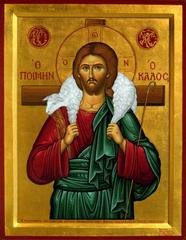
From earliest times, Christian art found its inspiration in this touching image of the Good Shepherd, thereby leaving us a representation of Christ’s love for each of us.
In addition to the title of Good Shepherd, Christ applies to Himself the image of the door into the sheepfold of the Church. “The Church,” Vatican II teaches, “is a sheepfold, the sole and necessary gateway to which is Christ (cf. John 10:1-10). It is also a flock, of which God foretold that He Himself would be the shepherd (cf. Isaiah 40:11; Ezekiel 34:11ff.), and whose sheep, although watched over by human shepherds, are nevertheless at all times led and brought to pasture by Christ Himself, the Good Shepherd and Prince of shepherds (cf. John 10:11; 1 Peter 5:4), who gave His life for His sheep (cf. John 10:11-15)” (“Lumen Gentium”, 6)
Continued on next post…
 
1-2. The flock can be harmed in a subtle, hidden way, or in a blatant way through abuse of authority. The history of the Church shows that its enemies have used both methods: sometimes they enter the flock in a secretive way to harm it from within; sometimes they attack it from outside, openly and violently. “Who is the good shepherd? He who enters by the door' of faithfulness to the Church's doctrine and does not act like the hireling who sees the wolf coming and leaves the sheep and flees’; whereupon `the wolf snatches them and scatters them’” ([St] J. Escriva, “Christ Is Passing By”, 34).
3-5. In those times it was usual at nightfall to bring a number of flocks together into one sheepfold, where they would be kept for the night with someone acting as look-out. Then at dawn the shepherds would come back and open the sheepfold and each would call his sheep which would gather round and follow him out of the pen (they were used to his voice because he used to call them to prevent them from going astray) and he would then lead them to pasture. Our Lord uses this image–one very familiar to His listeners–to teach them a divine truth: since there are strange voices around, we need to know the voice of Christ–which is continually addressing us through the Magisterium of the Church–and to follow it, if we are to get the nourishment our soul needs. “Christ has given His Church sureness in doctrine and a fountain of grace in the Sacraments. He has arranged things so that there will always be people to guide and lead us, to remind us constantly of our way. There is an infinite treasure of knowledge available to us: the word of God kept safe by the Church, the grace of Christ administered in the Sacraments and also the witness and example of those who live by our side and have known how to build with their good lives a road of faithfulness to God” ([St] J. Escriva, “Christ Is Passing By”, 34).
  1. Christ develops and interprets the image of the shepherd and the flock, to ensure that everyone who is well-disposed can understand His meaning. But the Jews fail to understand–as happened also when He promised the Eucharist (John 6:41-43) and spoke of the “living water” (John 7:40-43), or when He raised Lazarus from the dead (John 11:45-46).
7. After describing His future Church through the image of the flock, Christ extends the simile and calls Himself the “door of the sheep”. The shepherds and the sheep enter the sheepfold: both must enter through the door, which is Christ. “I”, St. Augustine preached, “seeking to enter in among you, that is, into your heart, preach Christ: if I were to preach other than that, I should be trying to enter by some other way. Through Christ I enter in, not to your houses but to your hearts. Through Him I enter and you have willingly heard me speak of Him. Why? Because you are Christ’s sheep and you have been purchased with Christ’s blood” (“In Ioann. Evang.” 47, 2-3).
**8. **The severe reproach Jesus levels against those who came before Him does not apply to Moses or the prophets (cf. John 5:39, 45; 8:56; 12:41), nor to the Baptist (cf. John 5:33), for they proclaimed the future Messiah and prepared the way for Him. He is referring to the false prophets and deceivers of the people, among them some teachers of the Law–blind men and blind guides (cf. Matthew 23:16-24) who block the people’s way to Christ, as happened just a little before when the man born blind was cured (cf. John 9).
*Continued on next post… *
 
**From: John 10:11-18
The Good Shepherd (Continuation)
--------------------------------**
(Jesus said to the Pharisees,) [11] “I am the good shepherd. The good shepherd lays down his life for the sheep. [12] He who is a hireling and not a shepherd, whose own the sheep are not, sees the wolf coming and leaves the sheep and flees; and the wolf snatches them and scatters them. [13] He flees because he is a hireling and cares nothing for the sheep. [14] I am the good shepherd; I know my own and my own know me, [15] as the Father knows Me and I know the Father; and I lay down My life for My sheep. [16] And I have other sheep that are not of this fold; I must bring them also, and they will heed My voice. So there shall be one flock, one shepherd. [17] For this reason the Father loves Me, because I lay down My life, that I may take it again. [18] No one takes it from Me, but I lay it down of My own accord. I have power to lay it down, and I have power to take it again; this charge I have received from My Father.”

Commentary:
11-15. **“The good shepherd lays down his life for his sheep”: “Here”, says St. John Chrysostom, “He is speaking of His passion, making it clear this would take place for the salvation of the world and that He would go to it freely and willingly” (“Hom. on St. John”, 59, 3). Our Lord spoke further about giving abundant pasture; now He speaks about giving His very life: “He did what He said He would do”, St. Gregory comments; “He gave His life for His sheep, and He gave His body and blood in the Sacrament to nourish with His flesh the sheep He had redeemed” (“In Evangelia Homilae”, 14, “ad loc.”). Hired men, on the other hand, run away if there is any danger, leaving the flock at risk. “Who is the hireling? He who sees the wolf coming and flees. The man who seeks his own glory, not the glory of Christ; the man who does not dare reprove sinners. You are the hireling; you have seen the wolf coming and have fled …] because you held your peace; and you held your peace, because you were afraid” (St. Augustine, “In Ioann Evang.”, 46, 8).
“Let them remember that their priestly ministry…is–in a special way–‘ordered’ to the great solicitude of the Good Shepherd, solicitude for the salvation of every human being. And this we must all remember: that it is not lawful for any one of us to deserve the name of ‘hireling’, that is to say, the name of one ‘to whom the sheep do not belong’, one who, ‘since he is not the shepherd and the sheep do not belong to him, abandons the sheep and runs away as soon as he sees the wolf coming, and then the wolf attacks and scatters the sheep; this is because he is only a hired man and has no concern for the sheep.’ The solicitude of every good shepherd is that all people ‘may have life and have it to the full’, so that none of them may be lost but should have eternal life. Let us endeavor to make this solicitude penetrate deeply into our souls; let us strive to live it. May it characterize our personality, and be at the foundation of our priestly identity” ([Pope] John Paul II, “Letter to Priests”, 8 April 1979).
Continued on next post…
 
The Good Shepherd knows each of His sheep and calls it by name. This touching simile seems to be an exhortation to future pastors of the Church, as St. Peter will later on explain: “Tend the flock that is your charge, not for shameful gain but eagerly, not as domineering over those in your charge but being examples to the flock” (1 Peter 5:2).

“The holiness of Christ’s Spouse has always been shown–as it can be seen today–by the abundance of good shepherds. But our Christian faith, which teaches us to be simple, does not bid us to be simple-minded. There are hirelings who keep silent, and there are hirelings who speak with words which are not those of Christ. That is why, if the Lord allows us to be left in the dark even in little things, if we feel that our faith is not firm, we should go to the good shepherd. He enters by the door as of right. He gives his life for others and wants to be in word and behavior a soul in love. He may be a sinner too, but he trusts always in Christ’s forgiveness and mercy” (St. J. Escriva, “Christ Is Passing By”, 34).

16. “One flock, one shepherd”: Christ’s mission extends to everyone even though His own preaching is addressed, in the first instance, to the sheep of the house of Israel, as He Himself revealed to the Canaanite woman (cf. Matthew 15:24), and even though He sent the Apostles on their first mission (cf. Matthew 10:6) to preach to the people of Israel. Now, however, foreseeing the fruits of His redemptive death (verse 15), He reveals that these will be applied to “other sheep, that are not of this fold”, that is, Israel, and, after the Resurrection, He does send the Apostles to all nations (cf. Matthew 28:19), to preach the Gospel to all creation (cf. Matthew 16:15), beginning in Jerusalem and extending to all Judea, Samaria and the ends of the earth (cf. Acts 1:8). This fulfills the ancient promises about the rule of the Messiah covering the whole world (cf. Psalm 2:7; Isaiah 2:2-6; 66:17-19). The universal scope of salvation caused St. Paul to exclaim: “Remember that at one time you…were…separated from Christ, alienated from the commonwealth of Israel, and strangers to the covenants of promise, having no hope and without God in the world. But now in Christ Jesus you who once were far off have been brought near in the blood of Christ” (Ephesians 2:11-13; cf. Galatians 3:27-28; Romans 3:22).

The unity of the Church is to be found under one visible head, for “it was to the Apostolic College alone, of which Peter is the head, that we believe that our Lord entrusted all the blessings of the New Covenant, in order to establish on earth the one body of Christ into which all those should be fully incorporated who belong in any way to the people of God” (Vatican II, “Unitatis Redintegratio”, 3). It is a Catholic’s constant yearning that everyone should come to the true Church, “God’s one flock, which like a standard lifted high for the nations to see, ministers the Gospel of peace to all mankind, as it makes it pilgrim way in hope towards its goal, the fatherland above” (“ibid.”, 2).

**17-18. **Jesus shows that of His own free will He will give Himself up to death for the sake of the flock (cf. John 6:51). Having been given supreme authority, Christ is free to offer Himself as a sacrifice of expiation, and He voluntarily accepts His Father’s commandment, in an act of perfect obedience. “We will never fully understand Jesus’ freedom. It is immense, infinite, as is His love. But the priceless treasure of His generous holocaust should move us to ask, ‘Why, Lord, have you granted me this privilege which I can use to follow in Your footsteps, but also to offend You?’ Thus we come to appreciate that freedom is used properly when it is directed towards the good; and that it is misused when men are forgetful and turn away from the Love of loves” (St. J. Escriva, “Friends of God”, 26).

Continued on the next post…
 
**From: John 10:22-26
Jesus and the Father are One
----------------------------**
*[22] It was the feast of the Dedication at Jerusalem; [23] it was winter, and Jesus was walking in the temple, in the portico of Solomon. [24] So the Jews gathered round Him and said to Him, “How long will You keep us in suspense? If you are the Christ, tell us plainly.” [25] Jesus answered them, "I told you, and you do not believe. The works that I do in My Father’s name, they bear witness to Me; [26] but you do not believe, because you do not belong to My sheep. *

Commentary:**
  1. This feast commemorates an episode in Jewish history (cf. 1 Maccabees 4:36-59; 2 Maccabees 1-2:19; 10:1-8) when Judas Maccabeus, in the year 165 B.C., after liberating Jerusalem from the control of the Seleucid kings of Syria, cleansed the temple of the profanations of Antiochus Epiphanes (1 Maccabees 1:54). From then onwards, on the twenty-fifth day of the month of Kislev (November-December) and throughout the following week, all Judea celebrated the anniversary of the dedication of the new altar. It was also known as the “Festival of Lights” because it was customary to light lamps, a symbol of the Law, and put them in the windows of the houses (cf. 2 Maccabees 1:18).
24-25. When these Jews ask Jesus if He is the Messiah, “they speak in this way”, St. Augustine comments, “not because they desire truth, but to prepare the way for calumny” (“In Ioann. Evang.”, 48, 3). We have already seen Jesus reveal, by His words and deeds, that He is the Only Son of God (5:19ff; 7:16ff; 8:25ff). In view of their good dispositions, He explicitly told the Samaritan woman (4:26) and the man born blind (9:37) that He was the Messiah and Savior. Now He reproaches His listeners for refusing to recognize the works He does in His Father’s name (cf. 5:36; 10:38). On other occasions He referred to works as a way to distinguish true prophets from false ones: “You will know them by their fruits” (Matthew 7:16; cf. Matthew 12:33).
 
Gospel
John 10:27-30

These four verses are taken from a long discourse that Jesus gave in the Temple area on the feast of Dedication, the annual commemoration of the restoration of the Temple by the Maccabees in 165 B.C. The Jews were questioning his claim to be the Messiah. He quotes his miracles as his proofs—could God allow him work miracles if he were an imposter? He calls himself the Shepherd of God’s flock in this section of his discourse. Shepherd was a title commonly used for the King or ruler of the people in ancient Mesopotamia and also in Israel (see Jer. 2:8; 3:15; Ez. 34: 2-21) and God himself is called the Shepherd of Israel (Gen. 48:15; Ps. 28:9 etc.). Catholic Matters]
• The setting for this Sunday’s Gospel is the city of Jerusalem during the Jewish Feast of the dedication, also known as Hanukkah. This feast celebrated the deliverance of the Jews from the Greek tyrant, Antiochus IV Epiphanes, during the Maccabean Revolt (168—165 B.C. See 1 Maccabees 4:36-39). Antiochus had attempted the Hellenization (forced adoption of Greek culture) of Israel and had ordered the committing of sacrilege in the Jewish temple.
• During this festival, there was sure to be strong nationalistic feelings against the Roman occupation of Israel, and a heightened longing for the coming of Messiah.
• At this time Jesus is within the Temple precincts amidst the crowds. He is challenged to proclaim outright whether or not he is the promised Messiah.
• Jesus tells them in effect that it is because of their refusal to believe, that they cannot recognize who he is (verses 25-26). He then goes on to relate a type of extended parable of the Good Shepherd and his sheep who hear his voice. Our reading today is the conclusion of that parable.
• He then goes on to make two other remarkable claims that scandalize and infuriate them.

**27
My sheep hear my voice; I know them, and they follow me. **

• Among shepherds in the Holy Land, sheep learn to distinguish the voice of their shepherds and will not heed (may, indeed, flee from) the voice of a stranger. The sheep of Jesus’ flock heed only his voice.

28
I give them eternal life, and they shall never perish. No one can take them out of my hand.


• Eternal life—the pasturage to which the Good Shepherd Jesus leads his flock is eternal life, possessed in a partial way now in this life, but fully in the life to come.
• No one can take them out of my hand—the same power which is attributed to God the Father in verse 29.

**29
My Father, who has given them to me, is greater than all, and no one can take them out of the Father’s hand. **

• It is impossible that Jesus should lose the sheep that have been given him by the Father since the Father’s omnipotence is the guarantee of the gift.

Continued on next post…
 
Status
Not open for further replies.
Back
Top