Are our artistic interpretations of angels accurate?

  • Thread starter Thread starter marine13
  • Start date Start date
Status
Not open for further replies.
Three words: chill down, mate. 🙂 Sorry if I came across as being too sharp. 😊

But to get back to the ‘graven image’ question: the point of the commandment is not so much to ban the making of images by itself, but the worship of idols. And oh, who said that we Catholics worship the icons or the statues? 😉
Yep, got a bit carried away there, I am suitably calmed and also sorry that my response was enflamed but I am so very frustrated with this issue. I have been brushed off so many times with this question, it’s as if people can’t see the actual, clearly articulated words in the 2nd Commandment.

Firstly the worship of Idols is covered in the 1st commandment “…You shall have no other gods before me”. The 1st Commandment deals with who we pray to, the 2nd Commandment deals with how we pray.
The 2nd Commandment uses clear unambiguous language and specificaly bans the making of Divine likenesses and images - It states - “You shall not make for yourself a carved image, or any likeness of anything that is in heaven above” It forebids us making a likeness of anything Divine. All art works; paintings, statues, etc are an artists personal interpretation of a subject, an expression of what the artists believes is a truth about that subject. The 2nd Commandment forbids this interpretation, it forbids kneeling down and praying to The Divine through a graven image or painting, these are all tainted by a third party, the artist. There is only one way to get to God:
Jesus said, “I am the way and the truth and the life. No one comes to the Father except through me.”
Except through Him; not a statue of Him, not a painting of Him…Him!
 
Yep, got a bit carried away there, I am suitably calmed and also sorry that my response was enflamed but I am so very frustrated with this issue. I have been brushed off so many times with this question, it’s as if people can’t see the actual, clearly articulated words in the 2nd Commandment.

Firstly the worship of Idols is covered in the 1st commandment “…You shall have no other gods before me”. The 1st Commandment deals with who we pray to, the 2nd Commandment deals with how we pray.
The 2nd Commandment uses clear unambiguous language and specificaly bans the making of Divine likenesses and images - It states - “You shall not make for yourself a carved image, or any likeness of anything that is in heaven above” It forebids us making a likeness of anything Divine. All art works; paintings, statues, etc are an artists personal interpretation of a subject, an expression of what the artists believes is a truth about that subject. The 2nd Commandment forbids this interpretation, it forbids kneeling down and praying to The Divine through a graven image or painting, these are all tainted by a third party, the artist. There is only one way to get to God:
Jesus said, “I am the way and the truth and the life. No one comes to the Father except through me.”
Except through Him; not a statue of Him, not a painting of Him…Him!
Just a little food for thought: since you claim to be Catholic, why not get familiar with John of Damascus and his Apologia against those who decry Holy Images? Read through his arguments first, then point out exactly where you disagree. Then we can get the discussion moving further. And I expect other posters would also chime in with their two cents in the meantime. 🙂
 
Can someone explain to me, without it sounding like a rationalisation, why there are artistic representations of angels or anything religious when it it plainly forbidden by the second commandment.
“Do not make an image or any likeness of what is in the heavens above…”
Or if you prefer;
“Thou shalt not make unto thee any graven image, or any likeness of any thing that is in heaven above, or that is in the earth beneath, or that is in the water under the earth.”
Thank you.
One partial reason is that Moses lived very early in the history of mans interaction with God. God would not even tell Moses His name, I am who I am, nor would He appear in any form, His voice, or the angel of the Lord spoke from a burning bush.
But about, maybe, a thousand years after this God finally showed people why He had not told them His name or appeared to them. It is at this point that God takes a name, Jesus and an image, that of a man.
This then is Gods name and His image. For the first time in history people can see an image of God and hear His name. This then must have been the reason for the prohibition against the people of Moses making an image of God. God had already chosen His time to appear to men and He had chosen the form of the image of Himself to appear in.
Since that time, the time God appeared to people as an image, there could be no prohibition against looking at an image of God, as He walked amongst men. The images of God or the Saints we make are just the images we would have seen had we been alive then.
 
One partial reason is that Moses lived very early in the history of mans interaction with God. God would not even tell Moses His name, I am who I am, nor would He appear in any form, His voice, or the angel of the Lord spoke from a burning bush.
But about, maybe, a thousand years after this God finally showed people why He had not told them His name or appeared to them. It is at this point that God takes a name, Jesus and an image, that of a man.
This then is Gods name and His image. For the first time in history people can see an image of God and hear His name. This then must have been the reason for the prohibition against the people of Moses making an image of God. God had already chosen His time to appear to men and He had chosen the form of the image of Himself to appear in.
Since that time, the time God appeared to people as an image, there could be no prohibition against looking at an image of God, as He walked amongst men. The images of God or the Saints we make are just the images we would have seen had we been alive then.
Thanks for this opinion; it’s an interesting point. I agree that we must take into account God’s ongoing, ever evolving relationship with Man as time goes by. But the burning bush and the appearance of Jesus as the manifestation of God are all God’s doing, God is the only artist here, if you will. He is the only one with the Authority to depict the Divine. The 2nd Commandment forbids any copying, rendering or facsimiles of this original. They are, at the very least, distilled and open to corruption from everything from the artists ego, greed or political motives. Case in point; in Botticelli’s “Adoration of the Magi” the artist not alone portrays specific members of the Medici family in the retinue of the Wise men who come to adore the Baby Jesus in an effort to court political favour and a lucrative commission but also depicts himself in the painting as well; ego, greed and ambition. The 2nd Commandment preaches humility and the danger inherent in attempting to emulate the Divine.
 
Just a little food for thought: since you claim to be Catholic, why not get familiar with John of Damascus and his Apologia against those who decry Holy Images? Read through his arguments first, then point out exactly where you disagree. Then we can get the discussion moving further. And I expect other posters would also chime in with their two cents in the meantime. 🙂
I tried to read the Apologia but it contains nearly 30,000 words and I felt quite lost ater the first few pages; I am a Catholic not an academic and, thankfully, this is a forum for discussion not a lecture room to hand out reading assignments and ask for reports.
You are obviously a very learned individual and, I assume, have read the Apologia; I would love to hear your opinion on this subject. What, in your view, is the main point(s) raised by John to justify what is, to my all too simple mind, a complete reversal of one of God’s Commandments?
 
Just a little food for thought: since you claim to be Catholic, why not get familiar with John of Damascus and his Apologia against those who decry Holy Images? Read through his arguments first, then point out exactly where you disagree. Then we can get the discussion moving further. And I expect other posters would also chime in with their two cents in the meantime. 🙂
Also it is not me who decrys Holy Images. It is God; he clearly forbids it in the 2nd Commandment! It bears repeating “You shall not make for yourself a carved image, or any likeness of anything that is in heaven above”
 
Thanks for this opinion; it’s an interesting point. I agree that we must take into account God’s ongoing, ever evolving relationship with Man as time goes by. But the burning bush and the appearance of Jesus as the manifestation of God are all God’s doing, God is the only artist here, if you will. He is the only one with the Authority to depict the Divine. The 2nd Commandment forbids any copying, rendering or facsimiles of this original. They are, at the very least, distilled and open to corruption from everything from the artists ego, greed or political motives. Case in point; in Botticelli’s “Adoration of the Magi” the artist not alone portrays specific members of the Medici family in the retinue of the Wise men who come to adore the Baby Jesus in an effort to court political favour and a lucrative commission but also depicts himself in the painting as well; ego, greed and ambition. The 2nd Commandment preaches humility and the danger inherent in attempting to emulate the Divine.
All of that does not matter. I believe He did not show Moses an image of Himself or tell him His name because the time was not come for Him to do so. If His time was now everyone would be taking photos of Him and painting portraits and making statues. Your view would then be that all these fans of His are going straight to hell because they took a photo of Him or made a portraiture.
I do not think it matters if we do not know exactly what He looked like in life. He had a beard and shared the features of many of that region. Indeed even His Apostles did not recognize Him at first after the resurrection so that worrying about details of appearance is not something important, we know who it is we depict and why.
 
All of that does not matter. I believe He did not show Moses an image of Himself or tell him His name because the time was not come for Him to do so. If His time was now everyone would be taking photos of Him and painting portraits and making statues. Your view would then be that all these fans of His are going straight to hell because they took a photo of Him or made a portraiture.
I do not think it matters if we do not know exactly what He looked like in life. He had a beard and shared the features of many of that region. Indeed even His Apostles did not recognize Him at first after the resurrection so that worrying about details of appearance is not something important, we know who it is we depict and why.
Firstly I never mentioned anything about what might happen to people who broke the 2nd Commandment. My position has always been that a Commandment clearly forbids something and everyone seems to be trying to tell me otherwise.
But you bring an interesting viewpoint to the table. If Jesus did appear today the media would be all over Him and everyone knows how much spin an editor can put on a news story. Even in reality shows like Big Brother when the camera’s are on 24/7 the programme makers have a huge say in what they show the public and how the individual participants come across.
I agree, it doesn’t matter what Jesus looked like but a well made film or a beautiful painting or a powerful documentary is much more about perception than looks, it can be used to push an third party agenda. Image-makers, be they artists, sculptors, newspaper editors or filmmakers, can shape how we perceive something and the 2nd Commandment says that Man shouldn’t have editorial power over God. Jesus, and the words he left us in The Bible, are the only route to God, go by any other road at your peril.
 
J a F, Maybe this article from my blog will help with your problems with this.
Iconoclasm: Or: Catholics Worship Graven Images NOT
Welcome!
A graven image according to the context of the 1st commandment is anything that a person would construct in order to give it the worship that is due only to God. Now, that said, it could also include anything that we choose to make more important than God in our lives, such as money, career, or power. The Catechism of the Catholic Church gets into it more here: christusrex.org/www1/CDHN/comm1.html#GRAVEN so you can peruse that at your convenience.
Islam forbids the display of ANY images (It’s called Iconoclasm, this forbidding) and the iconoclastic heresies that have arisen in Christianity were the result of Islamic influence in about the 800’s. You can find that history here at New Advent: newadvent.org/cathen/07620a.htm
 
… Image-makers, be they artists, sculptors, newspaper editors or filmmakers, can shape how we perceive something and the 2nd Commandment says that Man shouldn’t have editorial power over God. Jesus, and the words he left us in The Bible, are the only route to God, go by any other road at your peril.
And also the Church He left us; His One Holy Catholic and Apostolic Church, surely…

Artist, painters, centuries ago often put their patrons in the painting. You seem to have twisted this practice into something bad. But remember that religious art keeps religious ideas and truths alive. It, art, is a language for communicating ideas. Artists in those days were supported by the Church and by wealthy patrons. The patrons may request that their image by included in some biblical scene in their own habitual costume, which is sometimes funny. But as they were Catholic, and this biblical scene is something they believe in, they show their belief by having themselves painted into the scene. Usually they are kneeling in prayer.
The Iconoclasts after the reformation, especially in Holland, forbade artists to paint religious art. And artists starved and some made a living by painting wealthy patrons portraits in a totally secular way, as religious art was banned.
Now this is a strange turn of events, where you would take the side of secular anti-religious art protestants of the reformation and favour secular art.
I think that since art is a gift from God that artists depicting religious scenes in their work is a superior use of their talent than depicting the face of secular portraiture.
 
J a F, Maybe this article from my blog will help with your problems with this.
Iconoclasm: Or: Catholics Worship Graven Images NOT
Yes I agree with your first paragraph about the 1st Commandment. (I enjoyed your blog.)
And apart from your definition of the word Iconoclasm, which actually means the deliberate destruction of religious artefacts as opposed to forbidding a display, I agree with your second paragraph.
But I found nothing directly related my issue regarding the 2nd Commandment, please correct me if I missed something. Thanks.
 
And also the Church He left us; His One Holy Catholic and Apostolic Church, surely…

Artist, painters, centuries ago often put their patrons in the painting. You seem to have twisted this practice into something bad. But remember that religious art keeps religious ideas and truths alive. It, art, is a language for communicating ideas. Artists in those days were supported by the Church and by wealthy patrons. The patrons may request that their image by included in some biblical scene in their own habitual costume, which is sometimes funny. But as they were Catholic, and this biblical scene is something they believe in, they show their belief by having themselves painted into the scene. Usually they are kneeling in prayer.
The Iconoclasts after the reformation, especially in Holland, forbade artists to paint religious art. And artists starved and some made a living by painting wealthy patrons portraits in a totally secular way, as religious art was banned.
Now this is a strange turn of events, where you would take the side of secular anti-religious art protestants of the reformation and favour secular art.
I think that since art is a gift from God that artists depicting religious scenes in their work is a superior use of their talent than depicting the face of secular portraiture.
“And also the Church He left us…” Well sir, I think that may the source of my, very out of character, preoccupation with this conundrum. I am totally at a loss trying to reconcile the total reversal of a Commandment by Body established to promoted and maintain these basic tenets.
You mention that I seem to have twisted the practise of artists putting their patrons into their paintings into something bad. Well for the record I have no problem with what an artist does in his painting. He is the master of that canvas but to take a scene depicting the birth of Christ and stick a rich person into it to massage the patrons ego and sell your painting. turns it into a marketing ploy, it’s the equivilant of celebrity endorsement and that is why the 2nd Commandment forbids it. Let me put it into context, what if that painting had been done nowadays but instead of a Medici there was Arnold Swatzangegger as one of the wise men, would you still think it is me who has twisted it into something bad?
You mention that religious art keeps religious ideas and truths alive. No, the Word of God keeps religious ideas and truths alive. Religious art is forbidden in the 2nd Commandment.
You talk about the Church supporting artists but this is the main problem I have; The 2nd Commandment clearly forbids this.
You say that since art is a gift from God artists depicting religious scenes in their work is a superior use of their talent. And that is your opinion But it is forbidden in the 2nd Commandment!!!
You accuse me of taking the side of secular anti-religious art protestants. How can me feeling that a Commandment laid down by God being completely overturned be construed as being anti-religious.
 
“And also the Church He left us…” Well sir, I think that may the source of my, very out of character, preoccupation with this conundrum. I am totally at a loss trying to reconcile the total reversal of a Commandment by Body established to promoted and maintain these basic tenets.
You mention that I seem to have twisted the practise of artists putting their patrons into their paintings into something bad. Well for the record I have no problem with what an artist does in his painting. He is the master of that canvas but to take a scene depicting the birth of Christ and stick a rich person into it to massage the patrons ego and sell your painting. turns it into a marketing ploy, it’s the equivilant of celebrity endorsement and that is why the 2nd Commandment forbids it. Let me put it into context, what if that painting had been done nowadays but instead of a Medici there was Arnold Swatzangegger as one of the wise men, would you still think it is me who has twisted it into something bad?
Ahah… I see where you are confused, now. These paintings were not, as paintings are now, done on spec. The artist for the Medici family, for example, was not trying to sell Medici a painting. Rather Medici was the artist’s patron, he supported the artist and helped him. Medici asked for a painting for his living room and he requested that he, as a practicing Catholic, be included in the scene of the Nativity. Medici believes in the Nativity. And this is Medici’s painting, and here is Medici, doing no more than you or I, standing beside the Nativity scene statues at every Christmas in the parish Church.
You mention that religious art keeps religious ideas and truths alive. No, the Word of God keeps religious ideas and truths alive. Religious art is forbidden in the 2nd Commandment.
Spoken like a well educated man. For most of history, though, people were not educated, they had to work to live and learning to read was a luxury which is useless if you are ploughing a field. Religious art was accessible to everyone. You hear the word accessible a lot nowadays as a right for people with all sorts of disabilities or infirmities, from poor eyesight to everything else. Here, art is an example of teaching some of the Gospel in another language everyone can understand.
You talk about the Church supporting artists but this is the main problem I have; The 2nd Commandment clearly forbids this.
No the second commandment forbids like this;

Thou shalt not make thee any graven image, or any likeness of any thing that is in heaven above, or that is in the earth beneath, or that is in the waters beneath the earth:

That is to say, we cannot paint any pictures of dolphins etc.

Actually…

…the next commandment clarifies what is meant, what the second is talking about;

9 Thou shalt not bow down thyself unto them, nor serve them: for I the Lord thy God am a jealous God…

That is, the images the commandments are talking about are idols/false gods, or any thing which is given the reverence due to God alone, …for God is a jealous God.
You say that since art is a gift from God artists depicting religious scenes in their work is a superior use of their talent. And that is your opinion But it is forbidden in the 2nd Commandment!!!
See above. Art is a gift from God.
You accuse me of taking the side of secular anti-religious art protestants. How can me feeling that a Commandment laid down by God being completely overturned be construed as being anti-religious.
Because you misunderstand what the commandment means. Originally, I believe, the commandments were not numbered. By numbering subconsciously you are dividing each commandment from the other as if they were stand alone statements. This is not so, it is our mistaken impression.

By treating the second as if it were isolated from everything you must forbid yourself not only images of things in ‘heaven above’ but also things ‘in the earth beneath’ and, most strikingly things ‘that is[are] in the waters beneath the earth:’.

Not to sound too crass about this, but this is talking about fish, and lobsters, and dolphins and whales.

Making images of fish, lobsters, dolphins and of whales etc., is forbidden. Again, not to be crass, but do you prevent your youngsters, if you have any, from drawing images of things beneath the waters; or even things ‘in the earth beneath’, which is us, and all other animals and birds etc., etc.?

 
http://www.tali-virtualmidrash.org.il/userfiles/dura-bush.jpg


Just for a little something: a few examples of frescoes from the synagogue of Dura-Europos in Syria.

While it has long been considered a truism that ancient Israelite culture was totally aniconic (based on “Thou shalt not make any graven image”), the stereotype of a consistently aniconic Judaism was shattered during the 1920s-30s when archaeologists excavated the synagogues of Beit Alpha in Palestine and of Dura-Europos on the Euphrates River. (We could add Hamat Tiberias, and the synagogue at Sepphoris into the mix.) Already in the 2nd century rabbis had debated whether all images were prohibited for Jews or just the worship of images. In fact, one of the common motifs in 4th-6th century Palestinian synagogues is the zodiac. So it wasn’t just the Christians who struggled with this, no.

Besides, there was this carved stone from circa 50 BC-AD 100 found in the synagogue of Migdal (Magdala). In fact, the menorah design was a standard template in Jewish art!
 
Frescoes, I like. Is that a broken statue on the ground in the last image?🙂
 
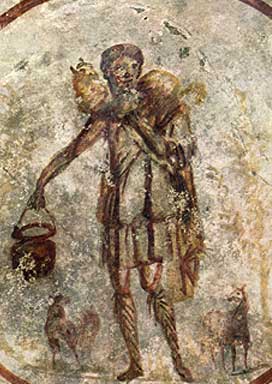
Near the synagogue in Dura-Europos stands one of the earliest known Christian house churches, dating from circa 235 AD. What is interesting is, like the synagogue, it itself sports art in the walls of its baptistry!


There was also this 3rd century church in Megiddo.

http://www.armageddonchurch.com/images/2_fishes_400kb.gif

(Please Note: This uploaded content is no longer available.)
“Akeptus the devout dedicated the table to God, Jesus Christ, as a memorial.”

And one of course could not forget the catacombs of Rome.


Frescoes, I like. Is that a broken statue on the ground in the last image?🙂
Yes. It’s a portrayal of the Ark (that thing on wheels) being captured by the Philistines, actually. So the broken idol is supposed to be Dagon.
 
Interesting, a graven image depicting a broken idol.
Well, the Hebrew word pesel originally meant something hewn, carved or fashioned into shape. So if we are going to take the commandment literalistically here, the commandment then is not addressing paintings and other two-dimensional media. 😛

The word pesel appears almost exclusively in the context of ritual and cultic imagery in the OT, however, and thus, is better understood and rendered as, ‘idol’.
 
Ahah… I see where you are confused, now. These paintings were not, as paintings are now, done on spec. The artist for the Medici family, for example, was not trying to sell Medici a painting. Rather Medici was the artist’s patron, he supported the artist and helped him. Medici asked for a painting for his living room and he requested that he, as a practicing Catholic, be included in the scene of the Nativity. Medici believes in the Nativity. And this is Medici’s painting, and here is Medici, doing no more than you or I, standing beside the Nativity scene statues at every Christmas in the parish Church.

Spoken like a well educated man. For most of history, though, people were not educated, they had to work to live and learning to read was a luxury which is useless if you are ploughing a field. Religious art was accessible to everyone. You hear the word accessible a lot nowadays as a right for people with all sorts of disabilities or infirmities, from poor eyesight to everything else. Here, art is an example of teaching some of the Gospel in another language everyone can understand.

No the second commandment forbids like this;

Thou shalt not make thee any graven image, or any likeness of any thing that is in heaven above, or that is in the earth beneath, or that is in the waters beneath the earth:

That is to say, we cannot paint any pictures of dolphins etc.

Actually…

…the next commandment clarifies what is meant, what the second is talking about;

9 Thou shalt not bow down thyself unto them, nor serve them: for I the Lord thy God am a jealous God…

That is, the images the commandments are talking about are idols/false gods, or any thing which is given the reverence due to God alone, …for God is a jealous God.

See above. Art is a gift from God.

Because you misunderstand what the commandment means. Originally, I believe, the commandments were not numbered. By numbering subconsciously you are dividing each commandment from the other as if they were stand alone statements. This is not so, it is our mistaken impression.

By treating the second as if it were isolated from everything you must forbid yourself not only images of things in ‘heaven above’ but also things ‘in the earth beneath’ and, most strikingly things ‘that is[are] in the waters beneath the earth:’.

Not to sound too crass about this, but this is talking about fish, and lobsters, and dolphins and whales.

Making images of fish, lobsters, dolphins and of whales etc., is forbidden. Again, not to be crass, but do you prevent your youngsters, if you have any, from drawing images of things beneath the waters; or even things ‘in the earth beneath’, which is us, and all other animals and birds etc., etc.?
My confusion? Wow, where do I start? This painting was not commissioned by The Medici Family and is so much more than the sweet little Christmas scene you imagine. To go a bit further into it’s history; The painting was commissioned by Gaspare di Zanobi del Lama, a corrupt banker who used it as coinage to to gain political favours from a powerfull family. This painting was created out of greed and dark ambition and uses the Nativity as currency. It has nothing whatsoever to do with God and is exactly what the 2nd Commandment sets out to avoid.
You say that Religious art was accessible to everyone. Not so, a lot of the commissioned art was kept in the houses of the patrons who paid for them, accessible only to them and their friends. The art that was accessible was housed in churches where, if you needed proper religious instruction, you could ask a priest. This old argument that it helped to instruct the uneducated has never stood up to scrutiny.
Furthermore you seem to be confusing the water ON the earth, where these unphotogenic dolphins live, with the waters BENEATH the earth upon which the land was made on the 2nd day (Proverbs 8:27) and from which the Great Flood poured (Genesis 7:11)
You then go on to talk about “The next Commandment”, quoting “Thou shalt not bow down thyself unto them…” again let me clear up your confusion; This is still the same commandment it is simply hammering home the main notion of the 2nd Commandment which forbids the making of any likeness of any thing that is in heaven above. The “next Commandment” of which you refer is about taking the Lords name in vain and in deference to this Commandment I won’t comment on the rest of your fish-filled response.
 
Status
Not open for further replies.
Back
Top