
Article: Now That It Has Lost God, Society Has Lost its Humanity

  • Thread starter Thread starter mdgspencer
  • Start date Start date
Status
Not open for further replies.
M

mdgspencer

Guest

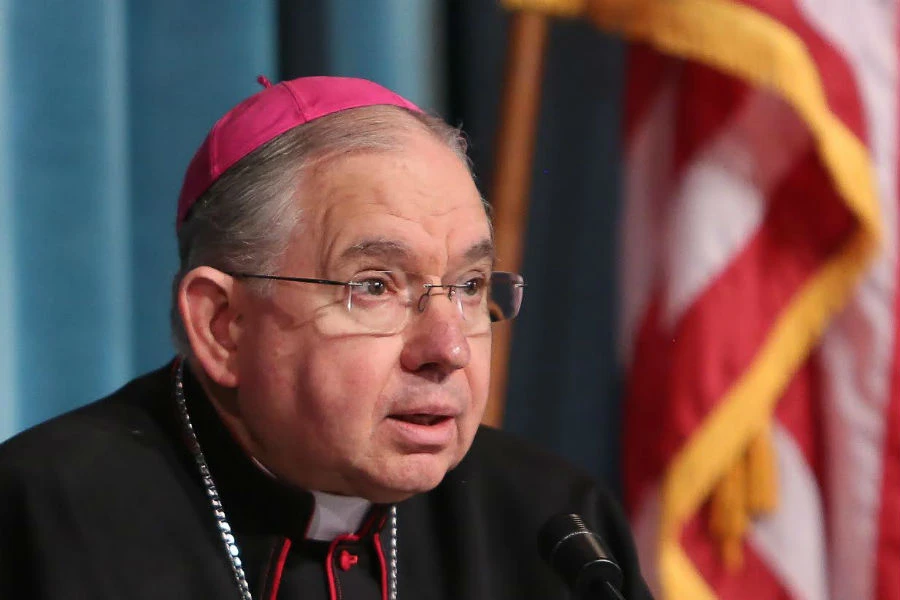
“If we are not free to order our lives and institutions according to God’s Word, then we are not free to live a truly human life.”

The Archbishop cited the “growing prevalence” of abortion and euthanasia, as well as human embryonic experimentation and research as evidence that humanity had lost sight of the central questions of life: who people are, why they are here, and what they should be living for.

The recent laws considered–and passed–in several states that would reduce barriers on late-term abortions were, Gomez said, an “extreme example” of society’s “moral confusion about the status of a human person.”

This moral confusion, the archbishop suggested, could be behind the prevalence of identity politics and racism in American society, and the “widespread confusion about gender and human sexuality.”
 
Today at the Practical Catholic, we’ll be looking with Pope Benedict at the erosion happening in societies across the world and what Christians can do in response. So here we have a few Pope Benedict XVI quotes from various sources to help us along the way.

The Holy Father says:
Code:
If we cannot have common values, common truths, sufficient communication on the essentials of human life–how to live how to respond to the great challenges of human life–then true society becomes impossible.
How true this is. Where there is no communication, no culture, no shared experience, there is no society; because there is no people. There remains only a vast and foreboding, unforgiving sea of individuals ready to crash upon each other and the world with the slightest wind. Without a common basis, we have not the vaulted pluralism we’re taught to embrace, but Babel, in all the confusion and madness of a society with no binding forces. Already we are seeing the tensions of this fragmentation breaking out across cultures.

Without common values and truths, such as in the socieites we find ourselves in, we find the fabric of society torn like Joseph’s cloak, by a great many tribes which would like to lay claim to the title of favored. Leftists, conservatives, anarchists, nihilists, secularists, objectivists, the shallow, the entertainers, the entertained, all vying for control against each other. Tribalism can indeed spawn differentiation, but without some common ground, and in the face of increasing jargon not only in the academies but in the cultures; we shall be left with madness. In the end this tribalism can only result in the decline of all their claims, and the alienation of one from the other. Babel is the happenstance when society tries to become God.
 
The attitudes of some (reiterating some) people I speak with today frighten me. I hear things like the following in regards to abortion:
  • Human life has no value. The world is better off with fewer people.
  • People shouldn’t be allowed to have children. Bringing children into the world is abuse and just creating suffering for the newborn and for others. Better to kill it.
  • Most people aren’t fit to be parents therefore only people approved by the state should have children.
  • People should be force sterilized.
  • Only low IQ people have children. Better to have abortion to control the population than let them dumb down culture.
Even as I type this it sounds like something I’d read in some alarmist article, but I’ve really spoken to people with these sentiments. Things I used to hear said ironically/tongue-in-cheek are now being said more and more unironically.
 
Thomas Malthus:

"In his 1798 book An Essay on the Principle of Population , Malthus observed that an increase in a nation’s food production improved the well-being of the populace, but the improvement was temporary because it led to population growth, which in turn restored the original per capita production level. In other words, mankind had a propensity to utilize abundance for population growth rather than for maintaining a high standard of living, a view that has become known as the “Malthusian trap” or the “Malthusian spectre”. Populations had a tendency to grow until the lower class suffered hardship and want and greater susceptibility to famine and disease, a view that is sometimes referred to as a Malthusian catastrophe. Malthus wrote in opposition to the popular view in 18th-century Europe that saw society as improving and in principle as perfectible.[4] He saw population growth as being inevitable whenever conditions improved, thereby precluding real progress towards a utopian society: “The power of population is indefinitely greater than the power in the earth to produce subsistence for man”.[5] As an Anglican cleric, Malthus saw this situation as divinely imposed to teach virtuous behaviour.[6] Malthus wrote:
That the increase of population is necessarily limited by the means of subsistence,
That population does invariably increase when the means of subsistence increase, and,
That the superior power of population is repressed by moral restraint, vice and misery."
 
US Supreme Court:

Buck v. Bell , 274 U.S. 200 (1927),[1] is a decision of the United States Supreme Court, written by Justice Oliver Wendell Holmes, Jr., in which the Court ruled that a state statute permitting compulsory sterilization of the unfit, including the intellectually disabled, “for the protection and health of the state,” did not violate the Due Process clause of the Fourteenth Amendment to the United States Constitution. The Supreme Court has never expressly overturned Buck v. Bell ."
 
Status
Not open for further replies.
Back
Top