Ask a pagan

  • Thread starter Thread starter RiverStone
  • Start date Start date
Status
Not open for further replies.
Ok people you are missing my point. I am not here to discus the history of Wicca. I want to know why I feel torn between Wicca and Catholicism.

 
Ok people you are missing my point. I am not here to discus the history of Wicca. I want to know why I feel torn between Wicca and Catholicism.
I think that’s something you’re going to have to expound upon a bit further before anyone jumps in with an opinion. In what ways are you torn exactly? What is it about each that you feel drawn to?
 
Ok people you are missing my point. I am not here to discus the history of Wicca. I want to know why I feel torn between Wicca and Catholicism.
Your asking other people why YOU are torn between to religions? The only one who can answer that is you I’m afraid. You must look within yourself, think deeply, and decide. It may not be easy or quick, but it will bring you peace. Trust me.

Looking deep within ourselves, meditating, contemplating, this is very important. I did this, and it brought me to more inner peace and acceptance than I could have imagined.

Think things over, be totaly oppen to yourself, and you will find the answers.
 
Your asking other people why YOU are torn between to religions? The only one who can answer that is you I’m afraid. You must look within yourself, think deeply, and decide. It may not be easy or quick, but it will bring you peace. Trust me.

Looking deep within ourselves, meditating, contemplating, this is very important. I did this, and it brought me to more inner peace and acceptance than I could have imagined.

Think things over, be totaly oppen to yourself, and you will find the answers.
Good advice. Very good. :yup:
 
Ok. This is a question I have. I am always hearing New Agers, Wiccans, and often Pagans talking about “energy”. I am pretty sure they are not using this term in the scientific sense. What exactly is meant by this?
 
My point is that there is no one “Pagan” religion, where you can point to it and say, “That’s Paganism!” I’m not criticizing for that, just saying that’s the way I have perceived it in my experience. And that’s both a weakness and a strength, IMHO. 🙂
I agree, I think most would agree.

There is a lot - of a lot of things, in this world. Especially religions, original or branches.

Considering the OP’s desire to learn more about Christianity an important cog to understand is that Christians believe there is truth in religion, by definition 1, housed in Christianity.

Considering the website we are on - in it’s fullness in the Catholic Church.
 
Do pagans and Wicca truly believe in the go’s and goddess? Do they believe in theither whole heart like Christians do?
 
Do pagans and Wicca truly believe in the go’s and goddess? Do they believe in theither whole heart like Christians do?
Yes they do. One will find equally devout worshipers in other religions as one will find in Christianity.
 
How can a Wicca not be a witch?
There are many forms of witchcraft, most of it secular so it’s not uncommon for it to be practiced either outside of a religious context, or as part of a religion. Wicca is simply one form of Craft.

Traditional Wicca is an initiatory pagan priesthood that incorporates religious witchcraft, the person becomes both a priest/ess and witch. So it’s not either/or.

However, much of what you see referred to as “Wicca” are practices that borrow from traditional Wicca. They use these elements as inspiration to create their own self-stylized practices. While often called “Wicca” too it’s actually different. Both practices are known by more precise names: Trad(itional) Wicca, and this other form is known alternately as Eclectic Wicca, Solitary Wicca or NeoWicca.

Because the NeoWiccan is creating his own individual practice, he essentially picks and chooses what to incorporate - borrowing not only from Trad Wicca but often from a multitude of other practices. As such, it’s feasible to find NeoWiccans who claim to be Wiccan but who do not use witchcraft.
 
Ok. This is a question I have. I am always hearing New Agers, Wiccans, and often Pagans talking about “energy”. I am pretty sure they are not using this term in the scientific sense. What exactly is meant by this?
I don’t think anyone has addressed this one yet, so I’ll take it. My particular branch of the pagan family tree doesn’t really have this concept, so bear in mind that I’m drawing from the way the term is used by other pagans that I’ve talked to.

It’s been my experience that “energy” is a catchall term for modern neo-pagans, especially those who are heavily New Age influenced, and it can mean different things based on the context of how its used. For instance, some neo-pagans believe that the universe is essentially a collection of various types of energy (elemental energies like fire and water, spiritual and lifeforce energies, etc). So, sometimes you hear pagans talk about breathing in “energy” like they would air and expelling stale energy, and that’s a good way to think about that usage of “energy”. Some neo-pagans also believe that people, animals, and certain types of objects generate their own “energy”. So, for instance, you might hear someone say “I’m not sure about her, I get bad energy off of her.” The person in that instance is saying that they feel like the subject gives off bad energy for some reason, usually because of negative attitudes, behaviors, and so on. And sometimes, a neo-pagan may be referring to some sort of culture specific energy construct like prana or chi, but they use “energy” as short hand.

Some pagans truly believe that real energy states are being manipulated during these examples. Personally, in my interaction with Wiccans and other New Age influenced pagans, I tend to think of their various constructs of “energy” as non-scientific ways of accessing and describing certain psychological techniques. So, for instance, when someone engages in visualization or meditation to cleanse themselves of bad energy and bring in good energy, they’re usually tapping into their imagination to help them resolve negative internal states. And when someone says that another person brings in bad energy, although there may be an occult component there, it seems like it’s usually a metaphor for some kind of social behavior, maybe by being overly dramatic or very negativistic or through inappropriate or unethical behavior. Also, for people who engage in magical practice, they may believe that they need to gather energy of some sort into themselves or another focus in order to accomplish whatever they’re doing, and there is a concept in some strands of Wicca that going through those rituals is actually unnecessary and they exist only to train people to focus and manipulate their own will.

In short, it’s a complicated and imprecise construct that isn’t really generalizable outside of the particular setting that its used in.
 
Kallisto, I have a question for you. I noticed you say you practice Hellenismos, which is the worship of the Olympians, right? Is there a sect that worships the Titans also, or are they not given worship much anymore?
 
Kallisto, I have a question for you. I noticed you say you practice Hellenismos, which is the worship of the Olympians, right? Is there a sect that worships the Titans also, or are they not given worship much anymore?
Yes, I list “Hellenismos” as that’s the term most often used (in the US) in regards to Greek polytheistic religion, even though the term itself has a more encompassing meaning - Greekness, as in embracing the Greek way of which the religion was a part. Either Olympianismos or Dodecatheism (Dodekatheism) are specific terms for the religion, both indicating the worship of the Olympian gods which is essential.

I don’t know of any practice that focuses solely or mainly on the Titans, however they are included along with other Hellenic (non-Olympian) deities and spirits in the general practice of the religion.
 
Studied Wicca for 2 years reading these posts bring me back. I’m like oh I know the answer to these questions. Anyways, I was a solitary but later wanted to join a coven. There are a lot of things I miss about it like Sabbath and estate, close to nature, life felt so magical. At first I felt happy but quickly it felt dark and scary. I always wondered why I had to cast a circle or prepare sacred space just to protect myself. I kept comparing it to Christianity and thought well praying to God, Mary, angels or saints I never had to protect myself. I’m afraid of it but I miss it. I have dreams about joining back and I feel tempted at times. But the thought of well, slight thought this is of Satan freaks me out. My question is why do I keep feeling drawn to it than next minute back to Christianity?
Why do you feel less near to nature as a Catholic than as a Wiccan? My own opinion regarding your question is that modern Western Christianity has played down its “magical” component, and that’s why you feel a lack.

Christianity doesn’t have to cut you off from the divine energies at work in nature. Only a truncated, rationalized Christianity does that. But in Christianity everything comes through the Logos Incarnate–which I suspect is why you feel “safer” in Christianity.

Are you familiar with C. S. Lewis’ work, particularly Prince Caspian?

Edwin
 
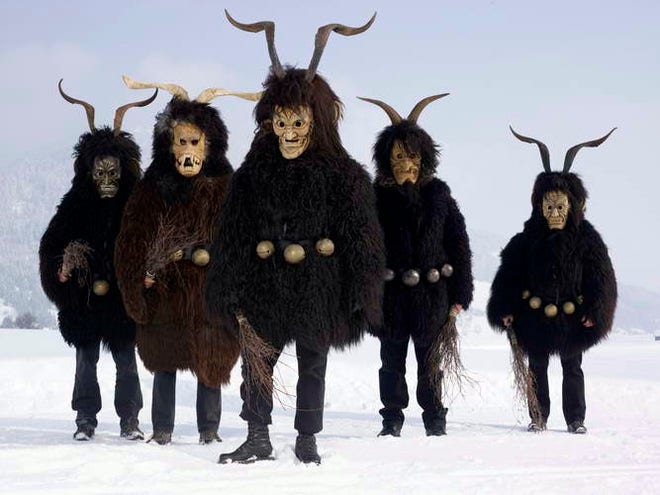
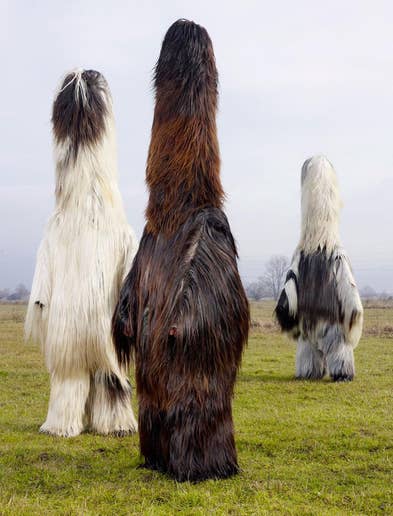
I don’t know anything about paganism, but a photographer spent some time travelling through Europe photographing pagan rituals.

Since this is an “Ask a pagan” thread, would someone please explain this:


These folks are dressed up as something called a krampus.
 
The first one is most likely Krampus. en.wikipedia.org/wiki/Krampus

The second one is related to the pan-European mythology of beast-men, from which the concept of werewolves (and probably also Krampus, in a corrupted post-Christianization of the original culture way) also descends. It most likely relates back to prehistoric shamanic practices where hunters “mantle” a real or mythological animal spirit to take on some of its qualities.

Edit: The closest concept I can think of that you may have already heard of would be the Southwestern Native American kachina masks. en.wikipedia.org/wiki/Kachina
 
Yes, the first is the Krampus, a pagan folk-lore figure from the Bavaria, Austria, and Switzerland. The Krampus has remained part of the local culture as basically the anti-Santa Clause. The people dressed as him arnt necessarily pagan (and in fact are probably catholic, being from the alps) but they are continuing a folk tradition that began within Pagan religion. This is the sort of stuff we mean when we say that paganism lived on in folk lore.
 
Status
Not open for further replies.
Back
Top