Atheists at Christmas: Eat, drink and be wary

  • Thread starter Thread starter Siddhartha
  • Start date Start date
Status
Not open for further replies.
S

Siddhartha

Guest
Even as they chafe at the omnipresence of Christmas, many of the atheists here are quick to stress their belief in the pagan roots of a yearly celebration near the winter solstice. Before Christianity and other organized religions, many cultures would mark the point where days started getting longer again with a “festival of light” that included parties, gift exchanges, even placing trees in homes. Some of those rituals were religious, but usually in a polytheistic way.
“What we’re celebrating this year is the promise of the sun returning. That’s S-U-N, not S-O-N,” said Bill Weir, a retired marketing executive from Plymouth.
“Then the Christians stole it,” added Marie Alena Castle of Minneapolis, the 82-year-old founder of Atheists for Human Rights and an atheist activist for two decades. It’s a season of celebration for the Jewish faith as well, with Hanukkah.
Still, none of the atheists interviewed for this story expressed a wish to be left out of Christmas entirely.
 
The Christians stole it? So are these Atheists saying they believe in a plathora of Gods, or are they saying they want to steal it as well?:confused:
 
40.png
Siddhartha:
do Buddhists celebrate Christmas?
 
The Christians stole it? So are these Atheists saying they believe in a plathora of Gods, or are they saying they want to steal it as well?:confused:
I’m pretty sure that they’re saying that Christians appropriated the celebration of the Winter Solstice – which corresponds to pagan celebrations, but obviously, one does not need to believe in gods to celebrate the changing of the seasons.
 
He seems a little too skinny to be a Buddha!😉
The “Fat Buddha” is actually a Chinese Buddhist monk named Budai (“Hotei” in Japanese).

http://www.newsfinder.org/images/uploads/uploads/laughingbudha.jpg

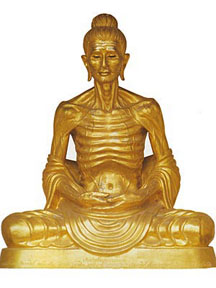
The real Buddha is Siddhartha Gautama, who was decidedly not fat (not that there’s anything inherently wrong with being fat). At one point, before he became enlightened, Siddhartha practiced the discipline of eating as little food as possible, and he got so thin that when he went to touch his stomach, he touched his spine instead:


Thankfully, Siddhartha soon realized, with the help of a compassionate girl, that eating too little was just as harmful as eating too much. Thus, Buddhism is also called “The Middle Way”, and condemns extreme asceticism as well as extreme indulgence. (Watch out for that Christmas turkey!:D)
 
The “Fat Buddha” is actually a Chinese Buddhist monk named Budai (“Hotei” in Japanese).

http://www.newsfinder.org/images/uploads/uploads/laughingbudha.jpg

The real Buddha is Siddhartha Gautama, who was decidedly not fat (not that there’s anything inherently wrong with being fat). At one point, before he became enlightened, Siddhartha practiced the discipline of eating as little food as possible, and he got so thin that when he went to touch his stomach, he touched his spine instead:

http://www.hsuyun.org/chan/images/stories/essays/falohng/asceticism-buddha-sm.jpg

Thankfully, Siddhartha soon realized, with the help of a compassionate girl, that eating too little was just as harmful as eating too much. Thus, Buddhism is also called “The Middle Way”, and condemns extreme asceticism as well as extreme indulgence. (Watch out for that Christmas turkey!:D)
Thanks for the education! Very interesting. Confucism seems to choose the moderate way too, are the two connected as philosophies?
 
Thanks for the education! Very interesting. Confucism seems to choose the moderate way too, are the two connected as philosophies?
The Greek philosophers talked about the Golden Mean, too.

Even St. Benedict in his rule, which he called “a little rule for beginners,” stressed moderation in asceticism.
 
Thanks for the education! Very interesting. Confucism seems to choose the moderate way too, are the two connected as philosophies?
In China, Confucius, Laozi (the founder of Taoism) and the Buddha are seen as symbolizing the three main life-choices: being an active member within society; living in harmony with nature; and entering the Transcendent.
 
The Greek philosophers talked about the Golden Mean, too.

Even St. Benedict in his rule, which he called “a little rule for beginners,” stressed moderation in asceticism.
Yes but I don’t think Jesus was for moderation! Pick up your cross, leave your family, let the dead bury their dead, sell all you have and follow Him. Pretty much all or nothing.😉
 
This reminds me of a joke: “I have the body of a god… unfortunately it’s Buddha.”😃

I guess it’s a common thing to think of Buddha as in the big chubby statues.

Anyway… I think I’m going to find an excuse to say, eat drink & be wary sometimes this Christmas… in reference to atheists of course:D
 
I’m pretty sure that they’re saying that Christians appropriated the celebration of the Winter Solstice – which corresponds to pagan celebrations, but obviously, one does not need to believe in gods to celebrate the changing of the seasons.
The Pagans however celebrated the winter solstice in relation to the gods, therefore, it is the atheists who have appropriated the celebration of winter solstice and not the Christians (since Christmas as nothing to do with the winter solstice).

p.s. Christmas was celebrated at this time of year in order to ease the transition of pagan converts into Christianity if I’m not mistaken.
 
p.s. Christmas was celebrated at this time of year in order to ease the transition of pagan converts into Christianity if I’m not mistaken.
If you’re correct, then you can’t say that Christmas has nothing to do with the Winter Solstice.

Then again, even if Christ really was born on or around 25 December, who is to say that the reason for that was absolutely not related to solar cycles? Perhaps the birth of Christ and the solar cycles were in synchronicity.
 
If you’re correct, then you can’t say that Christmas has nothing to do with the Winter Solstice.

Then again, even if Christ really was born on or around 25 December, who is to say that the reason for that was absolutely not related to solar cycles? Perhaps the birth of Christ and the solar cycles were in synchronicity.
Many early Christians used the solstice as an analogy to the coming of Christ. Christ is the bringer of light. As the Gospel of John says, ‘In him was life, and the life was the light of the world. And the light shineth in the darkness and the darkness did not comprehend it.’ Upon Christ’s birth, light came into the world. Similarly, around Dec.25 the days start to get longer.
 
If you’re correct, then you can’t say that Christmas has nothing to do with the Winter Solstice.

Then again, even if Christ really was born on or around 25 December, who is to say that the reason for that was absolutely not related to solar cycles? Perhaps the birth of Christ and the solar cycles were in synchronicity.
By “nothing” I meant we did not appropriate winter solstice in that the celebration of Christmas did not derive its origins from this pagan feast.

p.s. I’ll have to look into this but I’m fairly certain that the winter solstice derived in part from the celebration of Christmas.

note: I also believe that Jesus was thought to be born sometime in the spring.
 
Status
Not open for further replies.
Back
Top