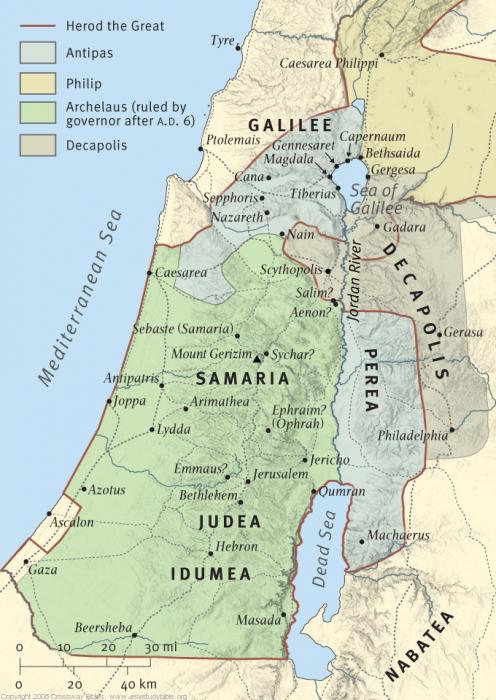
The political situation of the Holy Land during the time of Jesus was like this.
First off, the Galilee - where Jesus came from - and Judaea were technically different territories.
When “King of the Jews” Herod the Great died, his territory was split among three sons: Archelaus, Antipas and Philip. Archelaus got the lion’s share, the regions of Judea and Samaria, Antipas received the Galilee and Peraea (the east bank of the Jordan), while Philip got the rest. While Mark (and once, Matthew) call Antipas ‘King’ Herod, none of these sons were technically ‘kings’: Archelaus was an ethnarch ‘national leader’, while both Antipas and Philip were tetrarchs ‘rulers of a fourth’. Archelaus however ruled so badly that the Romans - who heard the complaint of Archelaus’ subjects against him - kicked him out and replaced him with a prefect around AD 6. Archelaus’ territory thus became a Roman province (a low-class one at that), the province of Judaea. (I’m spelling it with the extra ‘a’ to distinguish it from Judea proper.)
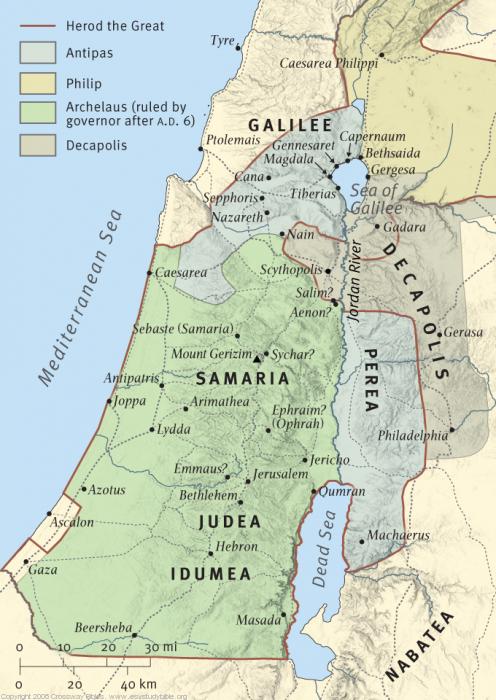 Galilee
The Galilee was under Antipas’ jurisdiction: he had his own soldiers and his own tax collectors*, and he ran his own government the way he wanted to. He paid tribute to Rome occasionally, kept things in line by keeping public order and defending his borders, and Rome would grant him some degree of autonomy in return (and some promise of protection against hypothetical enemies). He minted his own coins, one of the principal signs of ‘independence’.
- The tax collectors in the Galilee we see in the gospels - such as Matthew/Levi - would actually be working directly for Antipas, rather than Rome as we often imagine. In fact, the ‘hekatontarch’ in Capernaum - whose servant Jesus heals - is probably not a Roman centurion (because really, Roman troops had no business being in the Galilee at that time), but an official in Antipas’ army. We know that Herod the Great modelled his own personal army after the Roman military, and it’s not impossible his sons did likewise for their own armies. (Note that John’s closest parallel to the synoptic story of the centurion’s servant is the the son of the basilikos, the royal official.)
It’s kind of like the Soviet Union and its satellite states during the Cold War: Eastern Bloc countries established by the Soviets like East Germany, Hungary, or Poland all had their own ‘independent’ governments. They had to contribute to the Soviet Empire in various ways, but Moscow only intervened directly in these countries only very occasionally, when unrest or civil tumult got out of hand or when a brash government felt too independent. That’s the same tactic Romans used: as long as Rome saw that their client ruler ruled correctly, he was left in peace.
Judaea
Down south in Judaea, things were kind of a little different but at the same time, a little similar. While the prefect officially governed the area, actual daily government was left to Jewish authorities, who acted as the middlemen: for example, in Jerusalem it is the high priest and his circle of advisors. There were a few Roman soldiers in garrisons acting as token lookouts for trouble, but otherwise, cities, Jewish towns and villages were run by Jewish magistrates and elders, according to Jewish law. The Roman prefect only showed up in Jerusalem during the major pilgrimage festivals (such as Passover) to check for any potential unrest. During the rest of the year, however, he and most of his soldiers are in Caesarea-by-the-(Mediterranean) Sea (Maritima) with other gentiles. Again, you have here a form of indirect rule: letting the natives run their own affairs.
Speaking of which, the time when Jesus dies - the late 20s-30s - were actually relatively ‘peaceful’. When we think of the 1st century and imagine all those Roman soldiers patrolling the streets, that’s actually a picture that would fit the 50s-60s, when the land was becoming dangerous and Jews were beginning to engage in a massive rebellion against the Romans, more than the time Jesus lived in. There was of course
the threat that some uprising might erupt (it was a sort of tense ‘peace’), but all in all, the first half of the 1st century was relatively better when you compare it to the latter half of the same century.
Nothing has changed in the Middle East then and now: it was just a very volatile, tense place as it is today. A complete 180 could happen in just a matter of years. A lot changed in the decade or two after Jesus; ‘s*** just got real’ (pardon the crude slang) after Jesus was gone.