
N
NihilObstatINRI
Guest
This is a reflection on last week’s Gospel on the old calendar cycle.
Reference:
(Jn 8: 51-59)
If the Agony in the Garden is the best look at the dual natures of Christ, this passage may be the best example of His divinity alone. Specifically we should recall that God instructed Moses to tell the Hebrews “I Am has sent you”. God tells Moses “I AM that I am.”
Important to understand here is the continuity of existence, specifically Jesus’ claim to an uncreated existence. He did not say “before Abraham was made, I was made.” He said very specifically “I am”. There was no time where He was not. Very truly therefore, do we say that Christ was eternally begotten, not made.
http://kaweah.com/igneousrange/wp-content/uploads/2009/11/burning-bush.jpg
If we look further, we see also that Christ is not claiming to be the Father. Rather, He is showing the Jews Who really spoke to Moses in Exodus. He told Moses “I am”, and he tells the Jews in this Gospel the same; it was Jesus in both instances. As St. Justin the Martyr says in the First Apology, “Although the Jews were always of the opinion that it was the Father of all who had spoken to Moses, it was in fact the Son of God, who is called both Angel and Apostle, who spoke to him; they are, therefore, justly accused by both the Prophetic Spirit, and by Christ Himself of knowing neither the Father nor the Son. They who assert that the Son is the Father are proved to know neither the Father, nor that the Father of all has a Son, who is both the first-born Word of God and is God. Formerly, He appeared to Moses and to the other prophets in the form of fire and as an incorporeal image; and now, in the times of your reign, having become man, as we said, by a Virgin and by the will of the Father, for the salvation of those who believe in Him, He allowed Himself to be treated with contempt and to suffer so that by death and resurrection He might conquer death.” (Faith of the Early Fathers , §127)
Similarly, as Tertullian said in The Demurrer Against the Heretics, “There is one only God, and none other besides Him; the Creator of the world who brought forth all things out of nothing through His Word, first of all sent forth. This Word is called His Son; and in the name of God He was seen at various times by the patriarchs, and has always been heard in the Prophets [remember, “He has spoken through the prophets”]; and at last He was brought down from the Spirit and Power of God the Father into the Virgin Mary, and was made flesh in her womb; and having been born from her, came forth as Jesus Christ.” (Faith of the Early Fathers, §290)
This also connects, I see, to the last Gospel of the TLM.
Reference:
(Jn 1:1-14)
In the beginning was the Word. I Am; there is no beginning to Christ’s existence. He Is. He is with God in the beginning. The same Word was made flesh (obviously now John speaks of Jesus Christ), and the Word was begotten of the Father, though He was not made by the Father.
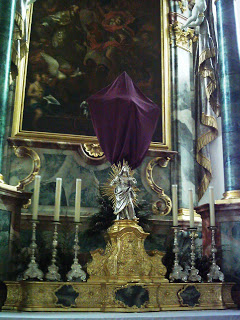
Finally, at the end of Passiontide’s Gospel, we see that Jesus hides Himself after the Jews present there take stones with which to kill Him. This connects in a powerful way to Lent as we draw quickly towards the climax of the Crucifixion, though the hour has not quite yet come. Jesus has been hidden from those who rejected Him. In the same way, now from Passiontide we may now cover images and crucifixes. As I wrote before, at the beginning on Lent it was inappropriate to do so, but now as Lent is far more advanced, Jesus Himself has been hidden from our sight. We have rejected Him like the Jews in the Temple, and we no longer see Him.
Jesus says earlier in this Gospel (verse 24) “For if you believe not that I am he, you shall die in your sin.” We are weak and sinful, and continually tempted not to believe in Him. The Lenten season represents poignantly our own weakness before God, and reminds us of how we continually reject Him. Therefore, when we do not believe in Him, nor can we see Him.
It is not, in fact, God who has veiled himself, but we who have veiled Him. We have rejected Him and hidden Him away, because when we gaze upon Him we are convicted of our sins. Soon, at Good Friday, we will again see Him. He will die with all the sin and rejection and weakness of the world upon Himself, and tear the veil of the temple in two. As He tears the temple’s veil, He also tears away the veil we ourselves placed on Him. Then we will see Him as He dies, and if we choose, we will see Him again when He rises in glory.

Reference:
(Jn 8: 51-59)
If the Agony in the Garden is the best look at the dual natures of Christ, this passage may be the best example of His divinity alone. Specifically we should recall that God instructed Moses to tell the Hebrews “I Am has sent you”. God tells Moses “I AM that I am.”
Important to understand here is the continuity of existence, specifically Jesus’ claim to an uncreated existence. He did not say “before Abraham was made, I was made.” He said very specifically “I am”. There was no time where He was not. Very truly therefore, do we say that Christ was eternally begotten, not made.
http://kaweah.com/igneousrange/wp-content/uploads/2009/11/burning-bush.jpg
If we look further, we see also that Christ is not claiming to be the Father. Rather, He is showing the Jews Who really spoke to Moses in Exodus. He told Moses “I am”, and he tells the Jews in this Gospel the same; it was Jesus in both instances. As St. Justin the Martyr says in the First Apology, “Although the Jews were always of the opinion that it was the Father of all who had spoken to Moses, it was in fact the Son of God, who is called both Angel and Apostle, who spoke to him; they are, therefore, justly accused by both the Prophetic Spirit, and by Christ Himself of knowing neither the Father nor the Son. They who assert that the Son is the Father are proved to know neither the Father, nor that the Father of all has a Son, who is both the first-born Word of God and is God. Formerly, He appeared to Moses and to the other prophets in the form of fire and as an incorporeal image; and now, in the times of your reign, having become man, as we said, by a Virgin and by the will of the Father, for the salvation of those who believe in Him, He allowed Himself to be treated with contempt and to suffer so that by death and resurrection He might conquer death.” (Faith of the Early Fathers , §127)
Similarly, as Tertullian said in The Demurrer Against the Heretics, “There is one only God, and none other besides Him; the Creator of the world who brought forth all things out of nothing through His Word, first of all sent forth. This Word is called His Son; and in the name of God He was seen at various times by the patriarchs, and has always been heard in the Prophets [remember, “He has spoken through the prophets”]; and at last He was brought down from the Spirit and Power of God the Father into the Virgin Mary, and was made flesh in her womb; and having been born from her, came forth as Jesus Christ.” (Faith of the Early Fathers, §290)
This also connects, I see, to the last Gospel of the TLM.
Reference:
(Jn 1:1-14)
In the beginning was the Word. I Am; there is no beginning to Christ’s existence. He Is. He is with God in the beginning. The same Word was made flesh (obviously now John speaks of Jesus Christ), and the Word was begotten of the Father, though He was not made by the Father.
Finally, at the end of Passiontide’s Gospel, we see that Jesus hides Himself after the Jews present there take stones with which to kill Him. This connects in a powerful way to Lent as we draw quickly towards the climax of the Crucifixion, though the hour has not quite yet come. Jesus has been hidden from those who rejected Him. In the same way, now from Passiontide we may now cover images and crucifixes. As I wrote before, at the beginning on Lent it was inappropriate to do so, but now as Lent is far more advanced, Jesus Himself has been hidden from our sight. We have rejected Him like the Jews in the Temple, and we no longer see Him.

Jesus says earlier in this Gospel (verse 24) “For if you believe not that I am he, you shall die in your sin.” We are weak and sinful, and continually tempted not to believe in Him. The Lenten season represents poignantly our own weakness before God, and reminds us of how we continually reject Him. Therefore, when we do not believe in Him, nor can we see Him.
It is not, in fact, God who has veiled himself, but we who have veiled Him. We have rejected Him and hidden Him away, because when we gaze upon Him we are convicted of our sins. Soon, at Good Friday, we will again see Him. He will die with all the sin and rejection and weakness of the world upon Himself, and tear the veil of the temple in two. As He tears the temple’s veil, He also tears away the veil we ourselves placed on Him. Then we will see Him as He dies, and if we choose, we will see Him again when He rises in glory.
