Bells ringing during the Consecration - OF Mass

  • Thread starter Thread starter MissRose73
  • Start date Start date
Status
Not open for further replies.
For us, recovery is a simple altar, with a crucifix, tabernacle on a pedestal behind it (our altars were never attached to the wall), no Gregorian chant, but beautiful hymns in whatever language is available (Latin, German, English, etc), very simple buildings with minimal decorations, statues, and furniture. Though I have to say that frescos are very much a part of Franciscan tradition. Francis liked them and he also liked icons.
Just curious, but was Mass said ad orientem in the Franciscan tradition? Also, is there anything like a “Franciscan Gradual” for the simple chant?
 
Just curious, but was Mass said ad orientem in the Franciscan tradition? Also, is there anything like a “Franciscan Gradual” for the simple chant?
There was never a gradual. You made it up as you went along and we still make it up as we go along.

Until we got into parishes, the mass was rather awkward, because it was only for the friars. The celebrant would face ad orientem, but the other friars were never looking at his back. They would stand around the altar or on either side of the altar. You still see it in those places where there is a large enough sanctuary to do this.

When they started to take over parishes, the congregation became bigger and everyone face in the same direction, as orientem. As we start to close parishes and we retreat back to our small chapels, we’re back to the community gathered around the altar or at least right in front with the celebrant facing the community.

Remember, the goal is to avoid singularizing the priest. He must always remember that he is a brother. Even when you look at old videos of Padre Pio, you will notice several friars around him during mass. This is very common. These friars are not ordained. They assist in some way. In Padre Pio’s case, since he was stationed at the house of formation, there were always transitional deacons and subdeacons too. You will see a lot of people in the sanctuary. Later, microphones would be introduced so that the friar presiding at the mass did not have to shout the canon and words of consecfration in order to be heard. It was very difficult to say them softly, as the rubrics require, but loudly enough to be heard by your congregation.

I remember we were trained in Soft, loud, low, clear and slow. That almost sounded silly to us. It required a lot of work to get it just right. Thank God for microphones.

Fraternally,

Br. JR, OSF 🙂
 

They did this form of act whenj it was said in Latin. But the reakl meaning for this ias that the churches were so largre AND THE PEOPLE COULND’T SEE, SO WHENE THE BELLS WOULD RING IT MEANT THAT THE CONSECRATION WAS BEING TAKEN.

JESUS I TRUST IN YOU

jr
That is historically inaccurate. The bells were rung for the same reason ANY Church bells were rung, as a celebration.

It became easier for someone just to ring a small bell than having someone pull the ropes on the main bells. but the reason was the same, it was an important act.

We see the same in the Eastern Catholic liturgies, those were commonly done in the the local language (Russian, Greek, etc…) but they have used bells for the same reason, and length of time as the Roman Church has.

It is a sing of great joy!
 
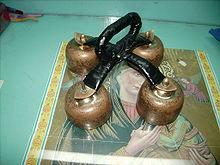
I would like to add nothing whatsoever of value to this thread and say that I got to ring the bells tonight at Mass. They were one of those four bell chime jobs with a hand grip on top.

I swang the thurible at a benediction too. I love that.

Like I said, no value here. Carry on. 😃

-Tim-
 
I would like to add nothing whatsoever of value to this thread and say that I got to ring the bells tonight at Mass. They were one of those four bell chime jobs with a hand grip on top.

I swang the thurible at a benediction too. I love that.

Like I said, no value here. Carry on. 😃

-Tim-
I have never been able to ring those things and make them sound beautiful. Some people have just the right wrist movement. Not I. 😦

Fraternally,

Br. JR, OSF 🙂
 
I have never been able to ring those things and make them sound beautiful. Some people have just the right wrist movement. Not I. 😦

Fraternally,

Br. JR, OSF 🙂
you mean theses?


yeah, they take practice to do it right. it took me forever to make it graceful and good sounding
 
Yeppers, those. I just don’t have the gift. When I ring them, they sound like Santa coming into town.

Fraternally,

Br. JR, OSF 🙂
Well, St. Nick was a bishop. That’s close enough for me.

I have a book by Dom Matthew Britt, O.S.B titled “How to Serve.” The fact that its copyright is 1934 should give a hint…

*How Rung

The bell should be rung softly and gently but sufficiently loud that it can be heard by those in the rear pews. In the ringing of the bell abruptness and violence should be avoided. A single stroke of the bell is preferable to a prolonged ringing. Thus, at the Sanctus, three distinct strokes, not too close together, are given; and that the Hanc igitur one stroke. At the Consecration the server rings the bell six times in all, once at each of the four genuflections, and once when the priest elevates the Host, and again when he elevates the Chalice. The ribric here permits the bell be rung but twice, and that continously from the time the priest begins to elevate the Host or Chalice till he again replaces it on the altar. The former is the better method and the one in general use.

What It Is

According to the rubrics of the Missal, the altar bell is a small hand bell. Nothing can equal in appropriateness a simple, single, sweet-toned bell. Bishop Van der Stappen would tolerate a correctly tuned chime of three or four small bells, but he hastens to add that the single bell prescribed by the rubrics is prefferable.

What It Is Not

Gongs are forbidden. But no less objectionable are chimes of plates or tubes mounted on a board, and so-called electric altar chimes which consist of tubes operated from a keyboard sunk in the altar step. Such devices savor of the theater, not of the sanctuary.*

It goes on about when to ring the bells and when not, about not rining the bell during a low Mass when a High Mass is also being sung in the same Church, and such things which make little sense to me. I bought the book hoping it would give me some pointers on being a better altar server but it is not too relevant. Fascinating, but not that relevant. One thing it did teach me is how to properly put on a surplice. Maybe I should read it again.

Again, another low value post. 🤷 Maybe I’ll keep it up all night and take a personal day tomorrow. 😃

-Tim-
 
I would like to add nothing whatsoever of value to this thread and say that I got to ring the bells tonight at Mass. They were one of those four bell chime jobs with a hand grip on top.

I swang the thurible at a benediction too. I love that.

Like I said, no value here. Carry on. 😃

-Tim-
I just realized…

Is “swang” a real word?

-Tim-
 
I just realized…

Is “swang” a real word?

-Tim-
just as much as “thurificized”.

Yep. I said it: thur-if-i-cised

take it or leave it. i heard it used somewhere, and i think its helarious
 
Well, St. Nick was a bishop. That’s close enough for me.

I have a book by Dom Matthew Britt, O.S.B titled “How to Serve.” The fact that its copyright is 1934 should give a hint…

How Rung

The bell should be rung softly and gently but sufficiently loud that it can be heard by those in the rear pews. In the ringing of the bell abruptness and violence should be avoided. A single stroke of the bell is preferable to a prolonged ringing. Thus, at the Sanctus, three distinct strokes, not too close together, are given; and that the Hanc igitur one stroke. At the Consecration the server rings the bell six times in all, once at each of the four genuflections, and once when the priest elevates the Host, and again when he elevates the Chalice. The ribric here permits the bell be rung but twice, and that continously from the time the priest begins to elevate the Host or Chalice till he again replaces it on the altar. The former is the better method and the one in general use.

What It Is

According to the rubrics of the Missal, the altar bell is a small hand bell. Nothing can equal in appropriateness a simple, single, sweet-toned bell. Bishop Van der Stappen would tolerate a correctly tuned chime of three or four small bells, but he hastens to add that the single bell prescribed by the rubrics is prefferable.

What It Is Not

Gongs are forbidden. But no less objectionable are chimes of plates or tubes mounted on a board, and so-called electric altar chimes which consist of tubes operated from a keyboard sunk in the altar step. Such devices savor of the theater, not of the sanctuary.

It goes on about when to ring the bells and when not, about not rining the bell during a low Mass when a High Mass is also being sung in the same Church, and such things which make little sense to me. I bought the book hoping it would give me some pointers on being a better altar server but it is not too relevant. Fascinating, but not that relevant. One thing it did teach me is how to properly put on a surplice. Maybe I should read it again.

Again, another low value post. 🤷 Maybe I’ll keep it up all night and take a personal day tomorrow. 😃

-Tim-
not low value!!
 
just as much as “thurificized”.

Yep. I said it: thur-if-i-cised

take it or leave it. i heard it used somewhere, and i think its helarious
I dare you to say that word really fast five times. 😃

Fraternally,

Br. JR, OSF 🙂
 
I had no idea about the bells thing and how they were to be done or variations, thank you for that recent post Timothy.
 
I’m an alter boy, 67 year old alter server, during the week. When I ring the bells, each time I ring them three times in honor of the Trinity that is present at the Consecration.
The origin of the bells is from the large Cathedrals in Europe. The people in the rear of the church had a hard time seeing. To help them know that the Consecration was taking place, they rang the bells. It used to be that the Priest would genuflect, then he would raise the Host, then would genuflect again. The same would happen for the consecration of the Blood of Christ. The bells were to ring on each genuflection and each time the Body or Blood of Jesus were raised.
I know it is not mandatory to ring the bells but I have never been in a Catholic Church where they were not used.
This is a little thing in itself, but so many things have been done away with that would add to the reverence of the Mass.
Actually that is that not the origin of sanctus bells. I mention it only because some people argue that sanctus bells are not needed now that the Mass is in the vernacular and the priest faces them. If what you say was accurate their comments might have merit and they do not.

The history and use of sanctus bells is given at www.SmellsBells.com
 
"…Finally, the use of substitutes for genuine sanctus bells has also quite rightfully soured many on the ringing of bells during the Mass. Old cow bells, gongs, Tibetan singing bowls, xylophones, etc. are all unacceptable substitutes for true sanctus bells per the Catholic Church.15, 16

  1. Sacred Congregation of Rites (Decree of September 10, 1898.) Negative response to Archbishop of Mexico on request to use oriental gong.
  2. De musica sacra et sacra liturgia. Instruction on Sacred Music and Sacred Liturgy Sacred Congregation for Rites. September 3, 1958.
From www.SmellsBells.com/sanctusbells.pdf pg.12
 
I too, and many of my mass-going friends sadly miss the ringing of the Sanctus bells. This to us in an integral part of the Mass and is part of the " Sounds and Smells of theMass(Sanctus Bells, Candles etc) that we are all so familiar with. We feel that it greatly takes from the Great Importance of the Moments of Consecration and we would like to begin a campaign to ensure that the Sanctus Bells are rung in all Churches throughout the World at all Masses.
We feel that ordinary daily Parishioners like ourselves can request this and we ask your support and backing by responding to this post, to inform the Clergy of our feelings.

Kind regards from " Savethebells"
 
It’s done at my parish, but only three times: When the priest extends his hands over the offerings, when he elevates the Host, and when he elevates the Chalice. (Our new pastor is having the altar servers ring the bell once at the Elevation instead of thrice, as our previous pastor required. I would love for it to change back to thrice). I would add more ringings of the bell if it were up to me.

I would want the altar server to ring the bell three times during the Sanctus, once when the priest extends his hands over the offerings, three times when he elevates the Host and Chalice, once each time he genuflects, once when he consumes the Host, once when he consumes the Blood, and once during the Ecce Agnus Dei.
 
I went to a special Mass Friday that was to anticipate the Feast of St Therese, and just after the Host was raised, the bells were rung by an altar boy. Same after the Chalice was raised. This was at an Ordinary Form Mass. I thought it was a beautiful thing to experience.

Has anyone experienced this? Would you like to have that custom restored to the Ordinary Form Mass, yes or no, and why?
The bells at the consecration of the Mass symbolize trembling. It calls to mind to the following Sacred Scripture verse: “Therefore, my beloved, as you have always obeyed, so now, not only as in my presence but much more in my absence, work out your own salvation with fear and trembling” - Philippians 2:12
 
Status
Not open for further replies.
Back
Top