
Bucking a trend, these churches figured out how to bring millennials back to worship

  • Thread starter Thread starter Duesenberg
  • Start date Start date
Status
Not open for further replies.
Catholic faith is rich, beautiful and traditional. Our faith should stop trying to compete with rock bands and flashing lights. It’s not about us.

It’s not about us.

It’s about worshiping our dear Lord Jesus Christ! Worshipping HIM! Not being entertained and coddled and lured in with “hip! fresh! new!” music… We have beautiful sacred music that is not of this world. We have the TRUE presence of the Living God in our Eucharist every single day. If you want coffee bars, rock concerts, jeans-n-tees, social groups and a bunch of jumping, clapping and praise the Lord-ing, then open some Catholic community centers for teens and young adults to socialize with like minded people.

But the Mass is sacred. We are worshipping our Lord. The focus is on Him and its our responsibility to grow in our faith enough where we are willing to let go of the world and conduct our lives with a view towards eternity.
 
Hahah I’m seriously the same. I like going to mass and not having to talk to anyone afterwards or go to coffee and donuts because frankly the people aren’t really my crowd (plus often there is gossip which makes me go, “really?”) but in general I don’t talk much anyway.
 
Meeting people where they are at is important otherwise such innovations can seem superficial and miss the point.

I think the biggest problems for young adults in the church are lack of other young people to begin with, it’s very off putting to go to church at 21 and for there to be no one your age, I found most of the older adults at church really weren’t used to talking to younger adults.

The other is that a lot of ministries are exclusively for retired people. It’s all well and good when the core of a church are sprightly 60 somethings but in 20 years time there could be trouble.

I think all parishes unintentionally have a preferred demographic that they cater to and it isn’t likely to be young adults.
 
That was an interesting article, thanks for sharing. This part really resonated with me:
I have spent plenty of time parish shopping—it took me a while to find a sacramental home. I have been the youngest person in the pews too many times. I can no longer count the number of churches I have walked in and out of without anyone saying hello and asking what my name was, or if I was new.
Like, is this person me? Did I write this?
 
I guess having a welcoming church is important, but it’s only for some people.
It should be for everyone. Maybe not back-slappy/schmoozy, but if you’re a regular, you should know people around you by name. Ideally you should be greeted at the door by name.
It makes me uncomfortable when I go to church and they expect me to be all social and talkative with people.
No, not really. But one should still be cordial.
It probably makes me sound mean, but I honestly don’t want to talk to anyone at my church.
That is very, very sad. The ticket-punching syndrome of coming to Mass for 45 minutes/week and then completely absent from parish life the rest of the week is far from optimal.
I personally don’t like specialized outreach that’s focused on specific groups of people.
Again, sad. Just choose not to take part.
Whenever a group tries to get me interested by being all modern or techy (I’m just a bit younger than millennials), I find it very off putting.
Yeap…
 
This isn’t about changing people and their preferences, or forcing people to interact if they don’t want to. This also isn’t about making everything more “modern” or “techy”.

This is about offering young adults things in a parish that they want and that they can take part in.

In another thread, it was mentioned that on some college campuses in the US having 10pm Masses is really great—they are well attended by students. That is addressing a community need, and preference.

If the majority of parish life is happening however at 10am those who do seek out community, faith instruction or other ministries cannot attend.
 
Last edited:
Thanks for linking that as it was also a good read.

The part about the church not being able to be continuously there in lifes transitions really resonated with me as I felt lost after university and came close to giving up.

I’m not sure if regional things would work so well in the UK for young adults as many don’t drive. Even if you do, my husband and I tried one earlier this year and it was a nightmare getting through the traffic and only a small number of young Catholics. I think local ecumenical young adult groups for prayer, service and fellowship could work better.
 
The importance of making people feel welcomed into a community and having a strong fellowship component to Sundays.
My concern is that, during this process of making young people feel welcome, the alienated most of their current members, writing them off as casualties of change. In addition to showing a complete disregard to the spiritual needs of their existing congregation, they created a church in which there are very few members of mature faith. An age-segregated Church does not strike me as particularly healthy. I’m troubled by this trend in our society and I’ve seen it quite a bit in Protestant churches. They have children’s church for the children and childless or older adults are never exposed to them. They have a Modern Service, a Contemporary Service, and a number of other activities segregated by age. While I understand the need and desire of people at the same stage of life to spend time in fellowship with others who are also in that stage, I think we need to be careful to avoid extremes. I think this model takes it to an extreme. Young people need to have the opportunity to learn from older people. Older people need to have the exposure to young people so that they can develop greater understanding and tolerance. It would be interesting to do a study and see how many of these new millennial churchgoers are still attending that church, or any church, in 10 years. I really feel for the former members of the congregation who were basically told that traditions that built and formed their faith we’re no longer relevant.
 
If Pastor AD3 sensed that people were tired of the status quo, if he sensed his congregation wanted/needed highly solemn “bells and smells” services, he would have provided them because it’s clear he listens to their needs.
He did not listen to the needs of his congregation. For the most part, they left because this type of church did not fit their needs. He chose a new congregation.
 
This part does make me uncomfortable, like the original congregation was too old. Ideally they should have tried incorporating younger people into the existing structure or if that failed creating an additional community more suited to young worshippers.
 
This is just my opinion from my side of the world.

I would say that we are usually drawn to the amount of passion here. For some, it could mean a better choir. For others it could be sound doctrine.

In my own opinion, better preachers that, well, preach proper doctrine would be what I would like. More charismatic people will help with the whole lack of passion here. I would like a couple of Fr Mikes in my parish.

There doesn’t have to be changes in the Mass, besides better homilies imo. (and maybe a more talented choir). I think it’s those ‘side dishes’ that make a difference. I know more youths are getting fired up because of the catholic conferences the US have
 
Last edited:
Maybe some Protestants on here can elaborate on this, but I find myself scratching my head sometimes about how non-Catholic religious ministers are given responsibilities within their demnominaiton. It seems like our requirements for priests are more stringent.
That really depends on the denomination, Presbyterian ministers e.g. are very highly educated. Its less so with pentecostal, baptists, independent ministers
 
I do see your point. I do not want shmoozy greetings and electric guitars in mass but, at my hometown parish our choir groups are made up of people 60 years and older. They do not welcome newer, younger members at all. I worry as to what will happen as they get too old to sing and these songs and traditions have not passed on! The groups are almost like an exclusive club for the rich and old!
 
Maybe some Protestants on here can elaborate on this, but I find myself scratching my head sometimes about how non-Catholic religious ministers are given responsibilities within their demnominaiton. It seems like our requirements for priests are more stringent.
I think the requirements for a priest are much more stringent than any Protestant church. Many Protestant ministers are well educated, especially in the more established denominations. And a pastor might well have a doctorate. But the requirements for any priest is certainly more than the average Protestant minister.
 
For many Protestants worship is about community. For many modern Catholics this may also be true. But Catholic Mass should be focused on God. Fellowship is good but it should take place outside the context of Mass. If fellowship is what primarily brings someone to church then they are missing the point. A man should want to worship God despite a lack of fellowship.
 
I think a lot of Catholics would be amazed if their pastors truly tried to find out what they wanted and then tried to provide it.

You want a quick a capella in-and-out Mass at 07:00? We can accommodate that.

You want the full bells and smells at 09:00 prefaced by a Rosary? OK.

You want a family-friendly Mass at 11:00? We can do that!

You want a Charismatic Renewal Mass at 10:00 PM? We’ll do our best!

It’s not about “modernization.” It’s about listening and ministering. Concepts so foreign to us at times that we discount their value.
The Church exists to lead us not to follow the various whims of the people. The Church should have continuity across time because she exists across generations. This doesn’t mean the Church can’t adapt to times, but it shouldn’t be a complete surrender to the times.

The Church is catholic. There is a danger in catering too much to different groups as that makes the Church less catholic.
If Pastor AD3 sensed that people were tired of the status quo, if he sensed his congregation wanted/needed highly solemn “bells and smells” services, he would have provided them because it’s clear he listens to their needs.
A lot of the meeting people’s needs seems to me providing some sort of feeling. A lot of popular religious practice is about moving the emotions. Moving the emotions isn’t bad, but the True Faith is reasonable. It appeals and is in sync with reason. Emotions shouldn’t be a focus but something that naturally follows from being in accord with reason.
 
I agree with you. I actually think even things like different grades in school are detrimental. The modern world is about segmenting people and keeping them isolated. It is about destroying the family, the first and most lasting bond in society. It is about creating radical individuals. The creation of the modern teenager who rebels against everything his family values isn’t an accident but a purposeful result from the system we’ve had imposed on us.
 
Well if millennials never felt apart of the Catholic Mass. My question is what did they put into it. It’s more than just a warm fuzzy feeling we go back in time with saint Irenaeus, Saint Augustine, st. Therese of Avelar, they understood what it meant to be Catholic and to receive the real body and blood of Jesus in the Eucharist.
There are plenty places for millennial in the Catholic Church. They have Youth Choir, youth retreat team for confirmation and Bible study. So to go outside of the Church to find because you are getting fed better is a cop out. Millennials don’t like it today just like I didn’t like it in the past because I didn’t understand what was going on. A miracle takes place everyday in every Catholic Church at every Mass when the priests raises the Bread and Wine and it is changed into the body and blood of our Lord. What they have is not a Church but a community that believes in God but doesn’t have the full revelation that Christ and the early Church and what they gave us.
 
Sometimes I wonder if my city would do well with a “Catholic club”? A central club where Catholics could go to after Mass at their home parishes for coffee, fellowship, simple meals, mini-courses, etc., etc. that so many parishes seem to lack?
That sounds like a good function for the cathedral or major shrine.

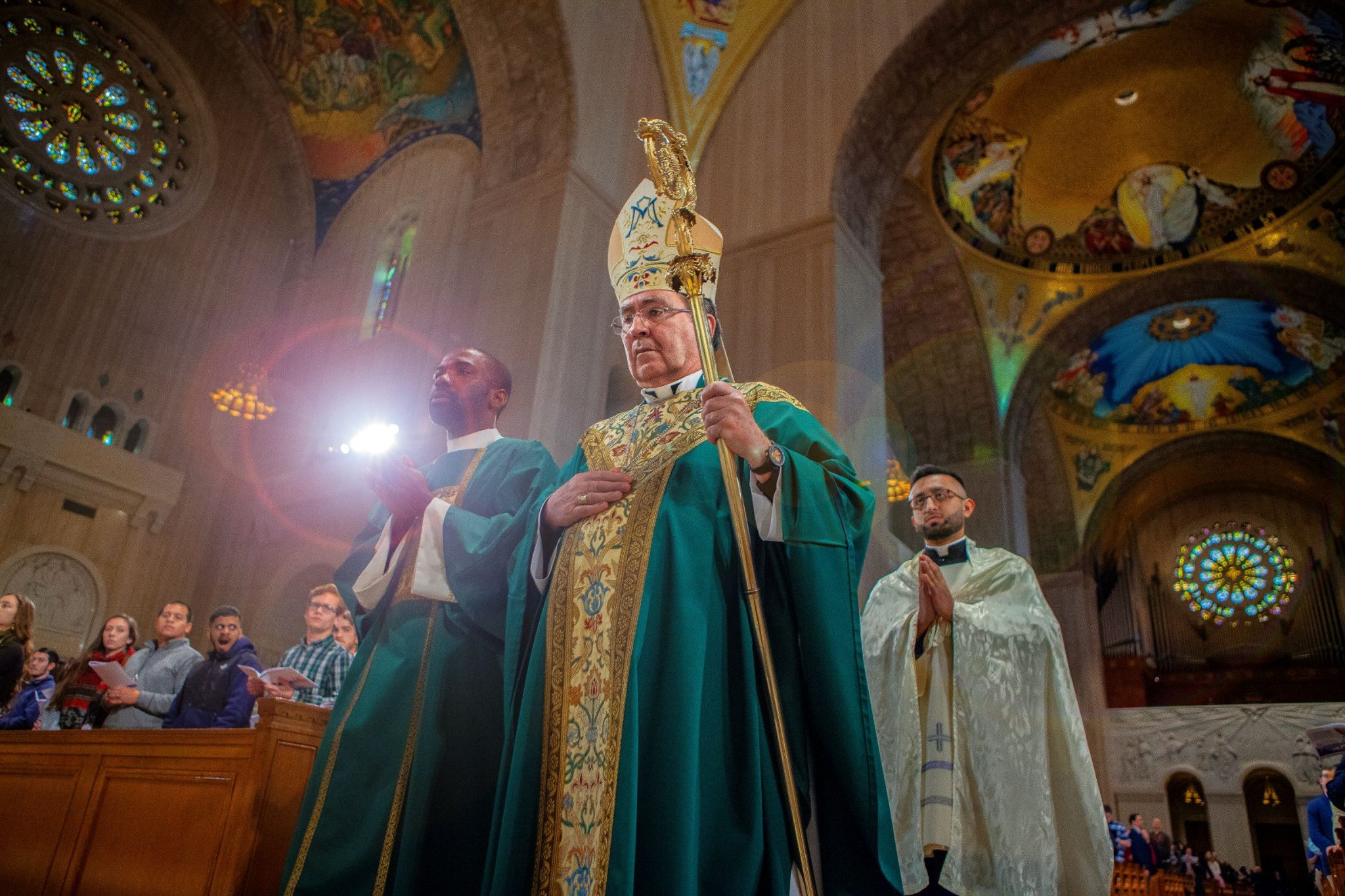
When we lived in DC, the National Shrine offered some of that, as you’d have the upper church, the crypt, a side chapel Mass, a cafeteria and a book shop.

The National Shrine has 7 Sunday Masses: 5:15PM vigil, 7:30 AM, 9 AM, 10:30 AM, noon (choir and sign languaghe), 1:30 PM (en espanol) and 4:30 PM.

 
Status
Not open for further replies.
Back
Top