Can a communion that respects Tradition retain orthodoxy without the Magisterium in an increasingly anti-Christian Western culture?

Status
Not open for further replies.
Not necessarily . Even a tradition built on doctrine, such as Lutheranism, has not done well maintaining orthodoxy over the last 60 to 80 years.

Jon
This is not so much a discussion from me but rather a request. Do you mind to expand on that (tradition built on doctrine) and perhaps give an example (in Lutheranism)?
 
This is not so much a discussion from me but rather a request. Do you mind to expand on that (tradition built on doctrine) and perhaps give an example (in Lutheranism)?
I’m new to Anglicanism, so somewhat of a novice, but by comparison, for virtually all Lutherans, the doctrinal symbols consist of the three ancient creeds, the Augsburg Confession and the Small Catechism. To these, Lutherans will say , “we believe, teach, and confess”. By contrast, the 39 Articles were not even part of my catechesis. Not all Anglicans are bound to them. Guys like GKC can give more details.
So, as we look at pan- Lutheranism’s struggle ( or lack thereof)to maintain orthodoxy, we see some move away from those doctrinal teachings. Even an otherwise orthodox synod such as the LCMS has allowed unordained seminarians to celebrate the sacrament, in direct violation of CA article XIV.

Jon
 
I’m new to Anglicanism, so somewhat of a novice, but by comparison, for virtually all Lutherans, the doctrinal symbols consist of the three ancient creeds, the Augsburg Confession and the Small Catechism. To these, Lutherans will say , “we believe, teach, and confess”. By contrast, the 39 Articles were not even part of my catechesis. Not all Anglicans are bound to them. Guys like GKC can give more details.
So, as we look at pan- Lutheranism’s struggle ( or lack thereof)to maintain orthodoxy, we see some move away from those doctrinal teachings. Even an otherwise orthodox synod such as the LCMS has allowed unordained seminarians to celebrate the sacrament, in direct violation of CA article XIV.

Jon
This thread helps with my comment about Anglicans.

Jon
 
I’m new to Anglicanism, so somewhat of a novice, but by comparison, for virtually all Lutherans, the doctrinal symbols consist of the three ancient creeds, the Augsburg Confession and the Small Catechism. To these, Lutherans will say , “we believe, teach, and confess”. By contrast, the 39 Articles were not even part of my catechesis. Not all Anglicans are bound to them. Guys like GKC can give more details.
So, as we look at pan- Lutheranism’s struggle ( or lack thereof)to maintain orthodoxy, we see some move away from those doctrinal teachings. Even an otherwise orthodox synod such as the LCMS has allowed unordained seminarians to celebrate the sacrament, in direct violation of CA article XIV.

Jon
The Articles were theology fashioned by politics. Or, politics manipulating theology.
As oft mentioned, the two fields were oft closely intertwined.
 
I’m new to Anglicanism, so somewhat of a novice, but by comparison, for virtually all Lutherans, the doctrinal symbols consist of the three ancient creeds, the Augsburg Confession and the Small Catechism. To these, Lutherans will say , “we believe, teach, and confess”. By contrast, the 39 Articles were not even part of my catechesis. Not all Anglicans are bound to them. Guys like GKC can give more details.
So, as we look at pan- Lutheranism’s struggle ( or lack thereof)to maintain orthodoxy, we see some move away from those doctrinal teachings. Even an otherwise orthodox synod such as the LCMS has allowed unordained seminarians to celebrate the sacrament, in direct violation of CA article XIV.*

Jon
*Well, *one *District President in *one *district of the LCMS permitted this nonsense for *one *congregation, as far as I’m aware (though I’m certainly open to correction). Whatever the case, most Missourians would be outraged to know this profane abuse took place within their communion. :o

The newly-reelected Synodical President is currently pressing forward movements for this week’s National Convention to stamp out this and other similar shirkings of the Confessions with regard to the Office of Holy Ministry. That there is an overwhelming and active movement from clergy and laypersons to “clean up” the church is a sign of its good health, I think.
 
*Well, *one *District President in *one *district of the LCMS permitted this nonsense for *one *congregation, as far as I’m aware (though I’m certainly open to correction). Whatever the case, most Missourians would be outraged to know this profane abuse took place within their communion. :o

The newly-elected Synodical President is currently pressing forward movements for this week’s National Convention to stamp out this and other similar shirkings of the Confessions with regard to the Office of Holy Ministry. That there is an overwhelming and active movement from clergy and laypersons to “clean up” the church is a sign of its good health, I think.
I pray he is successful, as this type of thing, as I understand it, has been permitted since the 1980’s. While the synod vice-president was kind and supportive, he made it clear he couldn’t help. Let me know whether they are successful in ending this heterodoxy.

Jon
 
I pray he is successful, as this type of thing, as I understand it, has been permitted since the 1980’s. While the synod vice-president was kind and supportive, he made it clear he couldn’t help. Let me know whether they are successful in ending this heterodoxy.

Jon
:sad_yes:
 
I pray he is successful, as this type of thing, as I understand it, has been permitted since the 1980’s. While the synod vice-president was kind and supportive, he made it clear he couldn’t help. Let me know whether they are successful in ending this heterodoxy.

Jon
For what it’s worth, the LC-C has already ended the practice. There is considerable pressure to do the same in the LCMS. I mean, Steadfast and the rest of the Confessional Lutheran blogosphere has been pushing the wonderfully-crafted Overture 6-02 since October of last year, and the basic gist seems to have been incorporated into Resolution 4-06, which essentially gives the Synodical President the indirect and broad power to fix this problem through the CTCR and various Task Forces so that the practice reaches an amicable (and, God-willing, permanent) end. It’ll also help when the various routes to ordination are simplified, as it appears they will be when Resolution 5-14A passes.

So I am more than optimistic. This is a good year to reform.
 
For what it’s worth, the LC-C has already ended the practice. There is considerable pressure to do the same in the LCMS. I mean, Steadfast and the rest of the Confessional Lutheran blogosphere has been pushing the wonderfully-crafted Overture 6-02 since October of last year, and the basic gist seems to have been incorporated into Resolution 4-06, which essentially gives the Synodical President the indirect and broad power to fix this problem through the CTCR and various Task Forces so that the practice reaches an amicable (and, God-willing, permanent) end. It’ll also help when the various routes to ordination are simplified, as it appears they will be when Resolution 5-14A passes.

So I am more than optimistic. This is a good year to reform.
Thanks, Don. 6-02 is exactly what my concern was.

Jon
 
To answer the question; yes, by the grace of God.

As for measuring whether a given body retains its orthodoxy, the tests are rather simple. Has its doctrine changed, developed, or “gotten with the times” in the last 500 years? If so, is it to further compliance with Scripture, or to appease the Zeitgeist? Does it profess the same faith as described in its own Confessional documents?
I would say “2000 years” rather than 500.
Newman’s ideas on doctrinal development are useful here. The problem is, who decides whether a “development” reflects compliance with Scripture, or the Zeitgeist?
If the answer is plural, which decider do we follow?
On a deeper level, the necessary functions of the Magisterium can be completed by a faithful Ministerium acting in an irenic spirit of brotherly koinonia with one another - passing on their knowledge of orthodoxy, calling out any errors of wayward be others, and jealously guarding the Office of Holy Ministry so that only those who’ve been properly vetted and trained are ordained.
The catch is, what template do they use to discern “Knowledge of orthodoxy”? Which interpretation of Scripture/Tradition is more authentic than other interpretations of Scripture/Tradition? The issue is more relevant in 2016 than decades ago because of growing divergence within communions.

I am tempted to argue that LCMS, or the Continuum, are more “orthodox” than their liberal peers. But why? Is it because their doctrine is unchanged from what Lutheranism and Anglicanism taught in 1960, or because LCMS and Continuum are compatible with the Magisterium? If you say “because unchanged”, there may be very questionable “Christian” fringe groups that are unchanged, too. They are not orthodox in our view.

I think the orthodox movements within Protestantism/Anglicanism are identifiable as orthodox because they mostly follow the Magisterium; like a guy who says he doesn’t need the farmers because he gets his food at the store (but if the farmer is attacked, he will - nowadays more and more - defend the farmer).
The added threat of financial, psychological, political and -eventually- physical martyrdom may end up pruning the branches, but that’ll only serve the health of the tree. Its roots grow deep.
Orthodox Catholics, Protestants, and Eastern Christians, had better all hang together or we will all hang separately.
 
Oh, don’t go!
Agreed.
As to the main question, it seems to me that the key point is not whether there is a Magisterium – most churches have some teaching authority – but the extent to which church members are willing to submit their own judgement to that authority. The RCC has been strong in that regard, but it cannot be guaranteed: we have seen on this forum that some Catholics seem perhaps not particularly happy to accept what has been evolving church teaching for 50 years on relationships with other Christians.
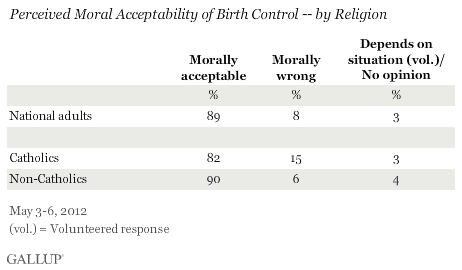
You should check the percentage of Catholics who are “not particularly happy” to accept the Church’s teaching on contraception.
 
For what it’s worth, the LC-C has already ended the practice. There is considerable pressure to do the same in the LCMS. I mean, Steadfast and the rest of the Confessional Lutheran blogosphere has been pushing the wonderfully-crafted Overture 6-02 since October of last year, and the basic gist seems to have been incorporated into Resolution 4-06, which essentially gives the Synodical President the indirect and broad power to fix this problem through the CTCR and various Task Forces so that the practice reaches an amicable (and, God-willing, permanent) end. It’ll also help when the various routes to ordination are simplified, as it appears they will be when Resolution 5-14A passes.

So I am more than optimistic. This is a good year to reform.
We should all learn from the experience: what helps groups maintain orthodoxy, what does not help.
Sometimes it is local groups that are playing fast and loose, and use their local rights to bend rules on doctrine and practice, against a more orthodox national denomination or convention. Other times it is the local churches that maintain orthodoxy, battling the theologians and bureaucrats who have the “CO (central office) syndrome”.
The age of the internet may change the dynamics, probably more for the better. The bad guys do utilize social media, and so on. But the good guys can often get their POV explained, through here, because it is still decentralized in part, even if the secular media is fawning over the progressives.
 
To answer the question; yes, by the grace of God.

As for measuring whether a given body retains its orthodoxy, the tests are rather simple. Has its doctrine changed, developed, or “gotten with the times” in the last 500 years? If so, is it to further compliance with Scripture, or to appease the Zeitgeist? Does it profess the same faith as described in its own Confessional documents?

On a deeper level, the necessary functions of the Magisterium can be completed by a faithful Ministerium acting in an irenic spirit of brotherly koinonia with one another - passing on their knowledge of orthodoxy, calling out any errors of wayward be others, and jealously guarding the Office of Holy Ministry so that only those who’ve been properly vetted and trained are ordained.

The added threat of financial, psychological, political and -eventually- physical martyrdom may end up pruning the branches, but that’ll only serve the health of the tree. Its roots grow deep.
The quote I bolded above sets the standard for a truly unchanging faith and adherence to orthodoxy: a written standard. As the Scriptures were faithfully preserved and brought down to us by God using scholars, so also the Confessions have been faithfully preserved and translated by scholars intent upon preserving the traditional and literal wording and meaning. Just stick to the standard!
 
“As for measuring whether a given body retains its orthodoxy, the tests are rather simple. Has its doctrine changed, developed, or “gotten with the times” in the last 500 years? If so, is it to further compliance with Scripture, or to appease the Zeitgeist? Does it profess the same faith as described in its own Confessional documents?”
The quote I bolded above sets the standard for a truly unchanging faith and adherence to orthodoxy: a written standard. As the Scriptures were faithfully preserved and brought down to us by God using scholars, so also the Confessions have been faithfully preserved and translated by scholars intent upon preserving the traditional and literal wording and meaning. Just stick to the standard!
I agree.
Just asking, how does the individual, or congregation, exactly make that happen. The individual should read the Bible on a regular basis, and do some study in foundational documents. But we all have seen some Christian colleges, congregations, districts, or whole denominations move away from orthodoxy. But others succeed in blocking challenges to orthodoxy. Why did some succeed? Why did most fail in maintaining orthodoxy?

The problem is, no denomination announces “We have decided to move away from Scripture, and our foundation documents, and follow the secular media”.
When they slide from the Truth, they always do this:
  • “We need to consider some of these other Scriptures, especially about Justice”;
  • “We need to apply the Confessions, or whatever, in different ways, to situations not anticipated years ago, using modern scholarship”
  • "Time to move the ancient truths out of the museum, into the street, in terms today’s youth can understand. (insert some old saying here, that the Church must be always awakening, always fresh…)
  • “We need to move beyond the cultural and denominational baggage, to a more ecumenical, **Scriptural **view (insert Bible quotes) to engage those marginalized or alienated by church structures”.
  • “Love…Love…Love” (insert quotes from Bible, Confessions, Reformers, etc)
What actions can individuals do to stop congregations, or denominations, from sliding away from orthodox doctrinal content. Prayer is number 1, but what else?

 
“As for measuring whether a given body retains its orthodoxy, the tests are rather simple. Has its doctrine changed, developed, or “gotten with the times” in the last 500 years? If so, is it to further compliance with Scripture, or to appease the Zeitgeist? Does it profess the same faith as described in its own Confessional documents?”

I agree.
Just asking, how does the individual, or congregation, exactly make that happen. The individual should read the Bible on a regular basis, and do some study in foundational documents. But we all have seen some Christian colleges, congregations, districts, or whole denominations move away from orthodoxy. But others succeed in blocking challenges to orthodoxy. Why did some succeed? Why did most fail in maintaining orthodoxy?

The problem is, no denomination announces “We have decided to move away from Scripture, and our foundation documents, and follow the secular media”.
When they slide from the Truth, they always do this:
  • “We need to consider some of these other Scriptures, especially about Justice”;
  • “We need to apply the Confessions, or whatever, in different ways, to situations not anticipated years ago, using modern scholarship”
  • "Time to move the ancient truths out of the museum, into the street, in terms today’s youth can understand. (insert some old saying here, that the Church must be always awakening, always fresh…)
  • “We need to move beyond the cultural and denominational baggage, to a more ecumenical, **Scriptural **view (insert Bible quotes) to engage those marginalized or alienated by church structures”.
  • “Love…Love…Love” (insert quotes from Bible, Confessions, Reformers, etc)
What actions can individuals do to stop congregations, or denominations, from sliding away from orthodox doctrinal content. Prayer is number 1, but what else?
My personal experience is that the denomination I was in “softened the room” through a generation of poor Sunday School curricula and poor choices in Sunday School teachers, during the 1930s and '40s. Well-meaning men and women who had poor resources to work with and not much academic knowledge of their faith were sent into Sunday School classrooms throughout the entire denominational Church with a mandate to “make the Faith comprehensible to the younger generation.” A laudable goal on its face - but disastrous because they didn’t know what they were taking about. That generation of Sunday scholars became the generation that taught Sunday School in the 1960s and '70s, leading to the current disastrous situation.
 
Status
Not open for further replies.
Back
Top