C
Caldera599
Guest
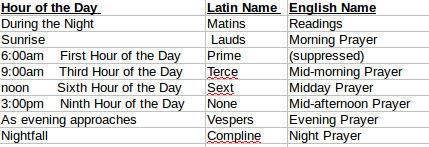
For the traditional Roman Breviary, at what times are the canonical hours said?

Hi,With my old LOTH books I usually only said Morning Prayer and Evening Prayer. MP was at 8:45 or so and EP was at 6 pm. Would that work at all?
Yes that’s fine. Nowadays, we’ve replaced the elastic concept of time based on the sun with metered time based on the clock. Just about all religious communities I know of celebrate the canonical hours at fixed times. Some may have differences for feast days, for example (and our abbey, having recreation on Thursdays, Vespers is postponed until 7 pm on that day). Carthusians really emphasize Vigils and say that hour (which lasts a very long time) starting at something like 11 pm.With my old LOTH books I usually only said Morning Prayer and Evening Prayer. MP was at 8:45 or so and EP was at 6 pm. Would that work at all?
Thanks, this is very helpful.Yes that’s fine. Nowadays, we’ve replaced the elastic concept of time based on the sun with metered time based on the clock. Just about all religious communities I know of celebrate the canonical hours at fixed times. Some may have differences for feast days, for example (and our abbey, having recreation on Thursdays, Vespers is postponed until 7 pm on that day). Carthusians really emphasize Vigils and say that hour (which lasts a very long time) starting at something like 11 pm.
In a monastery in the fairly northern latitudes, sunrise can be as early as 4 am in summer and as late as 8 in winter (by today’s measures). The Rule of Saint Benedict stipulates Lauds at dawn, and indirectly Vespers when the lamps would be lit for the evening, which of course could be very early in northern latitudes in winter.
8:45 am might be a bit late for MP, but still within bounds. Here is a very wide interpretation (my own), based on a monastic structure where there are Vigils instead of the Office of Readings (I’m currently on my “summer” hours; note I’m only doing one mid-day prayer for summer, either at the hour of Terce or Sext):
previous evening (by anticipation) to 6 am: Vigils (6 am for me except 7:30 on Sunday)
Lauds: 6 am-9 am (6:30 am in summer or 7:30 am in winter, 8 am on Sundays)
Terce/mid-day: 8 am-11 am (9:45 am if I am not able to make it mid-day prayer at Sext)
Sext/mid-day: 11 am-2 pm (noon for me)
None/mid-day: 2 pm-4 pm (I don’t recite None in summer)
Vespers: 4 pm-8 pm (6 pm in summer, 5 pm in winter)
Compline: 7 pm-10 pm (flexible, nominally 8:15 pm in winter, 9:15 pm in summer)
There’s no hard rule. As I stated these are my own “rule of thumb” so that if, say, I’m out between 4 pm and beyond 8 pm, I will omit Vespers and delay Compline if necessary (I have a handy recording of Monastic Compline on my iPhone that I can play and sing along with in my car), otherwise if I’m still “within bounds” by doing so, I’ll delay the Office to when I can recite it.
AndMay the almightyand merciful Lord grant us pardon, absolution and remission of our sins. Amen.
. The almighty and merciful Lord,
Yes in both cases. For the final blessing, it’s in the General Instructions:If you’ll tolerate one last question, but are these parts of compline appropriate for a layperson to recite?
And
For the penitential act, the only one that really makes sense in private recitation is the Confiteor. The other rites of the Mass are in verse/response format and best said in a presider or cantor/people response form.
- After the prayer the blessing, May the all-powerful Lord is used, even in private recitation.
(source: UK Liturgy Office)The leader says:
May almighty God have mercy on us, forgive us our sins, and bring us to everlasting life