Capital punishment...again

  • Thread starter Thread starter Ender
  • Start date Start date
We have no right to kill ourselves, even if mortally ill and in great pain. What right do we have to kill another?
As individuals we have no right to kill. The State, however, is altogether different. Individuals are forbidden to exact vengeance (properly understood), but the state is required to. (“Vengeance consists in the infliction of a penal evil on one who has sinned.” Aquinas) The State therefore has that right.

And thus that which is lawful to God is lawful for His ministers when they act by His mandate. It is evident that God who is the Author of laws, has every right to inflict death on account of sin. For “the wages of sin is death” Neither does His minister sin in inflicting that punishment. The sense, therefore, of “Thou shalt not kill” is that one shall not kill by one’s own authority. (Aquinas ST II-II 108, 1)
What wrongs are righted by taking another life?
No punishment can restore a life that has been taken, but it is punishment itself that redresses the disorder caused by the crime, and not mere punishment but only a punishment appropriate to the crime. This is a matter of justice which is essential to any society, and surely what Leo XIII was referring to when he said:

for public prosperity it is to the interest of all that virtue - and justice especially, which is the mother of all virtues - should be practiced
Or do we just continue doing the same old thing while bemoaning a culture of death while supporting all kinds of things that devalue life because they aren’t abortion?
How do we show a reverence for life if we don’t treat murder any more severely than lesser crimes? Trent taught that:

The murderer is the worst enemy of his species, and consequently of nature. To the utmost of his power he destroys the universal work of God by the destruction of man… he who makes away with God’s image offers great injury to God, and almost seems to lay violent hands on God Himself!

Trent also held that the best way to restrain murder was to understand just how evil it is:

Of these remedies {for the disease of murder} the most efficacious is to form a just conception of the wickedness of murder.

God himself held that a murderer’s life was forfeit because the life he took was sacred. We seem no longer to believe that.
 
Saint Ambrose (340-397) recommended that members of the clergy shouldn’t encourage nor execute capital punishment.
Yes, the Fourth Lateran Council made this point clear:

No cleric may pronounce a sentence of death, or execute such a sentence, or be present at its execution.

The council took for granted, however, that the State was allowed to apply such sentences. Ambrose himself explicitly recognized the State had that right in his reply to a Christian judge who asked if he had the authority to execute such a sentence.

You see therefore both what power your commission gives you, and also whither mercy would lead you; you will be excused if you do it, and praised if you do it not. (Letter 25)
As always, you quote out of context only to bend and distort facts.
That my citations rebut your assertions hardly means they are out of context.
 
You don’t know anything about history
I was citing Bishop Gregory. It is his knowledge you reject, not mine.

Nor does the citation of a priest requesting clemency really constitute “church opposition to capital punishment”. Even Father Vieira recognized that someone could deserve death for his actions, and to treat someone as he deserves is to treat him justly. A plea for clemency or mercy is not to deny the inherent justness of the penalty he deserves.
 
if we believe that no fault can merit the death penalty, how can one reasonably admit that certain faults may merit the eternal hell penalty? except to say like many modernists that God does not send anyone to Hell, that it is each one who goes freely to Hell …
The human rights of humanists have corrupted Catholicism, man has become a god who is entitled to everything. Mercy has become a right, we have the right to mercy
 
Yes, the Fourth Lateran Council made this point clear:

No cleric may pronounce a sentence of death, or execute such a sentence, or be present at its execution.
And now the Vicar of Christ has pronounced that the death penalty may not be used at all.

Such is the authority of the Vicar of Christ when it comes to matters of both faith and morals.

And again…your opinion is meaningless. Your judgment is meaningless.

Your only choice is submission to the Church’s authority in the person of her visible head, the Supreme Pontiff…or to place yourself outside the Church by your disobedience, which appears to be the path you have chosen by your public dissent.
 
if we believe that no fault can merit the death penalty, how can one reasonably admit that certain faults may merit the eternal hell penalty? except to say like many modernists that God does not send anyone to Hell, that it is each one who goes freely to Hell
It certainly is interesting. For that matter why do we deserve to die bodily? God, as conceived by modernism, ends up becoming, ironically, like the God of Calvinism or Islam. That is, He is arbitrary and capricious.
 
Only in the last 40 years of its history has the church come out against state-sponsored executions, except in highly delimited circumstances. Such a departure from previous teaching, which stretches back almost two millennia, is bound to invite controversy within the ranks of the Catholic faithful. (Bishop Wilton Gregory, 2008)
I wish to be very clear on this matter

You keep referring to men I have known and worked with across decades…Avery Cardinal Dulles, Archbishop Wilton Gregory who was the President of the United States Conference of Catholic Bishops, and Archbishop Charles Chaput

It is abundantly evident that you are not a theologian – that is most obvious

It is obvious also that you are trying to foment dissent on a public forum of the Catholic Church, a forum that exists under His Excellency, Bishop McElroy of the Diocese of San Diego – himself a great champion for the abolition of the death penalty. Such is an affront against the person of His Holiness the Pope and against the College of Bishop for they are the Church’s living Magisterium and it is they who clarify what the Church teaches in the various historical epochs – and the faithful have the duty to submit and obey

What, however, may be less obvious to the casual reader is how you are twisting the words of these venerable prelates of the Church. This can only be described as duplicitous – and more, as an act of deceit, as I am about demonstrate

To me, such an action against these extraordinary bishops and theologians that I have known, esteemed, and worked with is beyond repugnant. It is grotesque to so misrepresent them – and it calls, frankly, for sanction as well as censure

Here is the quote in its context – which is a masterful address AGAINST the death penalty
Yet much of our attention in this discussion on the death penalty continues to focus on the deterrence rationale since this aspect of the debate continues to be central to public debate. Already in 1980 we were on record as saying that the argument that executions deter potential offenders from committing capital crimes lacks empirical support. Against the backdrop of the already-mentioned developments of the 1990s, which include the changes in the catechism and the commentary of John Paul II, our episcopal conference continues to maintain that capital punishment deters only the potential crimes of those on whom it is carried out

It is clear to many observers that the Catholic Church has undergone a development in its teaching on the death penalty. Only in the last 40 years of its history has the church come out against state-sponsored executions, except in highly delimited circumstances. Such a departure from previous teaching, which stretches back almost two millennia, is bound to invite controversy within the ranks of the Catholic faithful
 
Continued

The Archbishop uses what you quote as an introduction to his review of the exchanges between the American Supreme Court Justice, Scalia, and the American Cardinal theologian, Avery Dulles – the only American, I might add, who has received that honour alongside the many Europeans who have received the honour

I am not going to quote the exchange…it may be referenced at the link

so that everyone may see how you have distorted and misrepresented His Excellency, the former President of your National Conference of Catholic Bishops


The Archbishop concluded his address thus:
In seeking to contribute to a civilization that promotes human dignity, the Catholic Church desires to strike a balance between the demands of justice and the need for the very acts of mercy that make it easier for people to practice compassion and justice. The Catholic moral tradition, as referenced in this presentation on capital punishment, shows an unambiguous preference to preserve life even when the order of justice is threatened and the safety of innocent life is at stake. While acknowledging the moral and legal prerogative of the state to execute criminals in strictly limited circumstances, the church pleads for restraint in the exercise of that prerogative.

The moral requirement to protect the innocent stands alongside the imperative to stem the cycle of violence that keeps individuals and communities enslaved to vengeance. As Mohandas Gandhi once said, “An eye for an eye makes the whole world blind.”

As heirs to the vision of the brotherly communion that Jesus Christ imparted to his disciples, we Catholic bishops long for an American society that is neither insensitive to the demands of justice nor blind to the need for mercy. As did our bishop-forebears in the ancient and medieval periods, we seek to make prudential application of the timeless principles of the moral law to the ever-changing circumstances of society.

In this presentation I have tried to show how the development in our teaching on capital punishment is consistent with our historic mission to preach the Gospel and advance the common good of society. I am grateful to this university community for an opportunity to speak to this public discussion of critical importance from my own tradition of faith and in my capacity as a pastor to the Catholic people of Atlanta. Thank you and God bless you.
In the next post, I shall show what Archbishop Gregory said following the revision of the Catechism of the Catholic Church and the Pope’s exercise of his Ordinary Magisterium to clarify Church teaching and to delineate the doctrine which has developed on the matter of the death penalty.
 
Your only choice is submission to the Church’s authority in the person of her visible head, the Supreme Pontiff…or to place yourself outside the Church by your disobedience, which appears to be the path you have chosen by your public dissent.
I agree with Professor Long.

Accordingly, the conclusion is predicated on prudential judgments that are susceptible to falsification. Thus, however strong the language of the conclusion, it can specify only prudentially. The conclusion about the inadmissibility of capital punishment in today’s circumstances is an instance of the fourth (and weakest) form of church teaching, prudential admonitions that command the attention of the faithful, but for which believers who conscientiously disagree are never denied communion with the Church. (Stephen A. Long)
 
Here are Archbishop Gregory’s thoughts in 2018 and Pope Francis’ decision:
In 2016, the state of Georgia executed prisoners at a fast pace. Nine men were executed in 2016, according to the Death Penalty Information Center. One man was put to death that year.

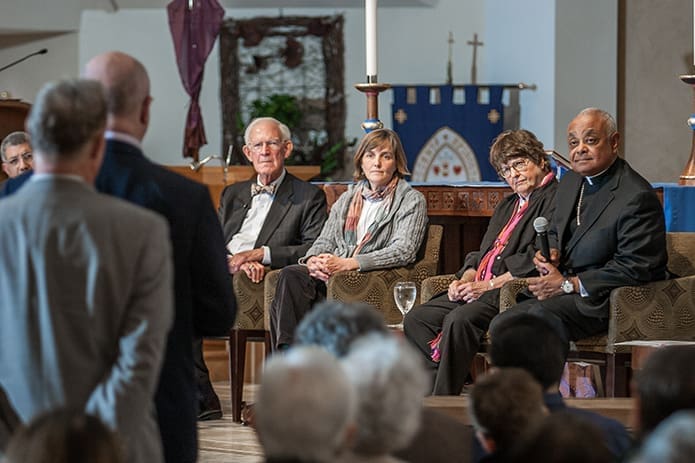
The pace of these killings bothers Archbishop Wilton D. Gregory, who participated in the panel forum. A resident of Georgia for a dozen years, the archbishop said he enjoys living in the community—except for the death penalty.

“We have a wonderful state. I just wish we weren’t so aggressive in putting people to death,”he said.

Archbishop Gregory said he writes frequently to the State Board of Pardons and Paroles urging its members to commute the sentences of death row inmates to life in prison. He said people guilty of serious crimes can be punished without lethal injection.

In his remarks, Archbishop Gregory said the Catholic Church has evolved on capital punishment with statements by recent popes, starting with St. John Paul II and the Catechism of the Catholic Church in 1992. He said the pope then listed the death penalty for the first time alongside abortion and euthanasia, giving the three issues equal moral weight. Archbishop Gregory said church teaching has moved from a position of being “permitted, but not to be preferred” to “contrary to the Gospel” as Pope Francis has stated.
To be clear, the source is the archdiocese’s own newspaper

 
Last edited:
I agree with Professor Long.
Professor Long is a philosopher, not a theologian.

It is for the Bishop of the Diocese of Venice in Florida to decide what sanctions would be appropriate for publicly questioning the Vicar of Christ in the exercise of his teaching office.

I am confident that the Bishop will deal with this matter.
 
To me, such an action against these extraordinary bishops and theologians that I have known, esteemed, and worked with is beyond repugnant . It is grotesque to so misrepresent them – and it calls, frankly, for sanction as well as censure

Here is the quote in its context – which is a masterful address AGAINST the death penalty…
That Bishop Gregory was against the death penalty says nothing whatever about the section I cited, which dealt solely with the amount of time the church has raised objections to capital punishment. In everything you cited does any of it alter in the slightest the passage I actually quoted?

Only in the last 40 years of its history has the church come out against state-sponsored executions…

Is this claim right or wrong, and if it is accurate then why should I be sanctioned for referring to it? What is so grotesque about repeating a true statement? I made no implication about the bishop’s position on capital punishment itself; I was refuting the claim that the church had opposed capital punishment for 500 years. So I ask again: does the passage I cited accurately reflect Bishop Gregory’s comment about how long the church has opposed capital punishment? That is the only context in which I referred to it and is the only context in which my use of it should be judged.
 
Capital Punishment is no good. Why would Jesus Christ want someone to be killed early before they got a chance to find him in their life?
 
40.png
Ender:
The thread is ‘capital punishment’. Piggy backing your argument for capital punishment on the general principle of punishment is misleading, duplicitous, distortion.
Capital punishment is a specific form of punishment, and all that applies to punishment in general also applies to capital punishment in particular. The comments of @(name removed by moderator) apply to all punishment, including capital punishment.
That is simply not true. The principle of punishment as Kant puts it, is a catagorical imperative, but sentences are relative. Sentences, for justice to be done, must as Aquinas puts it, be contingent on the ‘real mean’. Not the rational mean.

"the other moral virtues are chiefly concerned with the passions, the regulation of which is gauged entirely by a comparison with the very man who is the subject of those passions, in so far as his anger and desire are vested with their various due circumstances. Hence the mean in such like virtues is measured not by the proportion of one thing to another, but merely by comparison with the virtuous man himself, so that with them the mean is only that which is fixed by reason in our regard.

On the other hand, the matter of justice is external operation, in so far as an operation or the thing used in that operation is duly proportionate to another person, wherefore the mean of justice consists in a certain proportion of equality between the external thing and the external person. Now equality is the real mean between greater and less, as stated in Metaph. x [Didot ed., ix, 5; Cf. Ethic. v, 4: wherefore justice observes the real mean."


In other words, sentences must be imposed based on what serves the common good. We look to the society to determine the harm and the appropriate redress.

“We may speak of a thing being good simply in two ways. First a thing may be good in every way: thus the virtues are good; and there is neither mean nor extremes in things that are good simply in this sense. Secondly a thing is said to be good simply through being good absolutely i.e. in its nature, although it may become evil through being abused. Such are riches and honors; and in the like it is possible to find excess, deficiency and mean, as regards men who can use them well or ill: and it is in this sense that justice is about things that are good simply.” (ST II II 58 10)

In other words, some things like the virtues are ‘intrinsically’ good but the application of justice is good in its nature but require prudence by those ordained to apply it. A sentence authorised imprudently is there fore ‘extrinsically evil’. .
 
Last edited:
The particularly significant point being that it is a “ proper punishment ” that safeguards man’s dignity. This is because that alone treats him as a moral agent capable of making moral choices and fully responsible for the ones he freely makes. The church clearly recognizes this, which is why she says the State has an obligation to apply penalties of a severity commensurate with the severity of the crime.

This seems to me to be the strongest argument in favor of the death penalty: there are some crimes so heinous that anything less is insufficient, and therefore improper. We used to think that first degree murder was such a crime, but we clearly no longer think it is all that serious any more. Even those states that allow the death penalty often reserve it for crimes with “special circumstances”. Apparently murder just isn’t that big a deal nowadays.
As Aquinas states, to be just, a sentence needs to reflect the real mean.

“The injury inflicted bears a different proportion to a prince from that which it bears to a private person: wherefore each injury requires to be equalized by vengeance in a different way: and this implies a real and not merely a rational diversity.”

If a form of redress, that doesn’t ultimately do more good than harm to the society it serves, it is no longer a just redress. That is why capital punishment has been legitimately abolished around the world.
 
Actually, speaking of Ave Maria University and one of its philosophy professors, His Excellency, Bishop Frank Dewane, the Bishop of the Diocese of Venice in Florida, where Ave Maria University is located and under whom it exists, in conjunction with the United States Conference of Catholic Bishops, has produced a wonderful video.

The video explains the Church’s opposition to the death penalty, shows when the Pope addressed the US Congress on this issue and it encourages American Catholics to work for the death penalty’s abolition in the United States through the political process.

His Excellency gives a wonderful explanation of the Church’s teaching on this urgent matter. All American Catholics should unite behind the United States Conference of Catholic Bishops and the means that they are deploying in seeking the abolishment of the death penalty wherever it is still being used.

https://catholicsmobilizing.org/pos...gn-national-catholic-pledge-end-death-penalty
 
40.png
Don_Ruggero:
Your only choice is submission to the Church’s authority in the person of her visible head, the Supreme Pontiff…or to place yourself outside the Church by your disobedience, which appears to be the path you have chosen by your public dissent.
I agree with Professor Long.

Accordingly, the conclusion is predicated on prudential judgments that are susceptible to falsification. Thus, however strong the language of the conclusion, it can specify only prudentially. The conclusion about the inadmissibility of capital punishment in today’s circumstances is an instance of the fourth (and weakest) form of church teaching, prudential admonitions that command the attention of the faithful, but for which believers who conscientiously disagree are never denied communion with the Church. (Stephen A. Long)
This seems to come from an essay entitled “Magisterial Irresponsibility”. How do these dissenters keep their jobs in Catholic universities in the US?? When the Christian authorities and Jewish authorities in theology are all united in recognising the immorality (extrinsic evil)of the death penalty today, as perfectly in keeping with Divine Law, how do these self appointed experts justify their accusations of ‘irresponsibility’ of Christs Church?
 
Back
Top