Catholicism and Climate Change: The Sequel

  • Thread starter Thread starter kimmielittle
  • Start date Start date
Status
Not open for further replies.
Continued
It is, as I said, the result of the Vatican assembling a team of scientists from a wide range of backgrounds and asking them what the science says.
No they did not report what science says - They reported, “their hand picked view what their science says”.AND “their ideas of solution”. …These assessments have been questioned. The models have been questioned - The data has been questioned - the methods have been questioned - the Solutions offered have been questioned -
as opposed to, say, copying-and-pasting verbatim non-peer-reviewed blog postings and reports from right-wing think tanks and PR firms funded by Exxon Mobil and the Koch Brothers
Attack the report not the funding.

There is no difference in oil money going to research by Mr Jones as there is oil money going to research by Mr Singer. NONE

You seem to have a hard time understanding you can’t call foul - if you, yourself, are fouling. BUT you do so LOUDLY 😃
So arguing what constitutes “peer review” is pointless because the report is exactly as I characterised it and so far all you’ve done is attack strawmen rather than disprove what I said.
You called it peer reviewed #367
I said: “It is a peer review of the science by Ajai, L. Bengtsson, D. Breashears, P.J. Crutzen, S. Fuzzi, W. Haeberli, W.W. Immerzeel, G. Kaser, C. Kennel, A. Kulkarni, R. Pachauri, T. Painter, J. Rabassa, V. Ramanathan, A. Robock, C. Rubbia, L. Russell, M. Sánchez Sorondo, H.J. Schellnhuber, S. Sorooshian, T. F. Stocker, L.G. Thompson, O.B. Toon, and D. Zaelke — more peer review than most papers get.” That is absolutely correct. What do you think “peer review” is?
Why did you accuse me of throwing “objectivity out the window” and throwing “garbage to promote [my] causes” for daring to mention and accurately quote extracts from a report taken from the Vatican’s own website, on a Catholic forum?
Before we get our panties all swaggeriesed :D- You were invited to do an Objective report on the Pontifical Academy of Science paper - as a “scientist”. Evidently, you couldn’t bring yourself - to do it.🤷
Why is it acceptable for you to quote verbatim the musings of people who ask for and receive funding from the fossil fuel industry specifically to promote their cause, but unacceptable for me to quote a report published by the Vatican?
If it’s wrong, in your eyes, for me use the musings of some people - It’s even more wrong of you, as you have set yourself up as an Authoritarian figure “I’m a scientist” ], Using a biased piece opinion - editorial ] “musing” - to propagate move ] the faith.
What bizarre world do we live in where quoting from the Vatican’s own website on a Catholic forum is reason enough to abuse someone?
AWWWWwww - I’ll give you a hint - you have consistently dug at / sniped anyone who disagrees with you…from your very first posts here at CAF …I called it to your attention back then.

AND you now cry unfair? 🤷

Had Singer, Lindzen, Spencer et al been given a podium from the Pontifical Academy of Science for an Opinion-editorial to propagate move ] the faith…what would you be crying?:D:D

Believe it, or not…I would have agreed with you.🙂

Being an opinion-editorial…to propagate move ] the faith OR as I’ve called it a Religious propaganda , used to propagate move ] the faith… issued / contrived / conceived / chosen by Bishop M. Sánchez Sorondo of The Pontifical Academy of Sciences written to promote a one-sided bias of perceptions… with the intent to move The Holy Father and Catholics… I have EVERY RIGHT to question the wisdom behind it.
 
hmmmm… i can see once again you are having trouble

My comment was to this remark
I wonder what else is going on that has not been noticed by the press
Not the article . 🤷
I replied
It’s a shame, to me, that FOI has to be used to uncover what hasn’t been told.
Why stick to the facts when the claims you make up sound so much better, eh?
Let’s see who’s making up stuff 🙂

Have we had to use FOI to get answers to untold things?
What’s particularly amusing, given your earlier comments about genetic modification, is that not only does Heartland have a long history of promoting the interests of the tobacco industry, they also campaign in support of genetically engineered crops and products! Apparently that is no obstacle when it comes to unsubstantiated accusations of “tomfoolery” and only an issue when you contribute to a report on the Vatican’s website.
Ohhh my my 😃

You get soOoOoo much wrong…don’t you 🙂

My complaint about using the Pontifical Academy of Sciences in the GM report was this
But the 40 or so participants listed on the academy’s website are all GM supporters, with many well known for their extreme pro-GM views or having vested interests in GMO adoption.
AND trying to pass it off to Catholics that it was
Bishop Marcelo Sanchez Sorondo, the Academy’s chancellor, told the Catholic News Service that the aim was to gather **“an objective group of experts” in a search for “scientific clarity” **on the subject.
powerbase.info/index.php/SpinWatch_condemns_Vatican_GM_event_as_a_“charade_by_vested_interests”

You see…I don’t like that The Pontifical Academy of Sciences, seems to be , used by Activists with driven agendas - in order to move Catholics.

I especially, don’t think it’s wise to cut out Catholic opinions - in order to promote agendas within a Catholic Institution.

At least in that Paper…they cited contributions.

BUT because they did…people were able to find out who contributed what. IS this why the Himalaya paper is void of citations? 🤷🤷
 
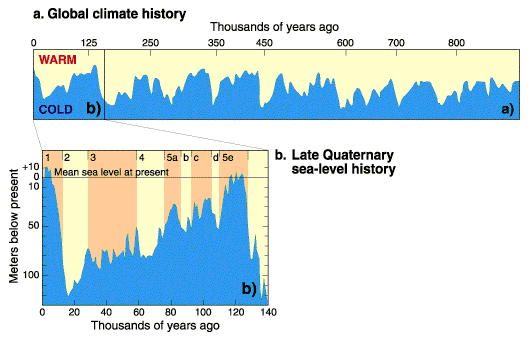
The charts you provided (Vidarholmi and Connecticut) show changes in meters so perhaps that’s too large a scale, but neither chart looks anything like a graph of temperature over those times. If temperature directly correlates with sea level shouldn’t the charts have somewhat similar shapes?
Let me start by pointing out that those are excellent questions. They directly relate to the information at hand, they are perfectly reasonable, they are asked directly and courteously, and there are no accusations or insinuations. This is the kind of discourse I originally imagined to find on a Catholic forum.

So what’s the answer?

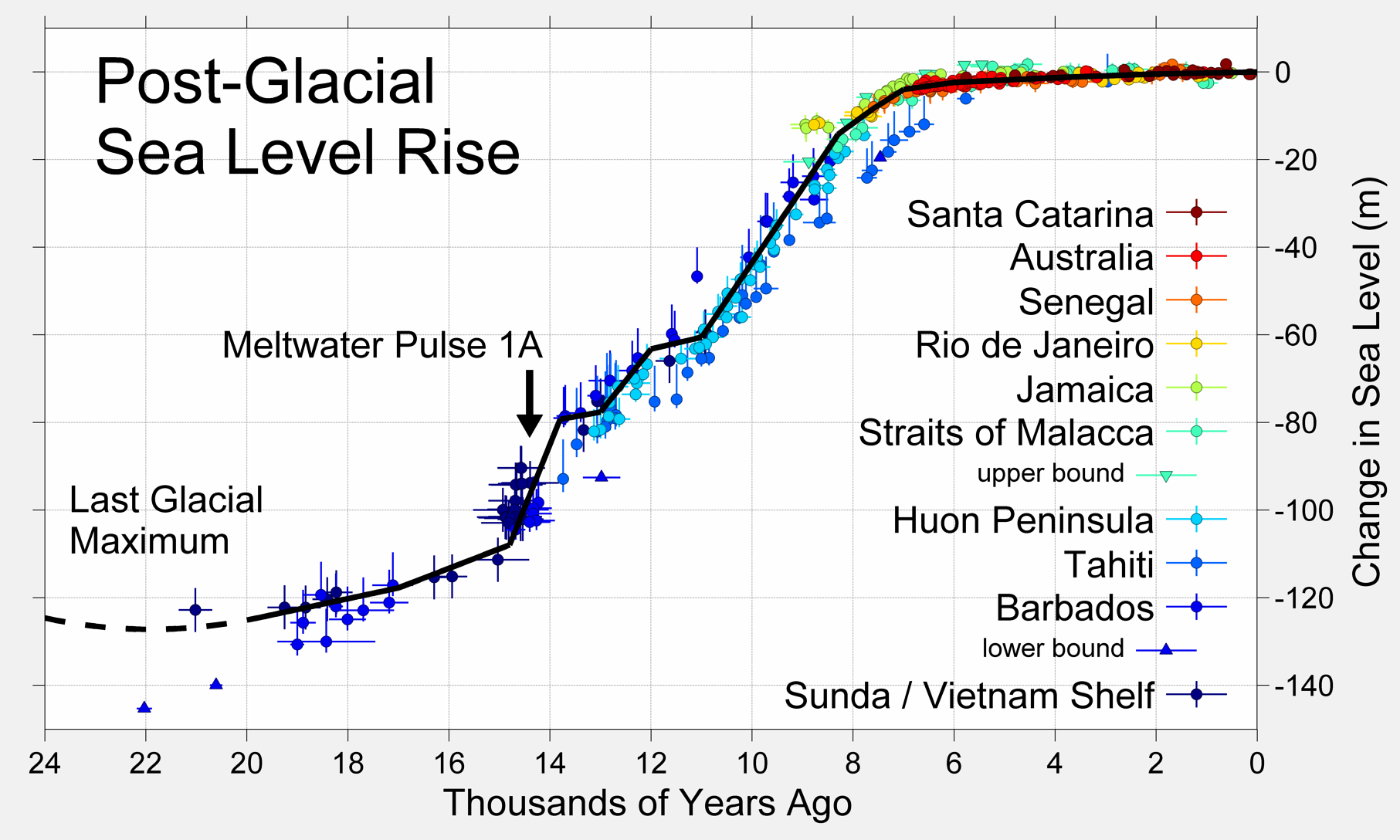
Well, firstly, sea levels clearly do respond to temperature changes, as basic physics suggests they must — you can’t warm water without it expanding, and you can’t melt glaciers on land without some portion of that meltwater ending up in the oceans. If we look at the change in sea level since the last glacial maximum this is clearly evident:


It is also evident is that the rise slowed dramatically about 8,000 years ago, roughly 2,000 years after the temperature stopped rising so dramatically:


Nevertheless, the temperature since then (until recently) has been on a slow decline, while the sea level has continued to slowly rise.

I think the reason is that there are multiple time scales involved. Some parts of the water cycle are still catching up with the temperature rise that peaked 8,000 years ago. Remember that the rate of sea level rise was still quite dramatic for 2,000 years after the rate of temperature rise ceased being so dramatic, then it, too, tapered off, but kept on rising. That suggests the sea level hadn’t reach equilibrium with Holocene temperatures yet, although the rate is so slow that clearly it must have been close.

At a certain point, without human involvement, the slow decline of temperatures leading into the next glaciation would cause the sea level rise to reverse and start to fall again as water is once again locked up in glaciers and also shrinks due to cooling, just as it has done in the past:


This is why it is the acceleration in sea level rise during the 20th century relative to the past 3,000 years (currently about 3.2 mm/year vs an average of 0.1-0.2 mm/year for the 3,000 years prior) that is important.
After all, if the rise in sea level in the last 150 years is attributed to rising temperatures then why don’t we see any sea level change due to the MWP and LIA?
In some records we do see some variation, e.g.:

http://www.skepticalscience.com/graphics/North_Carolina_SLR_500.jpg

The fact that not all records show the same effect at the same time would be consistent with prior temperature reconstructions that showed the “MWP” occurred at different times in different locations and didn’t affect all locations equally.
Global temps during the MWP were comparable to today’s temp 1 - why was the sea level lower then than now?
1 - Loehle, C. and McCulloch, J.H. 2008. Correction to: A 2000-year global temperature reconstruction based on non-tree ring proxies. Energy & Environment 19: 93-100.
You’ve asked the right question but reached the wrong conclusion. If sea level reconstructions don’t clearly show a big rise during the “MWP”, do we assume that:
  1. Sea levels really don’t respond to global temperature changes, despite the evidence that they do coupled with the known physical behaviour of water and ice in response to temperature increases, or
  2. Global temps during the MWP were not comparable to today’s temperatures after all, in contrast to your interpretation of Loehle 2008?
Since Loehle 2008’s temperature reconstruction ends in 1935, it’s a little difficult to use it to argue that the MWP was comparable to today’s temperature. If you add on the HadCRUT record to the end, you can see why:

http://www.skepticalscience.com/images/robhon_kungfu2.gif

Note that the green line is a 29 year smoothed average to make it comparable to Loehle’s data (which was also a 29 year smoothed average).

Furthermore, Loehle only uses 18 data sets in his temperature reconstruction (as opposed to Mann’s 1,200, for example) so you would also expect a lot more variance — this means that the blue line is more susceptible to regional effects than the green line, for example.

Therefore I’m inclined to lean towards the second explanation. We can’t assume the MWP really was comparable to today and then use that assumption to rule out actual data or physics — we have to use the preponderance of evidence to decide if the MWP really was comparable to today, and so far I haven’t seen anything to convince me that it was.
 
http://www.cmar.csiro.au/sealevel/images/gehrels_donnelly.jpg

That is what the graph shows, but as the graph (apparently) doesn’t correspond to temperature, I’m not sure what it means. There also seems to be some disagreement as to what the historical tide values actually were since the following description doesn’t describe what your charts show.

…scientists have deduced the four phases of sea-level development: From 200 BC to 1000 AD, the water level remained relatively stable. Starting in the 11th century, it rose for 400 years by about five centimeters per century, which was due to the Medieval Warm Period. Then there was another stable period with a cooler climate, which lasted until the late 19th century, as the researchers report in the journal “Proceedings of the National Academy of Sciences.”

thegwpf.org/science-news/3267-new-sea-level-study-divides-climate-researchers-.html
I’ve never read the paper in question, but if the criticisms raised in that post are accurate then I’m inclined to agree with them. Note that they’re talking about the same North Carolina record I showed above, which does match their description. When doing global mean sea level reconstructions, however, it’s a good idea to use a lot of different records from different locations. Their comments may well be accurate for North Carolina while not being an accurate representation of the global mean sea level as a whole.

The important point about all of the records, and the reason why I mentioned them, is that they are consistent with the tide gauges during the period of overlap. When we see independent measurement techniques giving roughly the same answers, it builds confidence in those techniques. They also happen to support the notion that the recent rate of sea level rise is remarkable, but the acceleration in sea level rise in recent decades is clear and statistically significant just with the instrumental record alone — the pre-instrumental reconstructions are merely interesting for putting the response to the forcings in context. (For example, the really rapid rise between 15,000 and 6,000 years ago that saw sea levels rise by 90 metres in response to the dramatic change in temperature at the end of the last glaciation was 10 mm/year, about three times larger than what we are currently experiencing, and the peak rate was 40 mm/year for 500 years during Meltwater Pulse 1A — ten times the current rate of rise.)

There’s certainly nothing to indicate that sea level rise can’t continue to accelerate as expected.
This is an aside - but I don’t understand this comment. Are you saying the IPCC has to get countries to agree about what the science says and if they were to oppose something their vote would override the facts?
The Summary for Policymakers is reviewed line-by-line by the delegates from each country in conjunction with the scientists, and scientists have often commented about how delegates from particular countries (particularly the United States, China, Russia and especially Saudi Arabia) changed the original wording of the scientists. For example, you can see the difference pre- and post-WG2 negotiations here.

“Impacts are very likely to increase due to increased frequencies and intensities of extreme weather events [high confidence].”

was replaced with

“Impacts due to altered frequencies and intensities of extreme weather, climate, and sea level events are very likely to change.”

while

“Many natural systems, on all continents and in some oceans, are being affected by regional climate changes, particularly temperature increases [very high confidence].”

was replaced with

“Observational evidence from all continents and most oceans shows that many natural systems are being affected by regional climate changes, particularly temperature increases.”

and so on.

It’s a good idea to remember that whatever is in The Summary for Policy Makers was subject to veto by delegates from the United States, China, Russia and Saudi Arabia.
But the last time temperatures were this high was the MWP and sea levels were nothing like that. What drives sea level: temperature or CO2?
We don’t know that temperatures were this high during the MWP, so that’s begging the question, and CO2 levels certainly weren’t. But higher levels of CO2 lead to higher temperatures due to enhancing the greenhouse effect, as proven by direct, empirical observation. Temperature then changes sea levels. If you want a simple, first-order approximation of what we can expect from CO2 levels as high as they are now, then, as I said, look at what the world was like the last time they were this high. The sun then was roughly as bright as it is now, the continents then were in roughly the same locations, and global temperatures were 5 to 10 degrees Fahrenheit higher than they are today, the sea level was approximately 75 to 120 feet higher than today, there was no permanent sea ice cap in the Arctic and very little ice on Antarctica and Greenland.

We don’t have a spare Earth we can run this CO2 Experiment on to see what will happen. The closest thing we have to the circumstances on Earth today are the circumstances on Earth 15 million years ago. Looking at what the consequences of those circumstances 15 million years ago certainly doesn’t make the IPCC report look “alarmist”.
 
In the face of asking for specific information, you are attempting to hide behind some high-minded platitude.

So let me address the platitude.

You have no fish.
What is this, a kindergarten?

If you hadn’t previously deleted a portion of my post to ask a question that was already answered in the deleted portion, then assumed I answered opposite to what the deleted portion already said just so you could say I was incorrect, and then complained about me wasting your time by taking a “dig” at you for refusing to read my posts, I might be a little more forthcoming.

If you hadn’t completely ignored a lengthy explanation I gave of the techniques they used to account for movements and then claimed I “apparently” didn’t know of the existence of tectonic plates or subsidence because “there where no tectonic drift readings before they started measuring it” and that tectonics weren’t mentioned in the paper I provided despite the fact they were, I might be a little more forthcoming.

If you hadn’t asked me to specify the specific location within the paper that supported my claims when I had already specified the exact location with the exact paper so you could see how they dealt with datum shifts and then, when I refused to specify it again, suggested I’m trying to hide a lack of understanding or ignorance, I might be a little more forthcoming.

As it is, you have a habit of making easily-refuted claims and expecting me to do all the leg work for you, and when I do, completely ignoring the response. When I try to encourage you to figure it out for yourself so I don’t have to keep spoonfeeding you, you assume it means I don’t know, despite coming unstuck using exactly the same tactic in relation to “perfectly level” seas.

I already gave you a bunch of hints but clearly they were too abstract for someone who started this debate with me by stridently claiming that the trivially-provable Central Limit Theorem is a “fallacy”, so here’s one more: “first differences”. If you’d read the section of the paper that I’d already pointed you to you would have noticed that phrase, and if you’d understood what they said, you would have known why sudden jumps caused by earthquakes are irrelevant.

The fact that not only did you raise it as an issue, you actually suggested I was “hiding” behind some “high-minded plattitudes” for not addressing it directly, tells me you have a long way to go before you can claim to understand a paper that you claim to have “read”.
 
You see…I don’t like that The Pontifical Academy of Sciences, seems to be , used by Activists with driven agendas - in order to move Catholics.
Sorry kimmielittle, I honestly didn’t know that the Pontifical Academy of Sciences had been taken over by Activists with driven agendas to form part of the global conspiracy.

I can see now why you were so touchy when I naively reported on what they had published.

How far up the hierarchy does it go? Is there anyone who isn’t part of this conspiracy that doesn’t work for Exxon Mobil or the Koch Brothers?

Thank goodness the money earned from denying the health effects of tobacco smoking allowed those brave souls to resist the temptation to join in on The Scam!

But maybe they’re in on it, too? Maybe the reason their theories are so lame and their arguments so full of holes is because they are secretly trying to discredit anyone who disputes the consensus? Uh-oh…

Anyway, great detective work, kimmielittle. It’s amazing how these guys can so successfully take over all of these scientific organisations and fabricate all of this data without so much of a whimper and yet the whole thing can be uncovered by a teenage girl sitting behind her computer.

What’s really scary is how they got the Antartic ice cap, the glaciers, the animals, and the plants to co-operate. Is there nothing they can’t control???
 
There is no difference in oil money going to research by Mr Jones as there is oil money going to research by Mr Singer. NONE
kimmielittle, when Philip Morris said in its 1995 internal report that it uses its contributions “as a strategic tool to promote our overall business objectives and to advance our government affairs agenda”, do you think it was giving money to “free market ‘think tanks’ and other public policy groups whose philosophy is consistent with our point of view” for them to do research on the health effects of tobacco smoke?

You know, the same “free market ‘think tanks’ and other public policy groups” that you now rely on for your information on AGW? (And, amazingly, DDT of all things. If ever there was a transparently blatant attempt to rewrite history, that would have to be it. So much for your “research” skills.)

The fact that you still fail to distinguish between money given to scientists who applied for scientific research grants and money given to lobbyists to “promote business objectives” explains pretty much everything there is to explain about your views.
 
What is this, a kindergarten?
No, it isn’t.

In kindergarten, it is generally expected that when a specific question is answered the teacher will try to teach the child how to arrive at the answer.
That is part of the learning process.

Here however, when specific questions are asked, specific answered are expected.

You refuse to answer with anymore then platitudes about teaching.
I wanted specific answers to specific questions.
Your refusal tells me volumes about your argument.

It is not hard to find specific quotes to back your case unless your case is not backed.
 
kimmielittle, when Philip Morris said in its 1995 internal report that it uses its contributions “as a strategic tool to promote our overall business objectives and to advance our government affairs agenda”, do you think it was giving money to “free market ‘think tanks’ and other public policy groups whose philosophy is consistent with our point of view” for them to do research on the health effects of tobacco smoke?
Hmmm a bit misleading…Care to provide evidence that Heartland did “research” / paid for "research"on the health effects of tobacco smoke?

How could I have been so stupid?

I now see how you wish me to think.

Promotion of tobacco users rights or exposing bad science in say EPA - BAD
Profiteering from selling Tobacco - GOOD

Free Markets - BAD
Coerced Market – GOOD

Exxon - BAD
Profiteering from selling Oil Exxon ] - GOOD

Heartland - BAD
“Politicized Science” - GOOD soros.org/resources/articles_publications/publications/annual_20070731/a_complete.pdf media policy ($1,060,000); and “politicization of science ($720,000)”.

SourceWatch - Center for Media and Democracy - Open Society Institute - Sunlight Foundation - Tides Foundation - GOOD
Other Sources - BAD

Soros - GOOD
Koch - BAD

Free Market Think Tanks - BAD
Socialist Think tanks - GOOD

Closed Disclosure - GOOD
Open Discloser - BAD

IPCC - CRU - Henson - GOOD
Other Scientists views - BAD

Coal - BAD
Profiteering from selling coal - GOOD

Redistribution of money as a fix for AGW - GOOD
Questioning that it won’t fix AGW - BAD

IMF control of AGW funds - GOOD
Not trusting the leadership of IMF - BAD

AGW schemes are a Philanthropic cause - GOOD
Questioning if there is anything Philanthropic about AGW schemes - BAD

Lightly covered attempts to smear dissenters - VERY GOOD
Until someone does research at who is behind the smear attempts - IT WILL BITE YOU BACK

What “common” appears before all of the above. The Hand / Money of Mr Soros,

The hypocrisy of some - never ends IMO
You know, the same “free market ‘think tanks’ and other public policy groups” that you now rely on for your information on AGW? (And, amazingly, DDT of all things. If ever there was a transparently blatant attempt to rewrite history, that would have to be it. So much for your “research” skills.)
Actually ONCE again - WRONG 🙂
Views about the use of insecticides for indoor protection from malaria have been changing in recent years. Environmental Defense, which launched the anti-DDT campaign in the 1960s, now endorses the indoor use of DDT for malaria control, as does the Sierra Club and the Endangered Wildlife Trust. The recently-launched President’s Malaria Initiative (PMI) announced last year that it would also fund DDT spraying on the inside walls of households to prevent the disease.
“Indoor spraying is like providing a huge mosquito net over an entire household for around-the-clock protection,” said U.S. Senator Tom Coburn, a leading advocate for global malaria control efforts. “Finally, with WHO’s unambiguous leadership on the issue, we can put to rest the junk science and myths that have provided aid and comfort to the real enemy – mosquitoes – which threaten the lives of more than 300 million children each year.”
Comes from numerous sources but the prominent I used… WHO World Health Organization Media releases
who.int/mediacentre/news/releases/2006/pr50/en/
The fact that you still fail to distinguish between money given to scientists who applied for scientific research grants and money given to lobbyists to “promote business objectives” explains pretty much everything there is to explain about your views.
Hmmm AGW scientist are Scientist…not Lobbyist? Could you please tell Mr Hansen et al
Anti-AGW scientists are Lobbyists - Not scientists?

Advice on smears attempts [SIGN]Momma says," Using Soros backed sources to fling tripe - gets nasties on your hands" [/SIGN]
 
Anyway, great detective work, kimmielittle. It’s amazing how these guys can so successfully take over all of these scientific organisations and fabricate all of this data without so much of a whimper and yet the whole thing can be uncovered by a teenage girl sitting behind her computer.
Don’t be jealous 🙂

Maybe, if you got out more? 🤷
 
In order to clarify part of my previous post

“Politicized Science” - GOOD

soros.org/resources/artic…a_complete.pdf
media policy ($1,060,000); and “politicization of science ($720,000)”.
Is what the Soros organization, itself, calls the money it provided Mr James Hansen. Found within the PDF on page 143 ]

On page 123 of the PDF we find this…
** “The campaign on Hansen’s behalf resulted in a decision by NASA to revisit its media policy.”.**
Mr Hansen calls it “legal and media advice”

newsbusters.org/blogs/jake-gontesky/2007/09/26/global-warming-alarmist-james-hansen-shill-george-soros

newsbusters.org/blogs/noel-sheppard/2007/09/26/nasa-s-hansen-mentioned-soros-foundations-annual-report
BUT from Soros org own mouth, the money was used to** change NASA Policy**

JasonSB would have us believe the lobbyist are Anti-AGW Scientists - Another smear by the Soros groups

This is some of the same group that people like JasonSB tries to use as a smear against dissenters. “The EXXON and Tobacco is bad” smear…come directly from the Soros camp YET …Mr Soros owns large blocks stocks of Philip Morris and EXXon. Do a search " Soros oil - Soros tobacco

How far reaching does Mr Soros An Atheist ] go at pushing his agenda?..ALL the way to Catholicism.

michellemalkin.com/2008/10/22/soros-funding-pro-obama-catholic-groups/

aim.org/aim-column/soros-group-behind-attack-on-boehner’s-catholicism/

usasurvival.org/ck111409.html

Are just a few links.
 
No, it isn’t.
I should have said “What is this, a kindergarten playground?”

It’s telling that this is the only sentence that you responded to.
Here however, when specific questions are asked, specific answered are expected.
Especially when the answer is first deleted so that the question that has already been answered can be asked again?

If you’re going to go around expecting to be answered, you might want to think about how you ask.
You refuse to answer with anymore then platitudes about teaching.
The question you asked was already answered in the section of the paper I had already cited.

I’ve now even told you which phrase to search for.
I wanted specific answers to specific questions.
Your refusal tells me volumes about your argument.
And your characterisation of my hints and suggestions as “refusal” tells me volumes about how much effort you are willing to put in to become informed. Clearly it is a lot easier to barge in and make absurd claims without any understanding or knowledge of the issues involved and then refuse to acknowledge that those claims are groundless than it is to actually read the material given to you and think about what you have read.
It is not hard to find specific quotes to back your case unless your case is not backed.
I’ve already given you the specific phrase to search for in the specific section of the specific paper that addressed your question. Either you are too lazy to read the paper or you did read it and you didn’t understand it, but rather than ask for help in understanding what it says and means, you prefer to complain that I haven’t bent over backwards far enough for you.

So, working on the assumption that you do need it explained for you, the section I was referring to was this:

It is not possible to reliably locate the stations in a single consistent vertical reference frame. Therefore, the data we use for analysis are first differences from one month to the next in each of the time series. Records were broken into separate sections, automatically at jumps of greater than 250 mm between adjacent monthly values, and manually at a few (51) more places. These jumps were thought to relate to datum shifts and occurred mostly in the metric records.

The first sentence is pointing out that it is not possible to reliably determine the absolute height of every station in a single, consistent reference frame. This means that the absolute height information at each station cannot simply be used to determine the sea level.

The second sentence describes the solution: rather than use the absolute height for each station, use the change in height for each station to determine the change in sea level. It doesn’t matter if one tide gauge is fixed 1 m higher than another because a 10 mm rise in sea level will show up as a 10 mm rise at each tide gauge, added to whatever local change in tide gauge height there may have been.

The third sentence describes how discontinuities were dealt with — precisely the same kind of discontinuities that you were so worried about.

An analogy would be a tap dripping into a bucket. We have a ruler attached to the bucket and measure the water level each day. The change in water level per day tells us the rate of water level rise — say, 10 mm per day. Now someone comes along and drops a rock into the bucket that raises the water by 100 mm. We now have a series of raw readings that might look like this:

100 mm, 110 mm, 120 mm, 130 mm, 240 mm, 250 mm, 260 mm.

The first differences are:

10 mm, 10 mm, 10 mm, 110 mm, 10 mm, 10 mm.

We break the time series at the discontinuity and say “the bucket was rising at 10 mm/day for the first four days and 10 mm day from the fifth day onwards, but we don’t really know how much it rose by on day 5”. So you lose one day’s worth of information.

In the real-world case when that happens you lose a whole month’s worth of information at one site. However, there are some hundreds of individual tide gauges at any given month and the trend shown in the graph I gave before were averaged over 20 years, so not knowing what the actual rate of change for a particular site was for a particular month has little bearing on the overall result.

The final sentence points out that the sudden changes in the record were mostly thought to be because of datum shifts (for any reason, not just earthquakes) and also pointed out that they were mostly in the metric records. What were the metric records? The records without reliable datum information. 275 of the 945 records in the original data set were “metric”, the other 670 wre “RLR” (Revised Local Reference), which are those stations that do have supporting documentation that related them to a constant local datum over the entire record.

So, as I pointed out, sudden changes are unimportant because the above technique automatically filters them out. Furthermore, because they will be uncorrolated over the whole world (even if they might be correlated locally), the Central Limit Theorem also tells us that even those changes that don’t get picked up automatically will tend to average out. (And, as the next paragraph goes on to explain, since they break the world up into a 1 ° × 1 ° grid, and each grid location will tend to have multiple tide gauges (between 1 and 13) which are then combined to create the record for that particular grid location, local effects at each tide gauge will also tend to be filtered out.)

The problem is gradual changes, like GIA, because they won’t be filtered out by the above procedure, which is why they are explicitly accounted for — much to the chagrin of the Heartland Institute’s lawyer.
 
The question you asked was already answered in the section of the paper I had already cited.

I’ve now even told you which phrase to search for.
Read, searched, did not find, asked for it to be pointed out.

In response, you refused.
And your characterisation of my hints and suggestions as “refusal” tells me volumes about how much effort you are willing to put in to become informed.
‘hints and suggestions’ are NOT answers.

I am glad we can agree that you were not answering straightforward questions.
Clearly it is a lot easier to barge in and make absurd claims without any understanding or knowledge of the issues involved and then refuse to acknowledge that those claims are groundless than it is to actually read the material given to you and think about what you have read.
As stated earlier, I read the materials.
I’ve already given you the specific phrase to search for in the specific section of the specific paper that addressed your question.
But STILL did not simply answer the question.
Either you are too lazy to read the paper or you did read it and you didn’t understand it, but rather than ask for help in understanding what it says and means, you prefer to complain that I haven’t bent over backwards far enough for you.
As though I should do your homework for you.
I would agree that laziness has something to do with it.
Someone here does not believe they should be required to do anymore then reference a paper.
Any English student will tell you a simple reference is useless. You need to interpret the data for the audience and then place the reference to tell everyone where the knowledge came from.
So, working on the assumption that you do need it explained for you, the section I was referring to was this:
It is not possible to reliably locate the stations in a single consistent vertical reference frame. Therefore, the data we use for analysis are first differences from one month to the next in each of the time series. Records were broken into separate sections, automatically at jumps of greater than 250 mm between adjacent monthly values, and manually at a few (51) more places. These jumps were thought to relate to datum shifts and occurred mostly in the metric records.
The first sentence is pointing out that it is not possible to reliably determine the absolute height of every station in a single, consistent reference frame. This means that the absolute height information at each station cannot simply be used to determine the sea level.

The second sentence describes the solution: rather than use the absolute height for each station, use the change in height for each station to determine the change in sea level. It doesn’t matter if one tide gauge is fixed 1 m higher than another because a 10 mm rise in sea level will show up as a 10 mm rise at each tide gauge, added to whatever local change in tide gauge height there may have been.

The third sentence describes how discontinuities were dealt with — precisely the same kind of discontinuities that you were so worried about.

An analogy would be a tap dripping into a bucket. We have a ruler attached to the bucket and measure the water level each day. The change in water level per day tells us the rate of water level rise — say, 10 mm per day. Now someone comes along and drops a rock into the bucket that raises the water by 100 mm. We now have a series of raw readings that might look like this:

100 mm, 110 mm, 120 mm, 130 mm, 240 mm, 250 mm, 260 mm.

The first differences are:

10 mm, 10 mm, 10 mm, 110 mm, 10 mm, 10 mm.

We break the time series at the discontinuity and say “the bucket was rising at 10 mm/day for the first four days and 10 mm day from the fifth day onwards, but we don’t really know how much it rose by on day 5”. So you lose one day’s worth of information.
What do you suppose would happen if the ruler used to gauge the water level were sinking at the rate of 2mm every day?
How about if the ruler started to float and actually rose a few millimeters a day?

Or how about the ruler breaks loose and floats for a few days, rising 2 mm per day and then becomes too soaked to float and begins to sink at the rate of 4 mm per day?

As you can see, you can attempt to compensate for anomolous readings, but without actually what is going on, you cannot know for certain your reading is correct.
 
In order to clarify part of my previous post

“Politicized Science” - GOOD

soros.org/resources/artic…a_complete.pdf

Is what the Soros organization, itself, calls the money it provided Mr James Hansen. Found within the PDF on page 143 ]

On page 123 of the PDF we find this…

Mr Hansen calls it “legal and media advice”

newsbusters.org/blogs/jake-gontesky/2007/09/26/global-warming-alarmist-james-hansen-shill-george-soros

newsbusters.org/blogs/noel-sheppard/2007/09/26/nasa-s-hansen-mentioned-soros-foundations-annual-report
BUT from Soros org own mouth, the money was used to** change NASA Policy**

JasonSB would have us believe the lobbyist are Anti-AGW Scientists - Another smear by the Soros groups

This is some of the same group that people like JasonSB tries to use as a smear against dissenters. “The EXXON and Tobacco is bad” smear…come directly from the Soros camp YET …Mr Soros owns large blocks stocks of Philip Morris and EXXon. Do a search " Soros oil - Soros tobacco

How far reaching does Mr Soros An Atheist ] go at pushing his agenda?..ALL the way to Catholicism.

michellemalkin.com/2008/10/22/soros-funding-pro-obama-catholic-groups/

aim.org/aim-column/soros-group-behind-attack-on-boehner’s-catholicism/

aim.org/aim-column/soros-group-behind-attack-on-boehner’s-catholicism/

usasurvival.org/ck111409.html

Are just a few links.
 
I am glad we can agree that you were not answering straightforward questions.
No, I refused to answer again straightforward questions that were already answered.
As stated earlier, I read the materials.
Clearly you did not, else you would not have needed to ask exactly where to look after I told you the phrase to search for (which was in the exact same section I had already pointed out to you).
As though I should do your homework for you.
What homework do I need to do? You’re the one asking me for help. I explained why your claims about measurement accuracy were wrong and why. I explained how tide gauges can be used to measure sea level. I gave you links to the papers that the graphs I had used were taken from. I gave you links to the paper that explained how the data was processed. I gave you links to the actual data so you could see it for yourself. I then explained the way GIA and tectonics were handled. I told you which section of which paper to read. I then told you what phrase to search for. And you’re complaining about me making you do my homework???
Someone here does not believe they should be required to do anymore then reference a paper.
Are you seriously trying to characterise my posts to you as nothing more than referencing a paper?
Any English student will tell you a simple reference is useless. You need to interpret the data for the audience and then place the reference to tell everyone where the knowledge came from.
We’re talking science, not English, and I have put in a lot of effort trying to explain all of this to you despite your repeated complaints. I also thought the papers were clear and concise. If you didn’t think so then it’s up to you to ask what they mean rather than claim they say the opposite of what I said or claim that they don’t support me. There’s a big difference between “I don’t get it” and “You’re a liar, that’s not what they say”.
What do you suppose would happen if the ruler used to gauge the water level were sinking at the rate of 2mm every day?
Which part is confusing you?

The first differences technique is to address the fact that there isn’t a single global height datum and the possibility of sudden datum changes, which was the last thing you raised. It isn’t meant to cater for gradual changes. As I said, “The problem is gradual changes, like GIA, because they won’t be filtered out by the above procedure, which is why they are explicitly accounted for”.

I explained how the gradual changes were accounted for earlier.

Why are we going around in circles?

Suppose we have multiple rulers in the aforementioned bucket. Each ruler is at a different height. Each ruler is moving up or down at a certain rate, and that rate can change over time. Once in a while, a ruler falls off and is put back on the side of the bucket, possibly at a different height to what it was before.

For the last 10% of the total time, we have, in addition to the rulers, an accurate and independent measure of the actual water level in the bucket.

The algorithm described in the paper is able to determine the rate of change of water level using those measurements and compensate for most of the errors introduced by the movements of the rulers. It is also able to estimate how much error remains uncompensated for.

The ruler falling off and being put back again is easy, the first difference algorithm I described already handles that. The error introduced by having a missing reading for a single ruler for a single day will be small because there are many rulers and we’re taking readings over a long period of time.

The gradual change in the rulers’ heights is partly handled by the physical calculations describing what is driving the change in heights of the rulers and partly by the way the algorithm uses an error minimisation technique to derive the rates of change that takes advantage of the redundancy of the measurements. That is far more complicated to explain, especially since you seem to have difficulty with even the “first differences” technique.

So I’ll just point out that when you have a lot of independent measurements, even if each of those measurements has its own error associated with it, when we average them, we tend to filter out those errors.

If you were to take all of the rulers in the bucket and move them all slowly in the same direction, then it wouldn’t work. But that’s not what happens in the real world. It would be analogous the the land masses all rising or all falling at the same time, whereas in reality when one end rises, the other end falls. So, in the real world, some are going up, but some are going down. Just as was recently proven with the temperature measurements, the exact same thing happens with them, leaving the average unbiased.

I’ll also point out again the obvious fact that the tide gauge technique gets the same result as the satellites do for the last 15-20 years. Clearly it works, arguments from incredulity notwithstanding.
As you can see, you can attempt to compensate for anomolous readings, but without actually what is going on, you cannot know for certain your reading is correct.
I cannot know for certain that the sun will come up tomorrow.

Nevertheless, in real-world physical calculations with redundancy in the measurements, it is possible to determine the most likely value and the accuracy with which you know that value. The graphs I showed did precisely that and the papers go into some detail on this topic. I’m afraid that claiming it’s not possible because you don’t understand how it can possibly work is not a valid argument.
 
Let me start by pointing out that those are excellent questions.
Thank you. My position is either right or wrong and is either defensible or … not.
Well, firstly, sea levels clearly do respond to temperature changes, as basic physics suggests they must… If we look at the change in sea level since the last glacial maximum this is clearly evident
I’d rather stick to the last millennium. The claim is that sea level change in response to temperature change is rapid - at least that seems to be the position implied by juxtaposing sea level increases with temperature increases over the last 150 years. If that is true then why would we not expect to see a close correspondence between sea level measurements and other significant temperature changes as happened during the MWP and LIA? I have yet to see a graph that shows that correspondence.
It is also evident is that the rise slowed dramatically about 8,000 years ago, roughly 2,000 years after the temperature stopped rising so dramatically
OK, this is evidence that temperature and sea level can move independently.
Nevertheless, the temperature since then (until recently) has been on a slow decline, while the sea level has continued to slowly rise.
More evidence of a discontinuity between temperature and sea level.
I think the reason is that there are multiple time scales involved. … That suggests…
And this suggests that the causes of sea level changes are not fully understood - despite what is being implied.
The fact that not all records show the same effect at the same time would be consistent with prior temperature reconstructions that showed the “MWP” occurred at different times in different locations and didn’t affect all locations equally.
This is weak. The MWP lasted 400 years; surely its effects would have roughly equalized over that period. Water won’t pile up at one end of the bathtub for that long.
Since Loehle 2008’s temperature reconstruction ends in 1935, it’s a little difficult to use it to argue that the MWP was comparable to today’s temperature. If you add on the HadCRUT record to the end, you can see why
They looked at that as well … and still came to the conclusion that the MWP was at least comparable with today’s temp:
  • “while instrumental data are not strictly comparable, the rise in 29-year-smoothed global data from NASA GISS from 1935-1992 (with data from 1978 to 2006) is 0.34°C,” … “adding this rise to the 1935 reconstructed value, the MWP peak remains 0.07°C above the end of the 20th-century values, though the difference is not significant.”*
The question remains: why weren’t sea levels during the MWP as high as today’s given essentially equivalent temperatures?
Furthermore, Loehle only uses 18 data sets in his temperature reconstruction (as opposed to Mann’s 1,200, for example) …
Mann made the MWP and LIA disappear. As far as I am concerned he is without credibility.
Therefore I’m inclined to lean towards the second explanation. We can’t assume the MWP really was comparable to today and then use that assumption to rule out actual data or physics — we have to use the preponderance of evidence to decide if the MWP really was comparable to today, and so far I haven’t seen anything to convince me that it was.
I don’t buy it. We talk with assurance about temperatures and other factors going back eons and simultaneously claim we can’t even be sure of temperatures going back only 1000 years. It may not have been in Gore’s movie but it is the MWP that is the inconvenient truth.

Ender
 
I agree that we need to take care of our planet and be good stewards of what God gives us whether Global Warming is a fact or not. The problem is that there is no credible scientific evidence that any global warming has taken place or that industrialization has caused it.

The real problem is that the Socialist/Communists are using the issue to increase Government control and eventually change the system of government in the USA to Communism. Van Jones was Obama’s Green Jobs Czar and I heard him admit this on a televised video clip. Obama says he is not a Socialist but during his presidential campaign I heard him say that he is a Marxist. Carl Marx was the inventor of Communism.

When the Catholic Church officially endorses that global warming is happening, they are playing into the hands of the Communists.
 
Status
Not open for further replies.
Back
Top