Catholicism and Climate Change

  • Thread starter Thread starter jaserius
  • Start date Start date
Status
Not open for further replies.
Heh – why didn’t you go the whole hog and just plot data from 2007 to show how sea ice is “recovering”?
When the sea ice extent in the Antarctic expands it is explained away with appeal to causes that have nothing to do with global warming. Fair enough, perhaps they accurately describe the situation there, but why is it simply assumed that the loss of sea ice extent in the Arctic doesn’t have non-warming reasons as well? Wouldn’t it be appropriate to consider such things as the oscillation pattern of the gyre changing from its standard counterclockwise rotation to clockwise which apparently caused an influx of warm water into the Arctic? Given that the reversal appears to have occurred around 2006 - and 2007 was the lowest extent for Arctic sea ice - it seems reasonable to conclude that there are non-warming forces at play in the Arctic as well.

Additionally, I really would like an explanation for how the oceans could warm during the same decade that land temperatures remained essentially constant. How does enhanced greenhouse warming account for that?

Ender
 
Given that ENSO is a cyclical event I assumed that, if it increased temperature for half of its cycle it would have to reduce it in the other half, but in order for the non-ENSO data to be higher from 1995-2009 the ENSO cooling in the first five years of that period would have to have been larger than the amount of warming in the next ten. Is that your position?
I think you misunderstand what ENSO is. Firstly, ENSO “cycles” are only 2-3 years long. It is not a decadal event. (ENSO is “SOI” in the following graph.)

http://www.skepticalscience.com/images/mclean_elnino1.gif

The 1999-2008 “trend” could well simply be an artefact of catching ENSO at the bottom of the post-1998 cycle and ending around the bottom of the 2007 cycle, and as you can see, how “deep” each cycle is is quite random. There were at least three El Ninos during that time and you could get almost any trend you wanted by picking the appropriate start and end year. Over longer periods of time the start and end dates become less important and you can see that ENSO has no trend.

Secondly, I’ve given you the graphs of exactly what effect ENSO had on the global temperature from 1995-2009. You can see for yourself what effect it had. The adjusted data had a steep increase until 2001 and then levelled off:

http://img443.imageshack.us/img443/2402/ensoadjusted.jpg

Thirdly, I have mentioned repeatedly that ENSO is not the only phenomenon. This is obvious from the fact that the global temperature anomaly graph still wiggles around a lot even after ENSO is removed. You should take a close look at the following graph:

http://www.globalwarmingart.com/images/4/43/Solar_Cycle_Variations.png

The solar cycle contributes to the global temperature as well and it wasn’t removed from that NOAA data. Clearly it has a strong negative trend from about 2003 to 2010. This means that if the adjusted data had a zero trend, and the solar influence had a negative trend, then using your logic the greenhouse effect trend must have been positive during that time.
It may be that Jones’ comment was valid but he certainly doesn’t deserve the benefit of the doubt, not with what the hacked emails revealed about the practices he presided over at CRU.
What, precisely?

youtube.com/watch?v=P70SlEqX7oY

youtube.com/watch?v=eJFZ88EH6i4

youtube.com/watch?v=5WvasALL-hw
That wasn’t my comment and I don’t feel any need to defend it or the people who made it.
Maybe so, but as I already explained, that’s what I thought you were referring to when you said there had been no “statistically significant global temperature increase in over a decade”. Since it turned out you were talking about something else, I explained the background for that video.
Not so … I don’t know what “other case” you refer to. I will certainly admit that in general I find his actions suspect.
When I said “Actually, Jones published a very interesting paper on what the temperature trend looks like if you remove known forcings with reasonable physical parameterisations, and, sure enough, when you remove extraneous factors you make the signal:noise ratio of the climate stronger and easier to see that yes, it has in fact kept climbing steadily.” – in other words, actually doing exactly what you were criticising him for not doing in responding to the BBC question – you responded with “Clearly something has to be done to explain away uncooperative data and a decade with 0.00 degrees of warming is surely uncooperative.”

He’s damned if he does, he’s damned if he doesn’t.
Sure. I also understood their contention that 15 years of zero warming would in fact be significant - which goes to the point about the supposed irrelevance of short periods of time, which is what the video you cited was all about.
Once again, remember that they said “15 years of zero trend in ENSO-adjusted data” would be statistically significant at the 95% level when compared to that one model.

The raw data needs longer to be statistically significant because it has more extraneous information to be filtered out (i.e. ENSO).

Statistically significant in that context means nothing more and nothing less that “we wouldn’t expect a zero trend more than one time in 20” – i.e. it can still happen, it just depends on how unlikely you think 1 in 20 is. After all, we would expect it to happen several times in a century even at “95% confidence”.

And they only used one model. The IPCC uses many, from many different research groups, in case one of the research groups has a flaw in their model. (There are many research groups are competing with each other to make the best models.)

Finally, it hasn’t happened. There hasn’t been 15 years of zero trend in the ENSO-adjusted data.

There is a fundamental difference between a 15 year period of positive trend that fails to meet the 95% statistically significant test, and a 15 year period of zero trend that does meet the 95% statistically significant test. The first has happened many times and says nothing about whether global warming is continuing or not, the second hasn’t happened yet but, if it did, would raise valid questions in the minds of researchers. (It wouldn’t disprove AGW, because it might simply mean the models aren’t good enough. Or that the sun went into an unusual period of decline that cancelled out the AGW trend. Or… To disprove AGW you actually need to explain why increasing the concentration of a known greenhouse gas won’t increase temperatures, because that’s basic physics.
 
When the sea ice extent in the Antarctic expands it is explained away with appeal to causes that have nothing to do with global warming.
No it’s not – it’s predicted to occur precisely because of global warming!

I already told you that twenty years ago climate models were predicting an increase in SH ice due to increased precipitation caused by warmer air being able to hold more moisture. (It is so cold at the Antarctic that the air is really dry – Antarctica is actually a desert in terms of precipitation, the interior receives less precipitation than the Sahara desert does.)
Fair enough, perhaps they accurately describe the situation there, but why is it simply assumed that the loss of sea ice extent in the Arctic doesn’t have non-warming reasons as well?
Because the exact same theory predicts that as well.

The reason the two predictions are different is because the two situations are different. The two poles are opposite in nature – one is a sea surrounded by land, the other is land surrounded by sea, and land and sea have different properties.

It’s exactly the same as the theory predicting drought in some areas and increased precipitation in others.
Wouldn’t it be appropriate to consider such things as the oscillation pattern of the gyre changing from its standard counterclockwise rotation to clockwise which apparently caused an influx of warm water into the Arctic? Given that the reversal appears to have occurred around 2006 - and 2007 was the lowest extent for Arctic sea ice - it seems reasonable to conclude that there are non-warming forces at play in the Arctic as well.
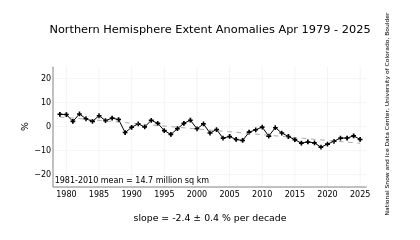
Nobody says that weather, whether triggered by AGW or entirely coincidental, has no impact. Quite the reverse! The long term trend is driven by AGW, but the 2007 minimum was caused by unusual weather patterns superimposed upon that trend. You can see quite clearly that 2007 was well below trend, whereas the 2009 “recovery” merely brought us back on to that declining trend:


(To put it another way – the 2009 “recovery” would have been a record low if it wasn’t for 2007 and 2008!)

It’s even more complicated than that because ice has a high albedo and therefore reflects a lot of the light that lands on it, and therefore reducing ice coverage effectively decreases the earth’s albedo, causing more of the energy from the sun to be aborbed, causing more warming. This is, in fact, one of those nasty positive feedbacks. CO2 warms the climate, the warming climate reduces ice, reducing albedo, warming the climate, etc.
Additionally, I really would like an explanation for how the oceans could warm during the same decade that land temperatures remained essentially constant. How does enhanced greenhouse warming account for that?
Do you know what ENSO actually is?

I think you’ll agree that it has a huge impact on global temperatures – look at the 1998 peak as a perfect example – and yet it’s simply a transfer of heat between the Pacific Ocean and the atmosphere caused by the relative temperature of the surface water.

The ocean has enormous thermal mass compared to the atmosphere. You could say that if the ocean sneezes, the atmosphere catches cold. If you could bring up cold water from the oceans’ depths to the surface, you could suck huge quantities of heat out of the air and lower global temperatures dramatically. (This wouldn’t actually solve the problem of AGW, just postpone it.)

Another effect is the melting of ice – if you apply constant heat to a mass of ice, it will gradually warm until it reaches 0C and then the heat you apply goes in to melting that ice rather than raising its temperature still further. Once the ice has turned into water then the temperature continues to rise again. (The same thing happens with water and steam – the water gets to 100C and then all the extra energy being applied to it is used to convert the water into steam, not to make the water hotter.)

So a certain portion of the heat energy is going in to melting ice rather than raising temperatures – atmosphere or ocean – and the exact portion could fluctuate over time.

So it’s easy to understand mechanisms for this to occur, but much harder to identify those actually responsible in a particular case and quantify them. The famous quote by Kevin Trenberth from the ClimateGate emails (which was taken directly from one of his peer-reviewed journal publications – just goes to show how closely the anti-AGW’ers are following the scientific literature) about it being a “travesty” that we are “unable to account for the lack of warming” was about precisely this – we know what the long term trend is, but we don’t have sufficient instrumentation to be able to actually account for the short-scale movements of heat between oceans, land, atmosphere, etc., and he was saying that this will be absolutely critical going forward. It would be great to be able to answer your question definitively, but to do that will require governments to be willing to fund climate change research sufficiently to afford such instrumentation.

(I think it apropos to point out that the “billions of dollars” that people sometimes bandy about as being spend on “AGW” are including money for things such as normal weather satellites, which are very expensive but not directly related to climate change. The Bush administration actually cancelled the launch of a satellite that would have been very useful in this regard after paying for it to be built; it’s been sitting in storage for years now.)
 
I was actually hoping for something a little more scientific than “a watched pot never boils.” In order for the oceans to warm the extra heat has to come from somewhere and if that somewhere is from enhanced greenhouse warming then, given that the radiation strikes the land with equal intensity, why didn’t the land warm? What natural factors cool the earth without cooling the atmosphere, and what do you mean that the oceans lag because of their inertia? If you remove a pot from the stove it immediately starts to cool, it cannot continue to get hotter without a heat source. In order for the oceans to warm for the last decade there must have been a heat source for them over that same period of time. So, what was heating the oceans but wasn’t heating the earth and how could that possibly be enhanced greenhouse warming?

Ender
I skipped over a few posts to try to avoid answering every single one and save a bit of time but just to make the answer I gave in my other response clearer:

The ocean waters are at different temperatures at different depths. The deep ocean is very cold, even in the tropics. If the currents change and either prevent deep, cold water from coming to the surface (like in an El Nino) or allow deep, cold water to come to the surface (like in a La Nina) then the surface water will have a different temperature. Since the surface water is in contact with the atmosphere, and the water has such a huge thermal mass, this has a dramatic effect on global atmospheric temperatures, which, in turn, affects land temperature (as anyone living near the coast can attest when the sea breeze comes in).

So even with a constant source of heat, the temperature of the atmosphere can swing wildly just because of changes to ocean circulation. Bring a lot of cold water to the surface and the ocean will suck in a lot more heat than it otherwise would have; leave the hot water on the surface and the atmosphere will get a lot hotter. The total amount of heat will be the same, it’s just the distribution that’s changing.

ENSO isn’t even the only one – another is PDO, which has a longer period (and, as Jones showed, if you remove the effect of PDO it makes the underlying global warming trend stronger because PDO appears as random fluctuations superimposed on the trend otherwise), and I’m sure there are plenty of others – and, on top of that, ENSO itself fluctuates randomly, both in length and magnitude.

The bottom line is that this is why you need to use longer time periods. As the length of the period increases, the effect of all these relatively short-term changes cancels out, revealing the underlying trend. Use short time periods, even when correcting for ENSO, and you still reveal very little about the underlying trend, as NOAA pointed out.
 
So even with a constant source of heat, the temperature of the atmosphere can swing wildly just because of changes to ocean circulation. Bring a lot of cold water to the surface and the ocean will suck in a lot more heat than it otherwise would have; leave the hot water on the surface and the atmosphere will get a lot hotter.
This is still no explanation for how the ocean surface temperature and atmospheric temperature can rise while land temperatures remain constant. Quite the opposite: increased ocean and atmospheric temperatures would normally contribute to terrestrial warming. These factors, coupled with increased CO2, should have caused the global temperature to increase. Obviously that didn’t happen.
The total amount of heat will be the same, it’s just the distribution that’s changing.
That’s not what your chart indicated: it was labeled “Earth’s Total Heat Content anomaly” and it showed “Ocean Heating”, not “Ocean Surface Heating”. Your own chart contradicts your explanation.

Further, you simply listed a number of natural factors that could have contributed one way or another, you made no attempt to explain what in fact did happen to keep temperatures flat in the last decade-plus, let alone why. I’m quite prepared to accept that normal, cyclical factors can explain warming. If that’s your argument then we don’t need to consider AGW.

Ender
 
I think you misunderstand what ENSO is. Firstly, ENSO “cycles” are only 2-3 years long.
The periodicity of the cycle is irrelevant to the validity of my comment; whether it is a month or a century doesn’t matter. If removing the ENSO effect for the past fifteen years increases the warming over that period then this can only be because the cooling effect in the first five years was larger than the warming effect of the last ten, which we know to have been 0.08 deg.
Secondly, I’ve given you the graphs of exactly what effect ENSO had on the global temperature from 1995-2009. You can see for yourself what effect it had.
Given that NOAA was able to calculate the ENSO effect from 1999-2008, it can surely be computed for 1995-1999. Do you know if someone has done that calculation and did they come up with a number less than -0.08? I understand your graph and in general how slopes are calculated but this doesn’t change the fact that, for your chart to reflect reality, ENSO cooling has to exceed ENSO warming for the removal of the ENSO effect to increase temperature.
Thirdly, I have mentioned repeatedly that ENSO is not the only phenomenon.
No argument there … it’s just not relevant to point under discussion.
The solar cycle contributes to the global temperature as well and it wasn’t removed from that NOAA data. Clearly it has a strong negative trend from about 2003 to 2010. This means that if the adjusted data had a zero trend, and the solar influence had a negative trend, then using your logic the greenhouse effect trend must have been positive during that time.
It’s not my logic, it’s NOAA’s. You say there was a strong negative trend but, for whatever reason, NOAA didn’t apply a solar correction. Are you suggesting that NOAA was negligent in their report? Incompetent?
To disprove AGW you actually need to explain why increasing the concentration of a known greenhouse gas won’t increase temperatures, because that’s basic physics.
I would have thought that facts would be sufficient to disprove a theory.

Ender
 
Dear friends,

This is my first post on this website, thanks for your answers.

I’m a committed Catholic from Sydney, Australia, and last night I was having a good conversation with a friend who is an athiest-humanist.

He actually didn’t pit the question to me directly, but if he did, I wouldn’t actually have known what to say:

What is the Catholic Church’s position on climate change? Why aren’t more Christian leaders committed to climate change, when the science so clearly points out that it is real and the planet’s fate depends on the climate?

Is the answer that we are still not convinced of the science?
Or that we are already quite active?
Or that there are more pressing moral issues to be dealt with, such as abortion and other life issues?

Or is the answer that the climate is such a big thing, that it is really beyond human control, and something that is really in God’s hands?
Is the answer that the climate will change depending on the degree of sin in the world - perhaps it is changing now because of the unprecedented wholesale change in the abandonment of God in western society?

Thanks for your help, God bless,

Jason.
The Church doesn’t tend to get into these kinds of scientific controversies. As for me, I’m kind of dubious about it after reading about all the nonsense that went on behind the scenes with the data.

judicialwatch.org/news/2010/jan/judicial-watch-uncovers-nasa-documents-related-global-warming-controversy

online.wsj.com/article/SB10001424052748704342404574576683216723794.html

And then there’s the question of why Mars seems to be experiencing temperature rises. Obviously, if it is, it’s not because of man’s greenhouse gas emissions.

timesonline.co.uk/tol/news/uk/article1720024.ece
 
This is still no explanation for how the ocean surface temperature and atmospheric temperature can rise while land temperatures remain constant. Quite the opposite: increased ocean and atmospheric temperatures would normally contribute to terrestrial warming. These factors, coupled with increased CO2, should have caused the global temperature to increase. Obviously that didn’t happen.
I’m a little confused about where your claims are coming from.

The HadCRUT global temperature anomaly that NOAA used for that report is a measure of the ocean surface temperature, the atmospheric temperature at the surface, and therefore also the land temperature. This is a natural consequence of the way the temperature readings are taken. It was this, when adjusted for ENSO, that failed to show any increase from 1999 to 2008, according to NOAA. Where did you get the idea that ocean surface temperature and atmospheric temperature were rising while land temperatures remained constant?
That’s not what your chart indicated: it was labeled “Earth’s Total Heat Content anomaly” and it showed “Ocean Heating”, not “Ocean Surface Heating”. Your own chart contradicts your explanation.
No, it directly supported it. You need to understand the difference between temperature measured at the surface and total heat content. You asked where the global warming was going and I showed you – the total heat content was rising the whole time. This is no way contradicts a measurement that shows surface temperature remaining constant.

I explained why – changes in ocean circulation that bring cold water to the surface can lower surface temperature while in no way diminishing the total heat content, for example. Total heat content is a more accurate measure of energy changes; surface temperatures are subject to the vagaries of ocean circulation, etc.
Further, you simply listed a number of natural factors that could have contributed one way or another, you made no attempt to explain what in fact did happen to keep temperatures flat in the last decade-plus, let alone why.
More than that, I explicitly stated that we don’t have enough information to do that:
40.png
JasonSB:
So it’s easy to understand mechanisms for this to occur, but much harder to identify those actually responsible in a particular case and quantify them. The famous quote by Kevin Trenberth from the ClimateGate emails … about it being a “travesty” that we are “unable to account for the lack of warming” was about precisely this – we know what the long term trend is, but we don’t have sufficient instrumentation to be able to actually account for the short-scale movements of heat between oceans, land, atmosphere, etc., and he was saying that this will be absolutely critical going forward. It would be great to be able to answer your question definitively, but to do that will require governments to be willing to fund climate change research sufficiently to afford such instrumentation.
If you think it’s really important to be able to say where the heat actually went in a particular year then feel free to petition your government to fund instrumentation capable of doing that. If you’re not willing to spend that money, don’t complain that nobody can answer the question.

If you think this in any way affects the case for AGW then you’re sorely mistaken, because although these fluctuations cause short-term variability in the climate that can disguise the underlying warming trend in the short term, the don’t have any effect in the long term as they all cancel out. This was clearly explained in the NOAA report. Didn’t you read it? They said: “Near-zero and even negative trends are common for intervals of a decade or less in the simulations, due to the model’s internal climate variability.” There is nothing to explain.
I’m quite prepared to accept that normal, cyclical factors can explain warming. If that’s your argument then we don’t need to consider AGW.
The flaw in that logic is that you are assuming that AGW is an attempt to explain the warming we’ve seen in recent decades.

It’s not.

AGW is a theory based on the physics of greenhouse gasses and the consequences of increasing the concentration those greenhouse gasses. Those consequences were clearly outlined in the 1979 Charney report, well before anybody thought there was any “global warming” that needed explaining. In the years since, those consequences have become directly measurable.

The time it takes for these kinds of effects to be felt can be predicted. It doesn’t take 200 years, for example, for the climate to start to respond to a change in solar output or greenhouse gas concentrations, therefore we don’t need to look at cycles that long to detect it. Two decades is sufficient.

Even in the case of long-term effects like the Milankovitch cycles it doesn’t take thousands of years for the climate to respond because the climate response is slow – it takes a long time because the forcing is changing slowly over a long period of time. If the change in forcing is small enough then it takes longer for the response to be detected against the background noise. So the issue over longer periods of time is how quickly and by how much is the forcing changing, not how long does it take for the climate to respond, and we can demonstrate that in the last 50 years or so the only signficant change in forcing is the greenhouse gasses.

Just because different effects occur over different time spans doesn’t mean that it’s a free-for-all and you can just pick and choose whatever time span you want. The period has to make sense.
 
If removing the ENSO effect for the past fifteen years increases the warming over that period then this can only be because the cooling effect in the first five years was larger than the warming effect of the last ten, which we know to have been 0.08 deg.
http://www.skepticalscience.com/images/mclean_elnino1.gif

See that hump in 1998? It’s reducing the trend over that period. Correcting for ENSO removes it:

http://img443.imageshack.us/img443/2402/ensoadjusted.jpg

Voila, bigger trend.
Given that NOAA was able to calculate the ENSO effect from 1999-2008, it can surely be computed for 1995-1999. Do you know if someone has done that calculation and did they come up with a number less than -0.08? I understand your graph and in general how slopes are calculated but this doesn’t change the fact that, for your chart to reflect reality, ENSO cooling has to exceed ENSO warming for the removal of the ENSO effect to increase temperature.
The ENSO removal technique was developed by Thompson et al (2008), as mentioned both in the RealClimate post I took my chart from and the NOAA publication. It isn’t “my chart”, and if you think one of them reflects reality then they both must because they’re both the same thing. The only difference is that the RealClimate post came out straight after the Thompson paper and therefore only covers the time period that was available at that time, whereas NOAA’s report came out a year later and includes 2008.

Now I really don’t understand what you think the problem is. I have reproduced the NOAA chart, and I have shown NOAA’s own graph that showed a positive trend in the ENSO-adjusted data from 1995 to 2008. You seem to be trying to cast doubt on the possibility that there can be a positive trend from 1995 to 2008 in the ENSO-adjusted data given a zero trend from 1999 to 2008 in the ENSO-adjusted data, but that’s exactly what NOAA said in the publication you pointed me to.

Again, in case you missed it:

http://img718.imageshack.us/img718/2124/noaa.jpg

You can clearly see, in the bottom graph, that the temperature change from 1995 to 2008 is about 0.2 degrees C.

I accept NOAA’s assessment. Why don’t you?
No argument there … it’s just not relevant to point under discussion.
It is if you keep trying to subtract one thing from another and make claims about what the other thing should be while ignoring the fact that there are other terms that also changed over that time.
It’s not my logic, it’s NOAA’s. You say there was a strong negative trend but, for whatever reason, NOAA didn’t apply a solar correction. Are you suggesting that NOAA was negligent in their report? Incompetent?
Why would I? I understand what they did. They were answering a specific question: Is the any implication to the theory of AGW from the observation that the ENSO-adjusted temperature trend from 1999 to 2008 is zero?

They answered it: No. It would take at least 15 years of zero trend in ENSO-adjusted data before we would start to think something had been overlooked.

They didn’t apply a solar correction because that wasn’t the question. There wouldn’t have been a question if a solar correction was included because then the trend would have been positive!
I would have thought that facts would be sufficient to disprove a theory.
They are. But that’s not what you have.

The facts say that CO2 is a greenhouse gas. You can prove this in the lab:

youtube.com/watch?v=Ot5n9m4whaw

The facts say that we are increasing the concentration of CO2 in the atmosphere. You can prove this by direct measurement.

http://www.skepticalscience.com/images/CO2-Emissions-vs-Levels.gif

The facts say that increasing the concentration of CO2 will increase its effect. You can prove this in a lab, too.

The facts say that the IR being emitted into space has declined at exactly the wavelengths that CO2 is known to absorb and re-emit IR. You need satellites to prove this, but it’s been done:

http://www.skepticalscience.com/images/harries_radiation.gif

The facts say that the IR being reflected down to earth from the atmosphere has increased at exactly the wavelengths that CO2 is known to absorb and re-emit IR:

http://www.skepticalscience.com/images/Greenhouse_Spectrum.gif

The theory explains the last two observations by the fact that when a CO2 molecule absorbs IR, it re-emits it in a random direction, and therefore half the IR at the CO2 wavelengths that was going to escape into space was reflected back down to earth instead, resulting in a reduction at those wavelengths as seen from space and an increase at those wavelengths as seen from the ground.

The facts say that the ocean is continuing to accumulate heat, even when surface temperature measurements show not much change:

http://www.skepticalscience.com/images/ocean-heat-2000m.gif

Therefore, for the theory to be wrong, any new facts have to have no other possible explanation and any alternative explanation must explain all the old facts that were already explained.

Now, surface temperatures not rising for a decade fails to falsify AGW because it is easy to explain that the heat has been going into the oceans and melting ice instead of warming the surface. So that fact is not sufficient to disprove the theory.
 
The Church doesn’t tend to get into these kinds of scientific controversies. As for me, I’m kind of dubious about it after reading about all the nonsense that went on behind the scenes with the data.
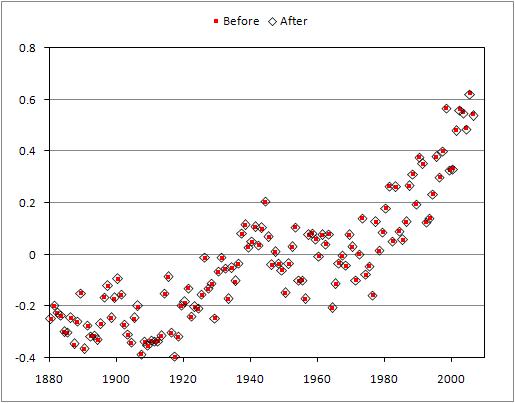
Nonsense? James Hanson clearly explains that the error had no measurable effect, as you can see here:

http://www.skepticalscience.com/images/GISS_temp_Y2K_adjustment.gif

Going earlier:


The question of “which year was hottest” is meaningless because, as Hanson explains, the difference in temperature between those years is less than the accuracy, which is why NASA likes to use the phrase “statistical tie”.

Why do the figures prior to 2000 change even though the error only affected stations after that date? Because some stations report data years after other stations do, and whenever new data is received it is used to update the historical records. In fact, there are literally thousands of stations that haven’t been updated since 1991 but their data is still out there and, at some point, will be added to the record as well. This will cause slight changes to the historic temperature record from 1991 to that date, but it won’t change the overall picture much, as has already been shown by links I gave previously that compared the temperature record pre-1991 for those stations with those that are still in use today. I also gave a link to work using thousands of stations not currently in use for the official figures, which showed much the same thing, and a demonstration that even using just 61 rural stations distributed around the world still gives much the same thing. In scientific terms this means the result is “robust”.
I don’t blame him for being frustrated when people accuse him of malfeasance or incompetance on the basis of that error even though it has no discernable effect and it was a minor error to begin with.

Not only that but many people have now reproduced the NASA GISS temperature record, including people like clearclimatecode.org/ who have re-written it in a programming language that is easier for laypeople to use.
How nice of the CEI to “request a slew of information” on our behalf, especially when everything they actually need to verify AGW is already publicly available. One could almost be excused for thinking the folks who told us that we should “think of smoking as a civic duty” might have ulterior motives for keeping researchers busy answering their requests…
And then there’s the question of why Mars seems to be experiencing temperature rises. Obviously, if it is, it’s not because of man’s greenhouse gas emissions.
Obviously, if it is, it’s not because of man’s greenhouse gas emissions. In fact your own link gives explanations in terms of dust storms.

Equally obviously, if it was because of the sun, or some other external source, then it would affect all the planets, not just Mars and Earth. And we’d be able to detect it.

I do find it curious that the people who are so ready to accept global warming on Mars find it so hard to accept it on earth, when we have so much more instrumentation and data available for earth – especially when they’re accepting the Mars information from the same people who’s claims regarding AGW they find “dubious”.

Anyway, is it so? Nobody knows for sure. But if it is, it says nothing about what is causing warming on earth, because (a) we can explain the warming on earth very easily by looking at the rapid increase in greenhouse gasses, and (b) warming on Mars can be caused by other things that are not currently having an effect on earth, like Mars’ orbital eccentricity and massive dust storms.

More here: skepticalscience.com/global-warming-on-mars.htm
 
Dear friends,

This is my first post on this website, thanks for your answers.

I’m a committed Catholic from Sydney, Australia, and last night I was having a good conversation with a friend who is an athiest-humanist.

He actually didn’t pit the question to me directly, but if he did, I wouldn’t actually have known what to say:

What is the Catholic Church’s position on climate change? Why aren’t more Christian leaders committed to climate change, when the science so clearly points out that it is real and the planet’s fate depends on the climate?

Is the answer that we are still not convinced of the science?
Or that we are already quite active?
Or that there are more pressing moral issues to be dealt with, such as abortion and other life issues?

Or is the answer that the climate is such a big thing, that it is really beyond human control, and something that is really in God’s hands?
Is the answer that the climate will change depending on the degree of sin in the world - perhaps it is changing now because of the unprecedented wholesale change in the abandonment of God in western society?

Thanks for your help, God bless,

Jason.
Welcome Jason!

HOW COOL IS THIS… the USCCB has gathered all their documents about climate change and created one page for them with links… usccb.org/sdwp/ejp/climat…rsalerts.shtml

Climate change matters and is a moral issue BECAUSE it impacts people, made in God’s image - and WE need to do something because the poor are the most vulnerable - does this mean some cap and trade scheme - perhaps not - but as individuals we need to do all we can - and work for polices that will actually make a difference.

visit this group for some interesting posts and information: CLIMATE CHANGE - Our faith calls us to action! Here on CAF - forums.catholic-questions.org/group.php?groupid=488
 
The ONLY moral issue, Is to demand:

1; Science remains neutral
2, The funding of Science is equally dispersered / not toward a one sided outcome.
3: Empirical Observational evidence matches the hypothesis / Not fixing the Hypothesis to the Evidence.
4: Poorly formed excuses Much like a bad parent excuses a bad child’s actions ], stop.
5; There is accountability to the public. Not to in-house task forces. We have invested over 2 billion dollars a year of USA tax payer funding Over twenty - three Billion dollars ] and expect accountability in reports etc
6: Demand a bang for our buck in reports. Not Thesis papers by Master degree students - PhD Student Thesis, GreenPeace , WWF, weekend backpackers, Evolutionary Feminism students Hanno produced graph ] etc climatequotes.com/2010/02/03/ipcc-cited-multiple-masters-students-in-ar4-some-unpublished/ Many in The WG1
7 Release and transparency - If this means ceasing the IPCC Climate Model under Multi National Guard and allow independent runs - backwards - So be it. Fear and atmosphere is what the hypothesis of AGW is all about - Surely, the Science behind this Hypothesis isn’t fearful of this atmosphere?
8: All sensors are used - and if some sensors are defunct - Use our tax payer monies to replace them - instead of ignoring them or adjusting them. Remove, instead of adjusting, Urban Heat Sensors and replace and hold the land they are replaced on as sanctuaries, allowing no future encroachments.
9; Use raw data only - no manipulations - homogenization etc - Allowing All scientists to reproduce / examine without these manipulations. .
10; Disband the IPCC . It has more than proven it’s conflict of interests.
11; CRU needs to distant itself from “soft money” . By staying with Soft Money, It’s seen as nothing more than any other Big business.
 
The ONLY moral issue, Is to demand:

1; Science remains neutral
2, The funding of Science is equally dispersered / not toward a one sided outcome.
3: Empirical Observational evidence matches the hypothesis / Not fixing the Hypothesis to the Evidence.
4: Poorly formed excuses Much like a bad parent excuses a bad child’s actions ], stop.
5; There is accountability to the public. Not to in-house task forces. We have invested over 2 billion dollars a year of USA tax payer funding Over twenty - three Billion dollars ] and expect accountability in reports etc
6: Demand a bang for our buck in reports. Not Thesis papers by Master degree students - PhD Student Thesis, GreenPeace , WWF, weekend backpackers, Evolutionary Feminism students Hanno produced graph ] etc climatequotes.com/2010/02/03/ipcc-cited-multiple-masters-students-in-ar4-some-unpublished/ Many in The WG1
7 Release and transparency - If this means ceasing the IPCC Climate Model under Multi National Guard and allow independent runs - backwards - So be it. Fear and atmosphere is what the hypothesis of AGW is all about - Surely, the Science behind this Hypothesis isn’t fearful of this atmosphere?
8: All sensors are used - and if some sensors are defunct - Use our tax payer monies to replace them - instead of ignoring them or adjusting them. Remove, instead of adjusting, Urban Heat Sensors and replace and hold the land they are replaced on as sanctuaries, allowing no future encroachments.
9; Use raw data only - no manipulations - homogenization etc - Allowing All scientists to reproduce / examine without these manipulations. .
10; Disband the IPCC . It has more than proven it’s conflict of interests.
11; CRU needs to distant itself from “soft money” . By staying with Soft Money, It’s seen as nothing more than any other Big business.
Well, the leaders of the Church seem to disagree with you about where the morality exists - but that may not be a concern for some.

The moral issue they point to (in all the documents listed and others penned by the Holy Father) is how climate change will impact the poor around the world - and how our choices must keep their needs central.

I’ll let Jason - who is doing a great job by the way :flowers:- continue to reply to the issues of where some are misunderstandings re the science, the reporting, and how some people have allowed skepticism - that is good in and of it self - to blind them.

Blessings, :signofcross:
 
usccb.org/sdwp/ejp/climate/lettersalerts.shtml

Sorry if that link to Church docs wasn’t working…
From one of the documents:

**What does climate change have to do with my Catholic faith? The Catholic Church brings a unique voice to the climate change debate by lifting up both the moral dimensions of caring for God’s creation and the needs of the most vulnerable among us. The Catholic bishops’ primary concern is to place the life, dignity and needs of the poor and vulnerable at the center of climate legislation. Poor people should not bear an undue burden of the impacts of climate change or the global adjustments needed to address it. **
 
No. I believe in God. That’s an article of faith. I accept the evidence that the globe is warming, that we’re largely responsible for it, and that the impact will be negative overall, especially for people who are most vulnerable but also the least culpable. That also makes it a moral issue for me.

If new evidence emerged that showed a hitherto unknown mechanism would either start to draw down our CO2 emissions or negate their impacts – say, a change in cloud behaviour that magically cancelled out the enhanced greenhouse effect by an increase in Earth’s albedo – then I would (a) be incredibly relieved, and (b) change my mind.

Right now, however, we have no evidence of that. I am not willing to gamble the future of millions of people on wishful thinking.

It’s not good enough to say you don’t “believe” a group of scientists – look at the evidence! A shrinking polar ice cap, retreating glaciers, changes in plant distribution, changes in the length of the growing season, changes in the timing of plant blossoming, changes in ocean acidity, heat content, and level, and on, and on, and on.

If you think that none of these things are happening then you’re proposing by far the largest conspiracy in the history of the world. You’re suggesting that thousands of scientists all over the world in different fields, who normally would be dreaming of becoming the next Galileo and overturning conventional wisdom, are all instead fabricating evidence in a consistent way that would be easily disproven by anybody simply looking at the evidence for themselves.

If you accept all that evidence that the world is warming, then what rational basis do you have for dismissing a theory that predicted that without proposing an alternative theory that not only explains why releasing enormous quantities of a known greenhouse gas into the atmosphere won’t cause the effects that physics predicts it will, but also explains why we are experiencing the effects that physics predicted that CO2 would cause?

An apple falling from a tree doesn’t prove Newton’s Law of Gravity, either. But that doesn’t mean it’s a good idea to step off a cliff.

You haven’t answered my question about what standard of proof you require to be willing to make some sacrifice for the benefit of millions in the future.

I see a lot of things you “believe” in there with scant evidence to support them. Your standard of “proof” is wildly asymmetric.

For example, you seem willing to “believe” people have acted dishonestly despite many independent investigations exhonorating them and despite the fact that their results are easily reproducible by anyone by looking at the raw data!

Your belief that climate models depend on the person providing (name removed by moderator)ut ignores the fact that you can freely download climate models, examine their source code to your heart’s content, and choose the (name removed by moderator)ut yourself if you wish. Have you seen any claims from the usual suspects that they found the proof that the climate models were wrong? The “skeptics” must be in on the conspiracy too!

Your belief that climate models can’t predict is easily disproven by looking at how they “predict” climate changes that have already happened. This is standard practice – you see, the climate model doesn’t know that this is 2010 unless you tell it, so if you ask it to predict the climate from 1950 to 2010 and only give it data from before 1950, it is predicting the climate from 1950 to 2010 even though from our point of view that has already happened. If it gets it right then a reasonable person would assume there is no reason to disbelieve predictions beyond 2010! (See skepticalscience.com/climate-models.htm for more.)

It’s also a strawman, because models aren’t even the most important foundation for the theory.

I could go on, but the point is clear – everything in your list of things that you believe is either (a) supported by scant evidence, (b) inconsequential (i.e. it doesn’t affect whether the science is correct or not), or (c) simply wrong.

I wish you were skeptical. But you are not. You only apply skepticism one way, to the point where you believe what you want to believe no matter what “proof” you’re offered, but are willing to accept anything that suggests the opposite.

If you think that everything I’ve said so far is “puppet-ting IPCC” then I think that just proves my point.

I’m sure the Russians thought a warmer planet would do them good as well. Until now.

Now I could point you to studies that show the impacts of increased CO2 on grain crops is actually not that beneficial nutritionally, as well as studies that point out that weeds respond much more positively than grain and so more pesticides will be required, as well as point out that even if warming means we open up growing areas further north, the lower light levels at high lattitudes and poor soil quality will mean a net reduction in grain – but I won’t. What would be the point? You won’t “believe” it anyway. Instead I’ll ask you one question:

Where in the Bible does it say you only have to worry about what happens to Americans? I must have missed that bit.

:clapping:

…and the exact point the Church makes - the poor and vulnerable around the world must be at the center of discussion, personal choices, and policy.
Very grateful for your posts…
 
I’m a little confused about where your claims are coming from.
Ditto. Let me try again: (according to you?) the heat content of the oceans has continued to increase in the last decade, the temperature of the (overall) atmosphere has increased, while the surface temperature (combined ocean and atmospheric temp at the surface) has remained flat after the ENSO effect is removed. The surface temp of the oceans remaining constant while the overall heat content increases is explained by appeal to shifting ocean currents bringing increased amounts of cold water to the surface. I understand the theory. What theory explains increased atmospheric temperature?
More than that, I explicitly stated that we don’t have enough information to [explain why temp has been flat for a decade]
I believe that. I just believe it is true for a great deal more as well.
If you think this in any way affects the case for AGW then you’re sorely mistaken, because although these fluctuations cause short-term variability in the climate that can disguise the underlying warming trend in the short term, the don’t have any effect in the long term as they all cancel out. This was clearly explained in the NOAA report. Didn’t you read it? They said: “Near-zero and even negative trends are common for intervals of a decade or less in the simulations, due to the model’s internal climate variability.” There is nothing to explain.
I already accepted this in a previous post. Didn’t you read it? In your opinion, what would it take to disprove AGW?
AGW is a theory based on the physics of greenhouse gasses and the consequences of increasing the concentration those greenhouse gasses.
No one disputes the fact that greenhouse warming exists or that - absent other considerations - if the concentration of greenhouse gases is increased warming will increase as well. It has not been demonstrated that “other considerations” are of lesser significance.
we can demonstrate that in the last 50 years or so the only signficant change in forcing is the greenhouse gasses.
This is what is disputed, and by scientists with more claim to our trust than Hansen, Jones, et al.

Ender
 
Climate change matters and is a moral issue BECAUSE it impacts people
Goodness, every problem impacts people, that’s why they’re called problems, but not every decision - even if it effects people - is a moral choice. The theory of AGW is just that, a scientific theory, and deciding how to act is determined by (1) whether or not one believes the theory is scientifically correct and (2) what one thinks can be done that will be effective. Neither of those two considerations presents us with moral conundrums. There is no moral component whatever to the issue of climate change any more than in picking stocks for investing. We make choices based on imperfect information and hope for the best.
WE need to do something because the poor are the most vulnerable - does this mean some cap and trade scheme - perhaps not - but as individuals we need to do all we can - and work for polices that will actually make a difference.
Yes, well it’s the “perhaps not” that is the problem. I’m happy to work for policies that will make a difference but I won’t accept the suggestion that my choices are somehow less moral than the choices others make. My actions may be less helpful - they may in fact be harmful - but that doesn’t make them less moral any more than investing in Enron was immoral. It may have been a disastrously bad choice but it wasn’t an immoral one.

Ender
 
I’ll let Jason - who is doing a great job by the way :flowers:- continue to reply to the issues of where some are misunderstandings re the science, the reporting, and how some people have allowed skepticism - that is good in and of it self - to blind them.

Blessings, :signofcross:
Sorry, Jason has done no better than Mr Jones…Hanson…et al. In short IMHO… continued with promoting the hypothesis as normal, and glossing over the bad child’s behavior.

I am almost positive, if your parish had these self inflicted problems, you’d be demanding answers. Knowing that they problems ] raise questions and aren’t being addressed - would it not be a moral responsibility to demand they be addressed?

Again, common sense conservation IS what the Church asks us…NOT what is offered as "solutions’ by the UN IPCC.

Demanding accountability, IS ALSO GOOD STEWARDSHIP 🙂

AND the idea being promoted by AGW’s that somehow, people that don’t believe in the accountability behind AGW … is being addressed honestly - as being amoral - is insulting AND IMHO, far from Christian…

Many of us do as much OR more, for our environment, then those who are insinuating such nonsense.

I’ll invite you and others who hold this view to step down off of your horse
 
usccb.org/sdwp/ejp/climate/lettersalerts.shtml

Sorry if that link to Church docs wasn’t working…
From one of the documents:

**What does climate change have to do with my Catholic faith? **The Catholic Church brings a unique voice to the climate change debate by lifting up both the moral dimensions of caring for God’s creation and the needs of the most vulnerable among us. The Catholic bishops’ primary concern is to place the life, dignity and needs of the poor and vulnerable at the center of climate legislation. Poor people should not bear an undue burden of the impacts of climate change or the global adjustments needed to address it.
Can you show one solution offered by the IPCC that doesn’t directly impact the poor and create more wealth to the wealthy?

How about this? Due to the recent problems with banking institutions around the world - Do you suggest one bank The World Bank ] Hold these tax monies? Doesn’t it make GOOD STEWARDSHIP SENSE to have the monies equally distributed to many individual banks, in case of another banking scandal ?
 
:clapping:

Very grateful for your posts…
I’m sure you are…BUT personally…when he glossed over the post of CRU funding Soft Money ] He Spoke volumes, to me.

I invite you to research some of those organizations. Here is just a few.
Oman LNG L.L.C
Formed: Set up by Royal Decree in February 1994.
Location: Head office: Muscat; Plant: Qalhat near Sur (approx 340 km from Muscat)
Products: Liquefied Natural Gas (LNG).
Shareholders: Government of Oman 51 %, Royal Dutch/Shell Group 30%, Total Elf Fina 5.54%, KOLNG 5%, Partex 2% Mitsubishi 2.77%, Mitsui 2.77%, ltochu 0.92%.
The Climate Research Unit (CRU) in the UK was set up in 1971 with funding from Shell and BP as is described in the book: “The history of the University of East Anglia, Norwich; Page 285)” By Michael Sanderson. The CRU was still being funded in 2008 by Shell, BP, the Nuclear Installations Inspectorate and UK Nirex LTD (the nuclear waste people in the UK)
blogs.telegraph.co.uk/news/jamesdelingpole/100020304/climategate-peak-oil-the-cru-and-the-oman-connection/

omanlng.com/
BP was named by Mother Jones Magazine, an investigative journal that “exposes the evils of the corporate world, the government, and the mainstream media”,[56] as one of the ten worst corporations in both 2001 and 2005 based on its environmental and human rights records.[57][58] In 1991 BP was cited as the most polluting company in the US based on EPA toxic release data. BP has been charged with burning polluted gases at its Ohio refinery (for which it was fined $1.7 million), and in July 2000 BP paid a $10 million fine to the EPA for its management of its US refineries.[59] According to PIRG research, between January 1997 and March 1998, BP was responsible for 104 oil spills.[60] BP patented the Dracone Barge to aid in oil spill clean-ups across the world.[61]
http://en.wikipedia.org/wiki/File:Gulf_oil_bp.jpg

As of 11 February 2007 BP announced that they would spend $8 billion over ten years to research alternative methods of fuel, including natural gas, hydrogen, solar, and wind. A $500 million grant to the University of California, Berkeley, Lawrence Berkeley National Laboratory, and the University of Illinois at Urbana-Champaign, to create an Energy Biosciences Institute[62] has recently come under attack, over concerns about the global impacts of the research and privatisation of public universities.[63]
en.wikipedia.org/wiki/BP#Environmental_record
.BP, the nation’s biggest oil and gas producer, has a worse health, environment and safety record than many other major oil companies…
msnbc.msn.com/id/37045263/ns/business-the_new_york_times/

His reference to evil Exxon…told me his research is …lacking unbiased substance
The industry standard for safety, analysts say, is set by ExxonMobil, which displays an obsessive attention to detail, monitors the smallest spill and imposes scripted procedures on managers.
Before drilling a well, for example, it runs elaborate computer models to test beforehand what the drillers might encounter. The company trains contractors to recognize risky behavior and asks employees for suggestions on how to improve safety. It says it has cut time lost to safety incidents by 12 percent each year since 2000.
Analysts credit that focus, in part, to the aftermath of the 1989 Exxon Valdez grounding, which spilled 11 million gallons of crude oil into Prince William Sound in Alaska.
“Whatever you think of them, Exxon is now the safest oil company there is,” said Amy Myers Jaffe, an energy expert at Rice University.
 
Status
Not open for further replies.
Back
Top