Catholicism and Climate Change

  • Thread starter Thread starter jaserius
  • Start date Start date
Status
Not open for further replies.
Accepting this hypothesis - That would require / hold true, for ALL GHE’s 🙂 Including water vapor
Of course it does.

Now ask yourself this: why, then, would scientists classify CO2 as the dominant climate forcing greenhouse gas, but water vapour as only a climate feedback?

Are scientists really so stupid that this never occurred to them? That someone on a blog could overturn decades of research by asking a really obvious question?

If you come to what I hope is the obvious conclusion that that’s pretty unlikely and start to wonder, therefore, that there must be something else to explain it, you might actually realise for yourself that the answer is “Residence Time Matters”.

If I release a molecule of any greenhouse gas into the atmosphere, the impact that will have on the climate depends on both how potent it is and how long it will stay in the atmosphere. (Note that the individual molecule doesn’t matter, it’s the increase in the total number of molecules that counts. That individual molecule could get sucked straight up by a plant, for example, but because the plant sucked up that particular molecule it didn’t suck up another molecule that it otherwise would have, and so the increase in the total number of molecules is what persists.)

As an analogy, imagine you have an interest-bearing savings account. You earn more interest the more money you have in there, and you earn more interest the longer you leave it in there. (It also doesn’t matter which individual dollars go in and out of your account over time, what matters is the total during that time.)

So, clearly, the residence time for a greenhouse gas (and, in particular, the residence time for the increase in concentration, not the particular molecules) makes a difference, just like the length of time you leave money in your savings account does.

Now, it turns out that water has a very short residence time – it rains if there is more water in the atmosphere than it “naturally” wants – while CO2 has a very long residence time. If you were somehow able to dump a vast quantity of moisture into the atmosphere today, the spike in water vapour concentration would cause temporary warming but it would have all rained out again in a matter of weeks – far too short a time for it to affect the climate. (It would certainly make for some very wet weather, however.)

In contrast, if you dump a vast quantitiy of CO2 into the atmosphere – as we are doing now – then it will stick around for a very long time. (A significant portion will remain for centuries.) The whole time it is up there it is causing warming. Therefore releasing CO2 can force the climate to change, while releasing H2O would not.

The reason water is still a problem, however, is that the amount of water that the atmosphere “naturally” wants to hold is a function of the temperature of the atmosphere. If you raise the temperature, evaporation will increase, and the total amount of water vapour in the atmosphere will be higher, and it will stay higher as long as the atmosphere remains warmer. Because you have now found a way to raise water vapour levels for a long time, water vapour now has a chance to influence climate – and therefore acts to amplify the initial warming that you introduced with CO2.

So you can influence climate with CO2 directly, but you can only cause water vapour to influence climate indirectly, by triggering it as a feedback to the initial warming caused by a forcing, like CO2.
 
As an analogy, imagine you have an interest-bearing savings account. You earn more interest the more money you have in there, and you earn more interest the longer you leave it in there. (It also doesn’t matter which individual dollars go in and out of your account over time, what matters is the total during that time.)
This analogy assumes that the bank never reaches saturation.
 
Let’s just cut to the quick:)

You believe in AGW, IPCC, RealClimate, Mr’s Mann, Hansen, Jones, Schmidt et al.
No. I believe in God. That’s an article of faith. I accept the evidence that the globe is warming, that we’re largely responsible for it, and that the impact will be negative overall, especially for people who are most vulnerable but also the least culpable. That also makes it a moral issue for me.

If new evidence emerged that showed a hitherto unknown mechanism would either start to draw down our CO2 emissions or negate their impacts – say, a change in cloud behaviour that magically cancelled out the enhanced greenhouse effect by an increase in Earth’s albedo – then I would (a) be incredibly relieved, and (b) change my mind.

Right now, however, we have no evidence of that. I am not willing to gamble the future of millions of people on wishful thinking.

It’s not good enough to say you don’t “believe” a group of scientists – look at the evidence! A shrinking polar ice cap, retreating glaciers, changes in plant distribution, changes in the length of the growing season, changes in the timing of plant blossoming, changes in ocean acidity, heat content, and level, and on, and on, and on.

If you think that none of these things are happening then you’re proposing by far the largest conspiracy in the history of the world. You’re suggesting that thousands of scientists all over the world in different fields, who normally would be dreaming of becoming the next Galileo and overturning conventional wisdom, are all instead fabricating evidence in a consistent way that would be easily disproven by anybody simply looking at the evidence for themselves.

If you accept all that evidence that the world is warming, then what rational basis do you have for dismissing a theory that predicted that without proposing an alternative theory that not only explains why releasing enormous quantities of a known greenhouse gas into the atmosphere won’t cause the effects that physics predicts it will, but also explains why we are experiencing the effects that physics predicted that CO2 would cause?
That is fine:)
It doesn’t prove CO2 causes Global Warming AGW ]
An apple falling from a tree doesn’t prove Newton’s Law of Gravity, either. But that doesn’t mean it’s a good idea to step off a cliff.

You haven’t answered my question about what standard of proof you require to be willing to make some sacrifice for the benefit of millions in the future.
I believe…
I see a lot of things you “believe” in there with scant evidence to support them. Your standard of “proof” is wildly asymmetric.

For example, you seem willing to “believe” people have acted dishonestly despite many independent investigations exhonorating them and despite the fact that their results are easily reproducible by anyone by looking at the raw data!

Your belief that climate models depend on the person providing (name removed by moderator)ut ignores the fact that you can freely download climate models, examine their source code to your heart’s content, and choose the (name removed by moderator)ut yourself if you wish. Have you seen any claims from the usual suspects that they found the proof that the climate models were wrong? The “skeptics” must be in on the conspiracy too!

Your belief that climate models can’t predict is easily disproven by looking at how they “predict” climate changes that have already happened. This is standard practice – you see, the climate model doesn’t know that this is 2010 unless you tell it, so if you ask it to predict the climate from 1950 to 2010 and only give it data from before 1950, it is predicting the climate from 1950 to 2010 even though from our point of view that has already happened. If it gets it right then a reasonable person would assume there is no reason to disbelieve predictions beyond 2010! (See skepticalscience.com/climate-models.htm for more.)

It’s also a strawman, because models aren’t even the most important foundation for the theory.

I could go on, but the point is clear – everything in your list of things that you believe is either (a) supported by scant evidence, (b) inconsequential (i.e. it doesn’t affect whether the science is correct or not), or (c) simply wrong.

I wish you were skeptical. But you are not. You only apply skepticism one way, to the point where you believe what you want to believe no matter what “proof” you’re offered, but are willing to accept anything that suggests the opposite.
Sooooo…you see, puppet-ting IPCC etc etc…to me…Just doesn’t get it done.😃
If you think that everything I’ve said so far is “puppet-ting IPCC” then I think that just proves my point.
I’m sure the Russians thought a warmer planet would do them good as well. Until now.

Now I could point you to studies that show the impacts of increased CO2 on grain crops is actually not that beneficial nutritionally, as well as studies that point out that weeds respond much more positively than grain and so more pesticides will be required, as well as point out that even if warming means we open up growing areas further north, the lower light levels at high lattitudes and poor soil quality will mean a net reduction in grain – but I won’t. What would be the point? You won’t “believe” it anyway. Instead I’ll ask you one question:

Where in the Bible does it say you only have to worry about what happens to Americans? I must have missed that bit.
 
This analogy assumes that the bank never reaches saturation.
True. But I’m sure that most banks, just like the atmosphere, won’t “saturate” if you give them too much money.

You aren’t seriously going to try suggesting that CO2 is saturated now, are you?

I certainly hope you asked for “proof” when you heard that furphy!
 
If this discussion is going to focus on carbon dioxide, here is some information from a previous post:

The increase of carbon dioxide is not a cause for alarm and, in fact, will be good for mankind.

CO2 is not a pollutant. It is the gas of life for plants, man, and animals. All plant life is sustained by photosynthesis, where CO2 plus water plus the Sun’s energy form carbohydrates plus Oxygen. Humans and animals breathe in oxygen and exhale CO2. Plants must absorb carbon dioxide (CO2) in combination with water, soil nutrients and sunlight to produce the sugars vital for growth. A shortage of any of these requirements will retard the growing process.

[All high school freshmen should know all this from their biology classes and should have studied and drawn the details of plant leaves.]

According to the Mauna Loa observatory the present atmospheric CO2 is about 385 ppm (parts per million.), but in times past it was as high as 2450 ppm. (Jaworoski, 1992a,1992b).

[Some contend that Mauna Loa is not a good place to measure it because the ocean is the major source and sink of carbon dioxide and Mauna Loa is in the middle of the ocean.]

Normal CO2 concentration varies = ~ 300 ppm = 0.03%

In order to increase their yield, commercial greenhouses may increase CO2 concentration to 600 to 1500 ppm or more = 0.06% to 0.15%

1000 ppm = 0.1%

We try to keep CO2 levels in our US Navy submarines no higher than 8,000 parts per million, about 20 times current atmospheric levels.

10,000 PPM = 1% drowsiness

20,000 ppm = 2% feeling of heaviness; awareness of deeper breathing

30,000 ppm = 3% breathing rate doubles

Our exhaled breath contains about 4% CO2. That is 40,000 parts per million, or about 100 times the current atmospheric concentration. CO2 is absolutely essential for life on earth.

50,000 ppm = 5% breathing rate increases by four times normal.

above 50,000 ppm = more than 5% toxic level of carbon dioxide.

If atmospheric CO2 drops to the 220 ppm, plants get sick. They start to die at 160ppm. In a field of corn on a sunny day, unless wind currents stir up the air, all of the CO2 is consumed within one meter of the ground in 5 minutes. Nighttime levels in a greenhouse range from 400 to 500 ppm due to plant respiration. Shortly after sunrise this level will drop to normal atmosphere (300 ppm) due to the plant using the early light to start photosynthesis. After 3 to 4 hours of early morning sunlight the CO2 level can drop to around l00 to 150 ppm, then growth is practically stopped. So, CO2 levels need to be monitored and adjusted with carbon dioxide generators if necessary.

If some of the carbon dioxide sequestration [a poor idea under any circumstances] people want to find a place to get rid of it, they might want to consider spreading it on farm fields … just like other fertilizers.
 
I have heard this claim made BUT no evidence - would you provide it, please. To me, it sounds much like a try at conservatives, Basically, saying " You conservatives put him in office - so if you don’t agree with him …"

I don’t believe President Bush had the whole say in the matter. IT might have happened during his administration…BUT that is a far cry from Mr Bush Or his administration - appointing him. I think he was elected by the assembly. 🙂
What offended you, the use of the word “installed” or the suggestion that they supported him? If it’s the former then I apologise – they supported him instead of the incumbent Robert Watson, much to the chagrin of scientists at the time and accusations that ExxonMobil was behind it. I didn’t intend to imply that nobody else had a say.

If it’s the latter, then the fact that the Bush administration supported Pauchari is a matter of record:

web.archive.org/web/20020416112427/http://www.state.gov/r/pa/prs/ps/2002/9132.htm

At that time the “AGW’ers” weren’t happy about this. Here’s Al Gore’s response back then:

nytimes.com/2002/04/21/opinion/21GORE.html

ClimateGate also provides useful information about what the actual scientists were saying to each other about the whole thing:
Amid the thousands of stolen emails from the University of East Anglia’s Climate Research Unit, posted on websites late last year, a telling exchange among the scientists has been largely overlooked.
It refers to reports that the US and Saudi Arabian governments had played a key role in picking a new candidate to chair the United Nation’s peak scientific body on climate change.
The emails, dating back to April 2002, noted reports of ‘‘intense lobbying’’ by the US oil industry, specifically Exxon, to try to persuade officials in President George Bush’s White House to block the high-profile British atmospheric chemist, Dr Robert Watson, getting a second term as chairman of the Intergovernmental Panel on Climate Change (IPCC).
And here’s the ExxonMobil fax that made quite a storm at the time:

nrdc.org/media/docs/020403.pdf

Why did I mention it? It’s simply information. Make of it what you will.
 
If this discussion is going to focus on carbon dioxide, here is some information from a previous post:

The increase of carbon dioxide is not a cause for alarm and, in fact, will be good for mankind.
If everything that is good for plants is good for mankind then I suppose we should cover the planet with manure…
CO2 is not a pollutant. It is the gas of life for plants, man, and animals.
Actually, it’s (name removed by moderator)ut for plants but it’s a waste product for animals. Just like manure. I prefer not to wallow in it.
According to the Mauna Loa observatory the present atmospheric CO2 is about 385 ppm (parts per million.), but in times past it was as high as 2450 ppm. (Jaworoski, 1992a,1992b).
And, in past times, the planet was up to 20 degrees C warmer, and most life of earth died out.

Also, don’t forget:
  1. In past times, the sun wasn’t as bright. So it took more CO2 to create a pleasant environment.
  2. The CO2 levels got even higher then that during the snowball earth episodes because ice covered the rocks preventing rock weathering from drawing it down, while volcanoes continued to belch it up. It was only because of CO2 that the extremely high albedo of the snowball earth was overcome, allowing the ice to melt, exposing the rocks, which then started lowering CO2 levels again.
You should watch the Richard Alley video I linked to before. The way the whole thing works is beautiful – temperature gets too high, rock weathering increases, CO2 levels drop, cooling the earth. Temperatures drop too low, ice covers the rocks, CO2 levels rise, warming it back up and melting the ice. Absolutely brilliant. The earth is destined to have reasonable weather.

The problem, of course, is that it takes a long time for this process to work. In the normal turn of events that’s OK because change is slow and the system has time to adapt. Right now, we are dumping several hundred million years worth of sequestered carbon into the system in the space of a couple of centuries and there’s just no way for the system to respond in time scales important to us. The earth will survive, yes. Life, almost certainly. Even humanity, quite likely. But a lot of people could die, and a lot of others suffer, all because we didn’t have to foresight to act in the face of the evidence in front of us.
[Some contend that Mauna Loa is not a good place to measure it because the ocean is the major source and sink of carbon dioxide and Mauna Loa is in the middle of the ocean.]
Well, that’s easy to disprove, isn’t it? Simply look at all the other CO2 monitoring stations and observe that they all agree. skepticalscience.com/co2-measurements-uncertainty.htm You could have checked that in less time than it took to write the above.
Normal CO2 concentration varies = ~ 300 ppm = 0.03%
Why not simply show a graph?

http://www.skepticalscience.com/images/co2_10000_years.gif
In order to increase their yield, commercial greenhouses may increase CO2 concentration to 600 to 1500 ppm or more = 0.06% to 0.15%
1000 ppm = 0.1%
They probably put manure or some other fertiliser in there, too, right? That doesn’t mean we want to cover the whole planet with it.

Regarding parts-per-million – that’s why greenhouse gases are called trace gases. It doesn’t change the fact that collectively they are responsible for the entire greenhouse effect of about 33 degrees C.
We try to keep CO2 levels in our US Navy submarines no higher than 8,000 parts per million, about 20 times current atmospheric levels.
10,000 PPM = 1% drowsiness
20,000 ppm = 2% feeling of heaviness; awareness of deeper breathing
30,000 ppm = 3% breathing rate doubles
Sure, but since we already established the problem with CO2 is not the fact that it’s poisonous at high concentrations, but rather the fact that it’s a greenhouse gas, which it would be regardless of whether it’s poisonous or not, why bother mentioning it?
CO2 is absolutely essential for life on earth.
Yes. At certain concentrations. Water is essential to life, too, but we wouldn’t want to flood the entire planet, would we?
If atmospheric CO2 drops to the 220 ppm, plants get sick.
Yes, so if we’re ever faced with a global decline in CO2, it would be really handy to have all those fossil fuels laying around to burn and solve that problem.

Unfortunately that’s not the problem we have today.

So, in summary, the your entire argument in favour of CO2 not being a cause for alarm, and in fact, being “good for mankind” is based on the idea that certain amount is good therefore more must be better, and it would need to be a lot more to poison us.

Well, that’s convincing. You seem to have overlooked the impact temperature has on plants, though. And everything else.
 
No. I believe in God. That’s an article of faith
Knock it off 😃
You can’t measure AGW with God - nor can you think that anyone who finds the hypothesis of AGW lacking, a disbeliever of God - Nor does morality come into play. Because I FIRMLY believe AGW and solutions offered, to be void of God. So just take that thinking off the Catholic board, please. 😦 You, as far as I can tell, you are no more God loving, ethical, or moral… than anyone else here - Please, don’t try to present yourself or belief in AGW as being such.
I accept the evidence that the globe is warming, that we’re largely responsible for it,
I Accept That God and ALL of His Nature is in control.
Right now, however, we have no evidence of that. I am not willing to gamble the future of millions of people on wishful thinking.
Then a cave would suit your requirements. Have at it 🙂
It’s not good enough to say you don’t “believe” a group of scientists
😃 I believe in ANOTHER GROUP of Scientists
look at the evidence! A shrinking polar ice cap, retreating glaciers, changes in plant distribution, changes in the length of the growing season, changes in the timing of plant blossoming, changes in ocean acidity, heat content, and level, and on, and on, and on.
It is insane and presumptuous, to think we are in a **Perfect Climate **. Or that yesterdays last decade ] climate was better, more ideal, than today’s. Even the die-hard AGW’ers don’t say that.

The World / Earth has ALWAYS in ALL WAYS been in transition.
Conservation has nothing to do with AGW, As AGW is a hypothesis and it’s "solutions offered’ Don’t even touch any environmentally sound issues.
If you think that none of these things are happening then you’re proposing by far the largest conspiracy in the history of the world.
ABSOLUTELY !!!🙂

Until there is a causation - effect linking CO2 as the driver - Nature of God, holds.
If you accept all that evidence that the world is warming, then what rational basis do you have for dismissing a theory that predicted that without proposing an alternative theory that not only explains why releasing enormous quantities of a known greenhouse gas into the atmosphere won’t cause the effects that physics predicts it will, but also explains why we are experiencing the effects that physics predicted that CO2 would cause?
Hmmmmm explain why NASA says there is / has been no increase in CO2 in the last year…WE didn’t stop emitting it over the year.
You haven’t answered my question about what standard of proof you require to be willing to make some sacrifice for the benefit of millions in the future.
Faulty logic and assumptions. Read my past posts - I would almost bet my footprint against most - here.
I see a lot of things you “believe” in there with scant evidence to support them. Your standard of “proof” is wildly asymmetric.
And I see many fallacious assumptions on your part:)
For example, you seem willing to “believe” people have acted dishonestly despite many independent investigations exhonorating them
Look over my past posts and read what has been said by the investigators. I don’t know what you consider honest ???
and despite the fact that their results are easily reproducible by anyone by looking at the raw data!
Actually, the data wasn’t released until AFTER Climategate…AND at that not the RAW data

You have mentioned before that the Russel report reproduced the graph and that it pretty much matched two other graphs made by independents - What you failed to mention was that all three share information …they differ only in (name removed by moderator)ut methodology. That was, I believe, the question posed to you by Ender. …that you seem to ignore.
Your belief that climate models can’t predict is easily disproven by looking at how they “predict” climate changes that have already happened.
Ahhhh…BUT they didn’t predict the 13 year cooling…did they? It can’t predict because it only shows trends AND that trend, is ONLY what is (name removed by moderator)ut into them. In other words, ONLY after the fact - Warming.🙂

If it was ABLE to Predict Climate - It would have Predicted the Cooling AS well as Warming.

IT can’t Predict because it is dependent on more (name removed by moderator)ut AND more (name removed by moderator)ut unless fudged ] Comes AFTER the Evidence is collected
Where in the Bible does it say you only have to worry about what happens to Americans? I must have missed that bit.
Where in the Bible does it say if I believe OR disbelieve in AGW - I’m a better Christian?😛
 
True. But I’m sure that most banks, just like the atmosphere, won’t “saturate” if you give them too much money.

You aren’t seriously going to try suggesting that CO2 is saturated now, are you?
Can you prove it’s not - Or NOT in balance? Can YOU Explain, NASA finding no more CO2 in the atmosphere - We haven’t stopped emitting CO2 ?
 
How about increasing air temperatures?
How about increasing humidity?
How about increasing sea surface temperatures?
Decreasing sea ice?
Increasing sea level?
Decreasing glaciers?
Decreasing snow cover?
Migration of plant species to higher latitudes?
All of which are consistent with AGW.
Or do you accept that all of these things are happening and merely dispute what’s causing it?
Certainly the fact (if it is fact) that the world is warming says nothing about what caused it; these items may be consistent with AGW but they would also be consistent with warming from other causes as well.

Regarding increasing air and sea surface temperatures, how is it that these can increase while global temperatures remain unchanged? There has been no statistically significant global temperature increase in over a decade. What mechanism allows AGW warming of air and sea surfaces but not land surfaces?

As far as decreasing sea ice is concerned: what decrease would that be? Global sea ice extent has been relatively stable for while it may be decreasing in the Arctic it is growing in the Antarctic. It is certainly a strange thing when supposedly global effects don’t appear globally. Perhaps it should be called Anthropogenic Local Warming.

In all of the items you listed are there any that would be unique to AGW as opposed to being common to any form of warming? What is the AGW fingerprint that distinguishes enhanced greenhouse warming from all other drivers?

Ender
 
For example SPM.3 shows global average changes in temperature and sea level and snow cover changes for the Northern Hemisphere and the first question that occurs to me is why they didn’t show global snow cover changes?
They explained why:
Outside of Antarctica (see Section 4.6), very little land area in the SH experiences snow cover. Long-term records of snow cover, snowfall, snow depth or SWE are scarce. In some cases, proxies for snow line can be used, but the quality of data is much lower than for most NH areas.
ipcc.ch/pdf/assessment-report/ar4/wg1/ar4-wg1-chapter4.pdf, p 345.
There may be a perfectly good reason for mixing apples and oranges but it’s not readily apparent and quite frankly that’s the kind of data manipulation that has - deservedly - given the entire AGW crowd a bad reputation.
How is it data manipulation? They clearly state what they are showing and they give more information in the actual WG1 report. They can’t make stuff up, if it’s not in the literature they can’t include it.

If you know of publications that they chose to ignore so as to avoid showing, well, showing that the Antarctic is doing basically what the models said it would do, please cite them.
More interesting, however, is that the graphs of temperature and sea level rise appear (overall) rather linear, sea level especially.
Yes, more or less.
They are shaped nothing like the graphs in SPM.1 showing the increase in CO2.
Why would you expect them to be?

Firstly, they’re on different timescales, because the CO2 data goes back so much further than the instrumental data for temperature, etc. Even if they inserted proxy temperature reconstructions they’d only be able to go back a fraction of the time they can go back with CO2, and doubtless people would then complain about the hockey stick being in there!

Secondly, you could take just the CO2 readings from 1850 so the time periods are the same, but the physics tells us that temperature responds to the logarithm of the CO2. This is why they cite climate sensitivity in terms of a doubling of CO2. Double CO2 once, 290 to 580 ppm, say, and you get a temperature increase of 3 C. Double it again – from 580 to 1160 ppm – and you get another temperature increase of 3 C.

Now what do you get if you take the logarithm of an exponentially increasing value? Yes, that’s right, a straight line. Just like you observed.

(It’s actually stronger then that. If you look carefully you’ll see that CO2 is actually rising faster than exponentially, and temperature and ocean levels are, indeed, actually rising faster than linearly. As expected.)
Why is there such poor correspondence between increased CO2 and increased sea level, especially in light of this comment?
There’s actually a very good correspondence if you use the time periods for which they overlap and you take the logarithm of CO2 as the physics says you must.

Is this a surprise? You say yourself that the sea level rises are especially linear compared to the temperature rises, and the link I already gave showed that taking the logarithm of CO2 and comparing it with temperature has a very high correlation: bartonpaullevenson.com/Correlation.html

If anything, the IPCC missed a chance to highlight the link between CO2 and temperature and sea level by not doing the above. What a shame they didn’t, especially when their oversight somehow made them look guilty of data manipulation in your eyes.
I also noticed that the graph in SPM.4 which shows the temperature history of North America doesn’t match up particularly well with the GISS data for the US over that same period.
Well, as the report says, they used decadal averages of HadCRUT temperatures, not GISS. If you think they represented the data wrong, feel free to show what the decadal averages of HadCRUT temperatures should look like for North America.

Personally, I actually prefer GISS – it makes more sense to me to try to reconstruct Arctic temperatures rather than simply ignore them, and the source code and data is all public so anybody can recreate their results (and many have). Why wouldn’t everyone want to use them? Oh, that’s right – they show 2005 is warmer than 1998. Anti-AGW folks love to bag the CRU, especially after ClimateGate, but they still can’t bring themselves to use the other data set because it shows more warming. (As it must, since it includes the Arctic and the Arctic has been warming more than average.)

It’s actually quite amusing. The cognitive dissonance must make their brains hurt.
Also, could you point out where the Mann hockey stick graph was in the AR4 report? It was such a prominent feature of TAR3 surely it can’t have just disappeared.
Of course not – it’s right there in Figure 6.10 on page 467 (MBH1999), together with his next one (MJ2003). Fortunately there have been many more attempts at reconstruction since TAR so now they can be included as well. No doubt the next report will include Mann’s latest version as well, available from meteo.psu.edu/~mann/shared/articles/MannetalPNAS08.pdf, and many more.
 
I’m not sure what you’re saying here. Are you saying that the Russell investigators recreated the raw instrumental data used by CRU or, working from their own sources of raw data recreated the adjusted data that CRU published?
Why didn’t you just read the report? I gave you a link to download it from and I even gave you the page number to start reading from.

They said:
Figure 6.1 below gives the results of the Team‘s trial analysis to produce three different global temperature anomaly average series. These use a 5x5 degree grid and a 5-year smoothing (for details see Appendix 7). In each case we started with the full dataset, requiring only that a station had enough data to construct the relevant normals when constructing the gridded averages. Apart from this we made no selection or other adjustments of our own. We show the result obtained using the GHCN unadjusted data set (blue), the GHCN adjusted data set (yellow) and the NCAR dataset which is unadjusted (green). On the same figure we show as a black line the global average series obtained from the land air temperature anomalies on a 5x5 degree grid-box basis (CRUTEM3) gridded analysis (which uses adjusted data). The green and blue lines are both from unadjusted datasets. The yellow and black lines are from adjusted datasets.
The goal was not to recreate the exact values, the goal was to see if they could get something consistent. If CRU were guilty of fraud, for example, their data would not be consistent.
And what does “something consistent” actually mean?
Look at the graph. If you ignored the caption, could you tell which one was CRU’s and which were from the review team’s reconstruction?

If you cannot predict which one it is, then you can’t claim they’ve fudged the results, can you?

As the report says, “All the lines, whether from adjusted or unadjusted datasets, agree very well.”
I find this claim a bit startling in light of the Harry_Read_Me file containing comments from the CRU programmer actually doing the work of adjusting the raw data. I mean, how does one go about reproducing something that was generated like this?
They explained what they did. Given that the majority of stations aren’t even adjusted, and given that research has shown that changes in temperature are consistent over surprisingly long ranges, the fact is that it doesn’t really matter much which stations you choose and exactly what adjustments you make. The overall shape is the same because the world really is warming.

Don’t like CRU because they won’t tell you what stations they’re using? Fine. Ignore them. Use GISS. Or download the stations and do it yourself. Your graph will still look basically the same.
 
Actually wasn;t that the graph that was based mostly off northern Europe proxies or something like that?
Worse than that – it seems to come from a series of publications by H. H. Lamb in the 60s that were based on central England temperatures with “no explicit calibration against instrumental data, [and are] just Lamb’s qualitative judgement and interpretation of what he refers to as the ‘evidence’”!

Wikipedia actually has a pretty good writeup: en.wikipedia.org/wiki/Description_of_the_Medieval_Warm_Period_and_Little_Ice_Age_in_IPCC_reports

It was written by William Connolley, but before kimmielittle dismisses it out of hand, I will point out that Steve McIntyre may deserve the credit: climateaudit.org/2008/05/09/where-did-ipcc-1990-figure-7c-come-from-httpwwwclimateauditorgp3072previewtrue/
Not quite no numbers but still not quite comparable to proxies taken from across North America. And it does boggle the mind how people can think a graph make from proxies from such a small area is a better representative of what temperature would have been like over a more global scale then one that involves data across the Northern Hemisphere.
Indeed. Can you imagine the uproar if a figure with that kind of scientific endeavour and provenance was included now? And yet this is somehow taken as The Truth and everything that was done after that is dismissed out of hand. The mind boggles.
But I think perhaps too much emphasis has been put on the “Hockey Stick” graph and people I think have gotten it stuck in their heads the idea that if the hockey stick can be shown to be wrong that if the medievil warm period was just as warm or warmer then today then AGW can be disproven. But unfortunately for them AGW doesn;t rise or fall based on the Hockey Stick graph. And yeah people seem to focus a lot on the original hockey stick graph and forget that there has been several more done since then.
I agree. Should the IPCC have downplayed it in the 2001 report? They are supposed to be reporting what’s in the peer-reviewed literature, and the hockey stick was in the peer-reviewed literature. I also think a lot of people overlook the uncertainties that were spelled out very clearly at the time and shown very clearly in the graph. It’s as if all they see is that central “best estimate” line and ignore the fact that the uncertainties depicted mean it can wobble all over the place within that area. Here’s the hockey stick as reported in the TAR:

grida.no/publications/other/ipcc_tar/?src=/climate/ipcc_tar/wg1/fig2-20.htm

Here’s the one with the famous “hiding of the decline”:

grida.no/publications/other/ipcc_tar/?src=/climate/ipcc_tar/wg1/fig2-21.htm

They very cleverly “hid” it by talking about it in the associated text:
Several important caveats must be borne in mind when using tree-ring data for palaeoclimate reconstructions. Not least is the intrinsic sampling bias. Tree-ring information is available only in terrestrial regions, so is not available over substantial regions of the globe, and the climate signals contained in tree-ring density or width data reflect a complex biological response to climate forcing. Non-climatic growth trends must be removed from the tree-ring chronology, making it difficult to resolve time-scales longer than the lengths of the constituent chronologies (Briffa, 2000). Furthermore, the biological response to climate forcing may change over time. There is evidence, for example, that high latitude tree-ring density variations have changed in their response to temperature in recent decades, associated with possible non-climatic factors (Briffa et al., 1998a).
They also explain:
The estimated uncertainties shown are those for the smoothed Mann et al. series. Significant differences between the three reconstructions are evident during the 17th and early 19th centuries where either the Briffa et al. or Jones et al. series lie outside the estimated uncertainties in the Mann et al. series. Much of these differences appear to result from the different latitudinal and seasonal emphases of the temperature estimates. This conclusion is supported by the observation that the Mann et al. hemispheric temperature average, when restricted to just the extra-tropical (30 to 70°N band) region of the Northern Hemisphere, shows greater similarity in its trend over the past few centuries to the Jones et al. reconstruction.
It turns out that the best way to guarantee people won’t know something is to actually put it in writing!

Another point that I think anti-AGW’ers don’t understand is if it can be proven that the climate was a lot more variable in the past, and the forcings didn’t actually change much, then it means the climate is actually more sensitive than currently thought and emitting lots of CO2 is an even worse idea. The flatter that hockey stick is, the less sensitive the climate is, and the more CO2 we can safely emit.
 
The emphasis was placed on the Hockey Stick graph by the IPCC when they splattered it all over the Third Assessment Report. What makes it appropriate to emphasize it when it (seemed to) prove AGW but not appropriate to emphasize the fact that the graph was entirely bogus?
Erm – because it wasn’t? Read what Dr North said in the link kimmielittle so helpfully provided. He agreed with Wegman that Mann’s use of PCA was incorrect, but Wegmen never went on to analyse what impact that error would actually have on the results and North did. As have a dozen others since.

North’s National Research Council report of 2006 found:
The basic conclusion of Mann et al. (1998, 1999) was that the late 20th century warmth in the Northern Hemisphere was unprecedented during at least the last 1,000 years. This conclusion has subsequently been supported by an array of evidence that includes the additional large-scale surface temperature reconstructions and documentation of the spatial coherence of recent warming described above (Cook et al. 2004, Moberg et al. 2005b, Rutherford et al. 2005, D’Arrigo et al. 2006, Osborn and Briffa 2006, Wahl and Ammann in press) and also the pronounced changes in a variety of local proxy indicators described in previous chapters (e.g., Thompson et al. in press).
Based on the analyses presented in the original papers by Mann et al. and this newer supporting evidence, the committee finds it plausible that the Northern Hemisphere was warmer during the last few decades of the 20th century than during any comparable period over the preceding millennium. The substantial uncertainties currently present in the quantitative assessment of large-scale surface temperature changes prior to about A.D. 1600 lower our confidence in this conclusion compared to the high level of confidence we place in the Little Ice Age cooling and 20th century warming. Even less confidence can be placed in the original conclusions by Mann et al. (1999) that “the 1990s are likely the warmest decade, and 1998 the warmest year, in at least a millennium” because the uncertainties inherent in temperature reconstructions for individual years and decades are larger than those for longer time periods, and because not all of the available proxies record temperature information on such short timescales. However, the methods in use are evolving and are expected to improve.
books.nap.edu/openbook.php?record_id=11676&page=R1, page 115.

Regarding Mann’s implementation of PCA:
In practice, this method, though not recommended, does not appear to unduly influence reconstructions of hemispheric mean temperature; reconstructions performed without using principal component analysis are qualitatively similar to the original curves presented by Mann et al. (Crowley and Lowery 2000, Huybers 2005, D’Arrigo et al. 2006, Hegerl et al. 2006, Wahl and Ammann in press).
So they think the grey error bars on that graph should have been larger in earlier times than Mann calculated, and his statistical method was not recommended but didn’t affect the result. On what planet does that constitute “entirely bogus”?

Let me put it another way: I bet that if the figure in the TAR had those problems corrected, you wouldn’t actually notice.
 
Knock it off 😃
You can’t measure AGW with God - nor can you think that anyone who finds the hypothesis of AGW lacking, a disbeliever of God - Nor does morality come into play. Because I FIRMLY believe AGW and solutions offered, to be void of God. So just take that thinking off the Catholic board, please. 😦 You, as far as I can tell, you are no more God loving, ethical, or moral… than anyone else here - Please, don’t try to present yourself or belief in AGW as being such.
I said:
No. I believe in God. That’s an article of faith. I accept the evidence that the globe is warming, that we’re largely responsible for it, and that the impact will be negative overall, especially for people who are most vulnerable but also the least culpable. That also makes it a moral issue for me.
The key words are “believe” and “accept”, which is why I emphasised them. You called me a “believer” in AGW. I was drawing a distinction between an article of faith – like the existence of God – and a matter of science, which is always provisional and can be overturned at any minute by new evidence. You should learn to distinguish between the two.

How you managed to contort that into whatever you managed to contort it into (I’m still trying to figure that out) I honestly don’t know.
I Accept That God and ALL of His Nature is in control.
You presume to know the mind of God now? You think He will step in and stop us from messing things up too much, and therefore you are free to ignore the consequences of your actions or listen to those warning you what those consequences are going to be?

Here’s a thought, then: How can you rule out the possibility that the way God is going to prevent the unthinkable from happening is by inspiring scientists to realise there is a problem, investigate it, understand it, and report it to the world?
Then a cave would suit your requirements. Have at it 🙂
No, it won’t.
😃 I believe in ANOTHER GROUP of Scientists
I believe that you believe that.
It is insane and presumptuous, to think we are in a **Perfect Climate **.
It is insane and presumptuous to think that it is OK to dramatically change the climate from that in which the entirety of human civilisation developed.

It is insane and presumptuous to think that the lives of millions of people can be gambled with.

Prove to me that the science is wrong and that raising CO2 to levels not seen in 20 million years – at which time the Arctic was, from memory, 22 degrees C warmer than it is now – is a safe experiment to run.

Let’s turn this around: suppose there had been no AGW at all, and some scientists said: “Hey, we have a theory – if we artificially raise CO2 to levels not seen in 20 million years, we might get better crops!”, would you say “Sure, go ahead, let’s see what happens!”, or would you be demanding better evidence that doing that will be safe and have no adverse consequences?
Or that yesterdays last decade ] climate was better, more ideal, than today’s. Even the die-hard AGW’ers don’t say that.
No. What the do say is that 6 billion people depend on the world producing enough food for them to live, and we can do that with the climate we have now. Prove to me that we can do that with the climate changes that might occur.
Hmmmmm explain why NASA says there is / has been no increase in CO2 in the last year…WE didn’t stop emitting it over the year.
Link?
Faulty logic and assumptions. Read my past posts - I would almost bet my footprint against most - here.
The problem is not what you do, it’s what happens if everyone else accepts what you say.
Look over my past posts and read what has been said by the investigators. I don’t know what you consider honest ???
I tried. I gave up after a while. Please tell me which posts you want me to read.
Actually, the data wasn’t released until AFTER Climategate…AND at that not the RAW data
Not only is that untrue, it’s obviously untrue. Why do you claim things without any effort to check them?
You have mentioned before that the Russel report reproduced the graph and that it pretty much matched two other graphs made by independents - What you failed to mention was that all three share information …they differ only in (name removed by moderator)ut methodology. That was, I believe, the question posed to you by Ender. …that you seem to ignore.
It takes time to get to all the posts, especially if I actually care about answering well and not just ignoring their arguments and repeating trite comments.

I gave the link to the report and the page number. I expect people to follow them so I don’t have to quote everything.

What you fail to mention is that two of the graphs used adjusted data and two used raw data. You also fail to mention that they don’t share everything, because CRU uses unknown stations from the public records plus stations with data under confidentiality agreements – which was the whole point of the exercise. It makes no discernable difference.

Now if you want to see a graph using genuinely different data, try this: yaleclimatemediaforum.org/2010/08/an-alternative-land-temperature-record-may-help-allay-critics-data-concerns/
 
Ahhhh…BUT they didn’t predict the 13 year cooling…did they?
They predict all sorts of coolings, and warmings, and coolings, and warmings, in the short term. But that’s not important. What’s important is that they predict the long term change in climate, where all the short-term effects average out. (web.archive.org/web/20080719092512/http://tamino.wordpress.com/2007/12/16/wiggles/)

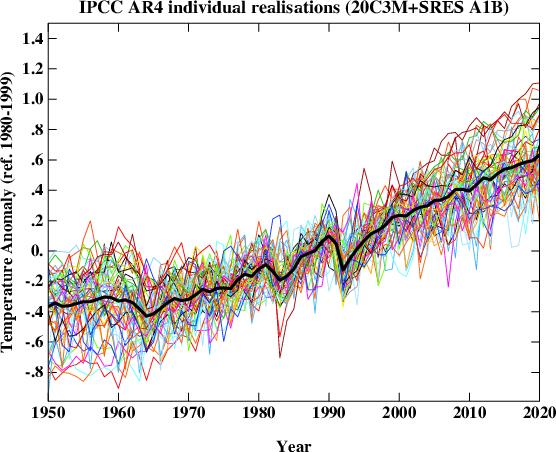
Here are the individual model realisations from AR4:


If we were to put the actual temperature in there, would you be able to tell which ones were model runs and which one was the actual temperature record?

The individual model runs don’t have to predict year-to-year temperatures to get the climate right, any more than I need to know what the weather is going to be tomorrow to predict that Vancouver will probably be cooler than San Diego. Climate is a long term phenomena. Some individual model runs even show periods as long as 20 years of cooling!

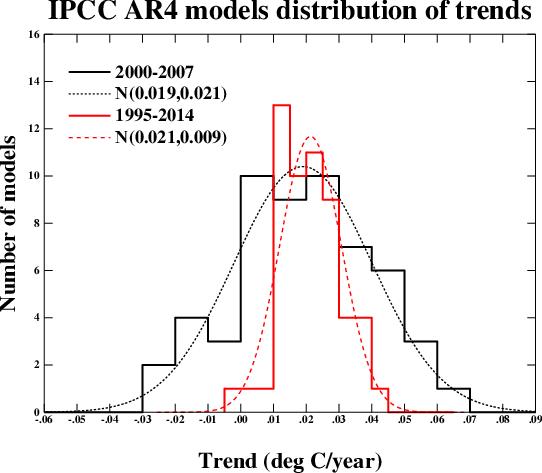
Here are the trends for the individual model runs for two time periods:


Notice how the longer period (in red) has a much narrower range because the noise averages out. But, as you can see, even the longer period has one model realisation with a trend of -0.4 C/decade.

The important thing is that the trend is predicted accurately, because that’s the underlying climate change signal beneath all the noise.
It can’t predict because it only shows trends AND that trend, is ONLY what is (name removed by moderator)ut into them. In other words, ONLY after the fact - Warming.🙂
You do realise that when you make statements like that you expose your lack of knowledge, don’t you? What’s the famous quote – “Better to keep quiet and have people think you’re a fool…”
If it was ABLE to Predict Climate - It would have Predicted the Cooling AS well as Warming.
Do you see all those squiggly lines going up and down in that graph? What do you think that means?
IT can’t Predict because it is dependent on more (name removed by moderator)ut AND more (name removed by moderator)ut unless fudged ] Comes AFTER the Evidence is collected
Repeating it don’t make it so.

You really should read the articles those graphs come from (realclimate.org/index.php/archives/2008/05/what-the-ipcc-models-really-say/) as well as realclimate.org/index.php/archives/2009/12/updates-to-model-data-comparisons/.

I know, I know, you don’t “trust” them. Unfortunately, if you aren’t willing to learn what they actually say, but you insist on repeating things that are obviously false – well, you do yourself no favours, let’s put it that way.
Where in the Bible does it say if I believe OR disbelieve in AGW - I’m a better Christian?😛
You provided a link specifically suggesting that crops in the USA might benefit from AGW. If that was actually true, would that make it OK given the effect it is likely to have on the rest of the world? I thought the question was pretty clear.
 
Certainly the fact (if it is fact) that the world is warming says nothing about what caused it; these items may be consistent with AGW but they would also be consistent with warming from other causes as well.
Absolutely! So now we have a choice. Do we accept:
  1. A theory with effects based on laboratory measurements of the properties of greenhouse gases and direct measurements by satellites that confirm that less heat is escaping into space at the precise wavelengths that CO2 absorbs heat and surface measurements showing heat being sent back to earth at the precise wavelengths that CO2 emits and the following predictions that have all come true: nights will warm faster than days, the poles will warm faster than the tropics, the stratosphere will cool while the troposphere warms, the ionosphere will shrink, and the temperature and sea levels will rise with a very high correlation to the log of CO2 concentrations,
-OR-
  1. A theory that the effect of CO2 is somehow being cancelled out by a currently-unknown mechanism and another, also currently-unknown mechanism is producing exactly the same effects that we would expect from rising CO2.
Personally, I don’t like being asked to believe in two unknown things while ignoring the really large elephant in the room.

Is it warming? skepticalscience.com/evidence-for-global-warming-intermediate.htm

Are we causing it? skepticalscience.com/The-empirical-evidence-that-humans-are-causing-global-warming.html
Regarding increasing air and sea surface temperatures, how is it that these can increase while global temperatures remain unchanged? There has been no statistically significant global temperature increase in over a decade. What mechanism allows AGW warming of air and sea surfaces but not land surfaces?
The answer is, “they haven’t remain unchanged”.

I think you need to watch this:

fool-me-once.com/2010/07/global-warming-has-stopped.html

Firstly, there’s a difference between saying “I’m only 92% certain that there has been global warming” and “there’s been no global warming”. Just because it’s not the generally-accepted 95% level doesn’t mean it’s not happening – it’s still far more likely than not.

Secondly, the start date in that question was cherry-picked – go just one year earlier and it is statistically significant.

Thirdly, you really need to be careful with a line of reasoning that depends on short term variability, because sooner or later, it’s going to be wrong. As Pat Michaels, the well-known climate science sceptic says, “Make an argument that you can get killed on and you will kill us all”. youtube.com/user/greenman3610#p/u/31/QwnrpwctIh4 If you asked Dr Jones that question now, the answer would be an unequivocal “yes”, because 2010 has been very hot.

No doubt in a few years we’ll be hearing “Global warming stopped in 2010!”.
As far as decreasing sea ice is concerned: what decrease would that be? Global sea ice extent has been relatively stable for while it may be decreasing in the Arctic it is growing in the Antarctic. It is certainly a strange thing when supposedly global effects don’t appear globally. Perhaps it should be called Anthropogenic Local Warming.
The Antarctic is fundamentally different to the Arctic. The north pole has a sea surrounded by land, the south pole has land surrounded by sea. Models have been predicting that Antarctica would actually cool before it warmed, and when it did warm it would be decades after the Arctic. (realclimate.org/index.php/archives/2008/02/antarctica-is-cold/) They also predicted ice to actually increase in Antarctica because it’s so cold there that the air is really, really dry, and warming the air increases precipitation.

Judith Curry published a paper on this recently that got a slightly frosty reception on WUWT: wattsupwiththat.com/2010/08/16/georgia-tech-on-resolving-the-paradox-of-the-antarctic-sea-ice/ I assume that will be in the next IPCC report.
 
In all of the items you listed are there any that would be unique to AGW as opposed to being common to any form of warming? What is the AGW fingerprint that distinguishes enhanced greenhouse warming from all other drivers?
There’s really only two ways to warm up the earth – increase the amount of radiation hitting the earth (sun), or reduce the rate that radiation can leave the earth (greenhouse effect).

Now, if it was the sun, then days should warm faster than nights, and the lower lattitudes should warm faster than the higher lattitudes, because, obviously, they get more sun. Conversely, if it’s an enhanced greenhouse effect, then nights should warm faster than days and the poles should warm faster than the tropic – and that’s what we see.

If it was the sun, the stratosphere should warm. If it’s greenhouse gasses, it should cool. It’s cooling.

One key point is that all of this was predicted before it actually happened. That is normally seen as a good test for a theory. Read the 1979 NAS report written a decade before any signal was detected, and at a time when the popular media was actually talking about global cooling: atmos.ucla.edu/~brianpm/download/charney_report.pdf
If carbon dioxide continues to increase, the study group finds no reason to doubt that climate changes will result and no reason to believe that these changes will be negligible.
We’re still waiting for a reason to doubt that climate change will result and a reason to believe that the changes will be negligible. In 30 years nobody has found any reason to believe that. Instead the current best estimate of CO2 sensitivity is remarkably similar to what that report estimated even back then.

They were remarkably prescient as well:
However, the study group points out that the ocean, the great and ponderous flywheel of the global climate system, may be expected to slow the course of observable climate change. A wait-and-see policy may mean waiting until it is too late.
In fact, climate change is now unequivocal and we’re still adopting a wait-and-see policy. Worse than that, CO2 emissions have actually been accelerating.

Anyway, browse the Skeptical Science site above, he has a few pages talking about this, all of them fully-referenced so you can check the original material if you wish. Greenman also has a good summary on his YouTube channel:

youtube.com/user/greenman3610#p/u/18/yLYqzIhhT6o
 
Status
Not open for further replies.
Back
Top