Church Architecture

  • Thread starter Thread starter triumphguy
  • Start date Start date
Status
Not open for further replies.
If you compare the OP’s pic to the typical modern church that is built nowadays, this is nicer by leaps and bounds! I think a lot of people in large old cities don’t know what passes for a newer Catholic church in the rest of our country (and world)
 
A brand new Church building in the Diocese of Knoxville, TN. St. John Newman Parish.
This church was featured in one of the articles cited above.

I had the pleasure of visiting this church on a recent trip to Knoxville, and it was truly magnificent - a glory to God!
 
Beautiful Church.

Now here’s a question: When traditionally styled Churches are built I’ve not seen a modern “Gothic” Church, just Romanesque and Byzantine styles.

Is the Gothic style too hard to build?
 
This church was featured in one of the articles cited above.

I had the pleasure of visiting this church on a recent trip to Knoxville, and it was truly magnificent - a glory to God!
We stopped for Mass there when we were moving to Texas. We used to live in the Diocese, albeit not in Knoxville itself. Beautiful Church building. I enjoyed how they did incorporate some modern touches to a traditional design such as the psuedo stadium style seating by putting a slope into the building. Obviously, this makes it easier for those in back to see and costs nothing in terms of the traditional feel of the building.

Good choir in that parish also!
 
I googled it:

It looks very serene and peaceful.

While being recognisably Benedictine.

It works!
Your pictures are the former Trappist monks of Oka, Quebec, their new abbey about an hour NE of Montreal. I haven’t been to their new monastery; as the crow flies it isn’t too far from me, but by road it’s a 3 hour drive so I haven’t been yet. But from what I’ve seen in the pictures, it’s gorgeous and I really enjoy that style of architecture for an abbey (and I’d love to build a miniature version as a home… but I don’t think I’ll ever realize that project!). Here is the 1917 church in Oka at the abbey they’ve now vacated:


The abbey I’m affiliated with is more of a mish-mash. The main section, built in the 30s, was by Dom Bellot, a famous Benedictine architect; it tends to be dark, but clearly monastic and fairly plain:


A newer portion built in the 40s/50s was built by a student of his (Dom Côté), but it’s a bit loud and not quite my style; it’s on the public side of the monastery, and leads to the chapel:


The chapel though is from 1994 and I really like it, in particular what it does with light and how the light fits in so well with the Divine Office and the time of the day of the Office.


Along one side of the chapel is the newest part of the cloister, built at the same time as the church:


I like the modern part the best. You have to experience the change in atmosphere when you walk into the cloister of a Benedictine monastery. It’s hard to describe, but palpable.

The chapel at the the Trappist monastery in the pictures you posted:


Some who have been have commented that the outside view is distracting at Mass; but I like the style nevertheless.

 
I am sorry to have to say this, but the above interior is absolutely atrocious! However the exterior is nice.
 
More, starting with the small oratory in my own home office, where I recite the Divine Office:


Now for something more traditional again in the monastic style. St. Saturnin’s chapel at St. Wandrille Abbey, in France (which founded the abbey I’m associated with):


The abbey’s more traditional cloister:


And lastly, while I was there the abbey church was under renovation so they converted the chapter room to a temporary chapel (St. Saturnin’s chapel is not attached to the monastery proper, it is in their gardens):


A much more ornate abbey church is that of Monte Cassino in Italy, and it is far too ornate for my tastes, and thus not very Benedictine, IMHO:


In the same monastery, there was an 11th century chapel that was more to my liking:

 
I am sorry to say, but this interior is absolutely atrocious!
You aren’t kidding. What a missed opportunity there.
I can only think they ran out of money and got free construction material from Lowe’s to finish the inside. 😉

But maybe over the years they will work on it.

We forget sometimes that a few centuries ago it would take decades or even centuries to complete a Church.

Ora Labora you mini-oratory is great!

The new Benedictine monastery looks wonderful (google misled me!), slightly less “naturish” than the Trappists, but very attractive too. And I agree I prefer the modern parts too.
 
You aren’t kidding. What a missed opportunity there.
Indeed. Yuck!

Take a look at this fairly “modern” abomination (1963). Our Gregorian schola is based here and sings here regularly:


The nave:


Not visible in the photo is that this church was built with a communion rail and the tabernacle is on the altar.

There is also a neat little adoration chapel:


Now, you might not like the architecture and I don’t care for it myself but it is one of my favourite churches on our schola’s parish circuit. Why? One, it has a very active community and the church is always packed on Sundays, even for the 4 pm Saturday evening Mass. Two: the pastor is very orthodox and follows the rubrics perfectly, and gives really good homilies, and three, the acoustics, which might surprise you, are terrific. Four, the light through the stained glass is very nice. Also it is a parish with very many young families, and oddly they were very curious to hear Gregorian chant and explore their traditions. We always were made to feel very welcome there, and when we sing there you can tell the community treats it as a very special occasion.

On the other hand we used to sing at an older and more “traditional” church (1930s), and while acoustics were good, the church was only attended by a handful of parishioners, the pastor was uninspiring and some of the priests really took liberties with the rubrics, and though the acoustics were good, this older “children of Vatican II” community was allergic to Gregorian chant and they kicked us out (even though we only sang once a month!)

So while being in nice surroundings is, well, nice, it really is the community that makes the place welcoming.
 
OraLabora;9563958:
Take a look at this fairly “modern” abomination (1963). Our Gregorian schola is based here and sings here regularly:
How very interesting - pre Vatican II 😉
Indeed, there are lots of examples of pre-conciliar “modern” churches around. Most, actually, are from the 1950s and early '60s, but some date from the late 1940s. While it seems that the trend got progressively worse as time has gone on (and let’s face it, the tide hasn’t turned yet), I suppose it could be considered post-WWII utilitarian-ugly more than anything else. And of course it doesn’t affect only Roman churches. There are plenty of Eastern and Oriental churches (both in and out of union with Rome) that fit the category.

(Even though it’s actually post-conciliar from the '70s, I can’t help but think of the Maronite cathedral in St Louis and it’s “living room” look. Oy …)
 
A brand new Church building in the Diocese of Knoxville, TN. St. John Newman Parish.

http://sjnknox.org/wp-content/uploads/2011/01/IMG_6486-1024x682.jpg

Would that all new Church buildings, including the one that we go to which was built at exactly the same time, looked this good.
Some commentary about this building.

Structurally I think the building is wonderful. The cruciform shape is about as wonderful as it can get, the colonnades are great. The dome is magnificent. However, the church is unfinished. It has so much white space. But wait…

I like that! I like the fact that the church is not yet completed. It gives the parish an ongoing project. Year by year they can purchase this and that painting, statue, etc. They can commission a mural for the white space on the walls every decade or so. After a century of doing this, it will be a truly spectacular church no doubt.

Some snobs who, more than not, are of the garden “children of Vatican II” variety who apply their academic minds to everything practical like to pick apart old European churches for being too “hodepodge-y.” However, I love this. It very much gives a church a very authentic feel. A truly spectacular and thematically consistent church like St. Peter’s is fantastic, but the quaint parish church that was put together over centuries which probably started out like the one above and which might have a bit of this and a bit of that is also truly spectacular to experience.

I think this church is great because it is an empty canvas waiting to be filled with the riches of history.

Furthermore, I have thus thought up a new reason why modern architecture generally fails as far as churches. Modern architecture is very academic and it demands perfection. If you stick a statue in a terribly brutish modernist church that was not originally part of the plan, it looks terrible. If you put one in a Baroque church, it might not look like it fits perfectly, but rather than look wrong, it adds character and interest. Modernist architecture is impossible to build up over time.
 
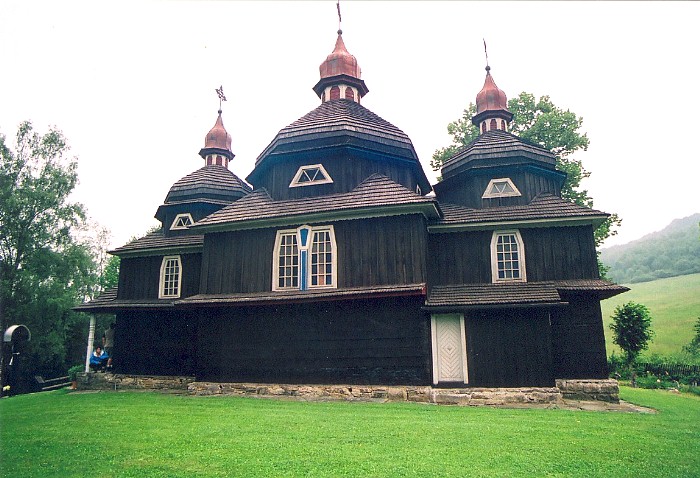
Just recently built in “the Old Country” (Slovakia)

(Please Note: This uploaded content is no longer available.)
 
vs. a “modern” traditional Rusyn wood church built in 1938 in the Presov region

 
Status
Not open for further replies.
Back
Top