
Cistercian monastery of Vyšší Brod recovers pre-Conciliar Cistercian Rite

  • Thread starter Thread starter YoungTradCath
  • Start date Start date
Status
Not open for further replies.
Y

YoungTradCath

Guest
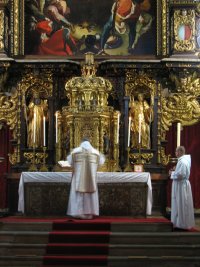
“Vyšší Brod is now the third monastery in the Benedictine tradition (after the Trappist monastery of Mariawald and the Benedictine monastery in Norcia) to make the switch, in the years since the promulgation of Summorum Pontificum, from being all “Reformed Rite” to being predominantly or exclusively Traditional Rite.”


rorate-caeli.blogspot.com/2013/01/a-cistercian-monastery-rediscovers.html

Good news. The reintroduction of diversity of liturgical tradition into the Latin Church cannot possibly be anything but good in my opinion. I am very excited to hear about the reintroduction of the various religious orders’ rites and uses!

I would say one of the bigger pitfalls of many new traditionalists is the assumption that the pre-Conciliar liturgical situation was one of standardization. It was not. The liturgical scene of the Latin Church was extremely diverse, albeit in a… different… way than it has been in recent history. As someone said to me recently, “Everyone did something different, but no one knew what everyone else was doing like now.” Or something like that. Fantastic!
 
Interesting, what language other than Latin and where was the mass celebrated, I don’t even recongnise the lettering with all the accents?

I have never seen so many birettas in a church or the celebrants vestments on the altar. Some Anglican churches leave the chasuble on the altar rail for part of the mass, but I have never seen that in a Catholic church.
 
Interesting, what language other than Latin and where was the mass celebrated, I don’t even recongnise the lettering with all the accents?

I have never seen so many birettas in a church or the celebrants vestments on the altar. Some Anglican churches leave the chasuble on the altar rail for part of the mass, but I have never seen that in a Catholic church.
Well, the language of the Mass in the video is Latin. The pre-Concliar Roman Rite was allowed in certain, limited places in the vernacular as a concession. I don’t recall them specifically, but they were small places. The text in the video is Czech.

The men wearing the birettas were very likely secular clergy/seminarians attending in choir. In the Extraordinary Forms of the liturgies of the Latin Church, it is a particular ceremony for the bishop or abbot, when celebrating Pontifical Mass, to process in choir dress and then, one by one, put on the vestments of sacrifice. This is especially striking when the celebrant in question enters the church in cappa magna and is then unceremoniously stripped of its worldly glory.
 
Well, the language of the Mass in the video is Latin. The pre-Concliar Roman Rite was allowed in certain, limited places in the vernacular as a concession. I don’t recall them specifically, but they were small places.
The one that comes to mind is the Glagolitic, which is Old Church Slavonic, used in parts of Dalmatia. 🙂

In the post-Novus Ordo era, the Cistercians (O.Cist) have always kept the right to retain the Cistercian Rite abbey-by-abbey. I was fortunate in the early 1970s to have been a guest at Our Lady of Springbank (long before it was dissolved and when it was still in Oconomowoc, WI) during the tenure of the late and lamented Abbot, Dom Raymond Molnar, where they happily and proudly kept the Cistercian Rite alive. It was quite a moving experience. 🙂

While I certainly don’t read Czech, in the video it seems that the guest celebrant is the abbot of Mariawald. IIRC, the OCSO, had abandoned the Cistercian Rite (with, I think, the exception of the Office) centuries ago in favor of the Roman, so it’s even more interesting that Mariawald has recouped its original heritage. 👍
 
The one that comes to mind is the Glagolitic, which is Old Church Slavonic, used in parts of Dalmatia. 🙂

In the post-Novus Ordo era, the Cistercians (O.Cist) have always kept the right to retain the Cistercian Rite abbey-by-abbey. I was fortunate in the early 1970s to have been a guest at Our Lady of Springbank (long before it was dissolved and when it was still in Oconomowoc, WI) during the tenure of the late and lamented Abbot, Dom Raymond Molnar, where they happily and proudly kept the Cistercian Rite alive. It was quite a moving experience. 🙂

While I certainly don’t read Czech, in the video it seems that the guest celebrant is the abbot of Mariawald. IIRC, the OCSO, had abandoned the Cistercian Rite (with, I think, the exception of the Office) centuries ago in favor of the Roman, so it’s even more interesting that Mariawald has recouped its original heritage. 👍
According to Rorate-Caeli three Cistercian monasteries now use the pre-Conciliar Roman Rite.
 
“Vyšší Brod is now the third monastery in the Benedictine tradition (after the Trappist monastery of Mariawald and the Benedictine monastery in Norcia) to make the switch, in the years since the promulgation of Summorum Pontificum, from being all “Reformed Rite” to being predominantly or exclusively Traditional Rite.”
This quote is not quite accurate. Clear Creek Abbey outside of Tulsa, OK uses the EF of the Mass as does Our Lady of Cenacle in Ireland. There are likely others as well. To be fair, its not really that easy to keep up on those things.

Also, if you go to many monasteries, you can also see the OF of the Mass celebrated with fantastic reverence. I was at St. Gregory’s Abbey outside of Oklahoma City yesterday for a Mass where a brother made his final solemn profession as a monk. The Mass, to my mind, constituted everything the OF of the Mass can be when done well.

Peace,
 
This quote is not quite accurate. Clear Creek Abbey outside of Tulsa, OK uses the EF of the Mass as does Our Lady of Cenacle in Ireland. There are likely others as well. To be fair, its not really that easy to keep up on those things.

Also, if you go to many monasteries, you can also see the OF of the Mass celebrated with fantastic reverence. I was at St. Gregory’s Abbey outside of Oklahoma City yesterday for a Mass where a brother made his final solemn profession as a monk. The Mass, to my mind, constituted everything the OF of the Mass can be when done well.

Peace,
Do the monks at Clear Creek use the Cistercian Rite? I thought they used the Roman.
The linked article? :confused:
Yes, the link in my OP.
 
Albeit that they are separate Orders, the O.Cist, and hence the OCSO as well, is part of the Benedictine tradition. The OSB itself has never had a proper Rite, but the O.Cist does. 🙂
Perhaps I’m a bit obtuse, but I don’t see anything contradicting this statement in any of the posts. :confused:
No, not the Cistercian Rite. They, along with their parent abbey in France, are OSB and so use the Roman Rite.
Yes, that is what I thought. Rorate refers to Cistercians as part of the Benedictine tradition, not me, sorry if that usage was confusing.
 
That is wonderful. It will be a glorious day when religious orders make use of all there particular rites. God Bless. :signofcross::byzsoc:
 
Perhaps I’m a bit obtuse, but I don’t see anything contradicting this statement in any of the posts. :confused:

Yes, that is what I thought. Rorate refers to Cistercians as part of the Benedictine tradition, not me, sorry if that usage was confusing.
The Cistercians are part of the “Benedictine tradition” insofar as monasticism is concerned, but they are totally separate from, and hence NOT part of, the OSB. I think that may be where the confusion lies.
 
The Cistercians are…NOT part of, the OSB. I think that may be where the confusion lies.
I know. :confused: I wasn’t aware there was any confusion. Now I am just confused. oh well, proceed with thread.
 
Do the monks at Clear Creek use the Cistercian Rite? I thought they used the Roman.
They do.

The quote stated “…monastery in the Benedictine tradition…” so I assumed it was referring to all, including the OSB. In addition, it said “to make the switch, in the years since the promulgation of Summorum Pontificum, from being all ‘Reformed Rite’ to being predominantly or exclusively Traditional Rite.” so I was assuming all Traditional Rites, not just the Cistercian. It also said, “… and the Benedictine monastery in Norcia…” which is OSB and uses the Roman Rite, which also, combined with the above, led me to believe the quote was referring to the larger Benedictine community and all of the more traditional forms of the Mass, not just the Cistercian Rite.

I hope that clears up any confusion.

Peace,
 
They do.

The quote stated “…monastery in the Benedictine tradition…” so I assumed it was referring to all, including the OSB. In addition, it said “to make the switch, in the years since the promulgation of Summorum Pontificum, from being all ‘Reformed Rite’ to being predominantly or exclusively Traditional Rite.” so I was assuming all Traditional Rites, not just the Cistercian. It also said, “… and the Benedictine monastery in Norcia…” which is OSB and uses the Roman Rite, which also, combined with the above, led me to believe the quote was referring to the larger Benedictine community and all of the more traditional forms of the Mass, not just the Cistercian Rite.

I hope that clears up any confusion.

Peace,
A couple of other OSB monasteries using the EF Roman Rite are Fontgombault in France (Solesmes Congregation) which is the founding abbey of Clear Creek, and Barroux, also in France and an abbey that came back into communion with Rome. BTW this is coupled with the pre-conciliar Monastic Rite for the Divine Office; this rite is properly Benedictine in tradition (and applies to Cistercians as well).

As pointed out as well many OSB abbeys and priories do the OF Mass very reverently and in Gregorian chant. That’s the case of the abbey I’m associated with. Some do the OF Mass entirely in Latin as well (ours does the Propers and ordinary in Latin/Greek and the rest in French plainchant).
 
Perhaps I’m a bit obtuse, but I don’t see anything contradicting this statement in any of the posts. :confused:

Yes, that is what I thought. Rorate refers to Cistercians as part of the Benedictine tradition, not me, sorry if that usage was confusing.
The Benedictines are made up of a confederation of congregations. Latin liturgy and Gregorian chant are one of the focus’ of the Solesmes Congregation of which Clear Creek Abbey is a member. Latin Liturgy is part of what they do. Looking at the website for the Abbey referenced in the OP, it is unclear what congregation they belong to.

One could say that the Cistercians “Broke away” from the mainstream Benedictines in the 1100’s but the Benedictines really don’t see it as a breaking-away. All Benedictines embrace continual renewal according to the needs of the time and place which God has presented them with - it is part of the Rule of St. Benedict that they do so.

The “Benedictine Tradition” (which includes Cistercians) doesn’t have a vow of poverty or chastity. They vow three things - obedience, stability and ongoing conversion. Ongoing conversion is lived in all aspects of their lives - in the micro in terms of ongoing repentance and growth in holiness as well in the macro as a community, renewing itself as the demands of the time and place require. That’s why it is so hard to pin down Benedictines to specific behaviors. Different communites can have vastly different feels to them when you spend time in retreat with them.

But the Cistercians set off on their own in the 1100’s to renew themselves and founded Citeaux.

***In this climate of readiness for renewal as new religious Orders emerged in the second half of the 11th century, the Cistercian order began in 1098 when a group of reforming monks led by Robert of Molesme, the renowned Stephen Harding, his friends Peter, and Alberic seceded to Citeaux, founded the abbey of Citeaux in Burgundy.

Read More…***

Renewal is part of the life of a Benedictine. Renewal is expected. God is continually renewing the face of the earth. God didn’t stop creating at the end of Genesis 2. They take part in the creative action of the Holy Spirit which blew across the face of the waters in Genesis 1:1.

OCSO is Order of Cistercians of the Strict Observance. The Cistercians are the classic black-hooded monks who observe perpetual silence unless charity demands that they speak. They are the Trappists. Oddly, most wear white now. But they are seperate from mainstream Benedictines in terms of governance. They have their own abbot general apart from the Benedictines.

I think there is also an Order of Cistercians of the Simple Observance or something similar, but I know little about them.

In another life and time I might have been a Cistercian. The link below will give you an idea of the life.

trappist.net/TheCall

The best book, I think, is “The Cistercian Way” by Andre Louf.

litpress.org/covers/0879079762.jpg

-Tim-
 
Status
Not open for further replies.
Back
Top