Cleansing of the Temple

  • Thread starter Thread starter zz912
  • Start date Start date
Status
Not open for further replies.
Z

zz912

Guest
Got into a discussion and were discussing whether Jesus, using the whip, just cracked the whip in the air, or actually started whipping people to get them to leave the Temple area.

I was of the opinion that Jesus was tossing things over, driving animals, and yes He would have whipped a person or two in driving them out. Not that He went after them to cause harm, but swinging a whip around is bound to hit someone. He was also throwing over their money, I just don’t see people not fighting against this. I see it as much more a confrontational, violent/aggressive act.

The opposite side was that they were intimidated by Him and He was cracking the whip, but didn’t actually hit anyone.

I just don’t see it. I don’t see this as some “scaring the Tusken Raiders” (to use a bad analogy), but as an aggressive/violent event. These people had been doing this for quite some time, and He was causing them to lose their money, and we know how much people love money.

What are people’s thoughts? Any other souces of info to shed more light?
 
I’m not sure what you are after here. Are you questioning whether or not Jesus’ actions during this event were sinful?

Chuck
Got into a discussion and were discussing whether Jesus, using the whip, just cracked the whip in the air, or actually started whipping people to get them to leave the Temple area.

I was of the opinion that Jesus was tossing things over, driving animals, and yes He would have whipped a person or two in driving them out. Not that He went after them to cause harm, but swinging a whip around is bound to hit someone. He was also throwing over their money, I just don’t see people not fighting against this. I see it as much more a confrontational, violent/aggressive act.

The opposite side was that they were intimidated by Him and He was cracking the whip, but didn’t actually hit anyone.

I just don’t see it. I don’t see this as some “scaring the Tusken Raiders” (to use a bad analogy), but as an aggressive/violent event. These people had been doing this for quite some time, and He was causing them to lose their money, and we know how much people love money.

What are people’s thoughts? Any other souces of info to shed more light?
 
I’m not sure what you are after here. Are you questioning whether or not Jesus’ actions during this event were sinful?

Chuck
Not in the least. Righteous indignation over egregious sins (using the Temple as a corrupt marketplace) is a good thing. Being upset about blatant disrespect for God is not sinful, but a holy thing.

I’m of the opinion that the person I was discussing with has this “My buddy Jesus” image that falls into complete pacifism, where I think Jesus was willing to scuffle a little bit to cleanse the Temple.
 
Jesus killed an innocent fig tree!

Yes, he had a few rough edges…
 
Got into a discussion and were discussing whether Jesus, using the whip, just cracked the whip in the air, or actually started whipping people to get them to leave the Temple area.

I was of the opinion that Jesus was tossing things over, driving animals, and yes He would have whipped a person or two in driving them out. Not that He went after them to cause harm, but swinging a whip around is bound to hit someone. He was also throwing over their money, I just don’t see people not fighting against this. I see it as much more a confrontational, violent/aggressive act.

The opposite side was that they were intimidated by Him and He was cracking the whip, but didn’t actually hit anyone.

I just don’t see it. I don’t see this as some “scaring the Tusken Raiders” (to use a bad analogy), but as an aggressive/violent event. These people had been doing this for quite some time, and He was causing them to lose their money, and we know how much people love money.

What are people’s thoughts? Any other souces of info to shed more light?
***…we have to take into account as many factors as possible:

a) Jesus, the Word Incarnate, became as man in everything except sin–this means that, as much as we would like to see Him as human as the next person, He would not engage in “business as usual.”

b) Casuality was never part of Jesus experience–which means that even in the most obscure and inconsequential event Jesus was perfecting our understanding as He took every opportunity to Reveal God’s Salvific Plan and to Teach and Guide His disciples.

c) Comparisons are sometimes mute (and they go both way: past to present/present to past) so we have to use precision when making them; the event at the Temple seems to be charged with disdain, anger, and summary execution–considering what we know about Jesus, can we actually see Him directly or indirectly whipping people or is the whip more symbolic than we want to admit? (Remember, Jesus was casting out merchants who, through years of complacency, would have relaxed their guard and a whip whieeling man could easily scare them off… even if only during the initial shock.)

d) Further light can be given by the instances when the various crowds sought to hurt/kill Jesus and He simply walked away from them–Jesus did not need a weapon to defend Himself from the mobbing people!

…my take? Jesus used the whip to procure the attention of the merchants and to frighten the animals away… ever seen frightened cows?

Maran atha!

Angel

 
Got into a discussion and were discussing whether Jesus, using the whip, just cracked the whip in the air, or actually started whipping people to get them to leave the Temple area.

I was of the opinion that Jesus was tossing things over, driving animals, and yes He would have whipped a person or two in driving them out. Not that He went after them to cause harm, but swinging a whip around is bound to hit someone. He was also throwing over their money, I just don’t see people not fighting against this. I see it as much more a confrontational, violent/aggressive act.

The opposite side was that they were intimidated by Him and He was cracking the whip, but didn’t actually hit anyone.

I just don’t see it. I don’t see this as some “scaring the Tusken Raiders” (to use a bad analogy), but as an aggressive/violent event. These people had been doing this for quite some time, and He was causing them to lose their money, and we know how much people love money.

What are people’s thoughts? Any other souces of info to shed more light?
Jesus cleared the Temple effectively without shedding blood. The suddenness and firmness caught the crooks unawares and they simply melted away. There was no bloodshed or injury. The most common technique for clearing unwanted crowds was used by Jesus. There is nothing to suggest anger or hatred but sheer determination.

He did the right thing because the racketeers were in fact proxies of the clergy who innovated schemes to harass and exploit humble believers, forcing them to change their money offerings into jewish currency and cheating in the process. They also found fault with sacrificial birds and animals brought by believers and forced them to buy it only from their stalls at exorbitant prices
 
Jesus cleared the Temple effectively without shedding blood. The suddenness and firmness caught the crooks unawares and they simply melted away. There was no bloodshed or injury. The most common technique for clearing unwanted crowds was used by Jesus. There is nothing to suggest anger or hatred but sheer determination.

He did the right thing because the racketeers were in fact proxies of the clergy who innovated schemes to harass and exploit humble believers, forcing them to change their money offerings into jewish currency and cheating in the process. They also found fault with sacrificial birds and animals brought by believers and forced them to buy it only from their stalls at exorbitant prices
Jesus cleared the Temple? It covered 35 acres.
 
The market and money exchange areas were not covering 35 acres! IIRC, they were in the “Court of the Gentiles,” an outer courtyard that even Gentiles could enter. (There was another courtyard further in for women and kids, another still further in for men, and then of course the areas that only priests could enter, and the Tabernacle that only the high priest could enter once a year.

However, even this Court of the Gentiles area was holy, “a house of prayer for all nations.” Jesus was not only clearing out “a den of thieves”, but demonstrating that he meant to clear a place for all us Gentiles to join His Covenant.

It seems unlikely that Jesus would have shed human blood on holy ground, barring His own. Fierce? Yes. Hurting people rather than scaring and pushing them? Not likely.
 
I think Jesus’ demonstration at the Temple area is motivated mainly by two factors: one is the use of (originally) pagan money as Temple currency, and the other the injustice being perpetrated upon the people of God, and especially the poor, by the Temple management through the vendors by obligating them to pay for sacrificial offerings, using it as a means to line their own pockets.

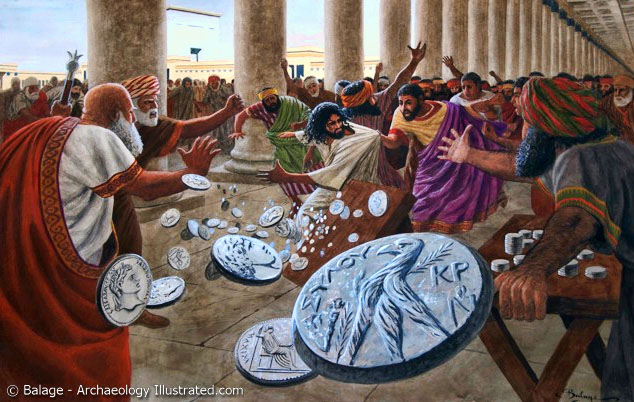
The silver Tyrian half-shekel or tetradrachma was the currency of choice for religious functions at the time, because it alone enough silver content which was deemed acceptable by priests: 94% and above compared to the mere 80% of Roman currency in common use. This silver coin was originally used in the city of Tyre (the Tyrian mint was eventually shut down by the Romans, so that by the time of Jesus, these shekels were being minted in Judaea itself, with the original design left unchanged), hence it bore the image of the Tyrian Eagle and a portrait of the city’s patron deity, the Phoenician god Melqart. From a Jewish religious perspective, the use of a coin bearing idolatrous graven images within the house of God would have been utterly offensive and nothing short of blasphemy.

http://www.welcometohosanna.com/LIFE_OF_JESUS/JESUS_LIFE_PIX/tyrianSheck.gif

http://upload.wikimedia.org/wikipedia/en/thumb/a/a9/Tyrian_shekel.png/220px-Tyrian_shekel.png

The Gospels say that Jesus also targeted pigeon-sellers: pigeon of course was the cheapest animal offering, which meant that the poor who did not have enough luxury to buy larger and more animals bought them (cf. Leviticus 12; Luke 2:24). Jesus is protesting the fact that the poor, who already have a hard enough time keeping themselves alive day after day without having to participate in sacrificial worship (what with the taxes, tolls and whatnot), are being squeezed by the authorities (the Temple priests) who control and profit from the sales.

Jesus’ words against the vendors echo that of Jeremiah: it is a warning against presumption that divine worship in the Temple could be divorced from divine distributive justice for the earth. How could the authorities “oppress the foreigner, the fatherless or the widow” and then think of using the Temple of God as their “den” of refuge, their hideaway? How can they “come and stand before me in this house, which is called by my name, and say, ‘We are delivered!’- only to go on doing all these abominations? Has this house, which is called by my name, become a den of robbers in your eyes? Behold, I myself have seen it, declares the LORD.
 
In short, Jesus’ public demonstration was an act of protest against this social inequality and a message of warning to the powers that be, in the same vein as the prophets of old: “If this kind of injustice continues, God will judge.” IMHO the Evangelists apparently saw this message as being fulfilled in the fall of Jerusalem and the destruction of the Temple: the men in power never heeded the signs.

And now, because you have done all these things, declares the LORD, and when I spoke to you persistently you did not listen, and when I called you, you did not answer, therefore I will do to the house that is called by my name, and in which you trust, and to the place that I gave to you and to your fathers, as I did to Shiloh.
 
If Jesus was an Essene, there would have been that aspect to it as well- the Essenes did not believe in animal sacrifice.
 
If Jesus was an Essene, there would have been that aspect to it as well- the Essenes did not believe in animal sacrifice.
This is where things get unclear, since surviving references to the Essenes’ (if it really was a monolithic group) stance on animal sacrifice is rather confusing. Philo says that they rejected animal sacrifice wholesale (Every Good Man is Free 75); what Josephus really wrote about them is unclear because of the contradictory statements which appear in the various different versions of his work, but it is mostly undisputed that what he was trying to say was that the Essenes did send sacrifices to Jerusalem, but because of their ‘different’ purificatory rituals they were barred from entering the Temple itself and so offered their own sacrifices elsewhere. (Antiquities 18.19) And if you believe that the Community in Qumran - which put huge emphasis on sacrifice if we go by the DSS - were (also) Essenes, the situation would become more complicated.
 
If Jesus was an Essene, there would have been that aspect to it as well- the Essenes did not believe in animal sacrifice.
***Jesus did not indulge in sect affiliations–the prophecy that states that the Messiah will be called “Nazarean” in no respect does it pertain to an affiliation with a sect; rather it is directly related to the geographical location of his domestic domicile; a fact that serves to obscure His Origins (Bethlehem).

Maran atha!

Angel***
 
***Jesus did not indulge in sect affiliations–the prophecy that states that the Messiah will be called “Nazarean” in no respect does it pertain to an affiliation with a sect; rather it is directly related to the geographical location of his domestic domicile; a fact that serves to obscure His Origins (Bethlehem).

Maran atha!

Angel***
A lot of people like to connect John the Baptist and Jesus with the Essenes because of perceived similarities. This Essene craze really reached its peak in the 18th-19th century when the group was literally the solution for every unsolved mystery in Jesus’ life. Where did Jesus get His philosophy? From the Essenes. Who were the people behind the scenes who were instrumental in making Jesus famous? The Essenes were. Who drugged Jesus, took Him down from the cross and revived Him? The Essenes did. Where did Jesus go back once His ‘mission’ was over? To the Essenes’ fold, where He spent the rest of His days. (Yeah, it gets rather crazy! :p)

While one can’t deny that there are similarities, that in itself proves nothing since Jesus has His own points of agreement and disagreement with the various forms of Judaism of the time (I mean, you also have people claiming that Jesus was a Pharisee - not that there’s anything wrong with that): John’s movement and Jesus’ are best treated as wholly separate categories on their own IMHO.
 
The market and money exchange areas were not covering 35 acres! IIRC, they were in the “Court of the Gentiles,” an outer courtyard that even Gentiles could enter. (There was another courtyard further in for women and kids, another still further in for men, and then of course the areas that only priests could enter, and the Tabernacle that only the high priest could enter once a year.
Here’s a rather nice 3D reconstruction of the Court of the Gentiles, looking south towards the so-called Royal Portico, where the vendors and the moneychangers would have been.

http://www.abu.nb.ca/courses/ntintro/images/ViewOuterCourts2_sm.jpg

And here’s the interior of the Royal Portico:

http://www.abu.nb.ca/courses/ntintro/images/USRoyPort.jpg

And here’s a picture of Jesus cleansing the Temple, by artist Balage Balogh.

 
A lot of people like to connect John the Baptist and Jesus with the Essenes because of perceived similarities. This Essene craze really reached its peak in the 18th-19th century when the group was literally the solution for every unsolved mystery in Jesus’ life. Where did Jesus get His philosophy? From the Essenes. Who were the people behind the scenes who were instrumental in making Jesus famous? The Essenes were. Who drugged Jesus, took Him down from the cross and revived Him? The Essenes did. Where did Jesus go back once His ‘mission’ was over? To the Essenes’ fold, where He spent the rest of His days. (Yeah, it gets rather crazy! :p)

While one can’t deny that there are similarities, that in itself proves nothing since Jesus has His own points of agreement and disagreement with the various forms of Judaism of the time (I mean, you also have people claiming that Jesus was a Pharisee - not that there’s anything wrong with that): John’s movement and Jesus’ are best treated as wholly separate categories on their own IMHO.
I concur! …there were not many crying in the desert as there is but One Messiah (Suffering Servant) whose cues are taken from the Father and are Revealed through the Holy Spirit.

…sadly too many want a flesh bound Christ who would understand their persistent disregard for humble obedience to God’s Authority.

Maran atha!

Angel
 
Status
Not open for further replies.
Back
Top