
T
TriuneUnity
Guest
+ St. Augustine of Hippo, Doctor of the Church +
28 August AD 430 (Lutheran Feast Calendar)
Saint Augustine was one of the greatest of the Latin church fathers and was among the most significant influences in the formation of Western Christianity, including Lutheranism. He was born to Monica and Patricius, a Christian mother and a pagan father, in AD 354 in Tagaste, Numidia (now Souk Ahras in Algeria).
Augustine’s early life was distinguished by exceptional advancement as a teacher of rhetoric. He described his life before his conversion to Christianity in his book Confessions. He was drawn into the moral laxity of the day, plagued by lust, and fathered an illegitimate son. He also joined himself to the Manichaeian religion.
Although he wandered (and sometimes wallowed) through a sinful, unchristian life for many years, Monica continued faithfully praying for Augustine’s conversion. During his times of spiritual unrest, he moved first to Rome and later to Milan in order to find and hold teaching positions.
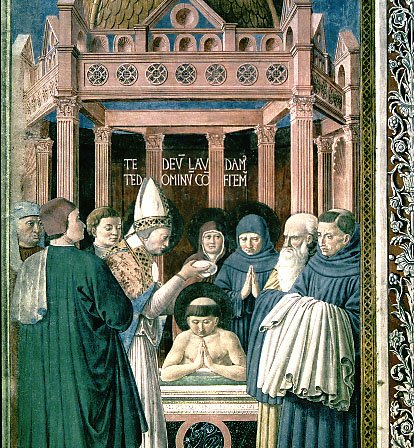
Monica’s prayers were answered as her son responded to God’s Word and the work of the Holy Spirit through the preaching of St. Ambrose, Bishop of Milan. Certainly Monica must have rejoiced to see her son baptized by Ambrose during the Easter Vigil of 387. However, her earthly joy was short-lived; she died at Ostia Antica, just outside Rome, as she was beginning a journey back to Africa with her sons Augustine and Navigius.
During the Pelagian Controversies of the Fifth Century, Augustine fought the notion of salvation by works and emphasized the unilateral grace of God in the salvation of mankind. The great theologian served as Bishop of Hippo in North Africa from AD 395 until his death in 430. Augustine was a man of immense intellect and deep love, a fierce defender of the orthodox faith, and a prolific writer. In addition to his Confessions, Augustine’s book *City of God * (De Civitate Dei) had great impact upon the Church throughout the Middle Ages and Renaissance.
His monastic rule was used and emulated in much of the Western Church. The Order of Saint Augustine adhered closely to his teachings. Through the Order, Augustine’s theology had a profound impact upon the thinking of the young German monk, Martin Luther. Luther espoused and refined Augustine’s understanding of divine grace and of original sin, becoming part of the theology that forged the Reformation.
The barbarian invasions of the 5th Century form the backdrop for his death. Saint Augustine died during the Vandal siege of Hippo. He urged resistance, at least in part because the Vandals held to the Arian heresy. He is listed with Saint Ambrose as two of the Western (or Latin) fathers among the eight great Doctors of the undivided Church. Jerome and Gregory the Great are the West’s other representatives; Athanasius, John Chrysostom, Basil the Great, and Gregory of Nazianzus represent Eastern (Greek) Christendom.
The picture above represents Augustine’s baptism at the hands of Ambrose. The text behind his head is the opening of the medieval hymn, Te Deum Laudamus. Some legends tell that Augustine and Ambrose jointly improvised it at this moment.
Collect of the Day
Lord God, the Light of minds who know You, the Life of souls who love You, and the Strength of hearts who serve You, help us to follow the example of Your servant Augustine of Hippo, knowing You that we may truly love You, and loving You that we may fully serve You, whom to serve is perfect freedom; through Jesus Christ our Lord, who lives and reigns with You and the Holy Spirit, one God, now and forever.