
Communion on the tongue discouraged?

  • Thread starter Thread starter Paul72
  • Start date Start date
Status
Not open for further replies.


Even though experiments show that a small risk of disease transmission via the use of a common cup does exist, there has not even been a documented case of the transmission of disease from a common cup, let alone from distributing Holy Communion directly onto the tongue. It is reasonable (and charitable) to take common sense precautions when a congregation has particularly vulnerable members and a dangerous epidemic is on the rise, such as asking sick people to stay home. That’ fine. That doesn’t give pastors an authority that does not belong to them to actually bar reception on the tongue.

The Church has said that receiving Holy Communion directly onto the tongue is a right of the faithful. Adding the option of recieving on the hand does not diminish the right to receive on the tongue:
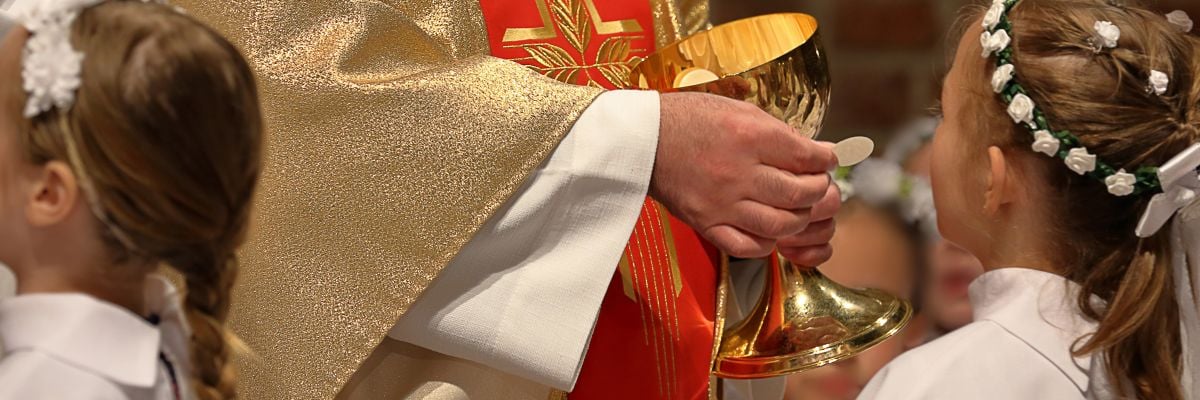

If your pastor or even your bishop asks you to receive on the hand, that is one thing. With all due respect, however, he does not have the authority to compel this.
 
Last edited:
At least they give it to you one priest won’t even give it on the tongue or the hand he holds it out like he’s passing around candy for Halloween.
 
I try my hardest to maintain proper hygiene but I don’t believe anyone has got sick as a result
The thing is, we really wouldn’t have any idea whether they had or not, right? It’s just one of those things – if they get ill a couple a days later, what are the chances they’d say “I bet it was that EMHC last Sunday!!!”…?

And, I’m with you – after Mass, I wash my hands well, so that there’s no chance that I’ll end up sick!
I do not have the right to refuse anyone take the host the way they want
Right. This is more a question for the pastor to address, anyway…
 
Yes it is up to the priest and we were instructed to give on the tongue or the hand…so as I say I have no right to refuse
 
In Poland, no one receives in the hand, and practically no one frets about germs from communion (although ice cream is a different matter!). I would guess that the intersection between people who sign up to be EMHCs and the people who receive exclusively on the tongue is probably tiny. The logic of one precludes the other - and vice versa. I expect to soon see a thread on the topic of “Communicants Stepping Out of My Line to Receive from Father Causes Hurt Feelings”.
 
In the second document posted above, a review titled, “Infections Associate with Religious Rituals”

In 1967 Hobbs and colleagues performed experiments that concluded that silver and wine may have antimicrobial properties. However, the time interval between each communicant drinking from the cup, which is typically less than five seconds, is not sufficient to cause a significant decrease in bacterial counts. They also found that rotating the chalice was ineffective at decreasing colonization; however wiping the rim with the linen cloth decreased bacterial counts by 90%. All studies concluded that the risk of spreading disease cannot be excluded but is extremely low (B. Hobbs, J. Knowlden, A. White Experiments on the communion cup J Hyg (Lond), 65 (1967), pp. 37-48)
 
Last edited:
You can post it as many times as you want. Until you are a Bishop, and more specifically, my priest friend’s Bishop, your opinion means nothing.
Because the GIRM means nothing? Instructions such as Redemptionis Sacramentum mean nothing?To whom? This is what is being posted, not a mere private opinion, so let’s hope neither your priest friend nor his bishop feel the way you seem to believe they do.

This is the explanation of the origins of Redemptionis Sacramentum, from its introduction (boldface mine):

It helps first of all to place this Instruction at its origins. At the Solemn Last Supper Mass on Holy Thursday in St Peter’s Basilica, on April 17 2003, the Holy Father signed and gave to the Church his fourteenth encyclical letter, Ecclesia de Eucharistia .

In this beautiful document Pope John Paul II states, inter alia , that the Holy Eucharist “stands at the centre of the Church’s life” (n. 3), that “it unites heaven and earth. It embraces and permeates all creation” (n. 8), and that it “is the most precious possession which the Church can have in her journey through history” (n. 9).

At the same time he notes that there are positive and negative developments in its celebration and worship since the Second Vatican Council (n. 10), that a number of abuses have been a source of suffering for many and that he considers it his duty “to appeal urgently that the liturgical norms for the celebration of the Eucharist be observed with great fidelity” (n. 52). “Precisely to bring out more clearly this deeper meaning of liturgical norms”, he continued, “I have asked the competent offices of the Roman Curia to prepare a more specific document, including prescriptions of a juridical nature, on this very important subject. No one is permitted to undervalue the mystery entrusted to our hands: it is too great for anyone to feel free to treat it lightly and with disregard for its sacredness and its universality” (n. 52).

This is the origin of this Instruction which the Congregation for Divine Worship and the Discipline of the Sacraments in close collaboration with the Congregation for the Doctrine of the Faith, now offers to the Latin Church.
 
Last edited:
I would assume they are not even aware they have an unpleasant expression and ignore it.

Sometimes facial expressions can be misread.
 
thing is, we really wouldn’t have any idea whether they had or not, right? It’s just one of those things – if they get ill a couple a days later, what are the chances they’d say “I bet it was that EMHC last Sunday!!!”…?
Is that kind of the same thought with everyone recieving from the cup. We are just not sure what germs could be picked up or not.
 
That would be me. I am not coordinated enough to maintain a pleasant facial expression and concentrate. People always think I am upset. Nope. Just my thinking face. 😠 🤣
 
I know this as well as you do so please stop lecturing me, I’m not some uneducated ninkompoop!
I’m very sorry to have made you feel lectured to. My mistake: please accept my apologies. I’ve gotten into the habit of giving a bunch of evidence for what I say here, because if I don’t I find that my post is usually presumed to be a private opinion. Obviously, the source evidence isn’t always needed.

My point was that the craftsmanship comes into consideration every bit as much as the materials. Neither is sufficient by itself, and that is not just my opinion. It is the Church that says this.

(PS I also added a connection to the original question to give the impression that we haven’t totally gotten off the OP’s topic… not sure that premise flies at all! Oh well 🙃 )
 
Last edited:
Is that kind of the same thought with everyone recieving from the cup. We are just not sure what germs could be picked up or not.
Except that, as the study that was cited says, it’s rather unrealistic to think that one might transmit through a shared cup.
 
Are there any studies addressing passing on germs or breakout of illnesses from recieving the host, either in the hand or on the tongue?

I think your comment about washing hands to protect yourself was spot on. If we protect ourselves, we are also protecting others.
 
I sometimes get a little sick after Mass from my celiac disease, though I take the GF host. It is likely cross contamination since the priest has been handling the wheat based hosts as well. Celiac can be that degree of crazy. Otherwise though, I doubt there is much risk. As for my situation, I figure this one single risk I take with gluten is worth it.
 
Perhaps you’re sensitive to the small amount of gluten that remains in the low gluten host? Have you considered talking with your priest about receiving from the cup alone? (You don’t need his permission unless the cup isn’t typically available, but you may need to arrange to receive from a cup before cross-contamination can occur.)
 
The cup isn’t available and typically contains part of the bread so the low gluten hosts I’d the safest available option. The cup only works if it’s prepared separately as it typically contains part of the bread.

My hope is that one day the insistence that there must be some wheat in the GF host will be abandoned. I think God would understand for celiac patients. There are many grains and the Lord God made them all.
 
Only the presider’s cup contains a piece of the host. A second cup would not.

In addition, if you are in the US, the hosts contain less then 20 parts per million. Unless, of course, the parish or priest isn’t handling them correctly. For example, if they are being mingled with the gluten hosts.

If you are having a reaction, I would try to figure out how to stop it. That reaction could lead you on the path to some very serious health problems.
 
This is what I was thinking. In one of the parishes I used to work for, we would often have Father add a second cup if we knew someone(s) was present that would be receiving from the cup alone so that it would be contaminant free. Of course, this was in the day before low-gluten hosts were much of a common thing.
 
Status
Not open for further replies.
Back
Top