Comparative Religion and General Faith Discussion

  • Thread starter Thread starter worldcitizen
  • Start date Start date
Status
Not open for further replies.
John 16:12"I have many more things to say to you, but you cannot bear them now. 13"But when He, the Spirit of truth, comes, He will guide you into all the truth; for He will not speak on His own initiative, but whatever He hears, He will speak; and He will disclose to you what is to come.…"

This is more than obvious there was more to come and that it was not Jesus the Christ that would bring that message.

Regards Tony
Tony, This is referring to the Holy Spirit. If you understood Christianity and Scripture you’d see it very plainly. Here an article that might help you and others.

In the New Testament the word spirit and, perhaps, even the expression spirit of God signify at times the soul or man himself, inasmuch as he is under the influence of God and aspires to things above; more frequently, especially in St. Paul, they signify God acting in man; but they are used, besides, to designate not only a working of God in general, but a Divine Person, Who is neither the Father nor the Son, Who is named together with the Father, or the Son, or with Both, without the context allowing them to be identified. A few instances are given here. We read in John 14:16-17: “And I will ask the Father, and he shall give you another Paraclete, that he may abide with, you for ever. The spirit of truth, whom the world cannot receive”; and in John 15:26: “But when the Paraclete cometh, whom I will send you from the Father, the Spirit of truth, who proceedeth from the Father, he shall give testimony of me.” St. Peter addresses his first epistle, 1:1-2, “to the strangers dispersed . . . elect, according to the foreknowledge of God the Father, unto the sanctification of the Spirit, unto obedience and sprinkling of the blood of Jesus Christ”. The Spirit of consolation and of truth is also clearly distinguished in John 16:7, 13-15, from the Son, from Whom He receives all He is to teach the Apostles, and from the Father, who has nothing that the Son also does not possess. Both send Him, but He is not separated from Them, for the Father and the Son come with Him when He descends into our souls (John 14:23).

newadvent.org/cathen/07409a.htm

Also look up “Pentecost”
Luke 24:45 He then opened their minds to understand the scriptures,
 
My opinion yes and no.

Physical DNA no. They each had their own identity and personality
So how can Baha’u’llah have his own identity and personality and at the same time have the identity and personality of Jesus ?
 
Baha’u’llah is Christ returned in the glory of the Father.
Pictures I’ve seen of Baha’u’llah he didn’t have the 5 wounds of Christ. The five wounds comprised one through each hand or wrist, one through each foot, and one to the chest. Nor did he suffer from stigmata
 
So how can Baha’u’llah have his own identity and personality and at the same time have the identity and personality of Jesus ?
Because “identity and personality” exist OUTSIDE the human body.

There is a lot you will discover after death Techno. Baha’u’llah’s “non-physical” SPIRITUAL Identity is shared with Jesus, just as John the Baptist’s identity was shared with Prophet Elijah…

.
 
From another thread:

Let us take this further…

Name one thing that is false about the Baha’i religion.

.
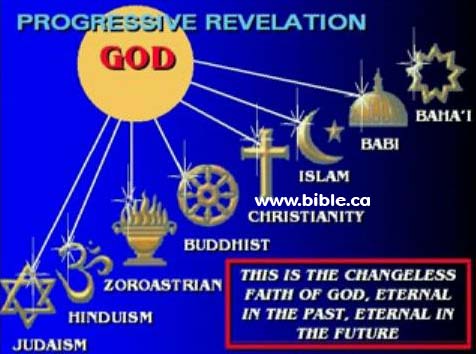
Although baha’is teach that God is unknowable in his essence, they believe that God does reveal something of himself to man, especially through his “manifestations” ( Krishna, Buddha, Jesus, muhammad, baha’u’llah, ). For those familiar with the conflicting doctrines of the major world religions associated with these “manifestations,” however, it is rather apparent that they cannot all be true. Yet this is exactly what the baha’is maintain, namely, that each of these religious leaders was a manifestation of God for his own era and therefore spoke some truth about God’s nature.

The Doctrine of God Taught by the Alleged Manifestations

MANIFESTATION IMPORTANT ELEMENTS IN HIS DOCTRINE OF GOD
Moses One personal God. The universe is not eternal, but was created by God (Gen. 1-3; Deut. 6:4; etc.).
Krishna Mix of polytheism and impersonal pantheism. The universe is eternal.
Zoroaster One good god and one evil god (religious dualism).
Buddha God not relevant; essentially agnostic.
Confucius Polytheistic.
muhammad One personal God who cannot have a Son.
Jesus Christ One personal God who does have a Son (Mark 12:29; John 4:24; 5:18-19;etc.)
baha’u’llah God and the universe, which is an emanation of God, are co-eternal.

The fact that the various alleged manifestations of God represented God in contradictory ways implies either that manifestations of God can contradict one another or that God’s own nature is contradictory. If the manifestations are allowed to contradict one another, then there is no way to separate false manifestations from true ones or to discover if any of them really speaks for the true and living God. Yet the baha’is obviously do not accept every person who claims to be a manifestation of God (e.g., Jim Jones, founder of Jonestown). If, on the other hand, God’s own nature is said to be contradictory, that is, that God is both one God and many gods, that God is both able and not able to have a Son, both personal and impersonal, etc., then the baha’i concept of God is reduced to meaninglessness.
 
Although baha’is teach that God is unknowable in his essence, they believe that God does reveal something of himself to man, especially through his “manifestations” ( Krishna, Buddha, Jesus, muhammad, baha’u’llah, ). For those familiar with the conflicting doctrines of the major world religions associated with these “manifestations,” however, it is rather apparent that they cannot all be true. Yet this is exactly what the baha’is maintain, namely, that each of these religious leaders was a manifestation of God for his own era and therefore spoke some truth about God’s nature.

The Doctrine of God Taught by the Alleged Manifestations

MANIFESTATION IMPORTANT ELEMENTS IN HIS DOCTRINE OF GOD
Moses One personal God. The universe is not eternal, but was created by God (Gen. 1-3; Deut. 6:4; etc.).
Krishna Mix of polytheism and impersonal pantheism. The universe is eternal.
Zoroaster One good god and one evil god (religious dualism).
Buddha God not relevant; essentially agnostic.
Confucius Polytheistic.
muhammad One personal God who cannot have a Son.
Jesus Christ One personal God who does have a Son (Mark 12:29; John 4:24; 5:18-19;etc.)
baha’u’llah God and the universe, which is an emanation of God, are co-eternal.

The fact that the various alleged manifestations of God represented God in contradictory ways implies either that manifestations of God can contradict one another or that God’s own nature is contradictory. If the manifestations are allowed to contradict one another, then there is no way to separate false manifestations from true ones or to discover if any of them really speaks for the true and living God. Yet the baha’is obviously do not accept every person who claims to be a manifestation of God (e.g., Jim Jones, founder of Jonestown). If, on the other hand, God’s own nature is said to be contradictory, that is, that God is both one God and many gods, that God is both able and not able to have a Son, both personal and impersonal, etc., then the baha’i concept of God is reduced to meaninglessness.
 
Although baha’is teach that God is unknowable in his essence, they believe that God does reveal something of himself to man, especially through his “manifestations” ( Krishna, Buddha, Jesus, muhammad, baha’u’llah, ). For those familiar with the conflicting doctrines of the major world religions associated with these “manifestations,” however, it is rather apparent that they cannot all be true. Yet this is exactly what the baha’is maintain, namely, that each of these religious leaders was a manifestation of God for his own era and therefore spoke some truth about God’s nature.

The Doctrine of God Taught by the Alleged Manifestations

MANIFESTATION IMPORTANT ELEMENTS IN HIS DOCTRINE OF GOD
Moses One personal God. The universe is not eternal, but was created by God (Gen. 1-3; Deut. 6:4; etc.).
Krishna Mix of polytheism and impersonal pantheism. The universe is eternal.
Zoroaster One good god and one evil god (religious dualism).
Buddha God not relevant; essentially agnostic.
Confucius Polytheistic.
muhammad One personal God who cannot have a Son.
Jesus Christ One personal God who does have a Son (Mark 12:29; John 4:24; 5:18-19;etc.)
baha’u’llah God and the universe, which is an emanation of God, are co-eternal.

The fact that the various alleged manifestations of God represented God in contradictory ways implies either that manifestations of God can contradict one another or that God’s own nature is contradictory. If the manifestations are allowed to contradict one another, then there is no way to separate false manifestations from true ones or to discover if any of them really speaks for the true and living God. Yet the baha’is obviously do not accept every person who claims to be a manifestation of God (e.g., Jim Jones, founder of Jonestown). If, on the other hand, God’s own nature is said to be contradictory, that is, that God is both one God and many gods, that God is both able and not able to have a Son, both personal and impersonal, etc., then the baha’i concept of God is reduced to meaninglessness.
The baha’i is required to accept that blatantly contradictory concepts of God were all infallibly revealed by God through his “manifestations.” For instance, monotheism (what Moses, Jesus, and muhammad taught) and polytheism (what Confucius and Zoroaster taught) cannot both be true, since it is contradictory to say both that there is only one god and that there is more than one god. Therefore, unlike the Christian doctrines of the Incarnation and the Trinity, the baha’i view of God implies mutually exclusive concepts of God.
 
Because “identity and personality” exist OUTSIDE the human body.

There is a lot you will discover after death Techno. Baha’u’llah’s “non-physical” SPIRITUAL Identity is shared with Jesus, just as John the Baptist’s identity was shared with Prophet Elijah…

.
That’s Baha’is bizarre interpretation.
 
The baha’i is required to accept that blatantly contradictory concepts of God were all infallibly revealed by God through his “manifestations.” For instance, monotheism (what Moses, Jesus, and muhammad taught) and polytheism (what Confucius and Zoroaster taught) cannot both be true, since it is contradictory to say both that there is only one god and that there is more than one god. Therefore, unlike the Christian doctrines of the Incarnation and the Trinity, the baha’i view of God implies mutually exclusive concepts of God.
They just gloss right over all the contradictions.
 
Certainly there is no reason to accept baha’u’llah’s claim to be that Messiah. He failed to fulfill any of the biblical prophecies concerning Christ’s second coming, and baha’i’s cannot produce a single text from the Bible that suggests that Jesus will not Himself fulfill those prophecies.
 
Although baha’is teach that God is unknowable in his essence, they believe that God does reveal something of himself to man, especially through his “manifestations” ( Krishna, Buddha, Jesus, muhammad, baha’u’llah, ). For those familiar with the conflicting doctrines of the major world religions associated with these “manifestations,” however, it is rather apparent that they cannot all be true. Yet this is exactly what the baha’is maintain, namely, that each of these religious leaders was a manifestation of God for his own era and therefore spoke some truth about God’s nature.

The Doctrine of God Taught by the Alleged Manifestations

MANIFESTATION IMPORTANT ELEMENTS IN HIS DOCTRINE OF GOD
Moses One personal God. The universe is not eternal, but was created by God (Gen. 1-3; Deut. 6:4; etc.).
Krishna Mix of polytheism and impersonal pantheism. The universe is eternal.
Zoroaster One good god and one evil god (religious dualism).
Buddha God not relevant; essentially agnostic.
Confucius Polytheistic.
muhammad One personal God who cannot have a Son.
Jesus Christ One personal God who does have a Son (Mark 12:29; John 4:24; 5:18-19;etc.)
baha’u’llah God and the universe, which is an emanation of God, are co-eternal.

The fact that the various alleged manifestations of God represented God in contradictory ways implies either that manifestations of God can contradict one another or that God’s own nature is contradictory. If the manifestations are allowed to contradict one another, then there is no way to separate false manifestations from true ones or to discover if any of them really speaks for the true and living God. Yet the baha’is obviously do not accept every person who claims to be a manifestation of God (e.g., Jim Jones, founder of Jonestown). If, on the other hand, God’s own nature is said to be contradictory, that is, that God is both one God and many gods, that God is both able and not able to have a Son, both personal and impersonal, etc., then the baha’i concept of God is reduced to meaninglessness.
If this is one false teaching in the Baha’i religion, I wish to know how you KNOW that Buddha and Krishna taught what they did about God?

.
 
I don’t like what they gloss it over with
There’s no glossing over.

The truth is being told.

if Christ said Krishna and Buddha were Manifestations of God you would accept it because you know He speaks infallibly. You wouldn’t need proof. The Word of God would be enough.

The same with Baha’is. We are told that all those Manifestations were sent by the same God and taught the oneness of God but their teachings either became lost or/and distorted but that they all taught the truth.

What is being presented here is a wrong list of supposed teachings. Which are false. Krishna did not teach pantheism according to Baha’u’llah. Buddha taught the oneness of God and was not an agnostic. Zoroaster did not teach a good and a bad God but one God.

Relying more on unreliable unproven records than a Manifestation of God of course you’re going to get contradictions.

Where are you sourcing your contradictions from a Manifestation or just upon ‘existing records’ not taking into account lost records. If Christ Himself told you there was no contradiction between them would you accept it? Despite the world saying differently? Of course. The same with Baha’is. It all comes down to WHO WAS BAHAULLAH???

Jesus never said anything about Zoroaster except we know the Magi saved His life. Never said anything bad about Buddha. Didn’t He know? Or Krishna didn’t He know? Of course He did but He never said anything derogatory about Therm so it’s wrong for Christians to just assume they were not Manifestations of God.
 
The baha’is claim that baha’u’llah is the fulfillment of the biblical prophecies of the return of Christ.Taken literally, of course, the biblical prophecies of Christ’s return do not fit baha’u’llah. The Bible speaks of Jesus Himself returning in the skies before the entire world in a cataclysmic fashion to judge the living and the dead (Matt. 24). By contrast, Baha’is recognized as the “Christ” another person (baha’u’llah) who came into the world in relative obscurity through natural means (conception and birth).
How, then, can the baha’is claim that bah’u’llah fulfills the biblical prophecies of Christ’s return? They can do this only by insisting that the literal meaning is to be ignored. According to baha’i doctrine, Jesus’ description of His second coming in the Bible should be understood spiritually rather than literally. That is, the text of the Bible is said to have some symbolic meaning which is contrary to the ordinary meaning of the words used.
 
Status
Not open for further replies.
Back
Top