Conciliarism vs universal Papal jurisdiction + Ecumenical council...?

  • Thread starter Thread starter joe370
  • Start date Start date
Status
Not open for further replies.
“After the reading of the foregoing epistle [The Tome of Leo], the most reverend bishops (eastern) - cried out: ‘This is the faith of the fathers! This is the faith of the apostles! So we all believe! Thus the orthodox believe! Anathema to him who does not thus believe! **Peter has spoken thus through Leo!’”
**
This too is taken out of context. Firstly, this sort of praise is not unique to the Tome of Leo. For example, this is what they say after Cyril’s second letter to Nestorius is read.
After the reading the most devout bishops exclaimed: ‘We all believe accordingly. Pope Leo believes accordingly. Anathema to him who divides and him who confuses! This is the faith of Archbishop Leo. Leo believes accordingly. Leo and Anatolius believe accordingly. We all believe accordingly. As Cyril so we believe. Eternal is the memory of Cyril. As is contained in the letters of Cyril, so we hold. We have believed accordingly, and we believe accordingly. Archbishop Leo thinks, believes and wrote accordingly.’
Furthermore, we know from the acts that the praise for Leo’s tome was not unanimous.
  1. After the reading of the aforesaid letter the most devout bishops exclaimed: ‘This is the faith of the fathers. This is the faith of the apostles. We all believe accordingly. We orthodox believe accordingly. Anathema to him who does not believe accordingly! Peter has uttered this through Leo. The apostles taught accordingly. Leo taught piously and truly. Cyril taught accordingly. Eternal is the memory of Cyril. Leo and Cyril taught the same. Leo and Cyril taught accordingly. Anathema to him who does not believe accordingly! This is the true faith. We orthodox think accordingly. This is the faith of the fathers. Why was this not read out at Ephesus? Dioscorus concealed it.’
  2. When there was being read the part of the aforesaid letter that contains the words, ‘For the payment of the debt owed by our nature divine nature was united to the passible nature, so that – this fitting our cure – one and the same, being the mediator between God and men, the man Christ Jesus, would be able to die in respect of the one and would not be able to expire in respect of the other’, and the most devout Illyrian and Palestinian bishops raised an objection, Aetius the most devout archdeacon of imperial Constantinople read out the chapter of Cyril of sacred memory, the late bishop of the city of Alexandria, containing the words, ‘Since again his own body by the grace of God tasted death on behalf of everyone, as the apostle says, he himself is said to have suffered death on our behalf, not as though he entered into the experience of death in regard to his own nature (for to say or think that would be lunacy) but because, as I have just said, his own flesh tasted death.’
  3. Likewise when there was being read the part that contains the words, ‘For each form performs what is proper to it in association with the other, the Word achieving what is the Word’s, while the body accomplishes what is the body’s; the one shines with miracles while the other has succumbed to outrages’, and the most devout Illyrian and Palestinian bishops raised an objection, Aetius archdeacon of the holy church of Constantinople read out the chapter of Cyril of sacred memory containing the words, ‘Some of the sayings are particularly fitting to God, some again are particularly fitting to man, while others occupy a middle position, revealing the Son of God as God and man simultaneously and at the same time.’
  4. Likewise when there was being read from the same letter the part that contains the words, ‘Although indeed in the Lord Jesus Christ there is one person of God and man, nevertheless that because of which the outrage is common in both is one thing and that because of which the glory is common is another, for he has from us the humanity that is less than the Father, and he has from the Father the Godhead that is equal with the Father’, and the most devout Illyrian and Palestinian bishops raised an objection, Theodoret the most devout bishop of Cyrrhus said, ‘There is a similar instance in the blessed Cyril which contains the words, “He became man without shedding what was his own, for he remained what he was; he is certainly conceived as one dwelling in another, that is, the divine nature in what is human.”
As we can see here, the reading of the tome was actually interrupted several times by the Illyrian and Palestinian bishops, who objected to certain language in the tome which seemed to them to be Nestorian. Each time, their objections are answered by other bishops showing how the Tome of Leo agrees with things which St. Cyril wrote. We can see however, that this is a far cry from the mentality of, “the pope wrote it, therefore it is Orthodox,” which a lot of Catholic apologists try to say was the mind of the council. They are actively defending the Orthodoxy of the Tome of Leo by showing that it agrees with previous writings which are taken to be sources of right faith (i.e., the Christological writings of St. Cyril).

Chalcedon is actually a rather poor argument for any sort of papal jurisdiction over a council. Aside from causing the rather devastating break with the Copts, Syriacs, and Ethiopians which lasts to this day, Chalcedon was called against the will of pope Leo, who nevertheless assented to the emperor’s wishes, and sent legates as he did to Ephesus II. At the council itself, the legates held considerable clout, being the representatives of Rome, but they were not running the council, nor did they have the authority to really demand that the senators act according to their instructions from the Archbishop of Rome, as we can see from the first excerpt which I provided.
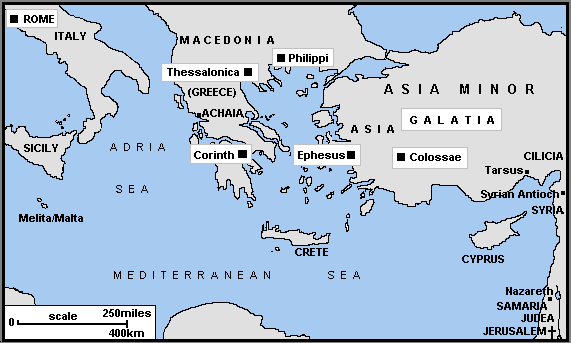
 
John is dead at the time and Ephesus, like Rome is a sea away…and Ephesus is not between Rome and Corinth. Rome is across the sea to the west…Ephesus to the east
What evidence shows that St.John was dead? I’ve always read that he was in Ephesus. And could you please cite these scholars you keep referring to, especially on their claim that no consultation was indicated on the letter? You’re right, Ephesus was not between them, but it was definitely much more convenient! And there were also other Christians much nearer than Rome per the maps I found. The Church of the Thessalonians did not even require a trip across the sea! (1st and 2nd map). And Rome required going round about Greece and then a long way across that sea around Italy as Rome was on the other side of Italy! Look at how accessible Ephesus is (2nd map).


Hey Radical…
b/c they thought that they had discerned a truth. They believed that the Corinthian church had dismissed several presbyters who had fulfilled their function righteously. Clement et al concluded that such a dismissal was sinful. By opposing sin they were describing the will of God.
So certain elders of Corinth called upon co-equal “elders in Rome” (as opposed to bishop of Rome) - to resolve the schism that had arisen in their community, due to the uprising of certain co-equal rash and self-willed elders of Corinth, because they had no residing bishop, as you have pointed out?

OK.

When dissension reared its ugly head in Corinth, why would those “few rash and self-willed persons” who had created a schism in the church in Corinth, by ousting certain leader elders of Corinth, suddenly submit to the will of the supposed co-equal “elders of Rome,” seeing them as speaking “with the authority of Jesus Christ” - but not their own co-equal elders in Corinth?

Why defer to the authority of those “witnesses” sent by the supposed co-equal “elders of Rome,” all the while paying absolutely no respect or submission to the co-equal elders among them in Corinth, which is clear by the fact that they ousted them?

Once Rome had spoken and passed judgment on the schismatics and ordered them to submit to their residing elders, they do. Why?

But if certain persons should be disobedient unto the words spoken by Him (Jesus) - through us, let them understand that they will entangle themselves in no slight transgression and danger…For ye will give us great joy and gladness, if ye render obedience unto the things written by us through the Holy Spirit…And we have also sent faithful and prudent men that have walked among us from youth unto old age unblamably, who shall also be witnesses between you and us." (St. Clement of Rome: Letter to the Corinthians – 1:1; 46:9; 47:3,6; 57:1; 58:2; 59:1; 63:2; 63:3)
 
Hey Cavaradossi…🙂
After the reading the most devout bishops exclaimed: ‘We all believe accordingly. Pope Leo believes accordingly. Anathema to him who divides and him who confuses! This is the faith of Archbishop Leo. Leo believes accordingly. Leo and Anatolius believe accordingly. We all believe accordingly. As Cyril so we believe. Eternal is the memory of Cyril. As is contained in the letters of Cyril, so we hold. We have believed accordingly, and we believe accordingly. Archbishop Leo thinks, believes and wrote accordingly.’
So I have mistakenly taken the quote, “Peter has spoken thus through Leo” - out of context because the same is said about Cyril in the preceding quote? In other words:

“Peter has spoken thus through Cyril.”

Why would the eastern patriarchs even be concerned with the idea of Peter speaking through Leo if the Petrine office was irrelevant, (since it is the Ecumenical Council that holds all sway) - or even non-existent?

I mean, who cares what one bishop in Rome has to say - right? :confused:
 
Cavaradossi, you said:
Furthermore, we know from the acts that the praise for Leo’s tome was not unanimous.
Based on the following excerpt, or have I overlooked something?

“After the reading of the aforesaid letter the most devout bishops exclaimed…” :confused:
 
Hey Cavaradossi…🙂

So I have mistakenly taken the quote, “Peter has spoken thus through Leo” - out of context because the same is said about Cyril in the preceding quote? In other words:

“Peter has spoken thus through Cyril.”

Why would the eastern patriarchs even be concerned with the idea of Peter speaking through Leo if the Petrine office was irrelevant, (since it is the Ecumenical Council that holds all sway) - or even non-existent?

I mean, who cares what one bishop in Rome has to say - right? :confused:
Well, certainly, his position as the archbishop of Rome accorded him much respect in the eyes of the council. I say that the quotation is taken out of context because, well, it is taken out of context :D. That’s why I provided the next couple of sections from the acts, so that a more clear picture of what was happening could emerge.
Cavaradossi, you said:

Based on the following excerpt, or have I overlooked something?

“After the reading of the aforesaid letter the most devout bishops exclaimed…” :confused:
Read the rest of the excerpt, where it details how the Illyrian and Palestinian bishops interrupted the reading of the Tome in order to voice their objections. The acts condense it, but the argument was supposedly rather intense. My point is that the Tome of Leo did not go unchallenged. In all of the cases presented in the acts, the challenges were dismissed by showing that Leo was in consensus with the teachings of St. Cyril—in other words, when the Tome was challenged, its supporters demonstrated its Orthodoxy by quoting St. Cyril whose teachings had been established at Ephesus as being Orthodox; the Tome was not simply accepted by virtue of Leo’s position as Archbishop of Rome.

Therefore, saying that the exclamation of ‘Peter speaking through Leo’ is evidence for the council essentially reading through the Tome of Leo (without any interruptions or objections) and then rubber-stamping it by virtue of his office and authority as the archbishop of Rome is a rather untenable position. It was only after the Tome of Leo had been demonstrated to be Orthodox to the Illyrian and Palestinian bishops, who believed it to be Nestorian but were corrected and shown its orthodoxy by virtue of its agreement with the writings of St. Cyril, that the lines praising the Orthodoxy of the Tome (including ‘Peter has spoken through Leo’) were spoken.
 
If the recent persecution in the letter is Nero then the letter is approximately 68AD. Saint John would have been alive. If the persecution is from Domitian then it is closer to the end of the fist century. Remember Clement is with Saint Paul at Phillipi (57AD). This could account for the appeal to Clement who succeeded Linus and Cletus as Bishop of Rome.

Peter was martyred (crucified upside down on a cross) for the Faith in the year 64 in Rome. Assuming Saint Paul was beheaded approximately 64 AD. If these are the successive calamitous events of the first paragraph then Saint John is still alive. Irenaeus places Saint Johns exile in Patmos at the end of Domitian’s reign. (Against Heresies V.4). The Emperor Domitian reigned A.D. 81-96 Saint John is busy with the Bishops (Angels) of the Church in Asia (Apocalypse).

It seems obvious, by this epistle, the Bishop of Rome is guiding one of His jurisdictional churches (Corinth).

biblestudy.org/question/sauldie.html
newadvent.org/cathen/01594b.htm

peace
 
If the recent persecution in the letter is Nero then the letter is approximately 68AD. Saint John would have been alive. If the persecution is from Domitian then it is closer to the end of the fist century. Remember Clement is with Saint Paul at Phillipi (57AD). This could account for the appeal to Clement who succeeded Linus and Cletus as Bishop of Rome.

Peter was martyred (crucified upside down on a cross) for the Faith in the year 64 in Rome. Assuming Saint Paul was beheaded approximately 64 AD. If these are the successive calamitous events of the first paragraph then Saint John is still alive. Irenaeus places Saint Johns exile in Patmos at the end of Domitian’s reign. (Against Heresies V.4). The Emperor Domitian reigned A.D. 81-96 Saint John is busy with the Bishops (Angels) of the Church in Asia (Apocalypse).

It seems obvious, by this epistle, the Bishop of Rome is guiding one of His jurisdictional churches (Corinth).

biblestudy.org/question/sauldie.html
newadvent.org/cathen/01594b.htm

peace
You are correct. People don’t realize it today, because it seems a bit counter-intuitive, but modern-day Greece was under the jurisdiction of the archbishop of Rome. It was only further East (Thrace in particular, I think) where the normal jurisdiction of the archbishop of Rome stopped. I think it is also worth pointing out that the role of the pope as a mediator in administrative church conflicts was never in dispute. This is certainly one of the canonical prerogatives laid out for the archbishop of Rome (although I forget which canon it is).
 
A side note…here in the USA, the Bishop Councils were becoming over reaching in that the bishops would vote differently. They admitted that when they voted alone without peers, they would vote in accordance with Rome.
 
Hey Radical…

So certain elders of Corinth called upon co-equal “elders in Rome” (as opposed to bishop of Rome) - to resolve the schism that had arisen in their community, due to the uprising of certain co-equal rash and self-willed elders of Corinth, because they had no residing bishop, as you have pointed out?

OK.
no, not OK. Nobody called upon the Roman Church to offer an opinion. Second, if the rash presbyters had wrongly ousted the righteous presbyters (which is what 1 Clement claims), then the rash presbyters wouldn’t be equals…they would be wrongly in office and not proper (co-equal presbyters).
When dissension reared its ugly head in Corinth, why would those “few rash and self-willed persons” who had created a schism in the church in Corinth, by ousting certain leader elders of Corinth, suddenly submit to the will of the supposed co-equal “elders of Rome,”…
we don’t know what happened…who submitted or who didn’t. Perhaps the Corinthian congregation agreed (with Rome) that the first ousting was wrong and then ousted the rash presbyters. Perhaps they ignored 1 Clement, but as Rome’s reputation grew the letter became important. We just don’t know.
Why defer to the authority of those “witnesses” sent by the supposed co-equal “elders of Rome,” all the while paying absolutely no respect or submission to the co-equal elders among them in Corinth, which is clear by the fact that they ousted them?
Once Rome had spoken and passed judgment on the schismatics and ordered them to submit to their residing elders, they do. Why?
Joe, you really need to pay some attention to the evidence and get the facts right
 
If the recent persecution in the letter is Nero then the letter is approximately 68AD. Saint John would have been alive.
possibly, but the tradition wrt John’s life isn’t rock solid…but, in any event, the tendency is to put the authorship of 1st Clement at around 95 AD.
It seems obvious, by this epistle, the Bishop of Rome is guiding one of His jurisdictional churches (Corinth).
it may seem obvious for Catholics who are determined to find early support for their papacy, but as I have repeatedly said, at the time of 1st Clement “there is a general agreement among scholars that the structure of ministry in the church of Rome at this time would have resembled that in Corinth: with a group of presbyters sharing leadership, perhaps with a differentiation of roles among them, but with no one bishop in charge.” (Sullivan p. 100) Not only was Clement not a monarchical bishop, but the majority of scholars don’t think that the church of Rome was exercising any authority (of its own).
 
You are correct. People don’t realize it today, because it seems a bit counter-intuitive, but modern-day Greece was under the jurisdiction of the archbishop of Rome.
Do you really think that jurisdictional boundaries had been laid out by 95 AD? …and that the office of an archbishop had been instituted at that time?
 
That might be what Mardukm thinks is implied, but he is off side of scholars on that point. As Sullivan says: “…(1st Clement) is generally recognized as the kind of exhortation one church could address to another without any claim to authority over it.” and “…some have seen an exercise of Roman primacy, but most scholars nowadays, including Catholics, interpret this (59 & 63) rather as an expression of confidence that the Holy Spirit has spoken through what they have written.”
That is a matter of interpretation. Protestants seem generally to think that just about anybody has the authority to have the Holy Spirit speak through them. Catholics and other Apostolic Christians, on the other hand, understand that when a particular person or body of persons is saying, “the Holy Spirit has spoken through us,” this is an indication that juridical authority is being utilized. St. James specifically tells us, “Let not many of you claim to be teachers,” and St. Paul specifically tells us that the charism of teaching is not given to all. Apostolic Christians live by this biblical standard. Many Protestants do not.

Blessings,
Marduk
 
Cavaradossi;8540620]This too is taken out of context. Firstly, this sort of praise is not unique to the Tome of Leo. For example, this is what they say after Cyril’s second letter to Nestorius is read.
I understand that praise was not limited to that of the bishop of Rome, for that would be silly. :thumbsup:However, was the following ever said about any eastern bishop, regarding the Petrine office:

Peter has spoken thus through Leo”?

If it was to be all about conciliarism, as opposed to papal jurisdiction + ecumenical council, then why did anyone in the east even care what this one bishop in Rome had to say, and why did he have such singular influence at the Council of Chalcedon?
Furthermore, we know from the acts that the praise for Leo’s tome was not unanimous.
:hmmm: In a nutshell, Pope Leo wrote a letter to Bishop Flavian of Constantinople, in which he affirmed that Christ has two natures, one human and one divine, and it was read in 451 AD by the Council of Chalcedon and judged by them to be sound doctrine, contributing much to the creedal statements of that council,** but was rejected by some. Is that what you are talking about? **
 
What evidence shows that St.John was dead?
the letter is likely written around 95 AD…do you think John is still alive at that time?
And could you please cite these scholars you keep referring to, especially on their claim that no consultation was indicated on the letter?
the Translators that I have referenced are J B Lightfoot and J R Harmer and M W Holmes. I have quoted Francis A Sullivan, SJ (From Apostles to Bishops, see pp 91-102 …it is previewed at googlebooks) and Edgar Goodspeed
 
Radical;8541097]no, not OK. Nobody called upon the Roman Church to offer an opinion. Second, if the rash presbyters had wrongly ousted the righteous presbyters (which is what 1 Clement claims), then the rash presbyters wouldn’t be equals…they would be wrongly in office and not proper (co-equal presbyters).
Prove to me that nobody called upon the Roman Church to offer an opinion??? Otherwise, it seems reasonable to infer, from the following, that the leaders of Corinth were in fact deferring to the leaders of Rome, anticipating their involvement:

“Owing to the sudden and repeated calamities and misfortunes which have befallen us, we must acknowledge that we have been somewhat tardy in turning our attention to the matters in dispute among you [Corinthians]; and especially that abominable and unholy sedition, alien and foreign to the elect of God…”

Looks like were down to 2 options:

Either certain superior elders of Corinth called upon co-equal “elders in Rome” (as opposed to bishop of Rome) - to resolve the schism that had arisen in their community, due to the uprising of certain rash and self-willed folks of Corinth who were Corinthian subordinates, or, the elders of Rome, 700 miles removed from Corinth, just decided to butt in without anyone in Corinth asking for their assistance, and then everyone in Corinth , be it superior elder or subordinate elder, just accepted the following from the “elders of Rome”?

“But if certain persons should be disobedient unto the words spoken by Him (Jesus) - through us, let them understand that they will entangle themselves in no slight transgression and danger…For ye will give us great joy and gladness, if ye render obedience unto the things written by us through the Holy Spirit…And we have also sent faithful and prudent men that have walked among us from youth unto old age unblamably, who shall also be witnesses between you and us.”
Joe, you really need to pay some attention to the evidence and get the facts right
:ouch:
 
I don’t understand the point here. Does it matter today what transpired in the early church? There have been conciliar pronouncements in both Vatican 1 and Vatican 2 that outline both the authority of the Pope and the authority of the bishops. Do you need the reference, or is this thread about something else?
 
I don’t understand the point here. Does it matter today what transpired in the early church? There have been conciliar pronouncements in both Vatican 1 and Vatican 2 that outline both the authority of the Pope and the authority of the bishops. Do you need the reference, or is this thread about something else?
Sadly, non-Catholics don’t give a hoot about the claims of V1 or V2?
 
With respect, when has this happened since the Second Council of Nicea? Is it possible for the pope to do this while the Church is in Schism?
Yes, I believe the Pope can do this even while the Church is in Schism because all Apostolic Churches have the same founts of Tradition.

Specifically, Vatican 1 states in Pastor Aeternus that the Pope can only defend and uphold Sacred Tradition in his decrees, not make any new doctrines.

Here’s a test case: The dogma of the IC. There is much debate over it now, but there was not a single voice from the EO opposing the definition until about 40 years after its promulgation. That’s waaaaay too long for me to believe that the modern EO opposition to the IC has any doctrinal merit. It just seems so artificial. In fact, this first opposition was not against the doctrine per se, but merely against the very act of dogmatizing it with papal authority (i.e., it seems the opposition was not to the IC, specifically, but to the V1 papal dogma). It was only later that doctrinal arguments came forth from the Orthodox side. Further, the very great majority of texts supporting the IC are from Eastern/Oriental Fathers in the first millenium. A lot of the opposition, too, has to do with a misunderstanding of what the IC teaches.

There’s a comparable situation on the issue of “universal vs. eucharistic ecclesiology” as discussed in this thread (forums.catholic-questions.org/showthread.php?t=609722 - I would appreciate your (name removed by moderator)ut in that thread, btw). EO apologists admit that the early Church at least since St. Cyprian lived according to a “universal ecclesiology.” But they claim they want to recover the original ecclesiology, and essentially claim that the Gates of Hades prevailed against the Church for these many centuries regarding this issue (as many EO regard “universal ecclesiology” as a heresy). I’m always wary of those who claim that they are “recovering” something original, even if they are from one of the Orthodox Churches. It just puts them on the same boat as the JW’s, or SDA’s, or the numerous other Protestant groups that claim the same thing in order to justify their existence, as far as I’m concerned.

Blessings,
Marduk
 
Do you really think that jurisdictional boundaries had been laid out by 95 AD? …and that the office of an archbishop had been instituted at that time?
It is possible, yes. Nicaea formalized what was already customary. We really have no idea when the custom came about.
I understand that praise was not limited to that of the bishop of Rome, for that would be silly. :thumbsup:However, was the following ever said about any eastern bishop, regarding the Petrine office:

Peter has spoken thus through Leo”?
They said it because of Rome’s connection to the apostle Peter. The contention is that this praise is just that, praise. Saying Peter spoke through Leo is not saying that the Pope is some sort of mouthpiece for Peter anymore than calling the Pope of Alexandria by the title, “Thirteenth Apostle,” or, “Judge of the World,” implied that the Pope of Alexandria had such faculties (this was the same civilization that called the librarian at the library of Alexandria the Universal Librarian). Still, I feel that you are arguing over a moot point; go back and read the excerpts from the acts and my commentary to understand the context of this exclamation.
If it was to be all about conciliarism, as opposed to papal jurisdiction + ecumenical council, then why did anyone in the east even care what this one bishop in Rome had to say, and why did he have such singular influence at the Council of Chalcedon?
The same reason why Ephesus focused on the teachings of Cyril against Nestorius, and Nicaea focused on the objections of Athanasius against Arius. These were influential men whose teachings were Orthodox. Their rank in the Church had nothing to do with it (Athanasius was, after all, a deacon at the time he started opposing Arius).

Furthermore, Chalcedon was called in order to determine whether Ephesus II had been conducted fairly by Dioscoros. Part of the investigation involved investigating documents which had been submitted to the council at Ephesus II, the tome being one of them. Dioscoros allegedly did not read the Tome at Ephesus II, which is what the exclamation, “Dioscoros hid it,” is referencing.
:hmmm: In a nutshell, Pope Leo wrote a letter to Bishop Flavian of Constantinople, in which he affirmed that Christ has two natures, one human and one divine, and it was read in 451 AD by the Council of Chalcedon and judged by them to be sound doctrine, contributing much to the creedal statements of that council,** but was rejected by some. Is that what you are talking about? **
That’s not quite what I’m getting at. It was not rejected as much as found objectionable (the rejection of the Tome came later with the rejection of Chalcedon by certain miaphysite Christians). When there was debate about whether the Tome used Nestorian language, the supporters of the Tome would show how it agreed with St. Cyril, in order to convince the opposition. That is to say, in other words, that the tome itself had no authority by virtue of any sort of Petrine ministry, in the eyes of these bishops, rather its authority was by virtue of the orthodoxy of its teachings. Had it truly said something very Nestorian or in complete disagreement with Ephesus, the fathers of the council would have rejected it for sure.
 
Status
Not open for further replies.
Back
Top