P
patrick457
Guest
I just happened to read this post by Trent Horn (very excellent BTW) about the ol’ Jehovah’s Witnesses claim that traditional/mainstream Christians are wrong in using the cross because Jesus actually would have been hung on a stake instead of the traditional cross that we know of.
This is actually what got me thinking. Very often, these debates can be summarized like this:
“Jesus was hung on a stake.”
“No, He was hung on a cross.”
I don’t know about you, but I see a problem with this. Not just with JWs, but also - especially - with people who make the cross argument. You want to know why? Here’s why.
My bone is really with that counter-argument: “No, He was crucified, He was hung on a cross.” Not too many notice it, but that statement actually presupposes two things: that a ‘cross’ is (1) different from a ‘stake’ and (2) made out of two or more pieces of wood that are perpendicular to each other. So when people say ‘crucified’, what they often mean is, ‘hung on a gibbet made out of two wooden beams perpendicular to each other’. You know, like our crucifixes.
But that presupposition is not entirely accurate.
I’ll focus on the word ‘cross’, because this is what trips up a lot of people. News flash: a cross (I’ll use the Latin word crux from here on to describe the device) actually does not have a definite shape. I’ll be honest with you: yes, there are times when a crux can be a simple vertical pole - in fact, the word does mean in the broadest sense ‘pole’. But, there are also other times when a crux could consist of two wooden beams joined in the shape of a T, a t, or an X. Heck, a tree can even be a crux. As long as it’s a pole/pole-like thing or a contraption which builds on the basic pole that you can hang people on.
The words crux or stauros simply meant ‘some kind of torture/execution device used for hanging people’ - nothing about their exact shape. They could and do mean ‘stake/pole’ or in some cases ‘more fancy variations shaped like a t or T’, but there was no connotation that specified what they are to look along the lines of, ‘cruxes (cruces?) are stakes’ or ‘cruces are t/T-shaped.’ To sum: a stake or a T or t-shaped gibbet are ‘crosses’, but not all ‘crosses’ were vertical stakes or Ts or ts.
The idea of applying the word ‘cross’ specifically to ‘a T or t or X shaped contraption’ actually only came with the early Christians. Christians had the idea that Jesus’ particular crux was shaped like a T or t and thus depicted it; when crucifixion as a punishment was long gone, all’s that’s left was those depictions of T or t shaped cruces or Jesus hanging on a T or t shaped crux. And so people subconsciously began to form the idea that crosses must have generally looked like that - because, you know, they’re crosses.
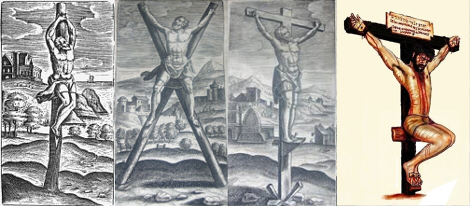
These are all ‘crosses’. Yes, even the stake on the left.
It’s telling that in English, one can use the term ‘cross-shaped’ without elaborating about just what a ‘cross’ is shaped like.
I’d like to use a modern analogy. The way we currently use the word ‘cross’ is like trying to use the term ‘chair’ with an added connotation of ‘the chair must look like this’ or ‘the chair is of this color’ or ‘the chair is this big’ in order for it to qualify as a real chair. But while chairs are all built using the same basic idea, not all chairs are of the same size or appearance or color or even number of legs. That doesn’t make single-legged chairs any less of a chair than a four-legged one.
So if you’ll ask me, a better argument is not simply to say that “Jesus was hung on a cross.” Instead:
The gibbet, the crux Jesus was hung on does not necessarily have to be a stake - it could have been any other shape, like a t, or a T, or an X, or whatever. But from early Christian testimony we can infer that the early Christians believed that the specific crux Jesus was hung on was shaped something like a T or t.
This is a mouthful, but at least, it’s a honest argumentation if you ask me.
This is actually what got me thinking. Very often, these debates can be summarized like this:
“Jesus was hung on a stake.”
“No, He was hung on a cross.”
I don’t know about you, but I see a problem with this. Not just with JWs, but also - especially - with people who make the cross argument. You want to know why? Here’s why.
My bone is really with that counter-argument: “No, He was crucified, He was hung on a cross.” Not too many notice it, but that statement actually presupposes two things: that a ‘cross’ is (1) different from a ‘stake’ and (2) made out of two or more pieces of wood that are perpendicular to each other. So when people say ‘crucified’, what they often mean is, ‘hung on a gibbet made out of two wooden beams perpendicular to each other’. You know, like our crucifixes.
But that presupposition is not entirely accurate.
I’ll focus on the word ‘cross’, because this is what trips up a lot of people. News flash: a cross (I’ll use the Latin word crux from here on to describe the device) actually does not have a definite shape. I’ll be honest with you: yes, there are times when a crux can be a simple vertical pole - in fact, the word does mean in the broadest sense ‘pole’. But, there are also other times when a crux could consist of two wooden beams joined in the shape of a T, a t, or an X. Heck, a tree can even be a crux. As long as it’s a pole/pole-like thing or a contraption which builds on the basic pole that you can hang people on.
The words crux or stauros simply meant ‘some kind of torture/execution device used for hanging people’ - nothing about their exact shape. They could and do mean ‘stake/pole’ or in some cases ‘more fancy variations shaped like a t or T’, but there was no connotation that specified what they are to look along the lines of, ‘cruxes (cruces?) are stakes’ or ‘cruces are t/T-shaped.’ To sum: a stake or a T or t-shaped gibbet are ‘crosses’, but not all ‘crosses’ were vertical stakes or Ts or ts.
The idea of applying the word ‘cross’ specifically to ‘a T or t or X shaped contraption’ actually only came with the early Christians. Christians had the idea that Jesus’ particular crux was shaped like a T or t and thus depicted it; when crucifixion as a punishment was long gone, all’s that’s left was those depictions of T or t shaped cruces or Jesus hanging on a T or t shaped crux. And so people subconsciously began to form the idea that crosses must have generally looked like that - because, you know, they’re crosses.

These are all ‘crosses’. Yes, even the stake on the left.
It’s telling that in English, one can use the term ‘cross-shaped’ without elaborating about just what a ‘cross’ is shaped like.
I’d like to use a modern analogy. The way we currently use the word ‘cross’ is like trying to use the term ‘chair’ with an added connotation of ‘the chair must look like this’ or ‘the chair is of this color’ or ‘the chair is this big’ in order for it to qualify as a real chair. But while chairs are all built using the same basic idea, not all chairs are of the same size or appearance or color or even number of legs. That doesn’t make single-legged chairs any less of a chair than a four-legged one.
So if you’ll ask me, a better argument is not simply to say that “Jesus was hung on a cross.” Instead:
The gibbet, the crux Jesus was hung on does not necessarily have to be a stake - it could have been any other shape, like a t, or a T, or an X, or whatever. But from early Christian testimony we can infer that the early Christians believed that the specific crux Jesus was hung on was shaped something like a T or t.
This is a mouthful,
but at least, it’s a honest argumentation if you ask me.


 )
)