Crucified through the hands or wrists?

  • Thread starter Thread starter Suslar
  • Start date Start date
Status
Not open for further replies.
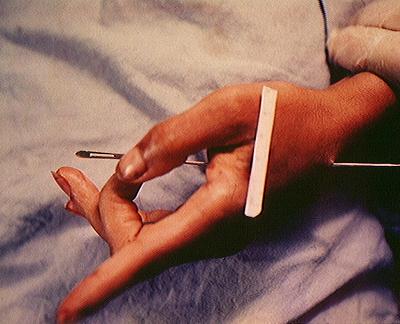
One of my recollections from reading about this whole matter is that if the nail went through the wrist area rather than the palm, the nail would have severed a major nerve, causing the hand and fingers to curl in and also causing excruciating pain, one that would continue as long as the individual was alive and moving, Given the barbaric method of execution - one designed to inflict maximum pain and slow death, it certainly makes sense that the nails would have gone where they would have done the most damage.

It might also be remembered that for quite some time after the beginnings of the Church, there appears to have been no art work showing Christ on the Cross, presumably because it was so barbaric that no one would go there artistically.
 
It might also be remembered that for quite some time after the beginnings of the Church, there appears to have been no art work showing Christ on the Cross, presumably because it was so barbaric that no one would go there artistically.
This is partially true. Orthodox Christians, did not depict any images of the crucified Christ, either because like most people they found it so barbaric (as you said), or out of necessity. However, there were a few folks who apparently never had such sensitivity.
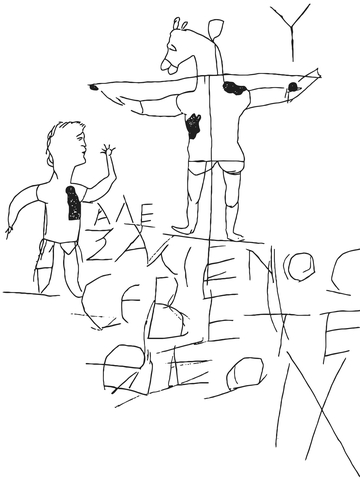


The Alexamenos graffito, an inscription carved in plaster on a wall near the Palatine Hill in Rome, now in the Palatine Antiquarium Museum, dating somewhere from the late 1st-3rd century AD. It holds the record as being one of the earliest known pictorial representations of the Crucifixion of Jesus.

The image depicts a human-like figure attached to a cross and possessing the head of a donkey. To the left of the image is a young man, apparently intended to represent Alexamenos, raising one hand in a gesture possibly suggesting worship. Beneath the cross there is a caption written in crude Greek: Αλεξαμενος ϲεβετε θεον. In standard Greek, the word ϲεβετε is the imperative of the verb “worship”. This would suggest a translation of the entire sentence as “Alexamenos, worship God!”. However it has been suggested by several scholars that ϲεβετε should be understood as a variant spelling (possibly a phonetic misspelling) of Standard Greek ϲεβεται, which means “worships”. As a result, the full inscription would then be translated as “Alexamenos worships [his] God”.

The vast majority of scholars consider the sketch to be a mocking depiction of a Christian. Both the portrayal of Jesus as having a donkey’s head and the depiction of him being crucified would have been considered insulting by contemporary Roman society. The accusation that Christians practiced onolatry, or donkey worship, seems to have been common at the time. Tertullian, writing in the late 2nd or early 3rd century, reports that Christians, along with Jews, were accused of worshipping a donkey(-headed deity).

 
http://www.infotdgeova.it/img/pozzuoli2.jpg

Another graffito found in a taberna near the ampitheatre in Puzzuoli (ancient Puteoli), Italy, of uncertain date. The sketch is thought to be a caricature of a victim put to death by crucifixion within the ampitheatre.

http://img240.imageshack.us/img240/389/crucifixiongemtu6.png


http://img508.imageshack.us/img508/2592/rome4thc.jpg

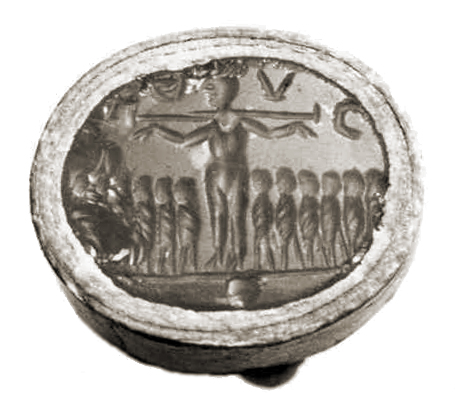
Engraved gems, usually thought to have been amulets. The dating (and even the authenticity of some of them) is disputed, and various dates ranging from AD 200-AD 500 have been suggested. These images are sometimes connected with gnostic groups.

Bear in mind that most, if not all, of these depictions were by non-Christians, or possibly even those who were considered ‘heretics’.
 
John 20:25-27

25 So the other disciples said to him, “We have seen the Lord.” But he said to them, “Unless I see** the mark of the nails in his hands **and put my finger into the nailmarks and put my hand into his side, I will not believe.”
26 Now a week later his disciples were again inside and Thomas was with them. Jesus came, although the doors were locked, and stood in their midst and said, “Peace be with you.”
27 Then he said to Thomas, "Put your finger here and see my hands, and bring your hand and put it into my side, and do not be unbelieving, but believe."
Wouldn’t that have broken his bones if nailed through the hands?
 
Please avoid graphic pictures. There are people who are uncomfortable with such pictures.

Thank You
 
Status
Not open for further replies.
Back
Top