
Crucifixion

  • Thread starter Thread starter patrick457
  • Start date Start date
Status
Not open for further replies.
P

patrick457

Guest
Since it’s Holy Week…

For me, the whole subject of crucifixion is a rather fascinating, and yet at the same time, very frightening (and repulsive) one, the kind you’d get chills running down your spine from just by reading about it. To be honest, the more I read about it, the more chills I get. 😊

Crucifixion is really a horrible way to die. To describe it briefly, a condemned victim would get beaten first, then afterwards in some cases he would be made to carry his cross, or a part of it, such as the horizontal beam in a shameful procession, and then he would be pinned to his gibbet in some fashion, usually by tying and/or nailing the hands/arms and the legs/feet, and left there until dead. The Romans apparently made measures to prolong a victim’s life (and thus his suffering) when hanging on a cross and to keep him there: at times, they seem to have enlarged the heads of nails with some sort of wooden washers to prevent the victim from breaking free of the nails. They also occasionally provided a kind of wooden peg or crotch support (sedile) for the victim to rest on, thereby taking the person’s weight off his arms. A few people out there even postulate that sometimes, the sedile would even have had a sort of spike in it - hence its other attested name, cornu or ‘horn’ - so that the victim who tried to ‘sit’ on it would get impaled through his anus or genitals. And that’s just the physical side of it - the shame associated with crucifixion was so great. :bigyikes:


http://www.infotdgeova.it/img/pozzuoli2.jpg

http://img827.imageshack.us/img827/4576/crucifixiongaza.png

http://img832.imageshack.us/img832/6059/cruzd.png

So, what do people think?
 
The first time I’d ever seen the movie The Passion, was last Wednesday. I promised myself I would not look away. The scouring, was so very very difficult. I do not recall looking away and remember reminding myself I said I would not. I watched, and watched. Then came to the nailing and I tried, and I tried but I could not watch.

Even reading as you wrote, when I first got past your first paragraph, I skimmed everything that followed at first. I did though read it all … after. It’s … I … cannot comprehend the cruelty of it all. I really cannot. I just baffles me.

And then to know, that our Lord suffered this for us … I am blown away.
 
The first time I’d ever seen the movie The Passion, was last Wednesday. I promised myself I would not look away. The scouring, was so very very difficult. I do not recall looking away and remember reminding myself I said I would not. I watched, and watched. Then came to the nailing and I tried, and I tried but I could not watch.

Even reading as you wrote, when I first got past your first paragraph, I skimmed everything that followed at first. I did though read it all … after. It’s … I … cannot comprehend the cruelty of it all. I really cannot. I just baffles me.

And then to know, that our Lord suffered this for us … I am blown away.
The whole physical aspect (of which many people have already written about) is harsh enough but the emotional and social aspects of it are also very…shall we say, unbearable. Crucifixion was designed to shame the victim and his associates by publicly ‘proving who’s boss’; it was by no means a quick or private affair. People couldn’t avoid seeing Rome’s victims even if they wanted to: crucifixion was a deterrent to future unrest and was one of Rome’s most effective propaganda techniques. It was a kind of living billboard which advertised what would happen if one tried to take on Rome. The scholar Martin Hengel ends his seminal work Crucifixion with concluding remarks on his survey, part of which are:
  1. Crucifixion was and remained a political and military punishment. While among the Persians and Carthaginians it was imposed primarily on high officials and commanders, as on rebels, among the Romans it was inflicted above all on the lower classes, i.e. slaves, violent criminals and the unruly elements in rebellious provinces not least in Judaea.
  2. The chief reason for its use was its allegedly supreme efficacy as a deterrent; it was, of course, carried out publicly. As a rule the crucified man was regarded as a criminal who was receiving just and necessary punishment. There was doubtless a fear that to give up this form of execution might undermine the authority of the state and existing law and order.
  3. At the same time, crucifixion satisfied the primitive lust for revenge and the sadistic cruelty of individual rulers and of the masses. It was usually associated with other forms of torture, including at least flogging. At relatively small expense and to great public effect the criminal could be tortured for days in an unspeakable way. Crucifixion is thus a specific expression of the inhumanity dormant within men which these days is expressed, for example, in the call for the death penalty, for popular justice and for harsher treatment of criminals, as an expression of retribution. It is a manifestation of trans-subjective evil, a form of execution which manifests the demonic character of human cruelty and bestiality.
  4. By the public display of a naked victim at a prominent place – at a crossroads, in the theatre, on high ground, at the place of his crime – crucifixion also represented his uttermost humiliation, which had a numinous dimension to it. With Deuteronomy 21.23 in the background, the Jew in particular was very aware of this. This form of execution, more than any other, had associations with the idea of human sacrifice, which was never completely suppressed in antiquity. The sacrifice of countless hordes of people in our century to national idols or to the ‘correct’ political view shows that the irrational demand for human sacrifice can be found even today.
  5. Crucifixion was aggravated further by the fact that quite often its victims were never buried. It was a stereotyped picture that the crucified victim served as food for wild beasts and birds of prey. In this way his humiliation was made complete. What it meant for a man in antiquity to be refused burial, and the dishonour which went with it, can hardly be appreciated by modern man.
  6. In Roman times, crucifixion was practiced above all on dangerous criminals and members of the lowest classes. These were primarily people who had been outlawed by society or slaves who on the whole have no rights, in other words, groups whose development had to be suppressed by all possible means to safeguard law and order in the state. Because large strata of the population welcomed the security and the world-wide peace which the empire brought with it, the crucified victim was defamed both socially and ethically in popular awareness, and this impression was heightened still further by the religious elements involved.
 
I recently read:

**The Crucifixion of Jesus, Completely Revised and Expanded: A Forensic Inquiry **by
Frederick T. Zugibe

As the blurb on Amazon states:
In a language that is both precise and easy to understand, Dr. Zugibe presents his discoveries culled from years of exhaustive research. Documented with 95 illustrations that explore the impact of crucifixion on the body, he demonstrates the realities behind the crucifixion on the body, providing a virtual autopsy on Christ from across the centuries
.

Rather gruesome. Had to force myself to read to the end.
 
A rich source of information about Roman undertakers are two inscriptions with copies of laws, usually referred to as Leges libitinariae or De publico libitinae, found in Cumae and Puteoli. Several datings have been suggested for the inscriptions, ranging from the 1st century BC to the Julio-Claudian period.

The inscription mentions the Lucus Libitinae or Grove of Libitina (an obscure Roman goddess of death, corpses and funerals, who lent her name to undertakers: libitinarii) as a place of activity of the undertakers in Puteoli. This grove must have been a copy of the one in Rome, which was located on the Esquiline Hill, possibly near the Porta Esquilina. The grove, which served as the headquarters of the libitinarii of Rome, was where funeral arrangements were made, equipment and services were hired and deaths were officially registered. The Campus Esquilinus, once a place of executions and burials, was probably nearby.

What is interesting is that the regulations imply that the funeral contractors also ran an execution service, available to public authorities and private citizens alike: delinquent slaves could be handed over by their masters to torture and death for a modest sum. Columns 8-14 of the regulations describe the requirement for the contractor for carrying out a ‘private’ crucifixion; here is a small excerpt from that portion (translation from Sverre Böe’s Cross-Bearing in Luke):

Qui supplicium de servo servave privatim sumere volet, uti is sumi volet ita supplicium sumet, si in crucem patibulatum agere volet, redemptor asseres vincula restes verberatoribus et verberatores praebere debeto, et quisquis supplicium sumet pro operis singulis quae patibulum ferunt verberatoribusque item carnifici HS IIII dare debeto.

Whoever will want to exact punishment on a male or female slave at private expense, as he [the owner] who wants the [punishment] to be inflicted, he [the contractor] exacts the punishment in in this manner: if he wants [him] to bring the patibulum to the cross, the contractor will have to provide wooden posts, chains and cords for the floggers and the floggers themselves. And anyone who will want to exact punishment will have to give four sesterces for each of the workers who bring the patibulum and for the floggers and also for the executioner.

The regulations go on to describe the preparation of necessary equipment such as “nails, pitch, wax, candles, and everything that is needed” (which were to be provided by the contractor “free of charge”) and the dragging of the executed corpses “to the place where many corpses will be by workers clothed in red, using a signal-bell.

There is some slight ambiguity in the text here: is it the condemned slave who will be crucified, or the workers? Line 11 refers to “each of the workers who bring the patibulum,” but this may refer to those who provide the equipment. One idea was that it was the slave who carried the patibulum while the workers dragged him/her on; however the text may also be read as simply regulating procedures for crucifixion. Occasionally the word patibulum may refer pars pro toto to the whole cross.
 
Patrick, what is your take on Pilate being surprised that Jesus died so quickly on the cross, compared to other people who were crucified?
 
Patrick, what is your take on Pilate being surprised that Jesus died so quickly on the cross, compared to other people who were crucified?
Crucifixion was designed to be an extremely slow death. Jesus lasted only for three to six hours before dying (which was unusually quick), whereas the average estimate various people give would be somewhere between a couple of days up to a week, at least.
 
Crucifixion was designed to be an extremely slow death. Jesus lasted only for three to six hours before dying (which was unusually quick), whereas the average estimate various people give would be somewhere between a couple of days up to a week, at least.
Yes I know. I wonder if you had a reason why he died so quickly. I know some people back then thought that he really had NOT died, but was smuggled off the cross alive by Joseph or Arimathea.
 
Yes I know. I wonder if you had a reason why he died so quickly. I know some people back then thought that he really had NOT died, but was smuggled off the cross alive by Joseph or Arimathea.
The vinegar he was given?

It was a drug to simulate death.

Don’t ask me how know this.
 
The vinegar he was given?

It was a drug to simulate death.

Don’t ask me how know this.
The “vinegar” was a narcotic to dull the pain…hasten death…it was a small mercy to the condemned.
 
Yes I know. I wonder if you had a reason why he died so quickly.
Jesus’ quick death is usually attributed to a weakened constitution due to severe injuries, perhaps brought about by the flogging that preceded the execution. Dr. Frederick Zugibe theorizes that the beating (which was possibly severe) brought Jesus into hypovolemic and traumatic shock - which would eventually prove to be His cause of death.
I know some people back then thought that he really had NOT died, but was smuggled off the cross alive by Joseph or Arimathea.
Ah, the swoon hypothesis. The problem with the theory mainly is that the Evangelists make it definitely clear that Jesus was indeed dead and did not just faint or fall into a coma, to the point that John even includes an account of a soldier piercing Jesus’ side as a precautionary measure. (If we are to propose that the Evangelists were deliberately lying about it or covering something up, then we’re into conspiracy territory.) And there is also the argument that the Romans would have been very careful to eliminate the possibility of surviving a crucifixion. The historian Josephus records (Life, 75) how three of his old acquaintances who had been crucified were pardoned at his behest and taken down: two of them eventually died under medical treatment. Moreover, the relevant reference class in Jesus’ case is the set of crucifixion victims who, unlike Josephus’ acquaintances, were not taken down and given treatment. Here, the known number of survivors is practically zero. (At least, we have no references for that.)

Most importantly, one could say that Jesus would have hardly been capable of inspiring faith in those who claimed to see Him after (barely) surviving one of the worst execution methods invented by man. The rationalist theologian David Strauss - himself no friend to the idea of resurrection - wrote:

It is impossible that a being who had stolen half dead out of the sepulchre, who crept about weak and ill, wanting medical treatment, who required bandaging, strengthening, and indulgence, and who still at last yielded to his sufferings, could have given the disciples the impression that he was a conqueror over death and the grave, the Prince of life: an impression that lay at the bottom of their future ministry. Such a resuscitation could only have weakened the impression he had made upon them in life and in death, at the most could only have given it an elegiac voice, but could by no possibility have changed their sorrow into enthusiasm, have elevated their reverence into worship.
 
The “vinegar” was a narcotic to dull the pain…hasten death…it was a small mercy to the condemned.
The ‘vinegar’ was most likely posca, a Greco-Roman beverage made of sour wine (wine vinegar) and water, with herbs, honey or eggs added for flavor in some cases. In origin a Greek medicinal mixture with no specific name, posca was a mainstay favorite among soldiers and the lower classes starting from around the 2nd century BC, continuing to be used throughout Roman history and into the Byzantine period (as phouska). This was it affordable enough and is one of the better alternatives to tap water, which was dangerous to drink by itself due to the presence of bacteria. The sour wine’s acidity killed all the harmful bacteria and the flavoring helped to overcome the bad smell and taste of local water supplies. As well as being a source of liquid, it provided calories and was an antiscorbutic, helping to prevent scurvy by providing vitamin C. In many ways, it was the ancient equivalent of an energy drink.

Some people think that the offer of ‘vinegar’ to Jesus was an act of mercy (based on a reading of John, and possibly Matthew), though in Mark, as well as in Luke, the implication is that it is offered in mockery.
Code:
And some of the bystanders, hearing it, said, “This man is calling Elijah.” And one of them at once ran and took a sponge, filled it with sour wine, and put it on a reed and gave it to him to drink. But the others said, “Wait, let us see whether Elijah will come to save him.”
(Matthew 27:47-49 ESV)

===

And some of the bystanders hearing it said, “Behold, he is calling Elijah.” And someone ran and filled a sponge with sour wine, put it on a reed and gave it to him to drink, saying, “Wait, let us see whether Elijah will come to take him down.”

(Mark 15:34-36 ESV)

===

And the people stood by, watching, but the rulers scoffed at him, saying, “He saved others; let him save himself, if he is the Christ of God, his Chosen One!” The soldiers also mocked him, coming up and offering him sour wine and saying, “If you are the King of the Jews, save yourself!”

(Luke 23:35-37 ESV)

===

After this, Jesus, knowing that all was now finished, said (to fulfill the Scripture), “I thirst.” A jar full of sour wine stood there, so they put a sponge full of the sour wine on a hyssop branch and held it to his mouth.

(John 19:28-29 ESV)
 
The vinegar he was given?

It was a drug to simulate death.

Don’t ask me how know this.
That’s another common argument among swoon hypothesists: that the ‘vinegar’ that was given Jesus has been in some way drugged.

Hugh Schonfield in his book The Passover Plot theorizes that Jesus, who was so convinced that He was the Messiah, plotted to fake His own death and resurrection by planning precisely this: for someone to give Him the narcotic, which would put Him in a death-like state, then take Him down from the cross and ‘bury’ Him. Unlike many other swoon theorists, though, Schonfield accepts the Johannine account as authentic (if highly distorted): he believes that Jesus’ plans went awry when a soldier pierced Him with a lance, thereby truly killing Him off. Those who are into the eponymous ‘plot’ had no choice but to think of a plan B.(The film adaptation of Schonfield’s book goes a different path here: Jesus barely survives the fatal spear wound, giving Him just enough time to show up before His disciples and convince them that He is risen before finally succumbing to it. Which brings us back to David Strauss’ comment: how did a Jesus who was literally dying from His injuries been able to inspire the Easter faith?)
 
Jehohanan

In June of 1968, building contractors working in the suburb of Giv’at ha-Mivtar in northern East Jerusalem accidentally uncovered four cave tombs dating from the late second century BC until AD 70 by the pottery in situ. Archaeologist Vassilios Tzaferis was sent out by the Israel Department of Antiquities, along with three others, to retrieve the artifacts and bring them back to the headquarters in the Rockefeller Museum. These family tombs with branching chambers, which had been hewn out of soft limestone, belong to the Jewish cemetery of Jesus’ time that extends from the nearby Mount Scopus in the east to the Sanhedriya tombs in the northwest.

From a stone ossuary discovered in one of the tombs, anthropologist Nicu Haas of the Department of Anatomy at Hebrew University found the bones of a child and a 24- to 28-year-old man, with an iron nail firmly embedded in his right heel-bone. This ossuary had the inscription Yehohanan son of Hagaqol, and above it Yehohanan scratched more faintly. Due to the presence of the bones of two (or possibly three, as a recent study shows) people inside the ossuary, we could not be sure whether the name might refer to two separate adults, or to one adult whose name happened to be written twice, or even to one of the adults and a child. However, Yigael Yadin made the case that the name Yehohanan refers to the man with the nail on his heel, arguing that the name Hagaqol was a posthumous nickname: “the one hanged with knees apart.” From early on, it became clear to experts that Yehohanan was a victim of crucifixion.

http://www.english.imjnet.org.il/Media/Uploads/Yehohanan-Hagkol-Oss.jpg
The ossuary

The nail in Yehohanan’s heel, when it penetrated the lateral surface of the heel-bone, seems to have encountered a hard knot in the wood (which was possibly olive) of the vertical post of the cross. This made the end of the nail bend and curl, making it difficult to remove the nail from the victim’s heel. Remains of olive wood found between the head of the nail and the heel bone suggest that the nail was first driven through a sort of wooden plaque, probably to increase the head of the nail and thus making it difficult for the victim to free his legs.

http://2.bp.blogspot.com/-GmLnVwy_4IE/TkQq-BTvaTI/AAAAAAAAFAs/c53lddwKxDk/s1600/1.png
The heel-bone at the time of discovery

In his article “Anthropological Observations on the Skeletal Remains from Giv’at ha-Mivtar” published in the Israel Exploration Journal in 1970, Haas concluded that Jehohanan was crucified as follows:

The whole of our interpretation concerning the position of the body on the cross may be described briefly as follows: The feet were joined almost parallel, both transfixed by the same nail at the heels, with the legs adjacent; the knees were doubled, the right one overlapping the left; the trunk was contorted; the upper limbs were stretched out, each stabbed by a nail in the forearm.

http://www.biblearchaeology.org/image.axd?picture=2009%2F10%2FTwoProposals.jpg
Jehohanan’s posture as per Haas

Haas was unable to examine the remains any further partly because of serious health problems and partly because of the insistent demands of the Jewish religious community for reburial of the bones (though there does seem to have been some modifications in his original reconstruction as can be seen from the picture above), and while his original conclusions became widely accepted by the general public, several errors in his observations were later identified by Joseph ‘Joe’ Zias and Dr. Eliezer Sekeles in their 1985 reappraisal (also published in the Israel Exploration Journal, in the article “The Crucified Man from Giv’at ha-Mitvar: A Reappraisal”). Zias described Haas’ reconstructions as “anatomically impossible on the basis of available evidence.
 
They report:

The nail was shorter than Haas had reported and thus would not have been long enough to pierce two heel bones and the wood. Pieces of bone had been misidentified. There was no bone from a second heel; the nail pierced only one heel. Some of the bone fragments were from another individual.

Haas said that the nail measured 17-18 centimeters in length, but upon reappraisal it was found to be but 11.5 centimeters long. Zias and Sekeles believe it more likely that the victim’s heels were probably nailed separately to either side of the upright post of the cross, so that he straddled it. Furthermore, despite the original belief that evidence for nailing was found on the radius, a subsequent reexamination of the evidence showed that the scratches in the wrist area were determined to be non-traumatic and, therefore, not evidence of crucifixion.

Many non-traumatic scratches and indentations similar to these are found on ancient skeletal material. In fact, two similar non-traumatic indentations were observed on the right fibula, neither are connected with the crucifixion…Thus, the lack of traumatic injury to the forearm and metacarpals of the hand seems to suggest that the arms of the condemned were tied rather than nailed to the cross.

Haas had also claimed that there was evidence that the legs of the victim had been broken, but this was apparently based on what is described as “inconclusive evidence.” The evidence is so ambiguous concerning the arms (Yehohanan could very well have extended his arms upward on a stake) that Zias and Sekeles had to rely on classical writings and guesswork for Jehohanan’s posture. In the new reconstruction, the victim is shown slumped forward with his arms tied with ropes to the crossbeam and with each leg affixed laterally to the vertical stake.

(Please Note: This uploaded content is no longer available.)

More recent work on the heel-bone and nail by Israel Hershkovitz, however, using modern medical scanning equipment, indicates that the actual piecing together and gluing of the (originally shattered) heel-bone by Haas in 1968 may have been incorrect - if this is so, it might affect the way we reconstruct Yehohanan’s crucifixion. Further work on the bones, however, is now nigh impossible, since all the bones from the tomb (except for the heel-bone and nail, and some additional fragments) were given over to the Jewish religious authorities for reburial four weeks after the original anthropological work was done.
 
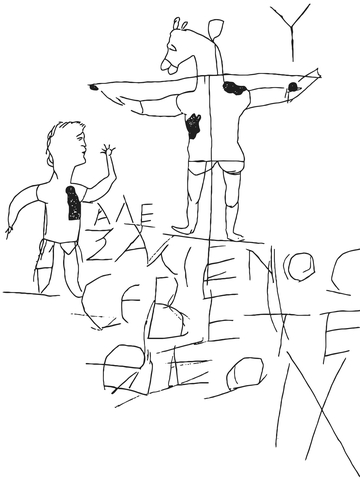
"Alexamenos worships [his] God"


A building called the domus Gelotiana was unearthed on the Palatine Hill in 1857, which the emperor Caligula had acquired for the imperial palace. After Caligula died, this building became used as a paedagogium or boarding-school for the imperial page boys. Later the street on which the house sat was walled off to give support to extensions to the buildings above, and it thus remained sealed for centuries. In one of the walls was a crude sketch carved in plaster dating from the late 1st to the late 3rd century AD, portraying a crucified humanoid figure with the head of a donkey. To the left of the image is a young man, raising one hand in a gesture possibly suggesting worship. Beneath the cross there is a caption written in crude Greek: Αλεξαμενος σεβετε Θεον. Translated, “Alexamenos, worship God.” However, it has been suggested that σεβετε should be understood as a variant spelling (possibly a phonetic misspelling) of σεβεται, ‘worships’. As a result, the full inscription would then be translated as “Alexamenos worships [his] God”. In the next chamber meanwhile, another inscription (in Latin) written by a different hand reads Alexamenos fidelis, “Alexamenos [the] faithful.” This has been suggested as a riposte to the mockery of Alexamenos in the sketch.

The inscription, believed to be one of, if not the, earliest pictorial representations of the crucified Jesus, is usually thought to be a mocking depiction of a Christian in the act of worship. The accusation that Christians practiced onolatry (donkey-worship) seems to have been common at the time. Tertullian, writing in the late second or early third century, reports that Christians, along with Jews, were accused of worshipping a donkey. He also mentions an apostate Jew who carried around Carthage a caricature which had donkey ears and hooves, labeled Deus Christianorum Onocoetes, “the God of the Christians born of a donkey.”

http://rometour.org/data/paedagogium_or_boarding_school_on_the_palatine_hill.jpg
 
Rivalling the Alexamenos graffito in antiquity is another crude graffito of a crucified victim, this time found in a taberna at Pozzuoli (ancient Puteoli), located in the vicinity of the Flavian Amphitheater. Believed to date from the late 1st to the 2nd century, it is believed that this sketch may be either another portrayal of the crucified Jesus or (more likely) a caricature of a victim who was crucified in the ampitheater as part of the brutal entertainment that occurred within its walls.

(Please Note: This uploaded content is no longer available.)

http://img843.imageshack.us/img843/4064/graffito.png

As in the Alexamenos graffito, this sketch shows the victim hanging, with arms widespread, on a T-shaped cross. The victim’s legs are wide open, with his feet seemingly separate and straddling the vertical beam. Notably, the victim is shown to ‘sit’ on a kind of ledge, which is probably the cornu or sedile of ancient literary sources. If you’ll look carefully, on this ledge there seems to be what looks like a pointed protrusion. :eek:
 
Status
Not open for further replies.
Back
Top