
Devotion to St. Thérèse of Lisieux

Status
Not open for further replies.
Apologies.
Saint Therese is always there, as I became acquainted with her as a young girl when my mother gave me her autobiography. It became my manual, and helped to establish my spirituality.
I don’t so much do the devotions, I just speak to her. Of value also is her sister Celine’s book, “Counsels and Reminiscences”

I’ll give you some quotes from the book as it can help our spiritual lives to listen to what a Saint has to say: Some of my accompanying thoughts may be included, as I copied the letters into my journal years ago. I’ll italicize my words.

Becoming as little children

Jesus says, “I tell you solemnly, anyone who does not welcome the kingdom of God like a little child will never enter it.” [Luke18: 17]

Therese of Lisieux elucidates how to live as child before God. “The only way to advance rapidly in the path of love is to always remain very little”

“‘Remaining little’ means—to recognise ones nothingness, to await everything from the goodness of God, to avoid being much troubled at our faults; finally, not to be worried about amassing spiritual riches.”

“There is but one means of compelling God not to judge us, and it is—to appear before Him empty-handed…spend your treasures as you gain them…All my earnings [merits] are spent immediately on the ransom of souls…Our Lord is justice Himself, and if He does not judge our good actions, neither will He judge our bad ones.”

In response to a novice who was discouraged by her faults, Therese said, “You make me think of a little child that is learning to stand but does not know how to walk. In his desire to reach to top of the stairs to find his mother, he lifts his little foot to climb the first step. It is all in vain, and at each renewed effort he falls.” “Well, be like that little child. Always keep lifting your foot to climb the ladder of holiness, and do not imagine that you can mount even the first step. All God asks of you is good will. From the top of the ladder, He looks lovingly upon you, and soon, touched by your fruitful efforts, He will Himself come down, and taking you in His arms, will carry you to His Kingdom never again to leave Him. But should you cease to raise your foot, you will be left for long on the earth.”

To another, Therese said, “You want to climb the mountain, whereas God wishes you to descend it. He is awaiting you in the valley of humility.” “It seems to me that humility is truth (honesty).”
“If the greatest sinner should repent at the moment of his death, and draw his last breath in an act of love, neither the many graces he had abused, nor the multiplied crimes he had committed, would stand in his way. Our Lord would see nothing, count nothing, but the sinner’s last prayer, and without delay He would receive him into the arms of His mercy.”

continued
 
Last edited:
Therese Martin has inspired generations of individuals to live the gospel way of spiritual childhood, including her family. In Celine Martin’s “Counsels and Reminiscences”, we note that while Therese died a saint at twenty-four, Celine strove against her imperfections until her holy death in her ninetieth year. Celine remained pupil of her young sister. When Therese, as her novice mistress, warned Celine what form her spiritual struggle would take, she might have been speaking any of us.

“You must never believe, when you don’t practice virtue, that it is due to some natural cause like illness, time, or grief. You must draw a great lesson in humility from it and take your place among the little souls, since you are able to practice virtue only in such a feeble manner.” Therese added, “What is necessary for you now is not to practice heroic virtues but to acquire humility. For that, your victories must of necessity always be mixed with failures, so that you cannot take any pleasure in thinking about them.”

Celine wrote of her struggle “with the faults that constantly kept me in a state of humiliation, for, due to my impulsive temperament, I often had little outbursts with the sisters that afflicted me a great deal on account of my self-love. I thought my exterior was deceiving, that I was better than I appeared to be: from that, I developed a certain frustration at not being judged at my true worth. Then my little sister endeavoured, by her penetrating instruction embellished with symbolic stories adapted to my circumstances, to make me love the shame I was in.” “She made me find my joy in believing that I was a ‘very little soul’ whom God constantly had to support because it was nothing but weakness and imperfection.”

Dear Celine! Even seven months before her death, she sent a note to a Sister whom she feared she had disedified, “‘Oh! How you touched me last night by your kindness, your meekness, your affection; me, who showed myself so headstrong; I humbly ask your pardon’.” She signed it by the name sometimes used amongst her sisters during childhood, “little repentant Celine.”

Towards the end, Therese’s sister Celine wrote, “If I consider where I am, I notice that I have not gone forward but backward…And there is astonishing peace even though it exists in darkness. I take as my own this passage from a prayer of Saint Thomas Aquinas: ‘At distant intervals, Lord, You draw me out of my lethargy, but alas! They are only passing visits. I do not know if You love me or I love You…I do not even know if I live by faith! I find only infidelity in myself, only random beginnings…and yet I long for You!’”
 
“Oh! Yes, I too, but I am not discouraged; and for many years have taken comfort in this verse of Psalm 63…
“Oh God, my God, for You I long, for You my soul is thirsting. My body pines for You like a dry weary land without water. So I gaze on You in the sanctuary to see Your strength and Your glory; for Your mercy is better than life.”

“I feel this so deeply that, in my imperfection, although I regret it, thrill with happiness at the thought that God’s mercy is better than life. Perfection, the possession of virtues, spiritual consolations, is what I call ‘life’. ‘Death’ is the state in which I am now, in that dry weary land without water. This state does not prevent me however, from approaching God with assurance, as if I were perfect, because I know it and feel it that ‘His mercy is better than life.’…Yes, I rely only on God’s mercy and on His compassion; I want to arouse His compassion by my poverty, for I know that is how I will have gained all.”

Therese’s “little way” of spiritual childhood was summarised by her Carmelite sisters, Celine and Pauline. It is the way of unselfish love, recognising that the “indescribable condescension” of Jesus is open even to the poorest of souls. It is the way of “joyful humility, passionate trust in Merciful Love, total abandonment to the divine will.” It is in “hidden sacrifices full of love and fidelity to every-day duties” with a “deep and experiential understanding of the Fatherhood of God.” It is in “zeal for souls.” It is lived with trust in our loving God. Such simplicity of heart is not of a childish nature, but childlike in its trust.

“It is love alone that counts,” wrote Therese. “And love is total abandonment, the blind trust of a little child in its heavenly father, which cannot work without a profound humility and which becomes, without anyone suspecting it, a natural virtue as it is in all little ones.”

On the fiftieth anniversary of Therese’s death, the Pope sent Celine the following message regarding the little way of spiritual childhood. “Many think that it is a special way reserved to the innocent souls of young novices in order to guide them in their first steps, and that it is not suited to already mature individuals who need much prudence because of their great responsibilities. That is to forget that our Lord Himself recommended this way to all children of God, even to those who have, like the apostles He formed, the greatest of responsibilities, that of the care of souls."

Contemplation of the words of these women prompts reflection upon a culture of love that is bequeathed through parental and family behaviours. It appears that Therese’s family may have attained a greater degree of love than many families, although the sisters do not conceal their struggle towards the purity of that love. The Martin family interactions may indicate that that fewer elements of unlove were communicated in their family than in many other admirable families.

(once again, italicizing my own words.)
 
Last edited:
There is another insight of Saint Therese that is important, because occasionally someone asks why one person will seem more favored by God than another,

Saint Therese rightly asserted that individual souls are different, with small simple souls scattered amongst great souls contributing towards making a glorious and colourful garden.


“I wondered for a long time why God has preferences, why all souls do not receive an equal amount of graces. I was surprised when I saw Him shower extraordinary favours on saints who had offended Him. For instance Saint Paul and Saint Augustine…I was puzzled at seeing how our Lord was pleased to caress certain ones from the cradle to the grave…helping them with such favours that they were unable to soil the immaculate beauty of their baptismal robe. I wondered why poor savages died in such numbers without ever having heard the name of God pronounced. Jesus deigned to teach me this mystery.

He set before me the book of nature; I understood how all the flowers He created are beautiful, how the splendour of the rose and the whiteness of the lily do not take away the perfume of the little violet or the delightful simplicity of the daisy. …If all flowers wanted to be roses, nature would lose her springtime beauty, and the fields would no longer be decked out with little wild flowers. And, so it is with the world of souls, Jesus’ garden. He willed to create great souls comparable to lilies and roses, but He has created smaller ones and these must be content to be daisies or violets destined to give joy to God’s glances when He looks down at His feet. Perfection consists in doing His will, in being what He wills us to be.” (_Story of a Sou_l)
 
Last edited:
(Please Note: This uploaded content is no longer available.)

I have a few pictures of her in my home. On my fridge. On my book cases. She is my sister and teacher and friend.

You could get a little statue of her, too. Or a medal to wear?

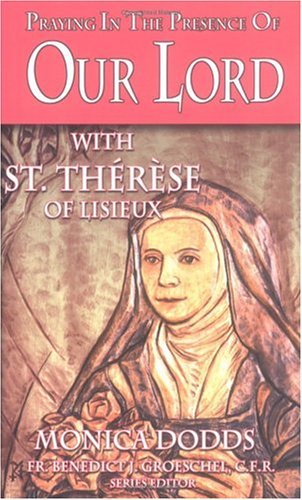
I have two books I like on her. One is quotes of St. Therese and another is praying in the presence of Our Lord.

https://www.amazon.com/Sermon-Sentence-Treasury-Spiritual-Therese/dp/0898708842

 
Last edited:
Wow … can we see your St. Therese statue, Joe?

I think I’m a little bit jealous of your fervent devotion to her. I must go to confession now. 🤕 👨‍🔧
 
Last edited:
Here is my little desk statue.

(Please Note: This uploaded content is no longer available.)

The one I have at home is nicer as it is probably 10 inches tall and in color.
 
OK, now we are ready to see “BIG” little Therese.

We have a relic of St. Therese in our adoration chapel. I like to go venerate it from time to time and talk to her a bit. 🌼
 
Last edited:
I have a big statue of Our Lady of Fatima that comes from Portugal but no Little Flower. Maybe I will get one. Our Lady seems to be hovering over on my shelf gently admonishing me for having given up the rosary for a rather long time. Yes, I do feel a bit guilty. Therese might do the same to me if I got a statue of her and then where would I be?

We have always had a very large and beautiful statue of Saint Therese in the sanctuary at the little rural Catholic Church I grew up in. I’m sure I had absolutely no idea who this saint was when I was a child. But she was there watching me all the same.
 
Last edited:
I think this is a really good short video on Therese by Father Barron. (First half is just 3 min. Second half is also just 3 min.)

 
Status
Not open for further replies.
Back
Top