My dear brother Adam

Vatican guidelines on interfaith discussion courtesy of yours truly (me

) from the 1991 Document “Dialogue and Proclamation”, a must read for any Catholic who wants to engage in interfaith dialogue:
forums.catholic-questions.org/showthread.php?t=635067
Remember, first of all, that Muslims are our brothers and sisters; and that the love of Holy Mother Church embraces all humankind within and without her bosom:
“…The maternal love of the Catholic Church embraces all people…It is the industrious guardian of the teachings of its Founder [Jesus] who, by His words and those of the apostles, taught men the fraternal necessity which unites the whole world. From Him we recall that everybody has sprung from the same source, was redeemed by the same ransom, and is called to the same eternal happiness…”
- Pope Leo XIII, CATHOLICAE ECCLESIAE, 1890
If pursuing a dialogue with Muslims is your desire, and you wish to have a meaningful exchange of spirit so as to both enrich yourself and your Islamic friends rather than simply try to convert them, then the first thing I would suggest is for you to buy - if you haven’t done so already - a good modern translation of the Qur’an and a reading guide to it. One has to know, understand and respect what is genuinely good in other religions, before properly engaging with them. And
goodness is there:
“…Now [we refer] to the adorers of God according to the conception of monotheism, the Muslim religion especially, deserving of our admiration for all that is true and good in their worship of God…”
***- Servant of God Pope Paul VI, Ecclesiam Suam 107, August 6, 1964 ***
“…There is something true and divinely revealed, in every religion all over the earth…”
- Blessed John Henry Cardinal Newman (21 February 1801 – 11 August 1890)
"…It is the Spirit who is the source of the drive to press on, not only geographically but also beyond the frontiers of race and religion, for a truly universal mission…The Spirit’s presence and activity affect not only the individuals but also society and history, peoples, cultures and religions. Indeed, the Spirit is at the origin of the noble ideals and undertakings which benefit humanity on its journey through history: “The Spirit of God with marvelous foresight directs the course of the ages and renews the face of the earth…I have repeatedly called this fact to mind, and it has guided me in my meetings with a wide variety of peoples. The Church’s relationship with other religions is dictated by a twofold respect: “Respect for man in his quest for answers to the deepest questions of his life, and respect for the action of the Spirit in man.” The interreligious meeting held in Assisi was meant to confirm my conviction that ‘every authentic prayer is prompted by the Holy Spirit, who is mysteriously present in every human heart.’…Every form of the Spirit’s presence is to be welcomed with respect and gratitude, but the discernment of this presence is the responsibility of the Church, to which Christ gave his Spirit in order to guide her into all the truth…”
-Pope John Paul II, Redemptoris Missio, 1990
In this dialogue it is important to remember that we should expect to find God both in each other and in our respective religious traditions, as the Catholic Bishops Conference of England Wales explain:
**"…We must certainly enter dialogue prepared to be surprised and to change our minds, because in dialogue with people of other religions we must not be surprised, but actually expect to find God already there. It is in dialogue that we meet and are moved to collaborate with the same Holy Spirit we have received ourselves…" **
cbcew.org.uk/page.aspx?pid=458
And it is my hope that through dialogue we can discover what Blessed Pope John Paul II described:
“…You speak of many religions. Instead I will attempt to show the common fundamental element and the common root of these religions…From the beginning, Christian Revelation has viewed the spiritual history of man as including, in some way, all religions, thereby demonstrating the unity of humankind with regard to the eternal and ultimate destiny of man. The Church sees the promotion of this unity as one of its duties…”
- Blessed Pope John Paul II, Crossing the Threshold of Hope
As others have wisely said, look to what unites Islam and Christianity - not (initially) to the differences, because:
"…Divine truth should be a means towards union, mutual understanding and peaceful living,and not a reason for quarrels and division…”
***- Pope Paul VI (Ecclesiam Suam n. 32), 1964 ***
One does not want dialogue to degenerate into petty “one-up-man-ship”.
This doesn’t mean that you cannot “share” your faith with them but you must be willing for them to equally share their faith with you. Its a two-way street.
Learn from the great saints and teachers of our tradition:
“…Through the participation of one people with another there will be love and concord…For just as we have one God, one Creator, one Lord, we should also have…one manner of loving and honouring God and we should love and help one another, and make it so that between us there be no difference …] which causes us to be enemies with one another and to be at war, killing one another and falling captive to one another. And this war, death and servitude prevent us from giving the praise, reverence and honour we owe to God every day of our life…[And so] all men might be brought together, that they might have understanding, and love one another, and agree in the service of God…Let Christians who are well schooled and proficient in the Arabic language go to Tunis to demonstrate the truth of their faith and let Muslims who are well schooled come to the kingdom of Sicily to discuss their faith with Christian scholars. By acting in this way, maybe, there can be peace between Christians and Muslims, when in the whole world the situation will take effect that neither Christians want to destroy Muslims nor Muslims want to destroy Christians…”
***- Blessed Ramon Llull (1232 – ca. 1315), Catholic mystic, philosopher,
logician and Franciscan missionary ***
Remember the example of Saint Francis.
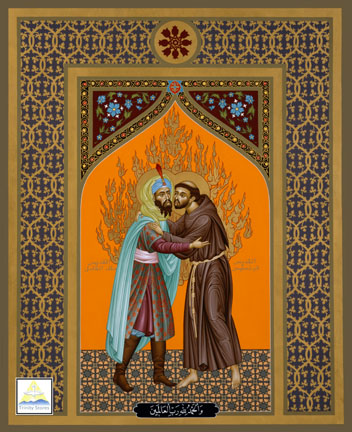
Saint Francis, in 1219, began a year-long, unarmed walk right through a war zone from Italy to northern Africa, where he managed to meet the Sultan, Melek-el-Kamel, the leading Muslim of the time. Both Francis and the Sultan were impressed with each other and Saint Francis and his brother friar stayed at the Muslim encampment for some time. Francis was impressed by the genuine prayerful attitude of the Muslims and it appears that Malik al Kamil was also impressed with the humility of St. Francis. These two men became friends and when it was time for Francis to move on, he was given safe passage to the Holy Land by Sultan Malik al Kamil. When Saint Francis returned home he added to his Rule of life ( for the friars) that if any brother felt called to go among the Muslims, he should receive permission to do so and the brother must always remember that he is to “live in Peace” with all Muslims and must be “subject to them” when living in their lands. Brothers were not to preach or try and convert Muslims. If asked about the Christian religion, a brother should answer the question in humility but no ‘preaching’. Francis believed that the actions (deeds) of his brothers would be sufficient.
There have been many artistic depictions of Francis and the Sultan, here is one by a modern artist:
(continued…)