Did all nationalities practice blessing of Easter food?

  • Thread starter Thread starter lak611
  • Start date Start date
Status
Not open for further replies.
L

lak611

Guest
I know that many parishes had blessing of Easter food in the past, and many parishes still do this. My mother has a Polish cookbook which has recipes for holidays, as well as everyday recipes. The cookbook mentions having the priest bless the Easter food (and it mentions what food would be included). Is this a custom amongst all nationalities?
 
No. In Roman Catholicism it is unique to the Poles.

It is a Slavic Orthodox custom, but not a borrowing. Southern (Little) Poland was evangelized by the missions established by Ss Cyril and Methodius into the Byzantine rite while it was part of the Moravian empire (in about 870AD to 890AD) long before Duke Mieszko accepted Christianity from Rome (in 960AD).
http://ocaphoto.oca.org/filetmp/2005/May/967/Detail/13.jpg

This is one of several popular customs the original eastern Catholics of Poland retained when they became Latin Christians by force of law. After the Poles of Gniezno accepted latin Christiainty they took control of the region around Krakow and gradually extinguished the Greek rite there. The formal expulsion of the Greek rite monks and priests was in the year 1022AD.

Another such Polish custom (remembered from the Byzantine rite days) is the traditional welcoming of the bishop with bread and salt.


http://ocaphoto.oca.org/filetmp/2003/July/711/Detail/DSC_0007.jpg
 
No. In Roman Catholicism it is unique to the Poles. (Although it may have later been introduced to the Lithuanians, I am not sure.)

It is a Slavic Orthodox custom, but not a borrowing. Southern (Little) Poland was evangelized by the missions established by Ss Cyril and Methodius into the Byzantine rite while it was part of the Moravian empire (in about 870AD to 890AD) long before Duke Mieszko accepted Christianity from Rome (in 960AD).
http://ocaphoto.oca.org/filetmp/2005/May/967/Detail/13.jpg

This is one of several popular customs the original eastern Catholics of Poland retained when they became Latin Christians by force of law. After 1000 years the Polish custom varies slightly from the Orthodox.

After the Poles of Gniezno accepted Latin Christianity (under the threatening long shadow of the Holy Roman emperor Otto) they obtained control of the region around Krakow (already heavily Christian) and gradually extinguished the Greek rite there. The formal (but not fully successful) expulsion of the Greek rite monks and priests was in the year 1022AD.

Another such Polish custom (remembered from the Byzantine rite days) is the traditional welcoming of the bishop with bread and salt.
http://farm1.static.flickr.com/111/281694448_96fc45d9be_m.jpg

http://ocaphoto.oca.org/filetmp/2003/July/711/Detail/DSC_0007.jpg

 
Back in Vietnam - we were too poor to have great food on Easter. However, the spirit of Easter was so great!
 
No. In Roman Catholicism it is unique to the Poles. (Although it may have later been introduced to the Lithuanians, I am not sure.)

It is a Slavic Orthodox custom, but not a borrowing. Southern (Little) Poland was evangelized by the missions established by Ss Cyril and Methodius into the Byzantine rite while it was part of the Moravian empire (in about 870AD to 890AD) long before Duke Mieszko accepted Christianity from Rome (in 960AD).
http://ocaphoto.oca.org/filetmp/2005/May/967/Detail/13.jpg

This is one of several popular customs the original eastern Catholics of Poland retained when they became Latin Christians by force of law. After 1000 years the Polish custom varies slightly from the Orthodox.

After the Poles of Gniezno accepted Latin Christianity (under the threatening long shadow of the Holy Roman emperor Otto) they obtained control of the region around Krakow (already heavily Christian) and gradually extinguished the Greek rite there. The formal (but not fully successful) expulsion of the Greek rite monks and priests was in the year 1022AD.

Another such Polish custom (remembered from the Byzantine rite days) is the traditional welcoming of the bishop with bread and salt.
http://farm1.static.flickr.com/111/281694448_96fc45d9be_m.jpg

http://ocaphoto.oca.org/filetmp/2003/July/711/Detail/DSC_0007.jpg
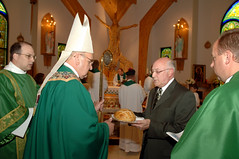
Thanks! I did not know about the bishop being welcomed with bread and salt. I guess most of the parishes in Cleveland still have the food blessing even if they are not Polish nationality parishes because there are a lot of Poles in Cleveland.
 
Our parishes blesses the easter foods [mainly breads] on Holy Saturday afternoon…It is not an ethnic parish…some parishioners asked our priest if he would make time to do the blessing, that is all it took. I have done it some years, other not…usually about 10 families +/-…

Some years we have had the breads that are served at the RCIA reception that follows the Vigil blessed…

Happy Easter 🙂
 
What nationalities are the most common in Ruthenian Byzantine Rite?
I think it more so has to do with whether you go to that paticular rite or not. The Eastern rites, at least in the United States largely consist of converts from the Latin rite. However, the Ruthenian rite at least in the United States originally consisted mostly of Slovaks (I’m half Slovakian). Since Slovakia is in the same region as Poland I assume that the countries in that region all share this custom. I go to the Latin Rite mass now for convenience and it’s nice going to mass with other students anyways; however, one thing I miss about being home for Easter is the divine liturgies for Holy week and the blessing of the foods. There are lots of good stuff. My family mailed me some Pascha bread and nut roll but of course they weren’t blessed yet.
 
I think it more so has to do with whether you go to that paticular rite or not. The Eastern rites, at least in the United States largely consist of converts from the Latin rite. However, the Ruthenian rite at least in the United States originally consisted mostly of Slovaks (I’m half Slovakian). Since Slovakia is in the same region as Poland I assume that the countries in that region all share this custom.
Thanks. You answered my question. I know there are people who have switched rites, but what I wanted to know was the nationality that the Ruthenian rite originated with. It sounds like the food blessing is something unique to Eastern European nationalities, from what I’ve seen posted here so far.
 
Italians have a blessing of food, particularly Easter breads.
 
OK, I stand corrected. It’s hard to prove a negative 😃

Anyway, I wonder if this is a northern Italian or southern Italian custom? Both?

The reason I ask (this may come as a shock to some) most of southern Italy from Naples on down was mainly Byzantine rite at one time. (there were actually 1000 Byzantine-rite monasteries in Italy then!) That did not change until after the Normans came through and (among other things) replaced the bishops. This was actually a touchstone that helped ignite the great schism, because the Latin parishes in Constantinople were closed in retaliation, and Cardinal Humbert (in going to Constantinople to try and work things out) got frustrated and excommunicated the Patriarch as a result…the rest (as they say) is history. :o

Michael
 
Status
Not open for further replies.
Back
Top