Did Mark base his Gospel on Matthew and Luke? [Akin]

  • Thread starter Thread starter Catholic_Opinion
  • Start date Start date
Status
Not open for further replies.
Still, I believe that Mark was first. It tells the whole story in a simple way and seems the truest to me. Both Luke and Matthew add things to Mark gospel, they don’t take away from it. The ending of Mark especially rings true - the awe and fright the women felt when they saw that the tomb was empty and the angel told them Jesus had risen from the dead.
When you write ‘they didn’t take away from Mark’ this is extremely important. They didn’t take away from Mark because Mark was using Matthew and Luke. That’s why.

They can’t take anything away from Mark if Mark wrote last.

98% of Mark’s passages are contained in either Matthew or Luke, all but a couple of passages that Peter added in his speech. Very small passages.

For Mark to have written first, then whoever wrote last (Matthew or Luke) would have had to read the second gospel (Luke or Matthew) made a detailed list of everything the 2nd writer left out from Mark and then made a concerted effort to include all of this material when writing their own gospel.

Much easier to see that Mark used some of Matthew and some of Luke and that’s why all of Mark is in Matthew and Luke.
 
When you write ‘they didn’t take away from Mark’ this is extremely important. They didn’t take away from Mark because Mark was using Matthew and Luke. That’s why.

They can’t take anything away from Mark if Mark wrote last.

98% of Mark is contained in either Matthew or Luke, all but a couple of passages that Peter added in his speech. Very small passages.

For Mark to have written first, then whoever wrote last (Matthew or Luke) would have had to read the second gospel (Luke or Matthew) made a detailed list of everything the 2nd writer left out from Mark and then made a concerted effort to include all of this material when writing their own gospel.

Much easier to see that Mark used some of Matthew and some of Luke and that’s why all of Mark is in Matthew and Luke.
I disagree. Mark is very succinct. It is the whole story of Jesus without a lot of extra agenda. Definitely Luke and Matthew used Mark as a template and added to it.
 
Actually, no.
Actually yes. With all deserved respect (and I mean that) nothing you have written negates the Matthew, Luke, Mark sequence.

If there are any reasons why this sequence in incorrect please say so.

You have to give textual comparative evidence for why the Matthew/Luke/Mark sequence must be incorrect.

With all respect I will listen to what you say, but you actually have to say something. Long strings of words that don’t address why the sequence is incorrect are superfluous to the discussion. Also stating that you interpret Irenaous and Papais as not specifically supporting my view is not negating the sequence.
 
I disagree. Mark is very succinct. It is the whole story of Jesus without a lot of extra agenda. Definitely Luke and Matthew used Mark as a template and added to it.
If you read the passages in parallel Christine you will see that Mark is very often more detailed than both Matthew and Luke when discussing the same passage. You then have to explain why both Matthew and Luke copied Mark but both left out his detail. If you like I will go and dig up my compared passages from a few years ago so you can explain how it makes sense for Matthew and Luke to independently both leave out his extra detail.
 
Actually yes. With all deserved respect (and I mean that) nothing you have written negates the Matthew, Luke, Mark sequence.

If there are any reasons why this sequence in incorrect please say so.

You have to give textual comparative evidence for why the Matthew/Luke/Mark sequence must be incorrect.

With all respect I will listen to what you say, but you actually have to say something. Long strings of words that don’t address why the sequence is incorrect are superfluous to the discussion. Also stating that you interpret Irenaous and Papais as not specifically supporting my view is not negating the sequence.
My weakness is that I’m too wordy. Let me try to sum up my view in lesser strings of words. 😃

IMHO to read Clement (Eusebius paraphrasing Clement) as if he is espousing a sort of proto-Griesbachian sequence - just because “the gospels that include genealogies” are mentioned first before his account of the making of Mark’s gospel - is to read too much into him. There’s of course the issue of whether we’ve been translating him correctly all along (“the gospels that include genealogies were progegraphthai”), but there’s also the fact that if you read him carefully, Clement, just like any Church Father before Augustine, never really discusses any literary relationship between the gospels. Augustine is the first Father to properly notice the synoptic problem and to attempt to come with a solution for it.

So I think it’s kind of anachronistic to read earlier accounts as if they literally suggest any literary relationship between the synoptics. They are more concerned with issues like when and where these gospels were composed, who they are composed for, the circumstances in which they were composed. They never discuss who borrowed from whom.

I’m an ex-Griesbachian, but to be honest I never really found this appealing to the Church Fathers for Griesbach-type argument very convincing. It takes a literal reading of Clement of Alexandria as the starting point, and then tries to harmonize the other patristic writings to Clement’s scenario (not always a perfect fit). I don’t know - I just have a problem with this type of method. I’ll elaborate if you want.

(My point with my talking Papias and Irenaeus meanwhile is to demonstrate why I think simply harmonizing all the patristic accounts about the gospels is probably not the way to go. Because they’re really different stories - although in the case of Irenaeus onwards, most later writers often take Irenaeus as their starting point, so there’s some kind of dependency; in fact Irenaeus also used Papias - that IMHO stand on their own and should first be taken on their own terms, not simply harmonized together into one.)

And yeah, you’re right that all this doesn’t necessarily negate the Griesbachian sequence. I haven’t gone to the heart of the matter yet.
 
If you read the passages in parallel Christine you will see that Mark is very often more detailed than both Matthew and Luke when discussing the same passage. You then have to explain why both Matthew and Luke copied Mark but both left out his detail. If you like I will go and dig up my compared passages from a few years ago so you can explain how it makes sense for Matthew and Luke to independently both leave out his extra detail.
Let’s review the data we have. I’m gonna get wordy here again, so pardon me.
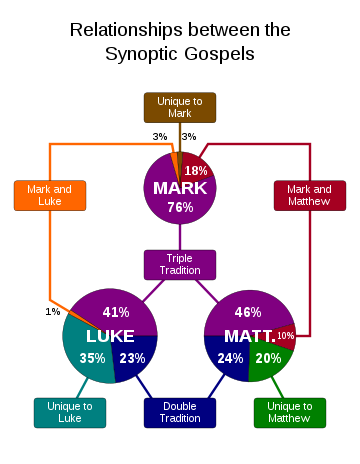


Triple tradition: Refers to the material shared by Matthew, Mark and Luke. It broadly has the same order across all three gospels, in fact this order tends to be identical with Mark’s, to the point that if you were to isolate triple tradition material in Matthew and Luke you’d end up with a complete gospel generally similar to Mark in structure. Now there are times when Matthew or Luke may occasionally place individual incidents differently, but striking thing about it is that it is rare for both Matthew and Luke to place the same incident differently. Even where Matthew and Luke apparently depart from Mark’s narrative order, they very often both of them end up reverting into agreement with Mark.

Hence, one of its characteristics of triple tradition is that it has a lot to do with Mark, i.e. Mark is often (but not always) the mediating factor or the so-called ‘middle term’.

http://img580.imageshack.us/img580/3347/63594641.png

Double Tradition: Material found in Matthew and Luke but not in Mark. The order tends to vary between the two gospels. This is what supporters of the two-source hypothesis call ‘Q Material’. It is not as numerous as triple tradition material (it’s roughly half the length of triple tradition), but is still substantial to some extent. The interesting thing about this material is that you don’t have much of it in a closely parallel order; there is some kind of parallel order, but not the same one you get with triple tradition. The order tends to vary between the two gospels.

Special Matthew (M): Material found in Matthew alone. Like double tradition, much of it is sayings material (for instance, the parables in Matthew 25:1-13 and 25:31-46), with a few exceptions (i.e. the temple tax in Matthew 17:24-27). Some of it can also be found embedded within triple tradition material; for instance, Judas’ death (27:3-10) and the brief reference to Pilate’s wife (27:19).

Special Luke (L): Material found in Luke alone. It’s usually narrative material like the announcement to Zechariah and John the Baptist’s birth, the Annunciation and Visitation, the boy Jesus in the temple and the Road to Emmaus, and also sayings material like the parables of the Good Samaritan and the Prodigal Son.

Those are the basics. Here’s the variations to the rule:

M in Triple Tradition: Material unique to Matthew embedded in triple tradition material and would make no sense outside of context; for example, Jesus’ conversation with John the Baptist just before His baptism in 3:14-15.

Lukan Triple Tradition: Three stories which have parallels in Matthew and Mark and might be described as Lukan versions of triple tradition material (the rejection at Nazareth at 4:16-30; the call of the first disciples at 5:1-11; the anointing of Jesus at 7:36-50).

Not Quite Triple Tradition: Material found in Matthew and Mark but not in Luke or in Mark and Luke but not in Matthew. These are not, strictly speaking, triple tradition material since they occur in only two gospels, but they are akin to triple tradition because they appear in the Markan order.

Mark being not the middle term: Some material halfway between triple and double tradition. Appears in all three synoptics but unlike triple tradition, features substantial agreement between Matthew and Luke against Mark.

Mark being the ‘middle term’ is an important factor here. There are really two ways you can explain this phenomenon: either Mark was written first, with Matthew and Luke making use of him (as per the two-source theory and the Farrer-Goulder theory) or Mark was written last, with him combining Matthew and Luke (as per the Griesbach theory).

 
Tobit was made from a late Aramaic (‘Chaldean’) text/paraphrase. It’s a different version altogether.Jerome to the Bishops in the Lord Cromatius and Heliodorus, health!

I do not cease to wonder at the constancy of your demanding. For you demand that I bring a book written in the Chaldean language into Latin writing, indeed the book of Tobias, which the Hebrews exclude from the catalogue of Divine Scriptures, being mindful of those things which they have titled Hagiographa. I have done enough for your desire, yet not by my study. For the studies of the Hebrews rebuke us and find fault with us, to translate this for the ears of Latins contrary to their canon. But it is better to be judging the opinion of the Pharisees to displease and to be subject to the commands of bishops. I have persisted as I have been able, and because the language of the Chaldeans is close to Hebrew speech, finding a speaker very skilled in both languages, I took to the work of one day, and whatever he expressed to me in Hebrew words, this, with a summoned scribe, I have set forth in Latin words.

I will be paid the price of this work by your prayers, when, by your grace, I will have learned what you request to have been completed by me was worthy.That’s the thing about Tobit: there’s no single version of the book. There’s like the five DSS manuscripts in Aramaic and Hebrew, the two or three Greek versions, the Vulgate version (based on a late Aramaic version), the Vetus Latina versions (which are generally quite similar to the longer Greek version and the DSS manuscripts, sometimes even more closer to the DSS texts than the Greek is), medieval Hebrew and Aramaic versions, and the versions in other languages.
Thank you Patrick.

In order that I may know that I understand your words correctly is my paraphrase below correct ? I added the words in blue

“Tobit - the version found in the **Douay-Rheims Bible which based on St. Jerome’s Latin Vulgate -**was made from a late Aramaic (‘Chaldean’) text/paraphrase.”

Isn’t Jerome’s Latin Vulgate officially considered as inspired?
Please comment on this quote in reference to this question if you desire.
** Pope John Paul II**
** … Therefore in the regions of the West the Church has preferred to the others that edition which is usually called the Vulgate and which, composed for the most part by the excellent teacher Saint Jerome, has been “confirmed in the Church herself by the usage of so many centuries” (Conc. Trid., sess. IV; * Enchir. Bibl., n. 21).* …
Code:
             **These things being so, by virtue                  of this Letter we declare the New Vulgate edition of the Holy                  Bible as "typical" and we promulgate it to be used especially in                  the sacred Liturgy but also as suitable for other things, as we                  have said.
**
Finally we decree that this Constitution of ours be firm and forever efficacious and be scrupulously observed by all concerned, notwithstanding any obstacles whatsoever.
(Apostolic Constitution, Scripturarum Thesaurus, 1979)

God bless,
.
 
Thank you Patrick.

In order that I may know that I understand your words correctly is my paraphrase below correct ? I added the words in blue

“Tobit - the version found in the **Douay-Rheims Bible which based on St. Jerome’s Latin Vulgate -**was made from a late Aramaic (‘Chaldean’) text/paraphrase.”
Yes, this is correct.
Isn’t Jerome’s Latin Vulgate officially considered as inspired?
Please comment on this quote in reference to this question if you desire.
** Pope John Paul II**
** … Therefore in the regions of the West the Church has preferred to the others that edition which is usually called the Vulgate and which, composed for the most part by the excellent teacher Saint Jerome, has been “confirmed in the Church herself by the usage of so many centuries” (Conc. Trid., sess. IV; * Enchir. Bibl., ***n. 21). …

Code:
             **These things being so, by virtue                  of this Letter we declare the New Vulgate edition of the Holy                  Bible as "typical" and we promulgate it to be used especially in                  the sacred Liturgy but also as suitable for other things, as we                  have said.
**
Finally we decree that this Constitution of ours be firm and forever efficacious and be scrupulously observed by all concerned, notwithstanding any obstacles whatsoever.
(Apostolic Constitution, Scripturarum Thesaurus, 1979)
God bless,
.
I’m leaving this question to someone who can answer it better than me, but I’d just like to note that what the Council of Trent declared about the Vulgate is that it is the touchstone of the canon concerning which parts of books are canonical.

Moreover, this sacred and holy Synod,—considering that no small utility may accrue to the Church of God, if it be made known which out of all the Latin editions, now in circulation, of the sacred books, is to be held as authentic,—ordains and declares, that the said old and vulgate edition, which, by the lengthened usage of so many years, has been approved of in the Church, be, in public lectures, disputations, sermons and expositions, held as authentic; and that no one is to dare, or presume to reject it under any pretext whatever.

The word ‘authentic’ here is clarified by a 1941 letter by the Pontifical Biblical Commission:

The Council of Trent, wishing to counteract the confusion arising from the new translations into Latin and into the vernacular, at that time first appearing, wished to sanction for public use in the Western Church the common Latin version that had already been used by the Church herself for centuries. By so doing the Council did not wish in any way to minimize the authority of any of those ancient versions that had been produced in the Eastern Church, most especially of the Septuagint used by the Apostles themselves, nor still less the authority of the original texts. For this reason it opposed the desire of one group of Fathers who wished to make the Vulgate the sole authoritative text to the exclusion of all the others.
…] In a word, the Council of Trent declared the Vulgate the ‘authentic’ text in the juridical sense of the word, that is, that it has ‘probative force in matters of faith and morals,’ but by no means excluded the possibility of divergences from the original text and from the ancient versions. Every good book on Biblical Introduction makes this clear. It is implied in the Acta of the Council itself.

(You can read this quote in context here: pp. 215-216.)

P.S. You might notice from the quote that Pope John Paul II was here referring to the Nova Vulgata, which is not exactly the same as the original Vulgate.
 
Status
Not open for further replies.
Back
Top